CULUTURE OF SEAWEEDS Introduction Seaweeds macroscopic algae growing


- Slides: 6
CULUTURE OF SEAWEEDS
Introduction • • Seaweeds - macroscopic algae growing in the sea Grouped into green, brown, red and blue green algae In Japan and China - form staple food; also used as fodder and fertilizers. Contain 60 trace elements whose concentration is higher than terrestrial plants Seaweeds - the only source of agar, algin and carrageenan – phytochemicals that have wide application in food, confectionary, pharmaceuticals, dairy and paper industries as gelling, stabilizing and thickening agents In India - Andaman and Nicobar Islands and Lakshadweep have rich resources of seaweeds The total resources of seaweeds in India are about 70, 000 tonnes
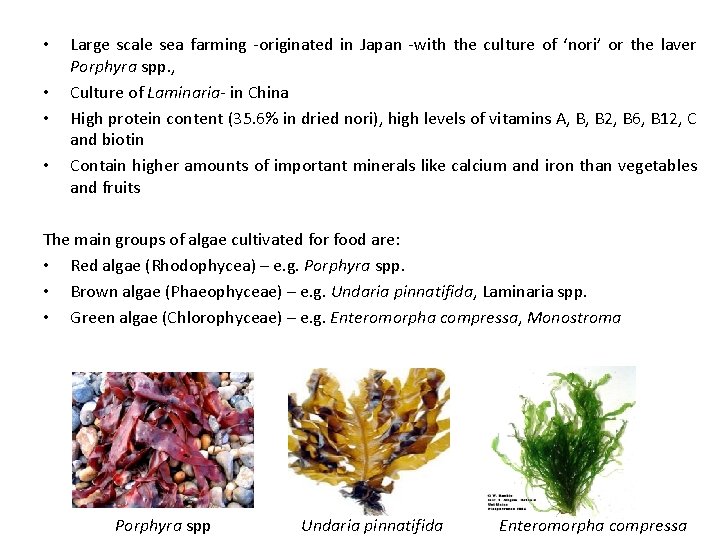
• • Large scale sea farming -originated in Japan -with the culture of ‘nori’ or the laver Porphyra spp. , Culture of Laminaria- in China High protein content (35. 6% in dried nori), high levels of vitamins A, B, B 2, B 6, B 12, C and biotin Contain higher amounts of important minerals like calcium and iron than vegetables and fruits The main groups of algae cultivated for food are: • Red algae (Rhodophycea) – e. g. Porphyra spp. • Brown algae (Phaeophyceae) – e. g. Undaria pinnatifida, Laminaria spp. • Green algae (Chlorophyceae) – e. g. Enteromorpha compressa, Monostroma Porphyra spp Undaria pinnatifida Enteromorpha compressa
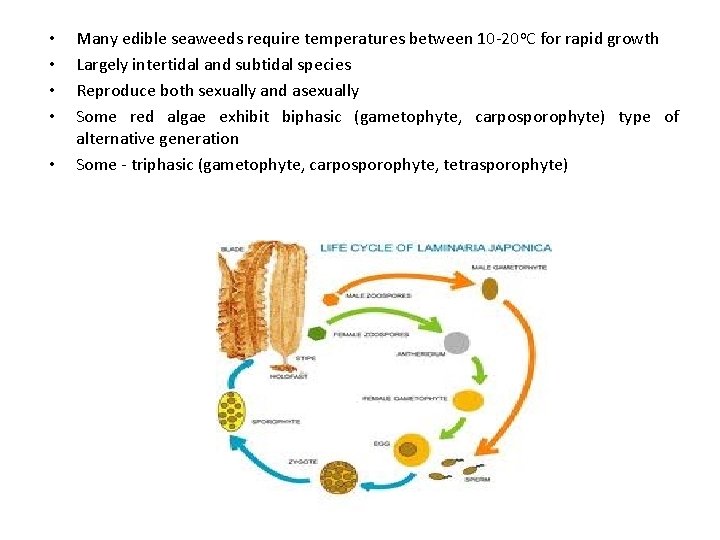
• • • Many edible seaweeds require temperatures between 10 -20 o. C for rapid growth Largely intertidal and subtidal species Reproduce both sexually and asexually Some red algae exhibit biphasic (gametophyte, carposporophyte) type of alternative generation Some - triphasic (gametophyte, carposporophyte, tetrasporophyte)
Culture systems: • Porphyra (Nori) culture – place bundles of twigs or rocks or concrete blocks for monospores to settle on • These are then transferred to shallow areas for development of thali to desired size • The common method - nets with large mesh (15 x 15 cm) and blinds made of 10 x 15 cm to collect spores and transfer to suitable areas for grow-out • Blasting rocks surfaces or rocky reefs to expose for additional surface area for propagation is common practice, particularly for Laminaria and Undaria culture • Euchema culture in China- cuttings of plants are inserted in sub-littoral reefs by divers • A new method - fastening cuttings to coral branches with rubber strings and dropping them onto reefs
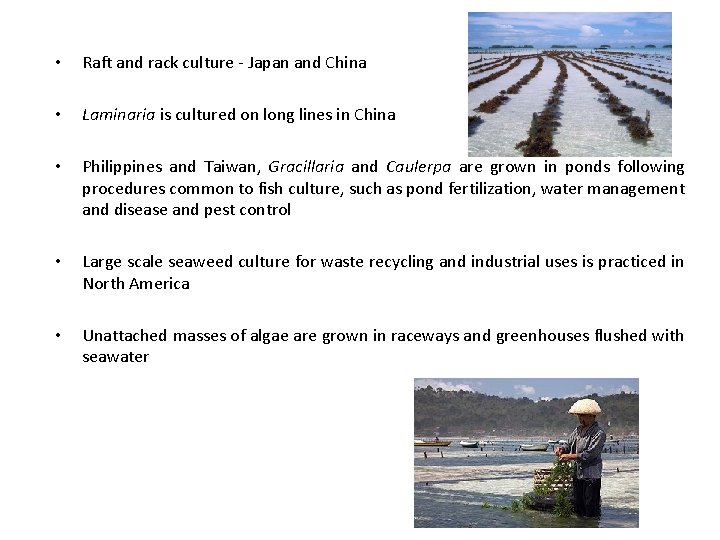
• Raft and rack culture - Japan and China • Laminaria is cultured on long lines in China • Philippines and Taiwan, Gracillaria and Caulerpa are grown in ponds following procedures common to fish culture, such as pond fertilization, water management and disease and pest control • Large scale seaweed culture for waste recycling and industrial uses is practiced in North America • Unattached masses of algae are grown in raceways and greenhouses flushed with seawater