CSE Senior Design II Staged Delivery Instructor Manfred
- Slides: 11
CSE Senior Design II Staged Delivery Instructor: Manfred Huber Partially adapted from Mike O’Dell
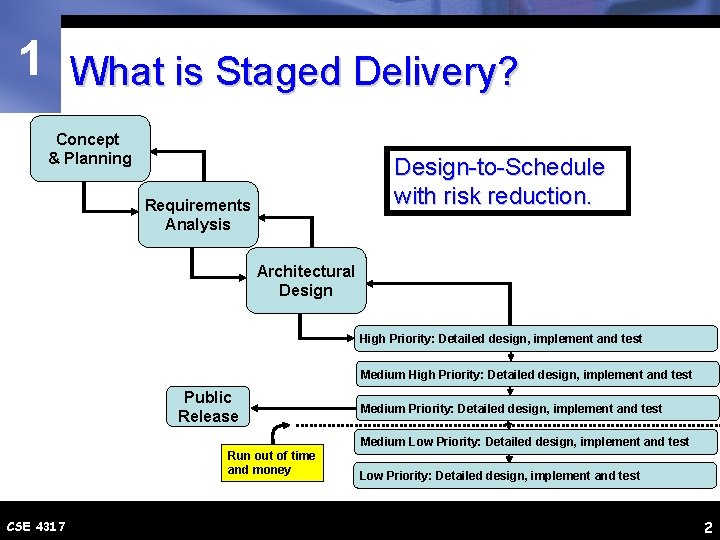
1 What is Staged Delivery? Concept & Planning Design-to-Schedule with risk reduction. Requirements Analysis Architectural Design High Priority: Detailed design, implement and test Medium High Priority: Detailed design, implement and test Public Release Medium Priority: Detailed design, implement and test Medium Low Priority: Detailed design, implement and test Run out of time and money CSE 4317 Low Priority: Detailed design, implement and test 2
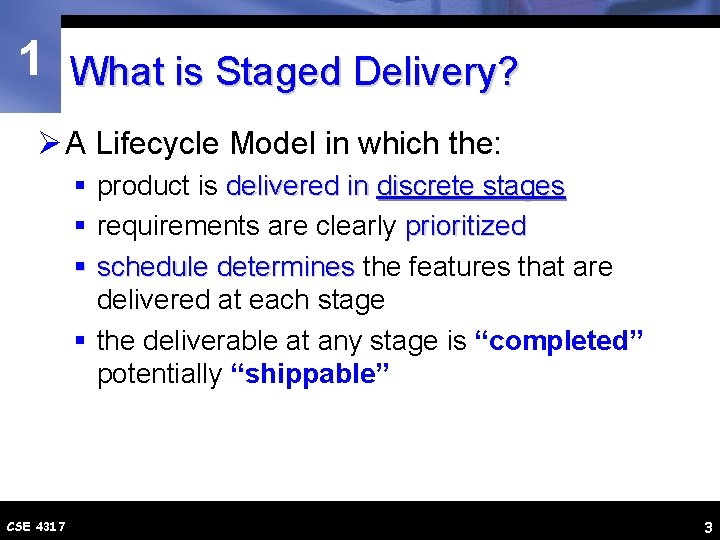
1 What is Staged Delivery? Ø A Lifecycle Model in which the: § product is delivered in discrete stages § requirements are clearly prioritized § schedule determines the features that are delivered at each stage § the deliverable at any stage is “completed” potentially “shippable” CSE 4317 3
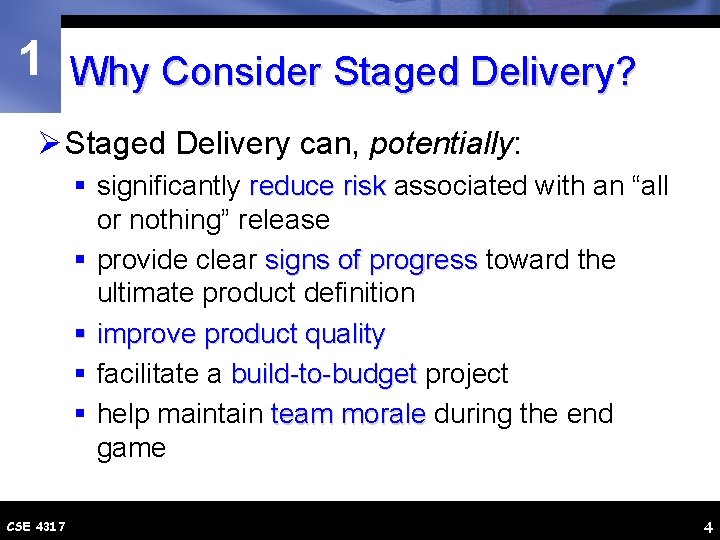
1 Why Consider Staged Delivery? Ø Staged Delivery can, potentially: § significantly reduce risk associated with an “all or nothing” release § provide clear signs of progress toward the ultimate product definition § improve product quality § facilitate a build-to-budget project § help maintain team morale during the end game CSE 4317 4
1 Requirements for Staged Delivery Ø Clear and agreed statement of product requirements Ø Buy-in at all levels on prioritization of features/requirements Ø Willingness of stakeholders and end-users to accept less than “the whole enchilada” CSE 4317 5
1 Requirements for Staged Delivery Ø Ability to partition the deliverables into phased releases Ø Commitment to focus on quality of each staged release Ø A clear and well-defined architectural model, model precisely mapped to your requirements. CSE 4317 6
1 Advantages of Staged Delivery Ø Provides visible signs of progress for customers and stakeholders § obviates, mitigates 90 -90 rule Ø Allows frequent and predictable releases § internal or external Beta releases/program? § encourages early and frequent customer/enduser feedback § engages marketing and sales team in process CSE 4317 7
1 Advantages of Staged Delivery Ø Provides early warning of problems in development § Ability/Inability to deliver even minimal core will be clear well before deadline Ø Cuts down on project management overhead § less reporting, more delivering! Ø Increases release options § e. g. , release version 1, hold version 2, release version 3, … CSE 4317 8
1 Advantages of Staged Delivery Ø Reduces estimation error § smaller tasks to estimate -> less variance Ø Reduces integration and test effort But… CSE 4317 9
1 Major Risk with Staged Delivery Feature Creep, late in the game! CSE 4317 10
1 Keys to Success with Staged Delivery Ø Be sure that the product architecture is flexible, flexible supporting as many future directions as possible Ø Plan stages in order of importance/priority Ø Define the first stage so that it can be delivered as early as possible Ø Define the stages in terms of “themes” themes Ø Get stakeholder buy-in on staging plan CSE 4317 11