CounterMissionary Education Jeremiah 31 30 3631 37 in
- Slides: 12
Counter-Missionary Education Jeremiah 31: 30 -36[31 -37 in Christian Bibles] – Will the Real “New Covenant” Please Stand Up! A Counter-Missionary Education Lesson by Uri Yosef, Ph. D. , Director of Education Virtual Yeshiva of the Messiah Truth Project, Inc. http: //virtualyeshiva. com [The article on this topic is located here http: //thejewishhome. org/counter/New. Covenant. pdf] Copyright © Uri Yosef 2011 for the Messiah Truth Project, Inc. All rights reserved June 2, 2011 Will the Real “New Covenant” Please Stand Up! 1
Introduction The passage Jeremiah 31: 30 -36[31 -37] is unique in that it contains the only instance of the phrase ( ברית חדשה b. RIT hada. SHAH), a new covenant, in the Hebrew Bible. Both Christians and Jews view this passage as messianic, albeit for different reasons. Christian missionaries claim that this unique phase foretells the advent of the Christian “New Covenant” that would replace what they call the “Old Covenant”, a reference to Judaism's Torah. Hebrew-Christians (commonly known as “Messianic Jews”) even adopted this Hebrew title for the New Testament. Consequently, this passage has turned into an important so-called “proof text” in the portfolio of the Christian missionary. A detailed analysis of the Hebrew text of this passage, within its proper context, demonstrates how this messianic passage lacks any relevance or connection to the New Testament and to Jesus, Christianity’s Messiah. Rather, it contains significant messianic prophecies that will be fulfilled in the messianic era. June 2, 2011 Will the Real “New Covenant” Please Stand Up! 2
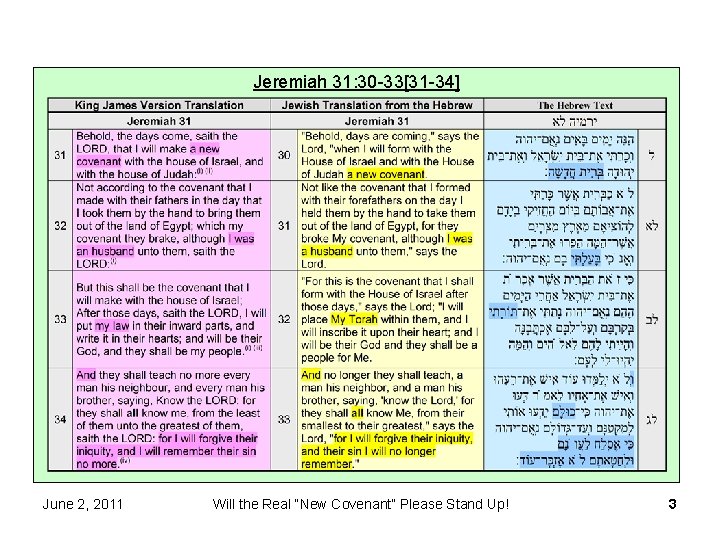
Jeremiah 31: 30 -33[31 -34] June 2, 2011 Will the Real “New Covenant” Please Stand Up! 3
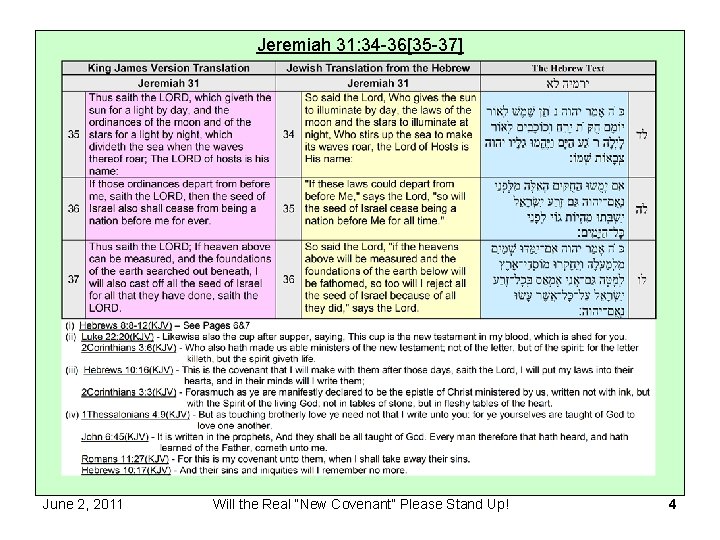
Jeremiah 31: 34 -36[35 -37] June 2, 2011 Will the Real “New Covenant” Please Stand Up! 4
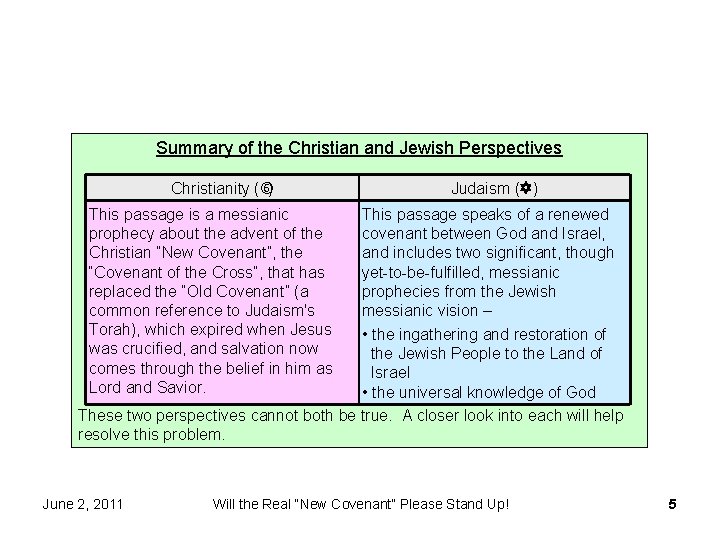
Summary of the Christian and Jewish Perspectives Christianity ( ) Judaism (Y) This passage is a messianic prophecy about the advent of the Christian “New Covenant”, the “Covenant of the Cross”, that has replaced the “Old Covenant” (a common reference to Judaism's Torah), which expired when Jesus was crucified, and salvation now comes through the belief in him as Lord and Savior. This passage speaks of a renewed covenant between God and Israel, and includes two significant, though yet-to-be-fulfilled, messianic prophecies from the Jewish messianic vision – • the ingathering and restoration of the Jewish People to the Land of Israel • the universal knowledge of God These two perspectives cannot both be true. A closer look into each will help resolve this problem. June 2, 2011 Will the Real “New Covenant” Please Stand Up! 5
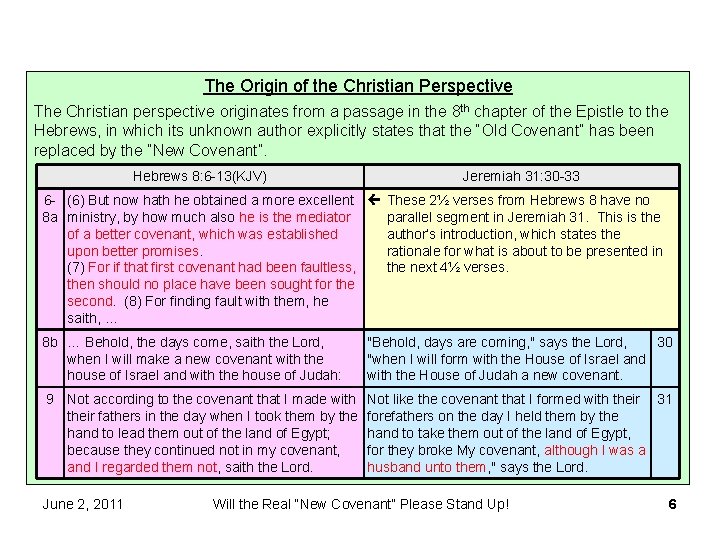
The Origin of the Christian Perspective The Christian perspective originates from a passage in the 8 th chapter of the Epistle to the Hebrews, in which its unknown author explicitly states that the “Old Covenant” has been replaced by the “New Covenant”. Hebrews 8: 6 -13(KJV) Jeremiah 31: 30 -33 6 - (6) But now hath he obtained a more excellent ç These 2½ verses from Hebrews 8 have no 8 a ministry, by how much also he is the mediator parallel segment in Jeremiah 31. This is the of a better covenant, which was established author’s introduction, which states the upon better promises. rationale for what is about to be presented in (7) For if that first covenant had been faultless, the next 4½ verses. then should no place have been sought for the second. (8) For finding fault with them, he saith, … 8 b … Behold, the days come, saith the Lord, when I will make a new covenant with the house of Israel and with the house of Judah: "Behold, days are coming, " says the Lord, 30 "when I will form with the House of Israel and with the House of Judah a new covenant. 9 Not according to the covenant that I made with their fathers in the day when I took them by the hand to lead them out of the land of Egypt; because they continued not in my covenant, and I regarded them not, saith the Lord. Not like the covenant that I formed with their 31 forefathers on the day I held them by the hand to take them out of the land of Egypt, for they broke My covenant, although I was a husband unto them, " says the Lord. June 2, 2011 Will the Real “New Covenant” Please Stand Up! 6
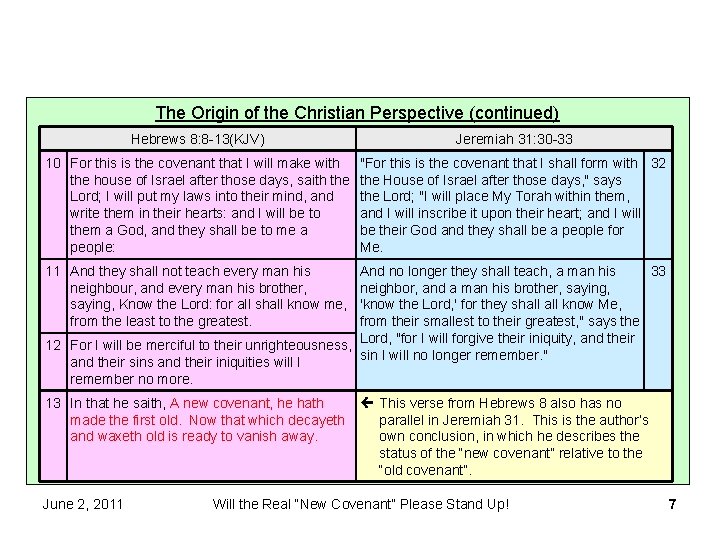
The Origin of the Christian Perspective (continued) Hebrews 8: 8 -13(KJV) Jeremiah 31: 30 -33 10 For this is the covenant that I will make with the house of Israel after those days, saith the Lord; I will put my laws into their mind, and write them in their hearts: and I will be to them a God, and they shall be to me a people: "For this is the covenant that I shall form with 32 the House of Israel after those days, " says the Lord; "I will place My Torah within them, and I will inscribe it upon their heart; and I will be their God and they shall be a people for Me. 11 And they shall not teach every man his neighbour, and every man his brother, saying, Know the Lord: for all shall know me, from the least to the greatest. And no longer they shall teach, a man his 33 neighbor, and a man his brother, saying, 'know the Lord, ' for they shall know Me, from their smallest to their greatest, " says the Lord, "for I will forgive their iniquity, and their 12 For I will be merciful to their unrighteousness, sin I will no longer remember. " and their sins and their iniquities will I remember no more. 13 In that he saith, A new covenant, he hath made the first old. Now that which decayeth and waxeth old is ready to vanish away. June 2, 2011 ç This verse from Hebrews 8 also has no parallel in Jeremiah 31. This is the author’s own conclusion, in which he describes the status of the “new covenant” relative to the “old covenant”. Will the Real “New Covenant” Please Stand Up! 7
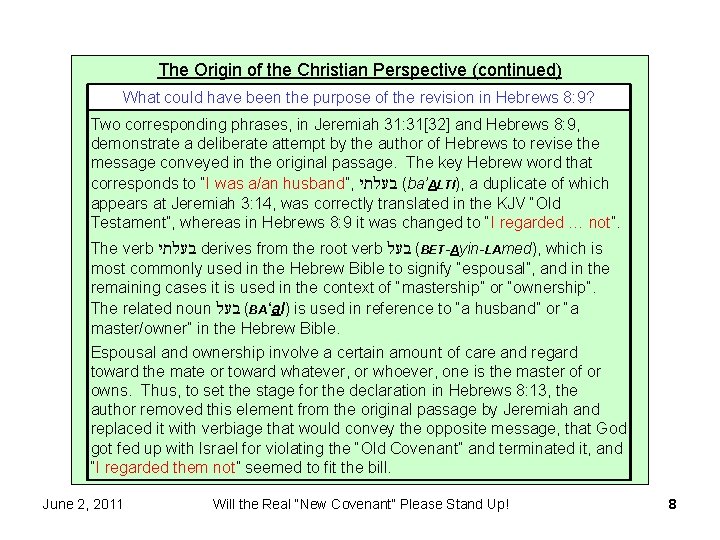
The Origin of the Christian Perspective (continued) What could have been the purpose of the revision in Hebrews 8: 9? Two corresponding phrases, in Jeremiah 31: 31[32] and Hebrews 8: 9, demonstrate a deliberate attempt by the author of Hebrews to revise the message conveyed in the original passage. The key Hebrew word that corresponds to “I was a/an husband”, ( בעלתי ba’ALTI), a duplicate of which appears at Jeremiah 3: 14, was correctly translated in the KJV “Old Testament”, whereas in Hebrews 8: 9 it was changed to “I regarded … not”. The verb בעלתי derives from the root verb ( בעל BET-Ayin-LAmed), which is most commonly used in the Hebrew Bible to signify “espousal”, and in the remaining cases it is used in the context of “mastership” or “ownership”. The related noun ( בעל BA‘al) is used in reference to “a husband” or “a master/owner” in the Hebrew Bible. Espousal and ownership involve a certain amount of care and regard toward the mate or toward whatever, or whoever, one is the master of or owns. Thus, to set the stage for the declaration in Hebrews 8: 13, the author removed this element from the original passage by Jeremiah and replaced it with verbiage that would convey the opposite message, that God got fed up with Israel for violating the “Old Covenant” and terminated it, and “I regarded them not” seemed to fit the bill. June 2, 2011 Will the Real “New Covenant” Please Stand Up! 8
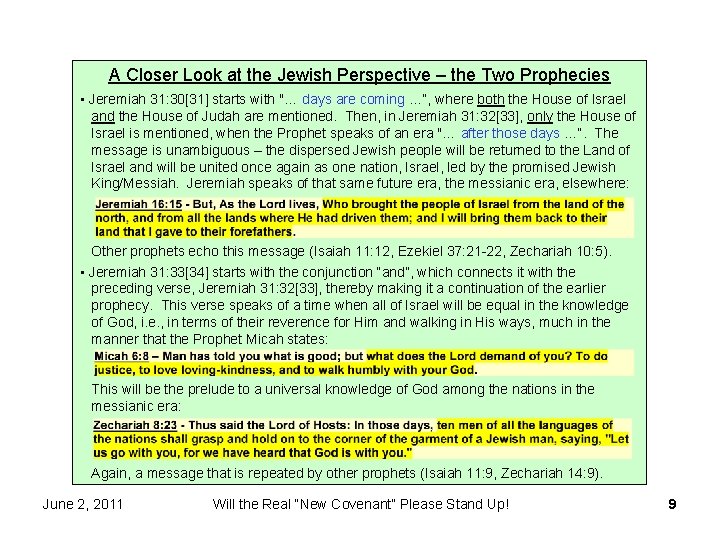
A Closer Look at the Jewish Perspective – the Two Prophecies • Jeremiah 31: 30[31] starts with "… days are coming …“, where both the House of Israel and the House of Judah are mentioned. Then, in Jeremiah 31: 32[33], only the House of Israel is mentioned, when the Prophet speaks of an era "… after those days …“. The message is unambiguous – the dispersed Jewish people will be returned to the Land of Israel and will be united once again as one nation, Israel, led by the promised Jewish King/Messiah. Jeremiah speaks of that same future era, the messianic era, elsewhere: Other prophets echo this message (Isaiah 11: 12, Ezekiel 37: 21 -22, Zechariah 10: 5). • Jeremiah 31: 33[34] starts with the conjunction “and”, which connects it with the preceding verse, Jeremiah 31: 32[33], thereby making it a continuation of the earlier prophecy. This verse speaks of a time when all of Israel will be equal in the knowledge of God, i. e. , in terms of their reverence for Him and walking in His ways, much in the manner that the Prophet Micah states: This will be the prelude to a universal knowledge of God among the nations in the messianic era: Again, a message that is repeated by other prophets (Isaiah 11: 9, Zechariah 14: 9). June 2, 2011 Will the Real “New Covenant” Please Stand Up! 9
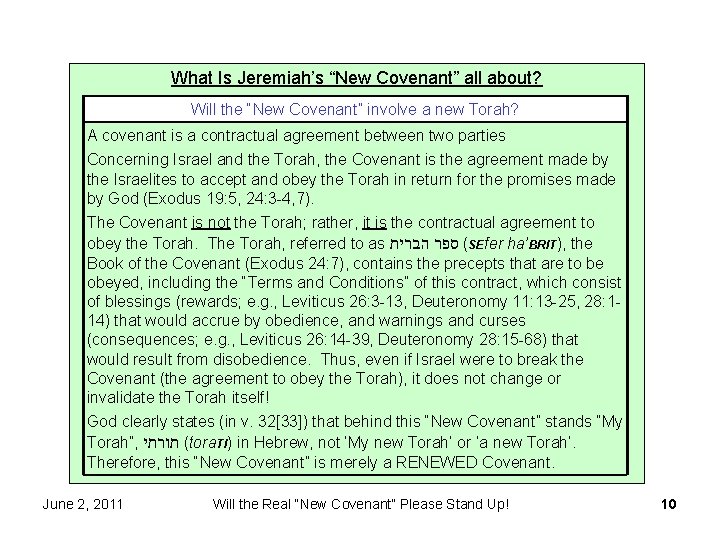
What Is Jeremiah’s “New Covenant” all about? Will the “New Covenant” involve a new Torah? A covenant is a contractual agreement between two parties Concerning Israel and the Torah, the Covenant is the agreement made by the Israelites to accept and obey the Torah in return for the promises made by God (Exodus 19: 5, 24: 3 -4, 7). The Covenant is not the Torah; rather, it is the contractual agreement to obey the Torah. The Torah, referred to as ( ספר הברית SEfer ha’BRIT), the Book of the Covenant (Exodus 24: 7), contains the precepts that are to be obeyed, including the “Terms and Conditions” of this contract, which consist of blessings (rewards; e. g. , Leviticus 26: 3 -13, Deuteronomy 11: 13 -25, 28: 114) that would accrue by obedience, and warnings and curses (consequences; e. g. , Leviticus 26: 14 -39, Deuteronomy 28: 15 -68) that would result from disobedience. Thus, even if Israel were to break the Covenant (the agreement to obey the Torah), it does not change or invalidate the Torah itself! God clearly states (in v. 32[33]) that behind this “New Covenant” stands “My Torah”, ( תורתי tora. TI) in Hebrew, not ‘My new Torah’ or ‘a new Torah’. Therefore, this “New Covenant” is merely a RENEWED Covenant. June 2, 2011 Will the Real “New Covenant” Please Stand Up! 10
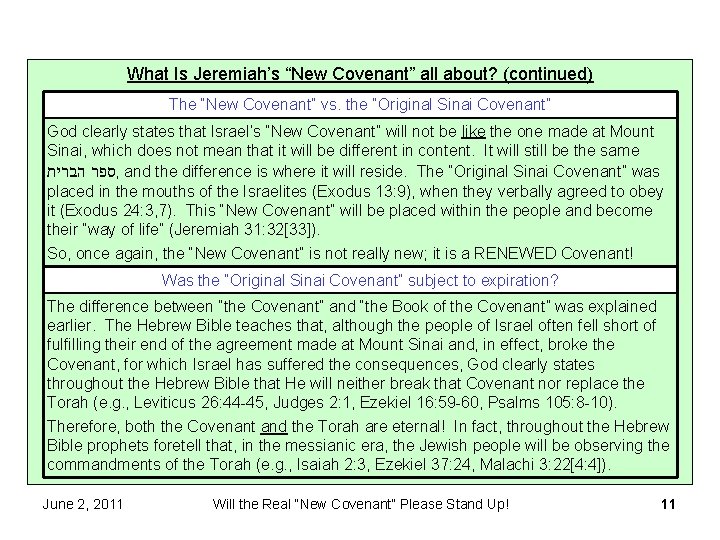
What Is Jeremiah’s “New Covenant” all about? (continued) The “New Covenant” vs. the “Original Sinai Covenant” God clearly states that Israel’s “New Covenant” will not be like the one made at Mount Sinai, which does not mean that it will be different in content. It will still be the same ספר הברית , and the difference is where it will reside. The “Original Sinai Covenant” was placed in the mouths of the Israelites (Exodus 13: 9), when they verbally agreed to obey it (Exodus 24: 3, 7). This “New Covenant” will be placed within the people and become their “way of life” (Jeremiah 31: 32[33]). So, once again, the “New Covenant” is not really new; it is a RENEWED Covenant! Was the “Original Sinai Covenant” subject to expiration? The difference between “the Covenant” and “the Book of the Covenant” was explained earlier. The Hebrew Bible teaches that, although the people of Israel often fell short of fulfilling their end of the agreement made at Mount Sinai and, in effect, broke the Covenant, for which Israel has suffered the consequences, God clearly states throughout the Hebrew Bible that He will neither break that Covenant nor replace the Torah (e. g. , Leviticus 26: 44 -45, Judges 2: 1, Ezekiel 16: 59 -60, Psalms 105: 8 -10). Therefore, both the Covenant and the Torah are eternal! In fact, throughout the Hebrew Bible prophets foretell that, in the messianic era, the Jewish people will be observing the commandments of the Torah (e. g. , Isaiah 2: 3, Ezekiel 37: 24, Malachi 3: 22[4: 4]). June 2, 2011 Will the Real “New Covenant” Please Stand Up! 11
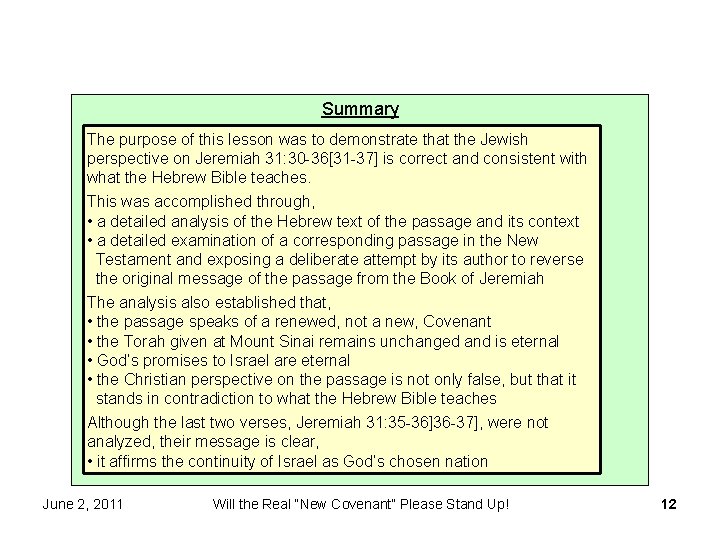
Summary The purpose of this lesson was to demonstrate that the Jewish perspective on Jeremiah 31: 30 -36[31 -37] is correct and consistent with what the Hebrew Bible teaches. This was accomplished through, • a detailed analysis of the Hebrew text of the passage and its context • a detailed examination of a corresponding passage in the New Testament and exposing a deliberate attempt by its author to reverse the original message of the passage from the Book of Jeremiah The analysis also established that, • the passage speaks of a renewed, not a new, Covenant • the Torah given at Mount Sinai remains unchanged and is eternal • God’s promises to Israel are eternal • the Christian perspective on the passage is not only false, but that it stands in contradiction to what the Hebrew Bible teaches Although the last two verses, Jeremiah 31: 35 -36]36 -37], were not analyzed, their message is clear, • it affirms the continuity of Israel as God’s chosen nation June 2, 2011 Will the Real “New Covenant” Please Stand Up! 12