Coordinating Energy Resources Ram Rajagopal Stanford University Changing
- Slides: 11
Coordinating Energy Resources Ram Rajagopal Stanford University
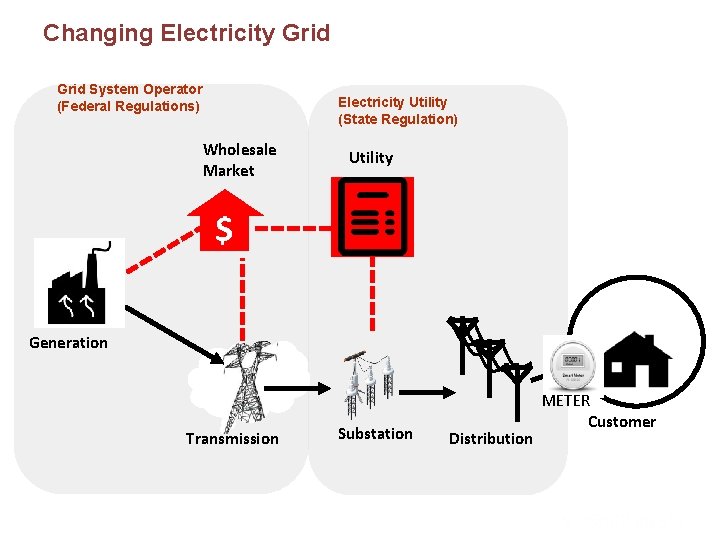
Changing Electricity Grid System Operator (Federal Regulations) Electricity Utility (State Regulation) Wholesale Market Utility $ Generation Transmission Substation Distribution METER Customer
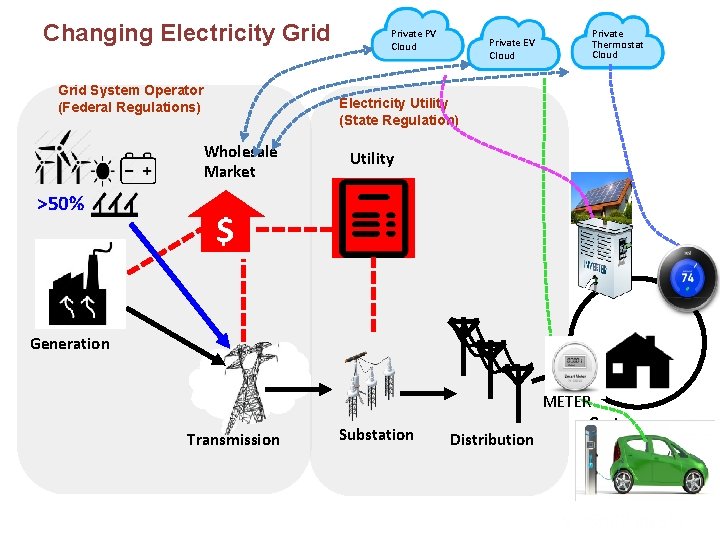
Changing Electricity Grid System Operator (Federal Regulations) Private EV Cloud Private Thermostat Cloud Electricity Utility (State Regulation) Wholesale Market >50% Private PV Cloud Utility $ Generation Transmission Substation Distribution METER Customer
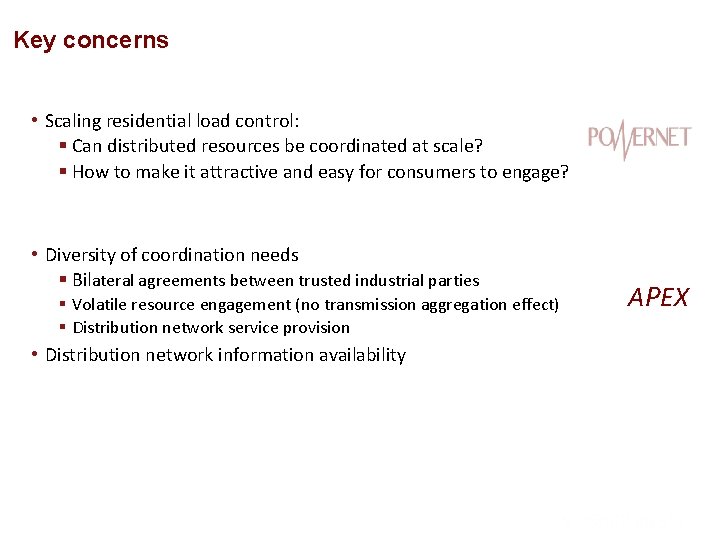
Key concerns • Scaling residential load control: § Can distributed resources be coordinated at scale? § How to make it attractive and easy for consumers to engage? • Diversity of coordination needs § Bilateral agreements between trusted industrial parties § Volatile resource engagement (no transmission aggregation effect) § Distribution network service provision • Distribution network information availability APEX
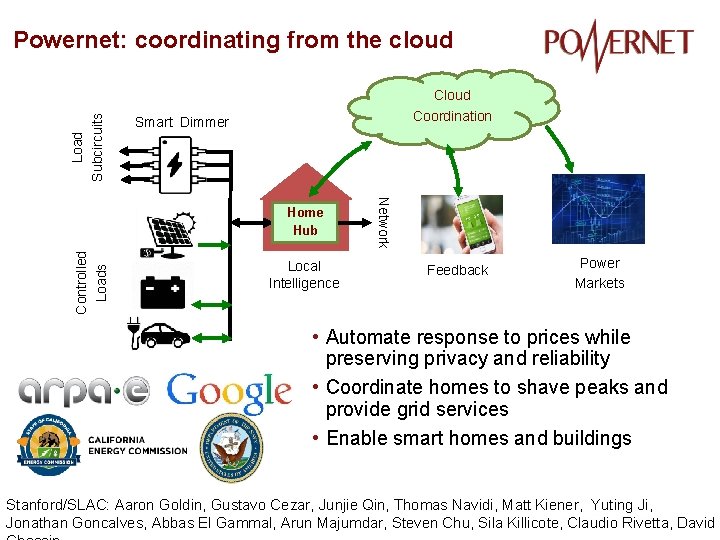
Load Subcircuits Powernet: coordinating from the cloud Coordination Smart Dimmer Controlled Loads Local Intelligence Network Home Hub Feedback Power Markets • Automate response to prices while preserving privacy and reliability • Coordinate homes to shave peaks and provide grid services • Enable smart homes and buildings Stanford/SLAC: Aaron Goldin, Gustavo Cezar, Junjie Qin, Thomas Navidi, Matt Kiener, Yuting Ji, Jonathan Goncalves, Abbas El Gammal, Arun Majumdar, Steven Chu, Sila Killicote, Claudio Rivetta, David
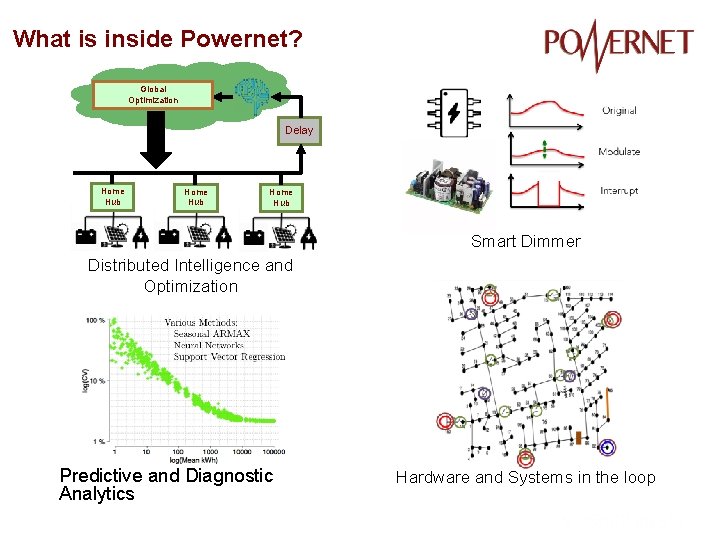
What is inside Powernet? Global Optimization Delay Home Hub Smart Dimmer Distributed Intelligence and Optimization Predictive and Diagnostic Analytics Hardware and Systems in the loop
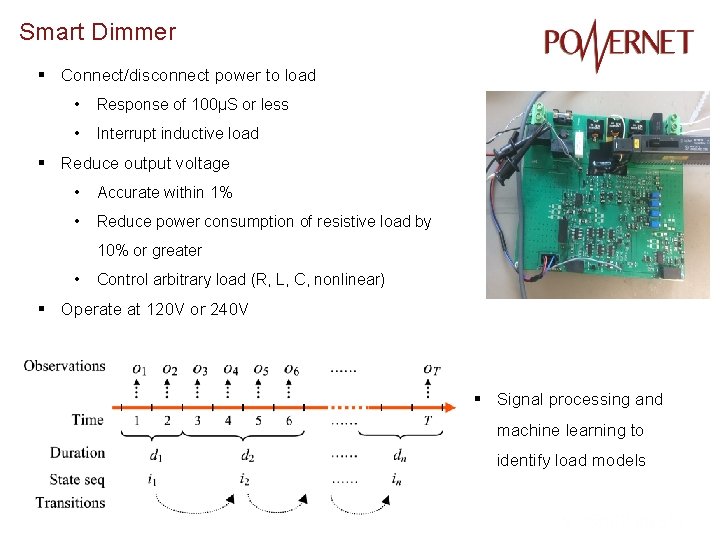
Smart Dimmer § Connect/disconnect power to load • Response of 100µS or less • Interrupt inductive load § Reduce output voltage • Accurate within 1% • Reduce power consumption of resistive load by 10% or greater • Control arbitrary load (R, L, C, nonlinear) § Operate at 120 V or 240 V § Signal processing and machine learning to identify load models
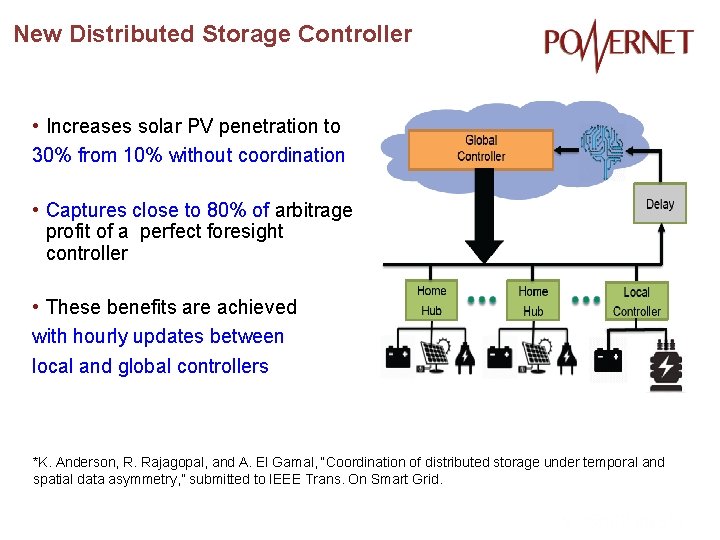
New Distributed Storage Controller • Increases solar PV penetration to 30% from 10% without coordination • Captures close to 80% of arbitrage profit of a perfect foresight controller • These benefits are achieved with hourly updates between local and global controllers *K. Anderson, R. Rajagopal, and A. El Gamal, “Coordination of distributed storage under temporal and spatial data asymmetry, ” submitted to IEEE Trans. On Smart Grid.
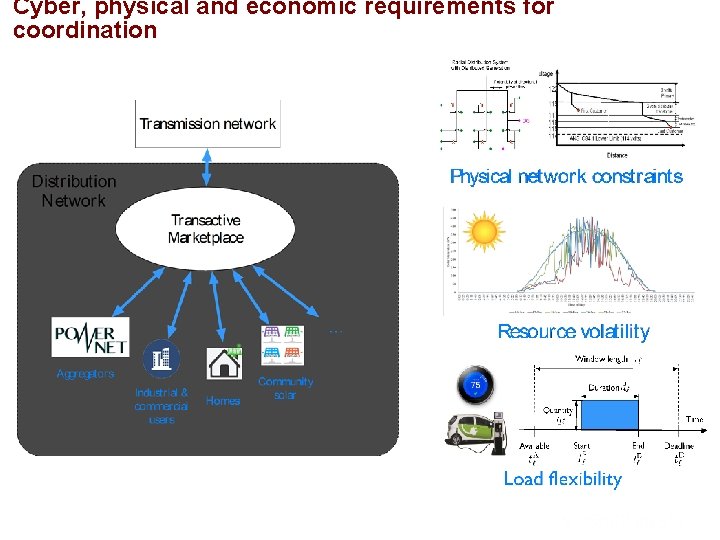
Cyber, physical and economic requirements for coordination
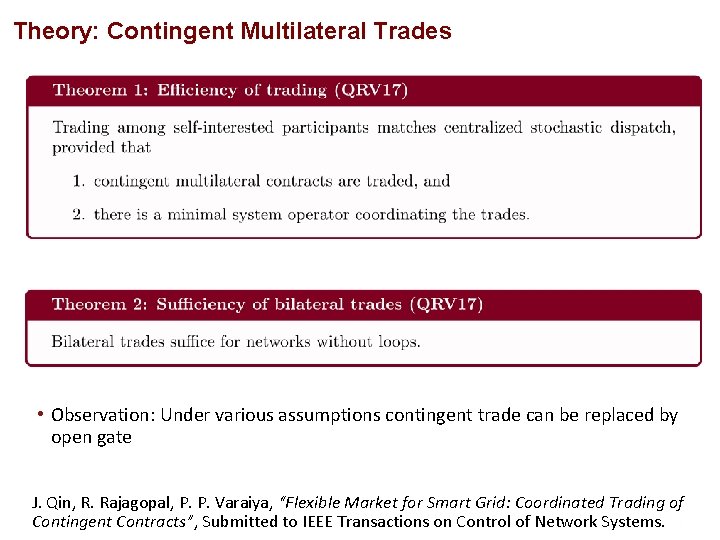
Theory: Contingent Multilateral Trades • Observation: Under various assumptions contingent trade can be replaced by open gate J. Qin, R. Rajagopal, P. P. Varaiya, “Flexible Market for Smart Grid: Coordinated Trading of Contingent Contracts”, Submitted to IEEE Transactions on Control of Network Systems.
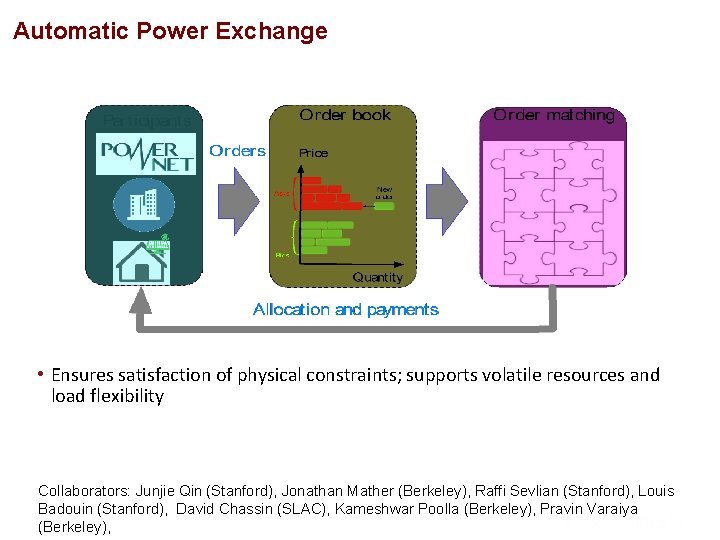
Automatic Power Exchange • Ensures satisfaction of physical constraints; supports volatile resources and load flexibility Collaborators: Junjie Qin (Stanford), Jonathan Mather (Berkeley), Raffi Sevlian (Stanford), Louis Badouin (Stanford), David Chassin (SLAC), Kameshwar Poolla (Berkeley), Pravin Varaiya (Berkeley),