CONTENTS 01 02 General aspect of evaluation in


- Slides: 24
�CONTENTS 01. 항암제 임상시험 승인 현황 02. General aspect of evaluation in cancer 03. Endpoint in Cancer Clinical Trial 04. Response Criteria 05. Conclusions
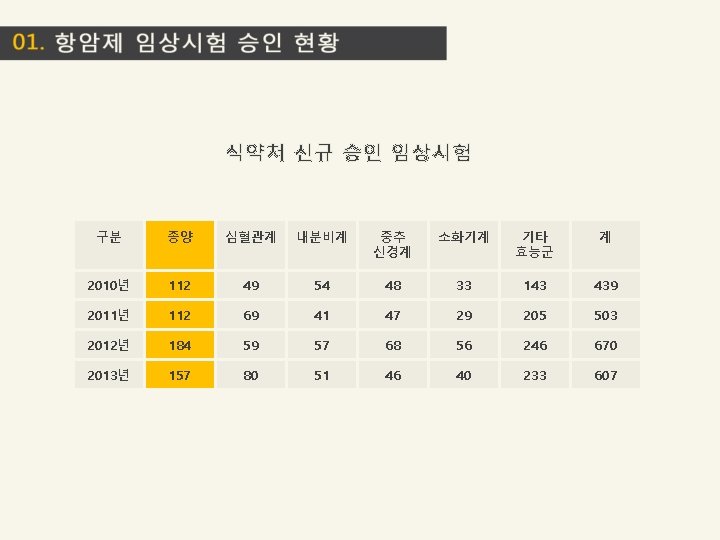
식약처 신규 승인 임상시험 구분 종양 심혈관계 내분비계 중추 신경계 소화기계 기타 효능군 계 2010년 112 49 54 48 33 143 439 2011년 112 69 41 47 29 205 503 2012년 184 59 57 68 56 246 670 2013년 157 80 51 46 40 233 607
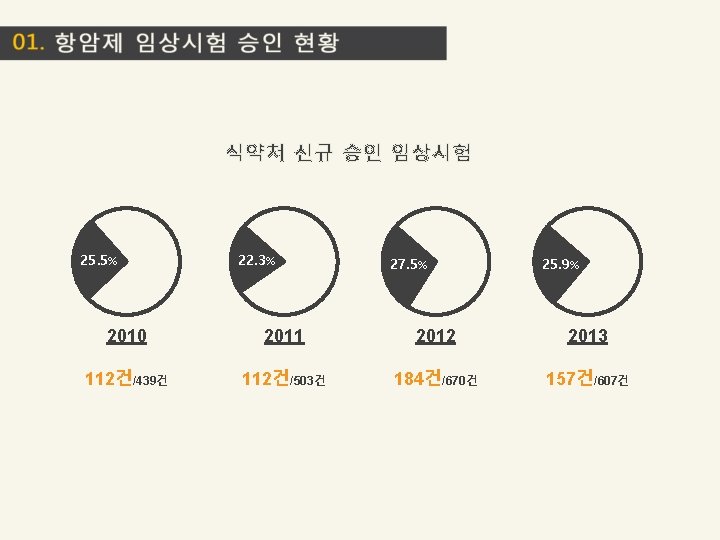
식약처 신규 승인 임상시험 25. 5% 22. 3% 27. 5% 25. 9% 2010 2011 2012 2013 112건/439건 112건/503건 184건/670건 157건/607건
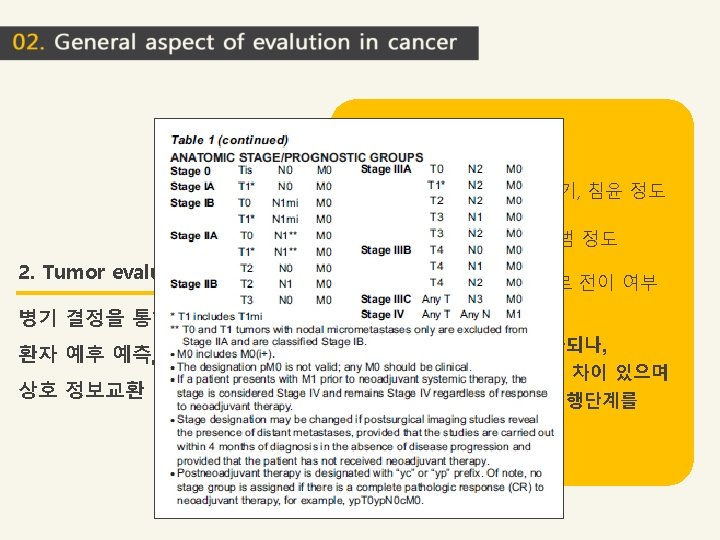
1. Patient evaluation 2. Tumor evaluation by staging 3. Treatment response evaluation
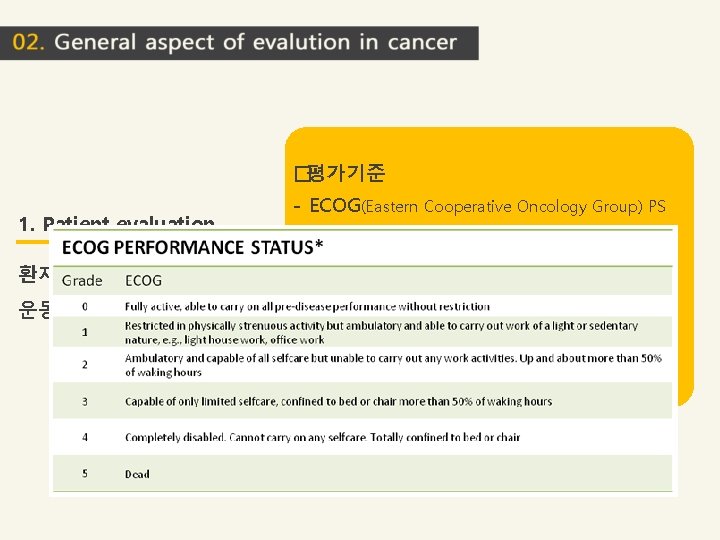
�평가기준 1. Patient evaluation 환자의 일반적 건강상태 및 운동능력평가 - ECOG(Eastern Cooperative Oncology Group) PS - KPS (Karnofsky Performance Status) Ø 항암치료의 원칙 - ECOG 0, 1, 2 - KPS≧ 70
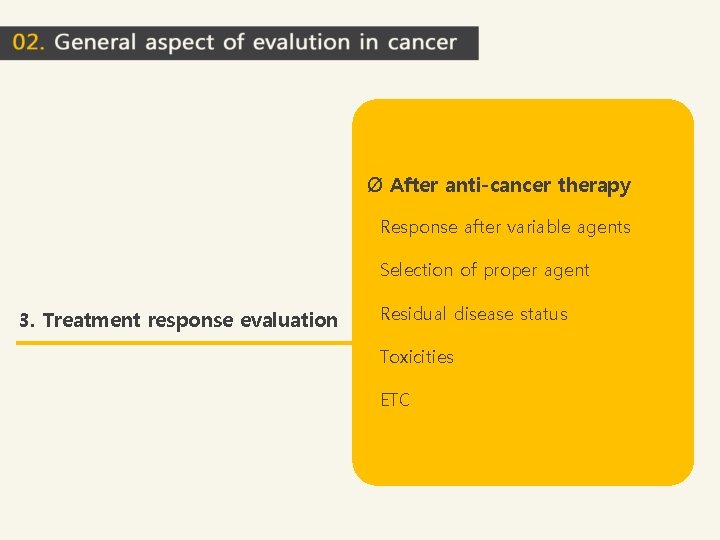
Ø After anti-cancer therapy Response after variable agents Selection of proper agent 3. Treatment response evaluation Residual disease status Toxicities ETC
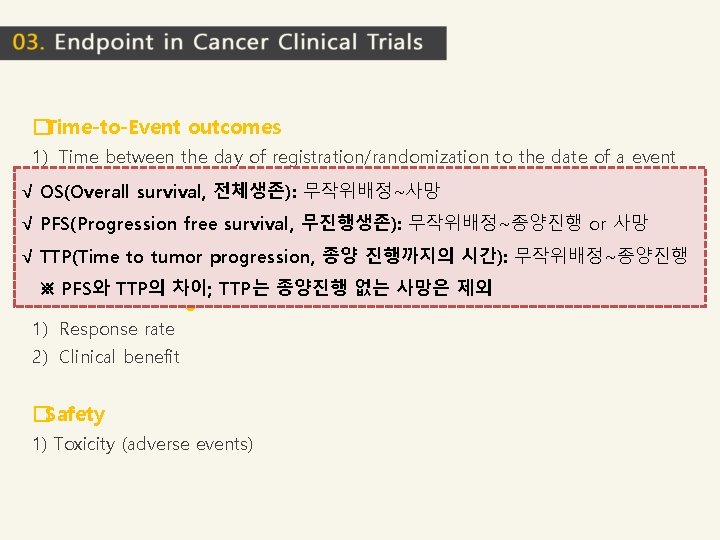
�Time-to-Event outcomes 1) Time between the day of registration/randomization to the date of a event Includes overall survival(OS), √ 2)OS(Overall survival, 전체생존): progression-free 무작위배정~사망survival(PFS) or time-toprogression(TTP), disease-free survival(DFS) or relapse-free survival(RFS), or √ PFS(Progression free survival, 무진행생존): 무작위배정~종양진행 or 사망 other event-free survivals √ TTP(Time to tumor progression, 종양 진행까지의 시간): 무작위배정~종양진행 ※ PFS와 TTP의 차이; TTP는 종양진행 없는 사망은 제외 �Tumor shrinkage or stabilization 1) Response rate 2) Clinical benefit �Safety 1) Toxicity (adverse events)
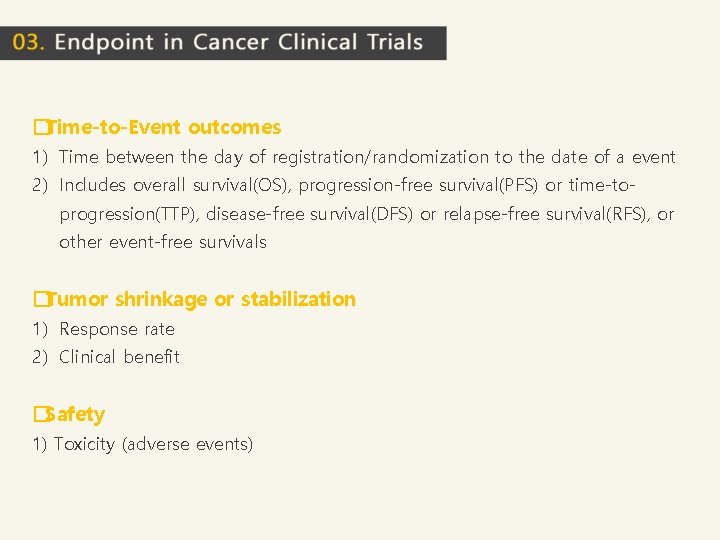
�Time-to-Event outcomes 1) Time between the day of registration/randomization to the date of a event 2) Includes overall survival(OS), progression-free survival(PFS) or time-toprogression(TTP), disease-free survival(DFS) or relapse-free survival(RFS), or other event-free survivals �Tumor shrinkage or stabilization 1) Response rate 2) Clinical benefit �Safety 1) Toxicity (adverse events)
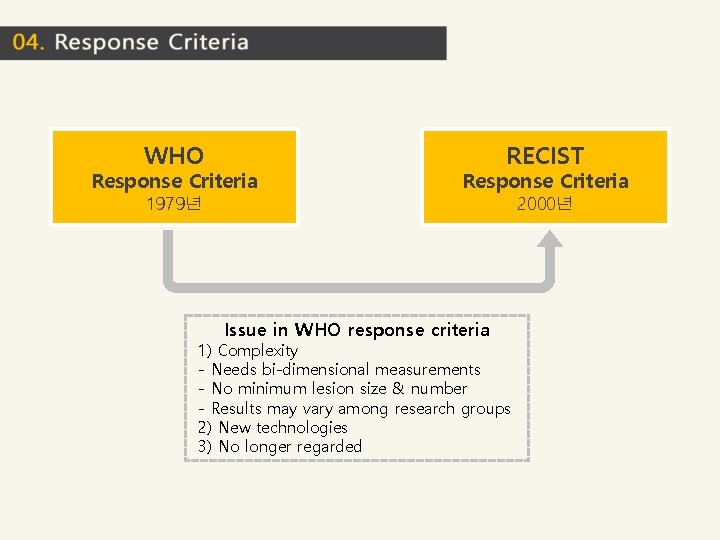
WHO Response Criteria 1979년 RECIST Response Criteria Issue in WHO response criteria 1) Complexity - Needs bi-dimensional measurements - No minimum lesion size & number - Results may vary among research groups 2) New technologies 3) No longer regarded 2000년
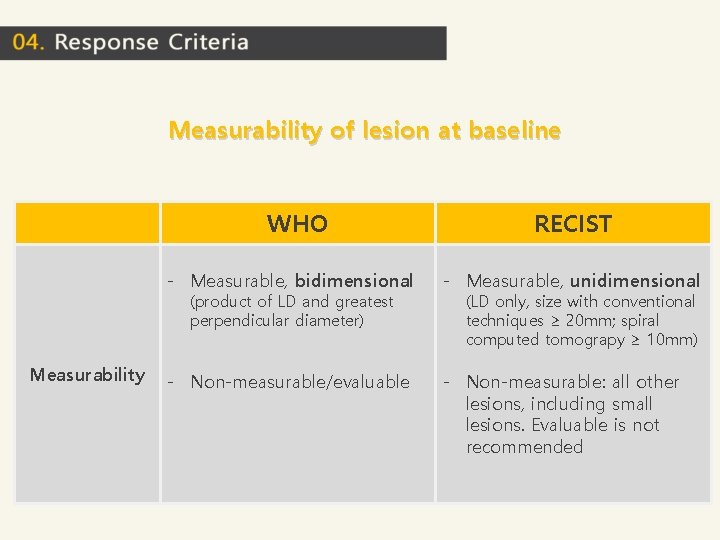
Measurability of lesion at baseline WHO - Measurable, bidimensional - Measurable, unidimensional - Non-measurable/evaluable - Non-measurable: all other lesions, including small lesions. Evaluable is not recommended (product of LD and greatest perpendicular diameter) Measurability RECIST (LD only, size with conventional techniques ≥ 20 mm; spiral computed tomograpy ≥ 10 mm)
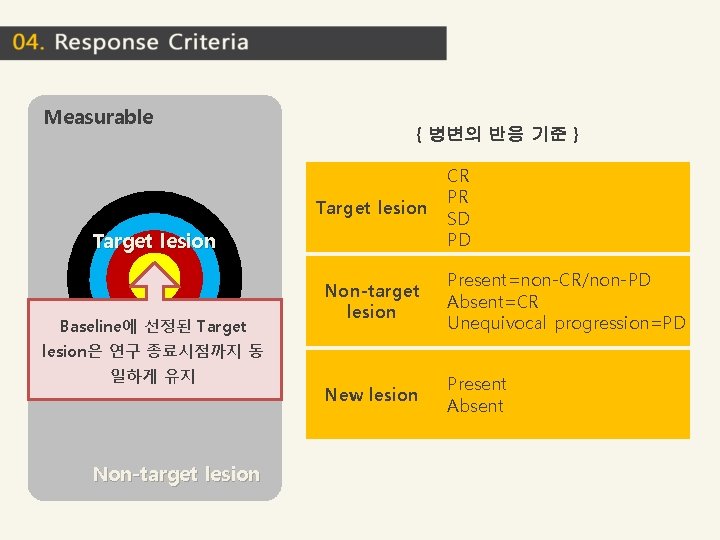
Measurable { 병변의 반응 기준 } Target lesion Baseline에 선정된 Target CR PR SD PD Non-target lesion Present=non-CR/non-PD Absent=CR Unequivocal progression=PD New lesion Present Absent lesion은 연구 종료시점까지 동 일하게 유지 Non-target lesion
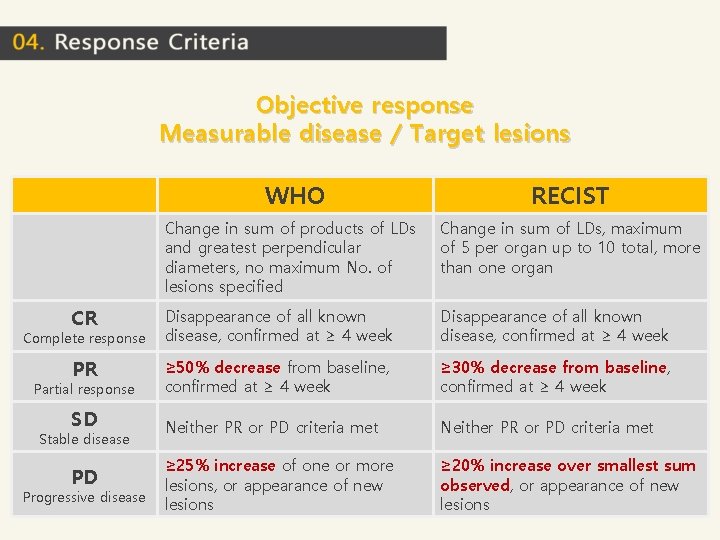
Objective response Measurable disease / Target lesions WHO RECIST Change in sum of products of LDs and greatest perpendicular diameters, no maximum No. of lesions specified Change in sum of LDs, maximum of 5 per organ up to 10 total, more than one organ CR Disappearance of all known disease, confirmed at ≥ 4 week PR ≥ 50% decrease from baseline, confirmed at ≥ 4 week ≥ 30% decrease from baseline, confirmed at ≥ 4 week Neither PR or PD criteria met ≥ 25% increase of one or more lesions, or appearance of new lesions ≥ 20% increase over smallest sum observed, or appearance of new lesions Complete response Partial response SD Stable disease PD Progressive disease
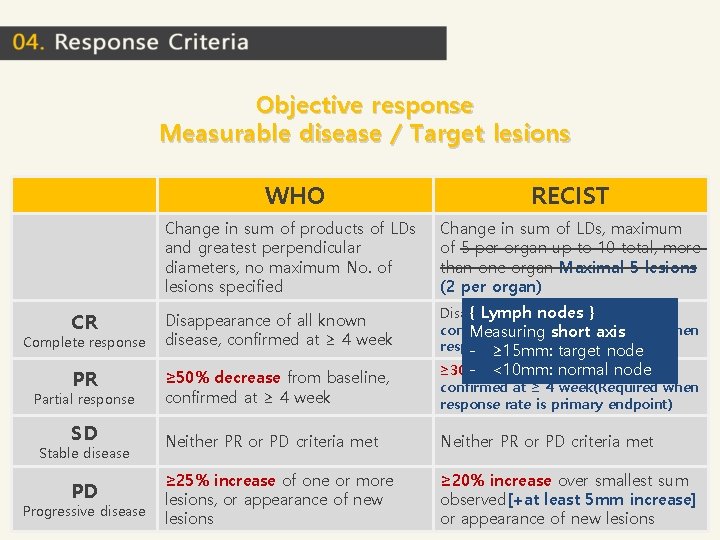
Objective response Measurable disease / Target lesions WHO RECIST Change in sum of products of LDs and greatest perpendicular diameters, no maximum No. of lesions specified Change in sum of LDs, maximum of 5 per organ up to 10 total, more than one organ Maximal 5 lesions (2 per organ) CR Disappearance of all known disease, confirmed at ≥ 4 week { Lymph nodes } Disappearance of all known disease, confirmed at ≥ 4 short week(Required when Measuring axis response rate is primary endpoint) - ≥ 15 mm: target node PR ≥ 50% decrease from baseline, confirmed at ≥ 4 week - decrease <10 mm: from normal node ≥ 30% baseline, confirmed at ≥ 4 week(Required when response rate is primary endpoint) Neither PR or PD criteria met ≥ 25% increase of one or more lesions, or appearance of new lesions ≥ 20% increase over smallest sum observed[+at least 5 mm increase] or appearance of new lesions Complete response Partial response SD Stable disease PD Progressive disease
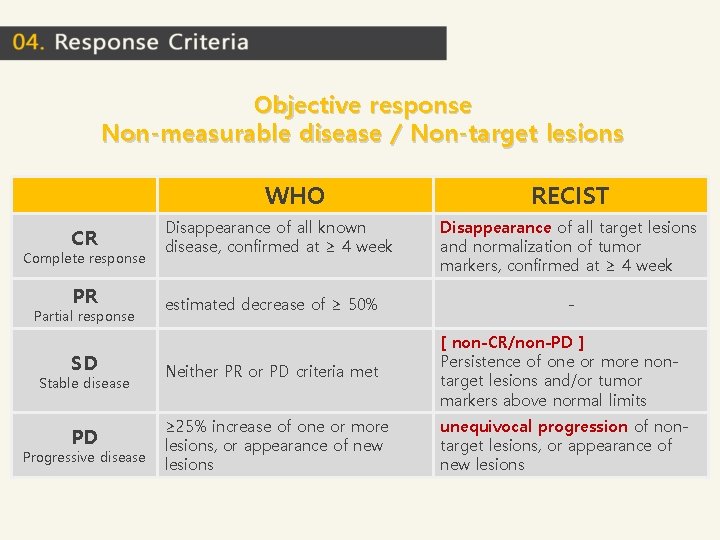
Objective response Non-measurable disease / Non-target lesions WHO CR Disappearance of all known disease, confirmed at ≥ 4 week PR estimated decrease of ≥ 50% Complete response Partial response SD Stable disease PD Progressive disease RECIST Disappearance of all target lesions and normalization of tumor markers, confirmed at ≥ 4 week - Neither PR or PD criteria met [ non-CR/non-PD ] Persistence of one or more nontarget lesions and/or tumor markers above normal limits ≥ 25% increase of one or more lesions, or appearance of new lesions unequivocal progression of nontarget lesions, or appearance of new lesions
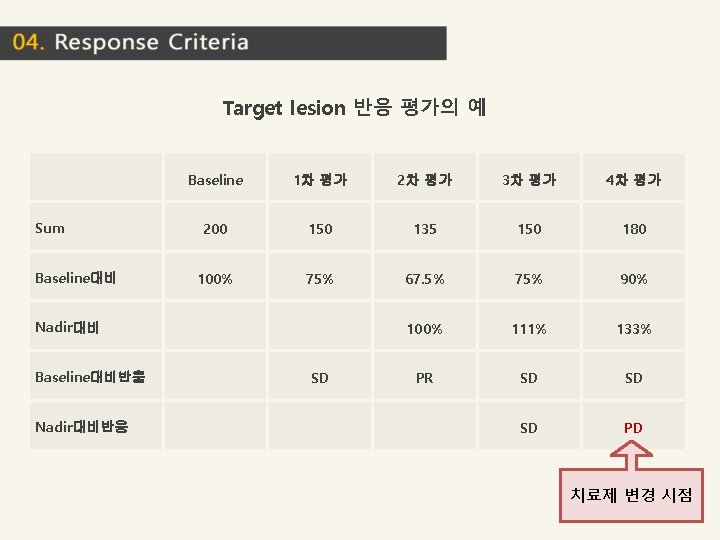
Target lesion 반응 평가의 예 Sum Baseline대비 Baseline 1차 평가 2차 평가 3차 평가 4차 평가 200 150 135 150 180 100% 75% 67. 5% 75% 90% 100% 111% 133% PR SD SD SD PD Nadir대비 Baseline대비반응 Nadir대비반응 SD 치료제 변경 시점
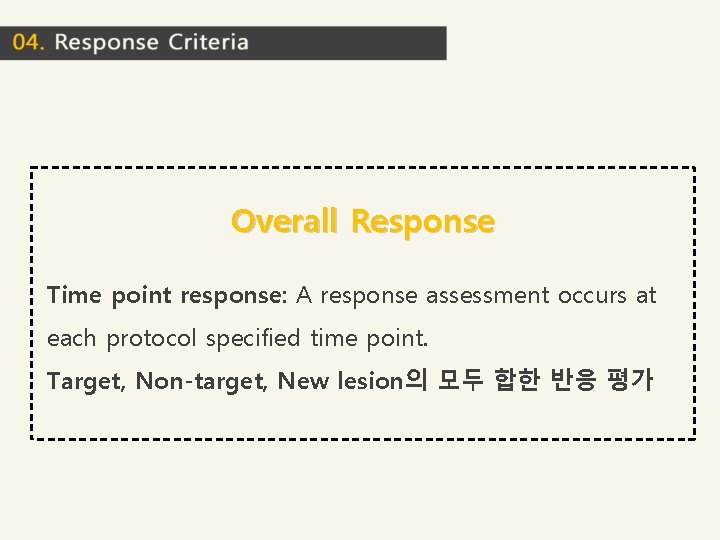
Overall Response Time point response: A response assessment occurs at each protocol specified time point. Target, Non-target, New lesion의 모두 합한 반응 평가
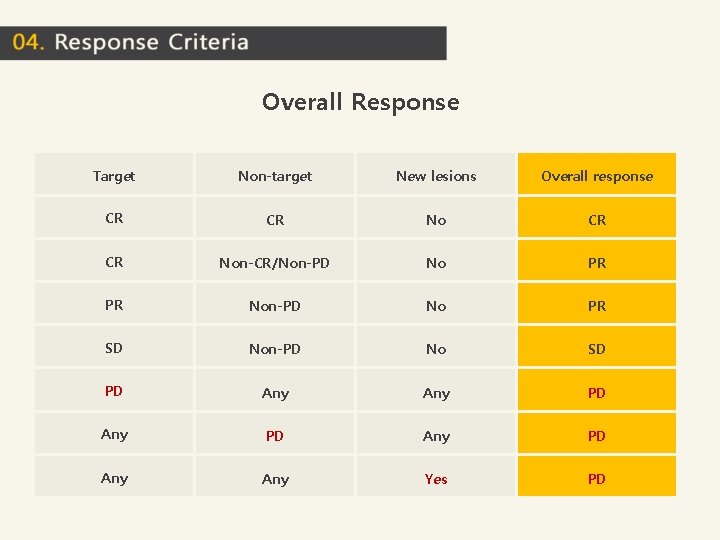
Overall Response Target Non-target New lesions Overall response CR CR Non-CR/Non-PD No PR PR Non-PD No PR SD Non-PD No SD PD Any PD Any Yes PD
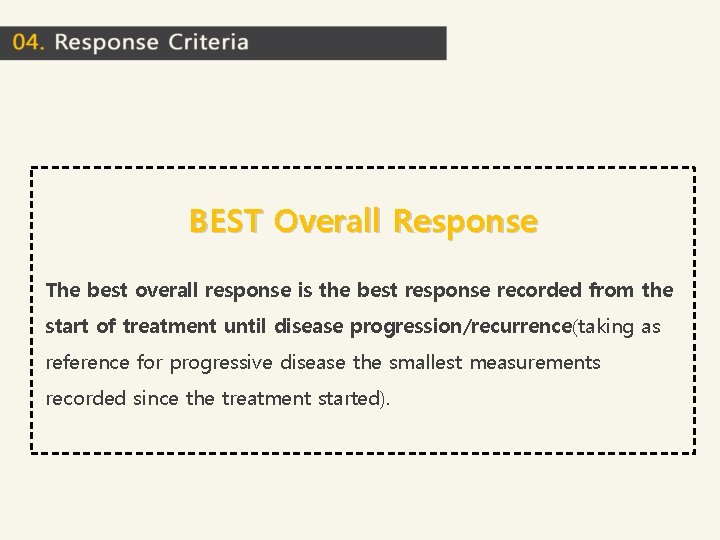
BEST Overall Response The best overall response is the best response recorded from the start of treatment until disease progression/recurrence(taking as reference for progressive disease the smallest measurements recorded since the treatment started).
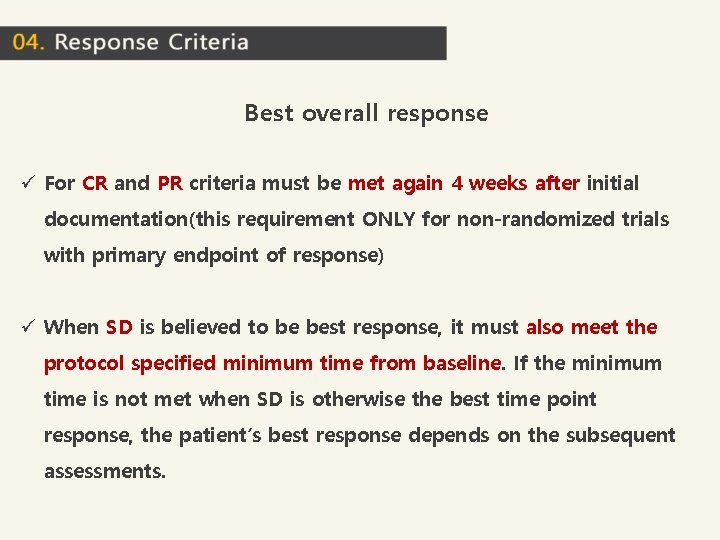
Best overall response ü For CR and PR criteria must be met again 4 weeks after initial documentation(this requirement ONLY for non-randomized trials with primary endpoint of response) ü When SD is believed to be best response, it must also meet the protocol specified minimum time from baseline. If the minimum time is not met when SD is otherwise the best time point response, the patient’s best response depends on the subsequent assessments.
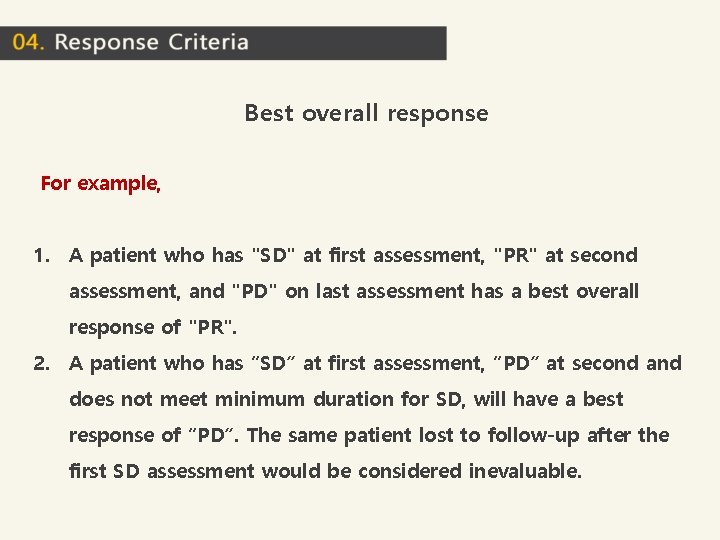
Best overall response For example, 1. A patient who has "SD" at first assessment, "PR" at second assessment, and "PD" on last assessment has a best overall response of "PR". 2. A patient who has “SD” at first assessment, “PD” at second and does not meet minimum duration for SD, will have a best response of “PD”. The same patient lost to follow-up after the first SD assessment would be considered inevaluable.