Conservation of Amount vs Weight A Critical Consideration
- Slides: 18
Conservation of Amount vs. Weight: A Critical Consideration of Piaget’s Conservation Sequence DANIELLE SCHUMER CHILD GROWTH & DEVELOPMENT RESEARCH STUDY
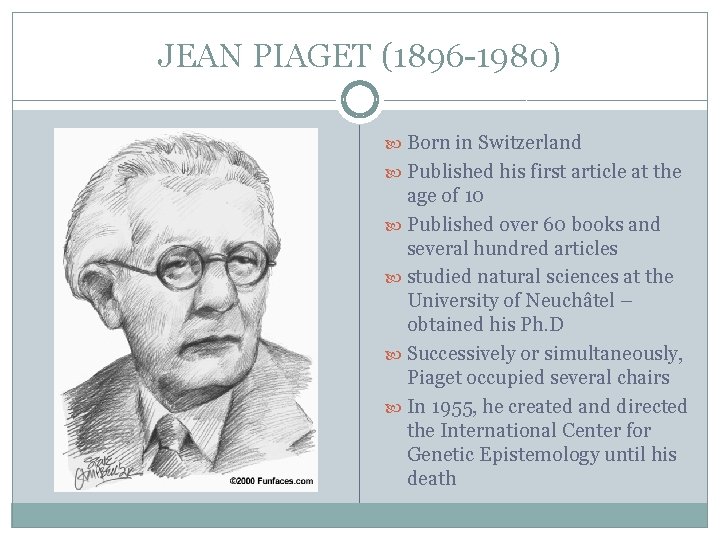
JEAN PIAGET (1896 -1980) Born in Switzerland Published his first article at the age of 10 Published over 60 books and several hundred articles studied natural sciences at the University of Neuchâtel – obtained his Ph. D Successively or simultaneously, Piaget occupied several chairs In 1955, he created and directed the International Center for Genetic Epistemology until his death
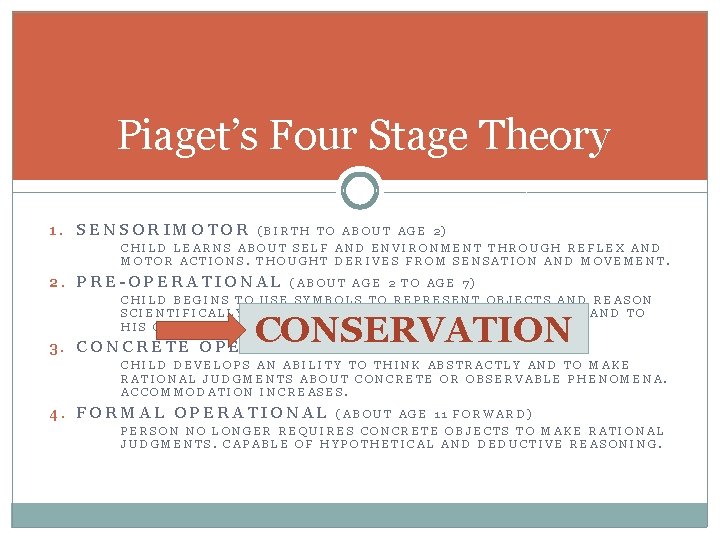
Piaget’s Four Stage Theory 1. SENSORIMOTOR (BIRTH TO ABOUT AGE 2) CHILD LEARNS ABOUT SELF AND ENVIRONMENT THROUGH REFLEX AND MOTOR ACTIONS. THOUGHT DERIVES FROM SENSATION AND MOVEMENT. 2. PRE-OPERATIONAL (ABOUT AGE 2 TO AGE 7) CHILD BEGINS TO USE SYMBOLS TO REPRESENT OBJECTS AND REASON SCIENTIFICALLY. ALSO CHILD IS ORIENTED TO THE PRESENT AND TO HIS OR HER OWN IDEAS OR THOUGHTS. CONSERVATION 3. CONCRETE OPERATIONAL (ABOUT AGE 7 TO AGE 11) CHILD DEVELOPS AN ABILITY TO THINK ABSTRACTLY AND TO MAKE RATIONAL JUDGMENTS ABOUT CONCRETE OR OBSERVABLE PHENOMENA. ACCOMMODATION INCREASES. 4. FORMAL OPERATIONAL (ABOUT AGE 11 FORWARD) PERSON NO LONGER REQUIRES CONCRETE OBJECTS TO MAKE RATIONAL JUDGMENTS. CAPABLE OF HYPOTHETICAL AND DEDUCTIVE REASONING.
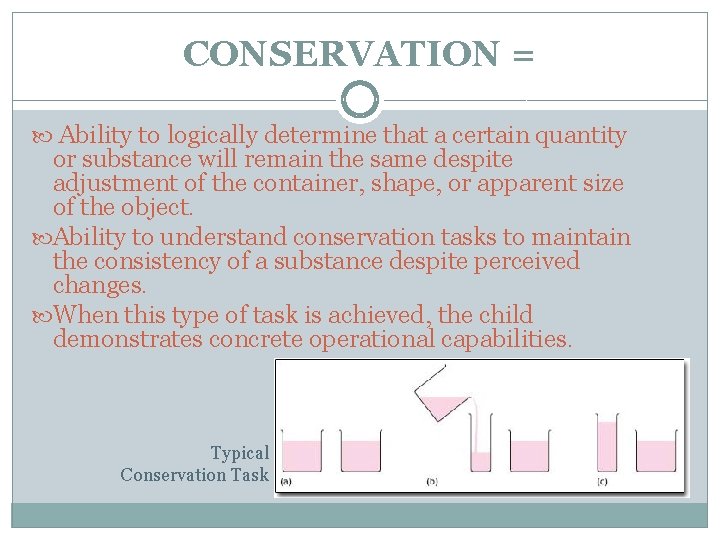
CONSERVATION = Ability to logically determine that a certain quantity or substance will remain the same despite adjustment of the container, shape, or apparent size of the object. Ability to understand conservation tasks to maintain the consistency of a substance despite perceived changes. When this type of task is achieved, the child demonstrates concrete operational capabilities. Typical Conservation Task
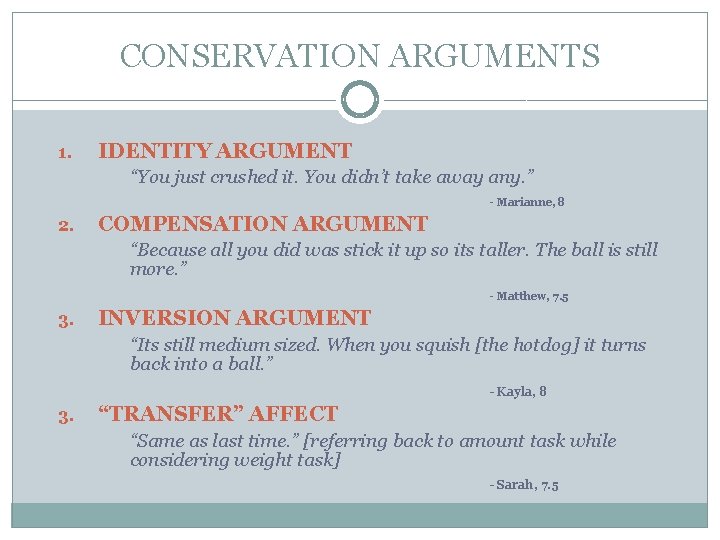
CONSERVATION ARGUMENTS 1. IDENTITY ARGUMENT “You just crushed it. You didn’t take away any. ” - Marianne, 8 2. COMPENSATION ARGUMENT “Because all you did was stick it up so its taller. The ball is still more. ” - Matthew, 7. 5 3. INVERSION ARGUMENT “Its still medium sized. When you squish [the hotdog] it turns back into a ball. ” - Kayla, 8 3. “TRANSFER” AFFECT “Same as last time. ” [referring back to amount task while considering weight task] - Sarah, 7. 5
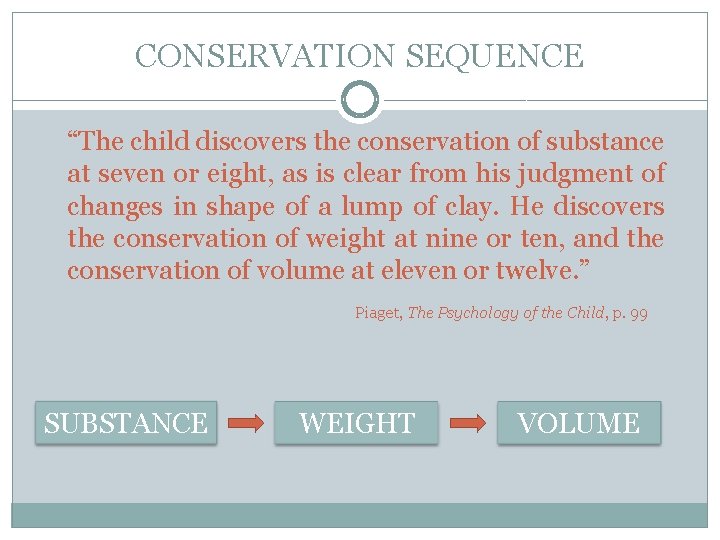
CONSERVATION SEQUENCE “The child discovers the conservation of substance at seven or eight, as is clear from his judgment of changes in shape of a lump of clay. He discovers the conservation of weight at nine or ten, and the conservation of volume at eleven or twelve. ” Piaget, The Psychology of the Child, p. 99 SUBSTANCE WEIGHT VOLUME
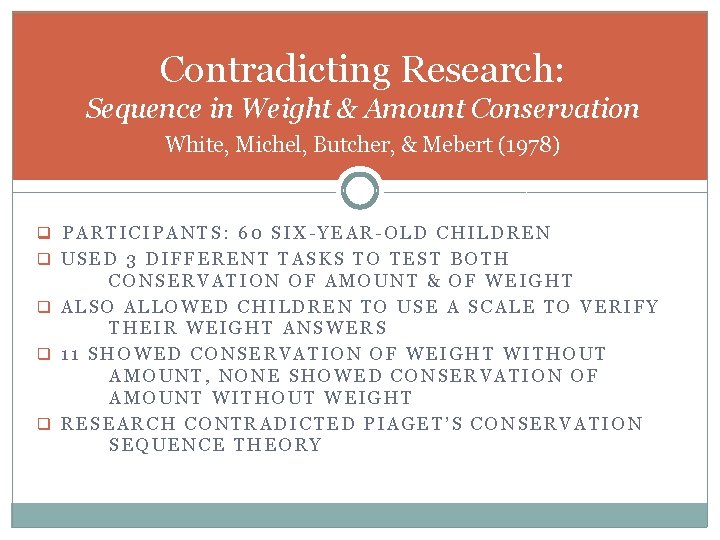
Contradicting Research: Sequence in Weight & Amount Conservation White, Michel, Butcher, & Mebert (1978) q PARTICIPANTS: 60 SIX-YEAR-OLD CHILDREN q USED 3 DIFFERENT TASKS TO TEST BOTH CONSERVATION OF AMOUNT & OF WEIGHT q ALSO ALLOWED CHILDREN TO USE A SCALE TO VERIFY THEIR WEIGHT ANSWERS q 11 SHOWED CONSERVATION OF WEIGHT WITHOUT AMOUNT, NONE SHOWED CONSERVATION OF AMOUNT WITHOUT WEIGHT q RESEARCH CONTRADICTED PIAGET’S CONSERVATION SEQUENCE THEORY
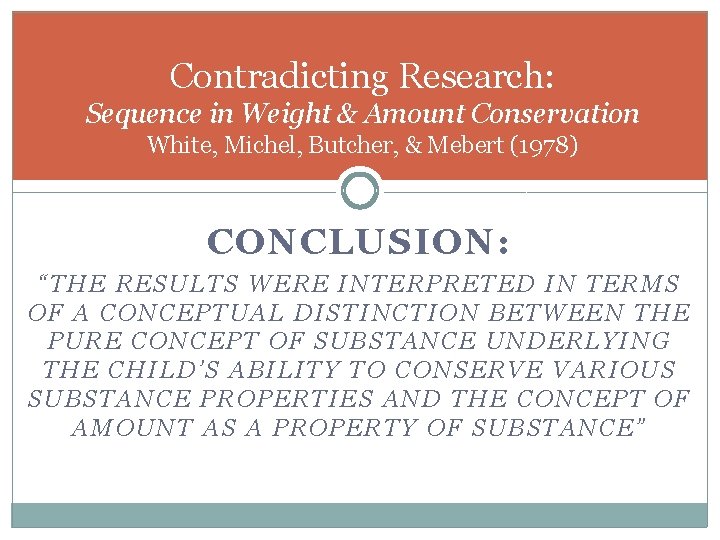
Contradicting Research: Sequence in Weight & Amount Conservation White, Michel, Butcher, & Mebert (1978) CONCLUSION: “THE RESULTS WERE INTERPRETED IN TERMS OF A CONCEPTUAL DISTINCTION BETWEEN THE PURE CONCEPT OF SUBSTANCE UNDERLYING THE CHILD’S ABILITY TO CONSERVE VARIOUS SUBSTANCE PROPERTIES AND THE CONCEPT OF AMOUNT AS A PROPERTY OF SUBSTANCE”
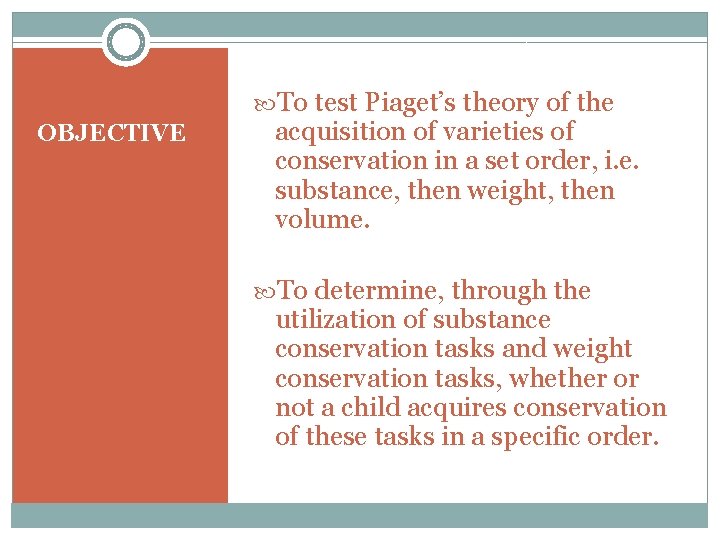
To test Piaget’s theory of the OBJECTIVE acquisition of varieties of conservation in a set order, i. e. substance, then weight, then volume. To determine, through the utilization of substance conservation tasks and weight conservation tasks, whether or not a child acquires conservation of these tasks in a specific order.
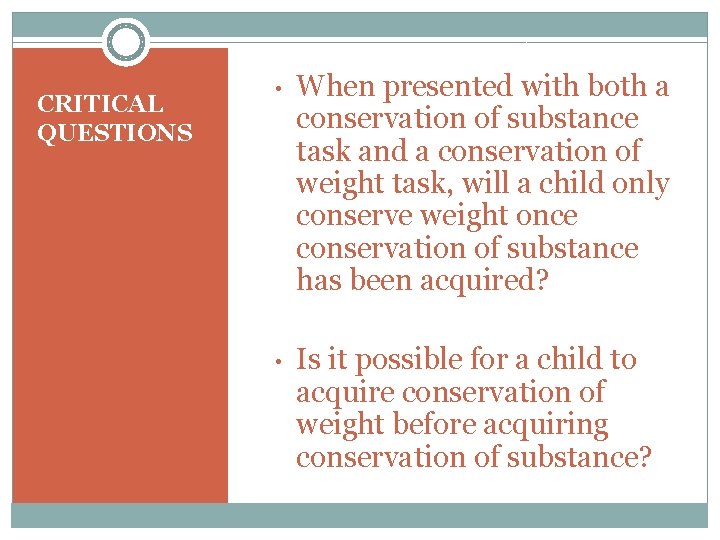
CRITICAL QUESTIONS • When presented with both a conservation of substance task and a conservation of weight task, will a child only conserve weight once conservation of substance has been acquired? • Is it possible for a child to acquire conservation of weight before acquiring conservation of substance?
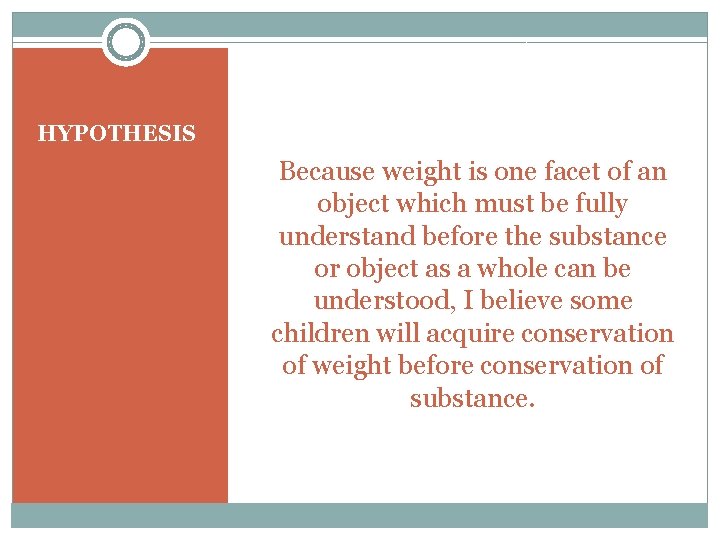
HYPOTHESIS Because weight is one facet of an object which must be fully understand before the substance or object as a whole can be understood, I believe some children will acquire conservation of weight before conservation of substance.
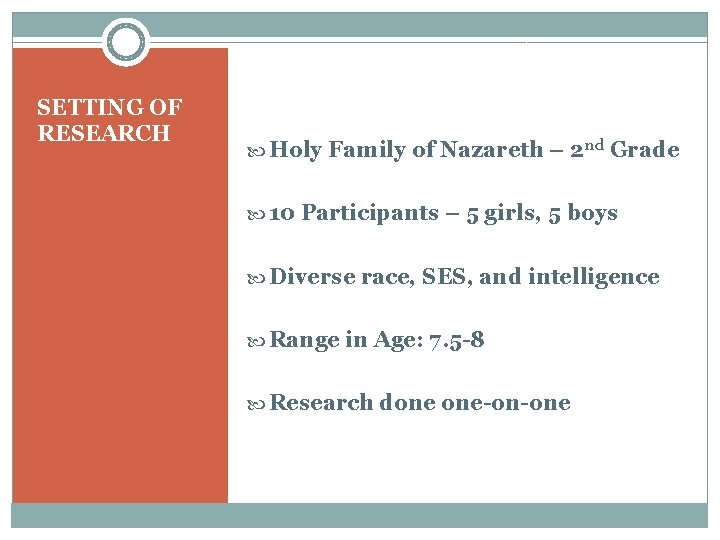
SETTING OF RESEARCH Holy Family of Nazareth – 2 nd Grade 10 Participants – 5 girls, 5 boys Diverse race, SES, and intelligence Range in Age: 7. 5 -8 Research done one-on-one
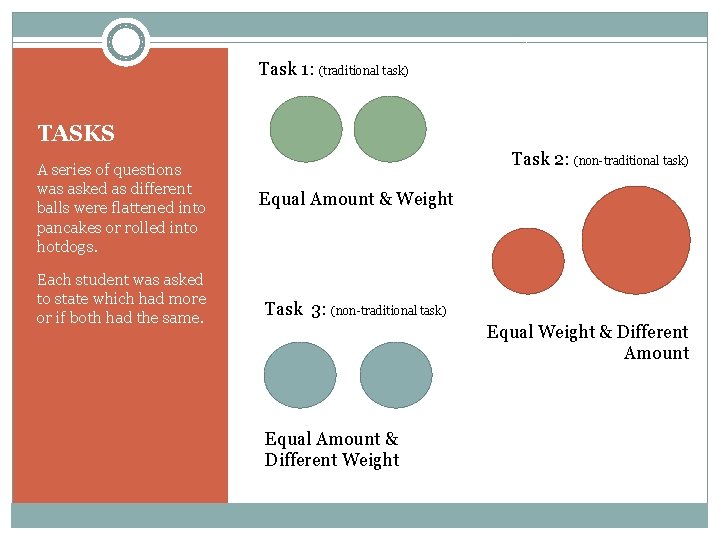
Task 1: (traditional task) TASKS A series of questions was asked as different balls were flattened into pancakes or rolled into hotdogs. Each student was asked to state which had more or if both had the same. Task 2: (non-traditional task) Equal Amount & Weight Task 3: (non-traditional task) Equal Weight & Different Amount Equal Amount & Different Weight
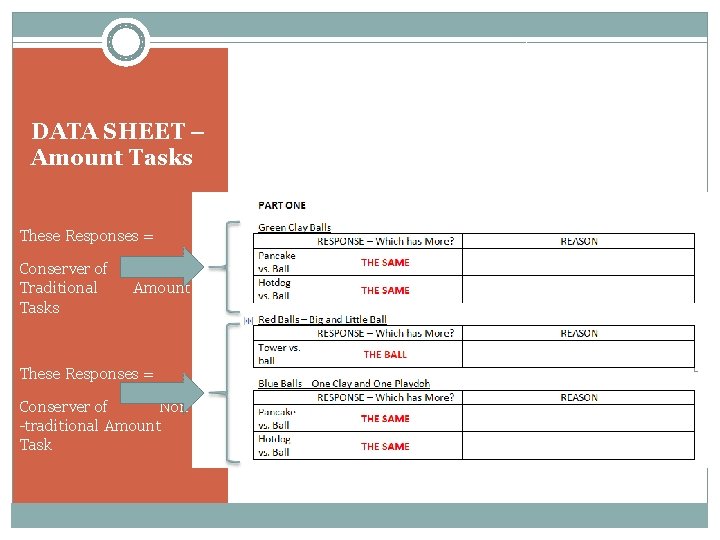
DATA SHEET – Amount Tasks These Responses = Conserver of Traditional Tasks Amount These Responses = Conserver of Non -traditional Amount Task
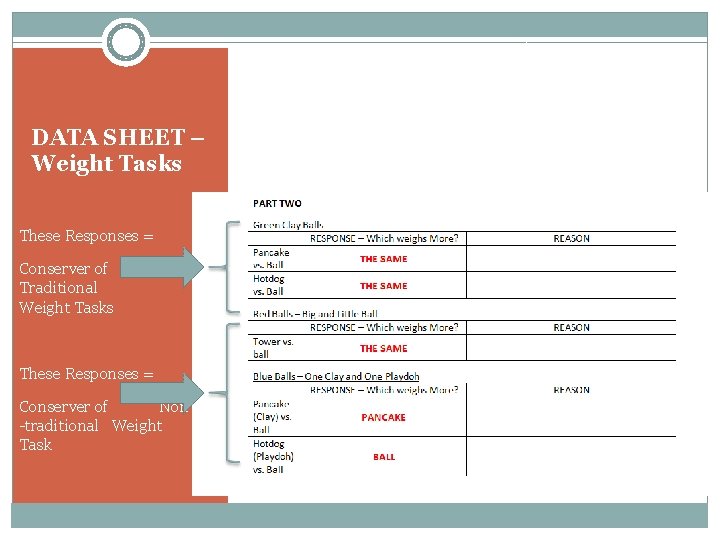
DATA SHEET – Weight Tasks These Responses = Conserver of Traditional Weight Tasks These Responses = Conserver of Non -traditional Weight Task
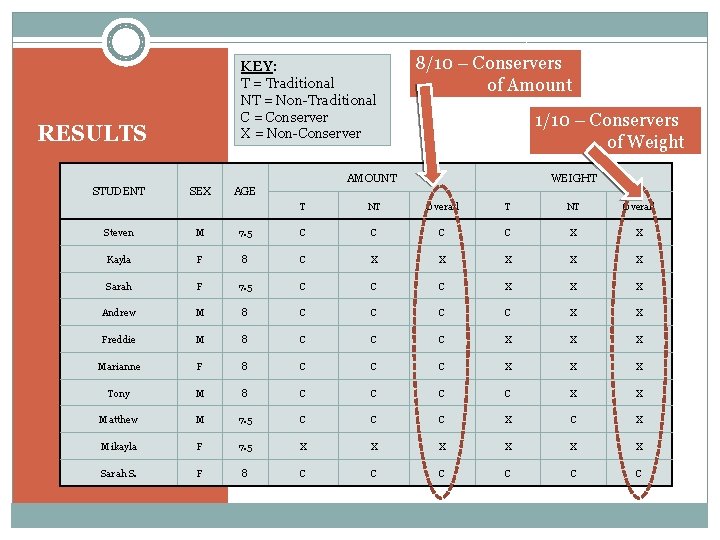
KEY: T = Traditional NT = Non-Traditional C = Conserver X = Non-Conserver RESULTS 8/10 – Conservers of Amount 1/10 – Conservers of Weight AMOUNT STUDENT SEX WEIGHT AGE T NT Overall Steven M 7. 5 C C X X Kayla F 8 C X X X Sarah F 7. 5 C C C X X X Andrew M 8 C C X X Freddie M 8 C C C X X X Marianne F 8 C C C X X X Tony M 8 C C X X Matthew M 7. 5 C C C X Mikayla F 7. 5 X X X Sarah S. F 8 C C C
CONCLUSIONS & LIMITATIONS Piaget’s theory seems to hold, such that acquisition of conservation of amount does precede acquisition of conservation of weight Causes of possible discrepancy between my findings and White, Michel, Butcher, & Mebert’s research study: 1. 2. 3. 4. Their use of a balance/scale The difference in participant age The population size Participants’ understanding of the terms
BIBLIOGRAPHY FOR PRESENTATION Crain, W. (2005). Piaget’s cognitive-developmental theory. Theories of development: Concepts and applications (5 th ed. ) (pp. 112 -150). New Jersey: Pearson Prentice Hall. Piaget, J. and B. Inhelder (1969). The Psychology of The Child. (Helen Weaver, trans. ) New York: Basic Books, Inc. (Original work published in 1966). White, K. , Michel, G. , Butcher, A. , & Mebert, C. (1978). SEQUENCE IN WEIGHT AND AMOUNT CONSERVATION. Journal of Genetic Psychology, 133 (2), 241. Retrieved from Academic Search Complete database. Piaget picture. http: //www. psywww. com/intropsych/ch 10_development/10 piaget. jpg Conservation task picture. http: //openlearn. open. ac. uk/file. php/3048/ED 209_1_006 i. jpg Biographical information. http: //www. piaget. org/about. Piaget. html