Conditions CSCI 201 Principles of Software Development Jeffrey


- Slides: 11
Conditions CSCI 201 Principles of Software Development Jeffrey Miller, Ph. D. jeffrey. miller@usc. edu
Outline • Conditions • Program USC CSCI 201 L
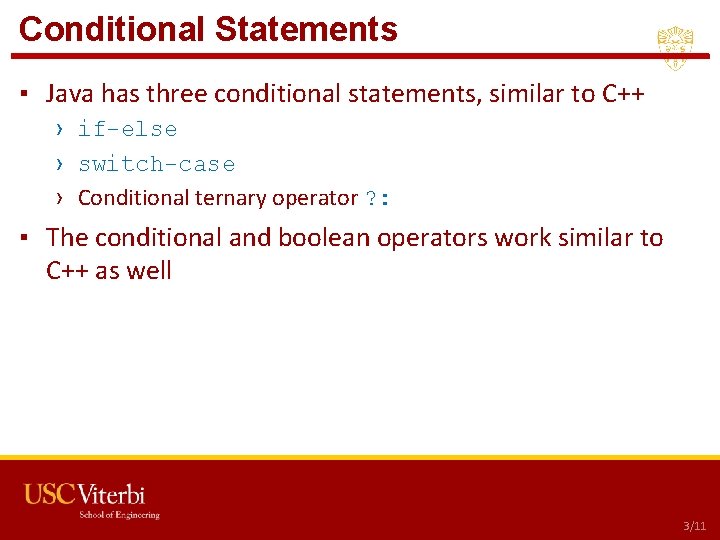
Conditional Statements ▪ Java has three conditional statements, similar to C++ › if-else › switch-case › Conditional ternary operator ? : ▪ The conditional and boolean operators work similar to C++ as well • Conditions USC CSCI 201 L 3/11
Comparison and Boolean Operators ▪ Comparison operators == != > >= < <= › NOTE: Comparison operators only work for primitive data types. Methods will be created for object comparisons ▪ Boolean operators • Bitwise boolean operators & | • Conditions • Logical boolean operators && || ! USC CSCI 201 L 4/11
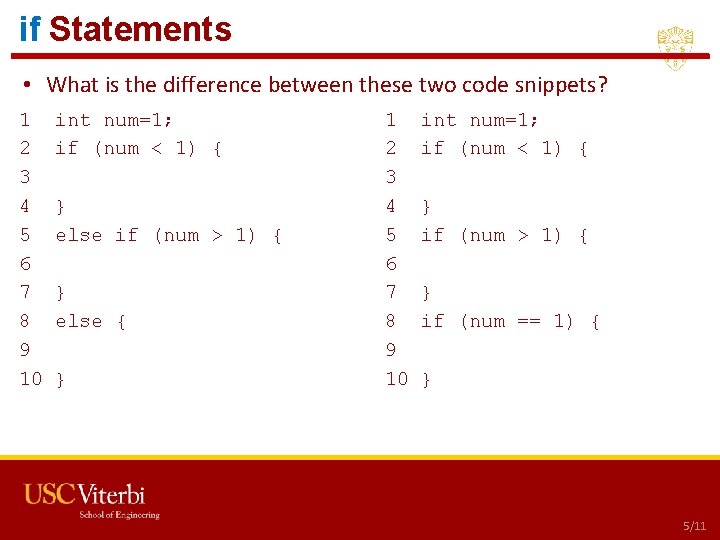
if Statements • What is the difference between these two code snippets? 1 2 3 4 5 6 7 8 9 10 int num=1; if (num < 1) { } else if (num > 1) { } else { } • Conditions 1 2 3 4 5 6 7 8 9 10 int num=1; if (num < 1) { } if (num > 1) { } if (num == 1) { } USC CSCI 201 L 5/11
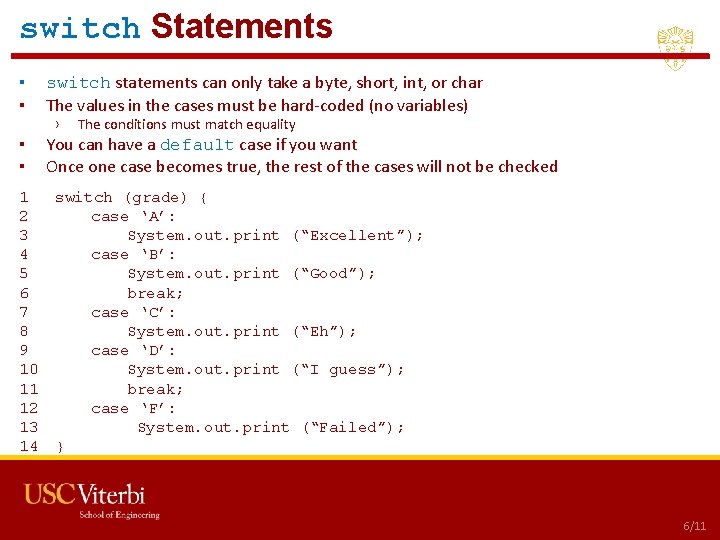
switch Statements ▪ ▪ switch statements can only take a byte, short, int, or char The values in the cases must be hard-coded (no variables) › ▪ ▪ 1 2 3 4 5 6 7 8 9 10 11 12 13 14 The conditions must match equality You can have a default case if you want Once one case becomes true, the rest of the cases will not be checked switch (grade) { case ‘A’: System. out. print (“Excellent”); case ‘B’: System. out. print (“Good”); break; case ‘C’: System. out. print (“Eh”); case ‘D’: System. out. print (“I guess”); break; case ‘F’: System. out. print (“Failed”); } USC CSCI 201 L 6/11
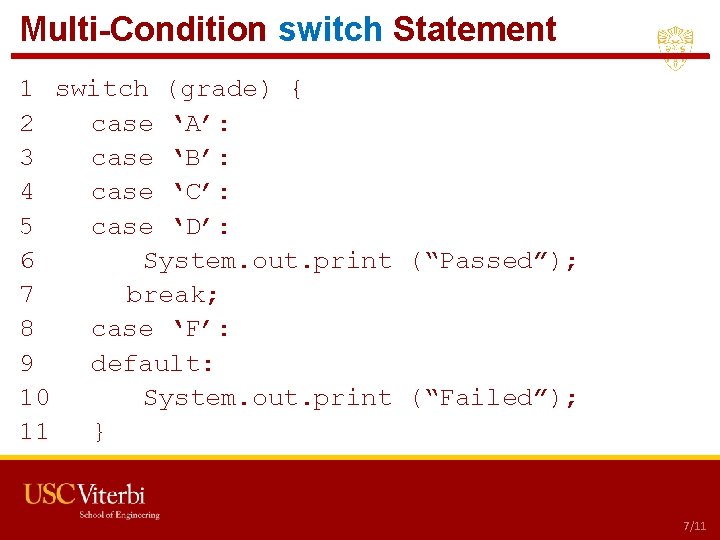
Multi-Condition switch Statement 1 switch (grade) { 2 case ‘A’: 3 case ‘B’: 4 case ‘C’: 5 case ‘D’: 6 System. out. print (“Passed”); 7 break; 8 case ‘F’: 9 default: 10 System. out. print (“Failed”); 11 } • Conditions USC CSCI 201 L 7/11
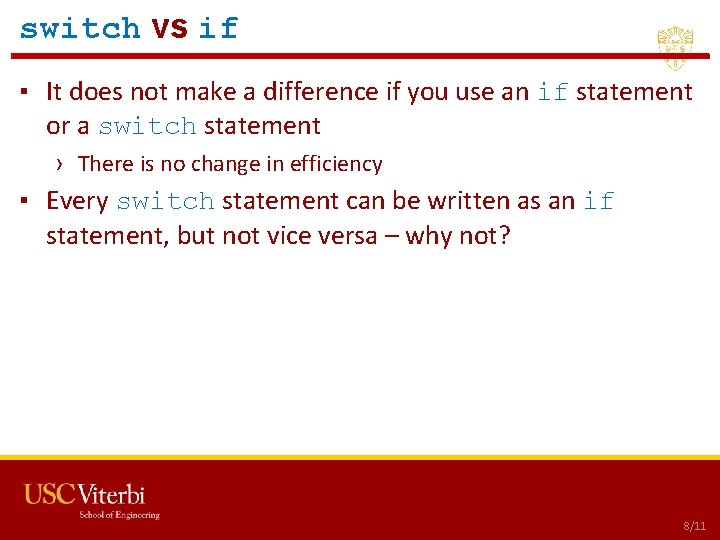
switch vs if ▪ It does not make a difference if you use an if statement or a switch statement › There is no change in efficiency ▪ Every switch statement can be written as an if statement, but not vice versa – why not? • Conditions USC CSCI 201 L 8/11
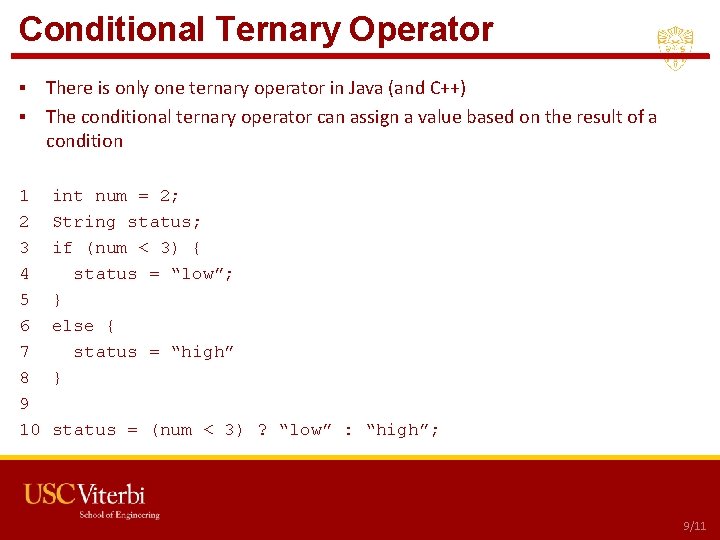
Conditional Ternary Operator ▪ There is only one ternary operator in Java (and C++) ▪ The conditional ternary operator can assign a value based on the result of a condition 1 2 3 4 5 6 7 8 9 10 int num = 2; String status; if (num < 3) { status = “low”; } else { status = “high” } status = (num < 3) ? “low” : “high”; • Conditions USC CSCI 201 L 9/11
Outline • Conditions • Program USC CSCI 201 L
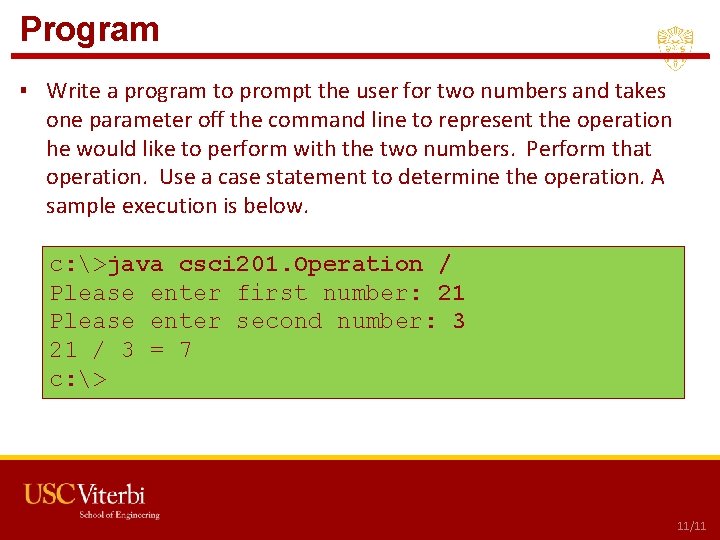
Program ▪ Write a program to prompt the user for two numbers and takes one parameter off the command line to represent the operation he would like to perform with the two numbers. Perform that operation. Use a case statement to determine the operation. A sample execution is below. c: >java csci 201. Operation / Please enter first number: 21 Please enter second number: 3 21 / 3 = 7 c: > • Program USC CSCI 201 L 11/11