Comparison of Jet EnergyLoss Schemes in a 3





- Slides: 22
Comparison of Jet Energy-Loss Schemes in a � 3 D Hydrodynamic Medium Steffen A. Bass Duke University collaborators: • J. Ruppert • T. Renk • G. Y. Qin • C. Nonaka • A. Majumder • C. Gale Steffen A. Bass • a model for the medium: 3 D-RFD • jet energy-loss schemes • azimuthally dependent jet energy-loss 1
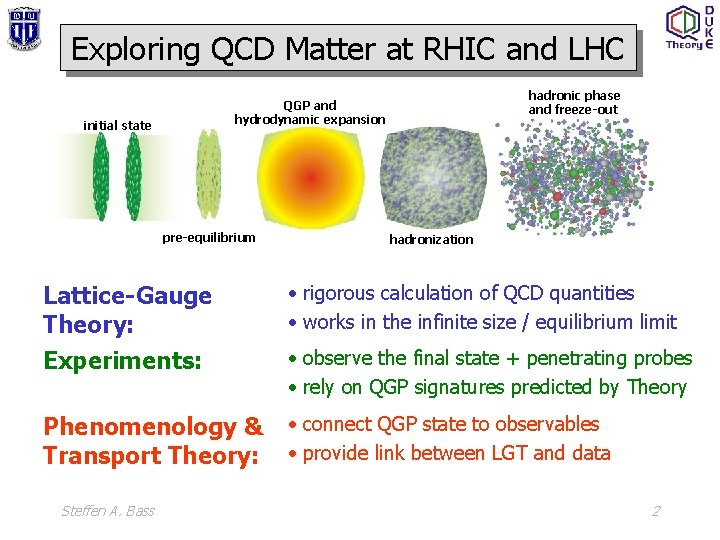
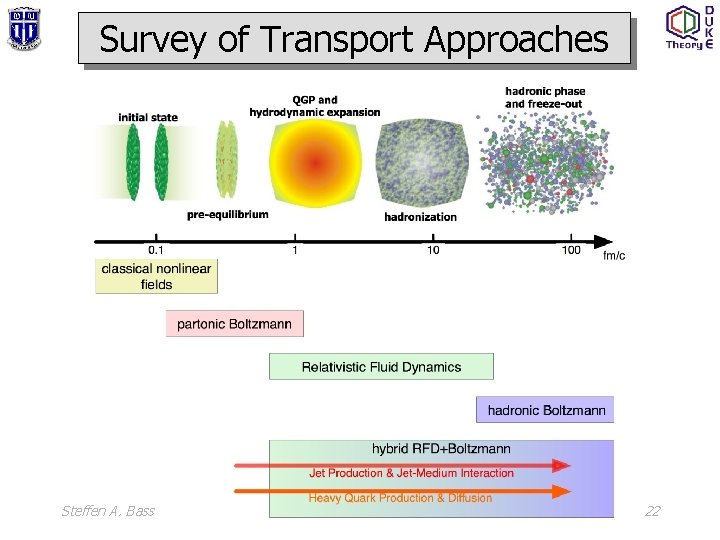
Exploring QCD Matter at RHIC and LHC hadronic phase and freeze-out QGP and hydrodynamic expansion initial state pre-equilibrium hadronization Lattice-Gauge Theory: • rigorous calculation of QCD quantities • works in the infinite size / equilibrium limit Experiments: • observe the final state + penetrating probes • rely on QGP signatures predicted by Theory Phenomenology & Transport Theory: • connect QGP state to observables • provide link between LGT and data Steffen A. Bass 2
The Medium: 3 D Relativistic Fluid Dynamics C. Nonaka & S. A. Bass, Phys. Rev. C 75 014902 (2007) Steffen A. Bass 3
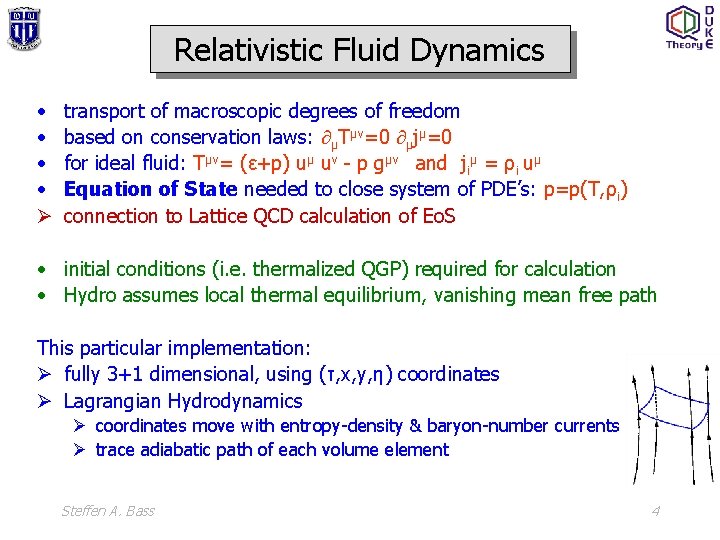
Relativistic Fluid Dynamics • • Ø transport of macroscopic degrees of freedom based on conservation laws: μTμν=0 μjμ=0 for ideal fluid: Tμν= (ε+p) uμ uν - p gμν and jiμ = ρi uμ Equation of State needed to close system of PDE’s: p=p(T, ρi) connection to Lattice QCD calculation of Eo. S • initial conditions (i. e. thermalized QGP) required for calculation • Hydro assumes local thermal equilibrium, vanishing mean free path This particular implementation: Ø fully 3+1 dimensional, using (τ, x, y, η) coordinates Ø Lagrangian Hydrodynamics Ø coordinates move with entropy-density & baryon-number currents Ø trace adiabatic path of each volume element Steffen A. Bass 4
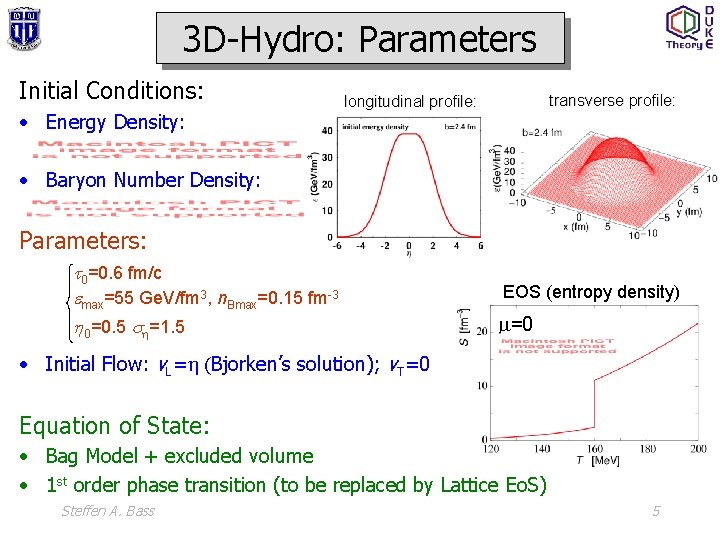
3 D-Hydro: Parameters Initial Conditions: • Energy Density: transverse profile: longitudinal profile: • Baryon Number Density: Parameters: 0=0. 6 fm/c max=55 Ge. V/fm 3, n. Bmax=0. 15 fm-3 0=0. 5 =1. 5 EOS (entropy density) =0 • Initial Flow: v. L= Bjorken’s solution); v. T=0 Equation of State: • Bag Model + excluded volume • 1 st order phase transition (to be replaced by Lattice Eo. S) Steffen A. Bass 5
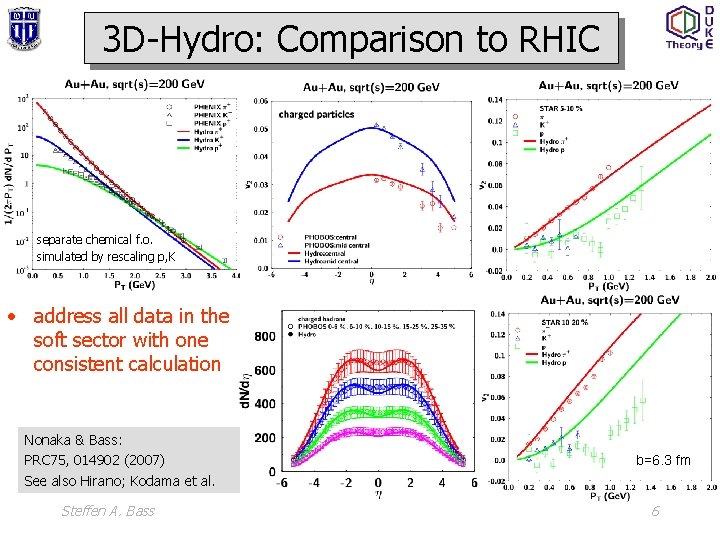
3 D-Hydro: Comparison to RHIC separate chemical f. o. simulated by rescaling p, K • address all data in the soft sector with one consistent calculation Nonaka & Bass: PRC 75, 014902 (2007) See also Hirano; Kodama et al. Steffen A. Bass b=6. 3 fm 6
Jet-Medium Correlations: Azimuthally Dependent Jet-Quenching Renk, Ruppert, Nonaka & Bass: Phys. Rev. C 75 (2007) 031902 Majumder, Nonaka & Bass: Phys. Rev. C 76 (2007) 041902 Qin, Ruppert, Turbide, Gale, Nonaka & Bass: Phys. Rev. C 76 (2007) 064907 Steffen A. Bass 7
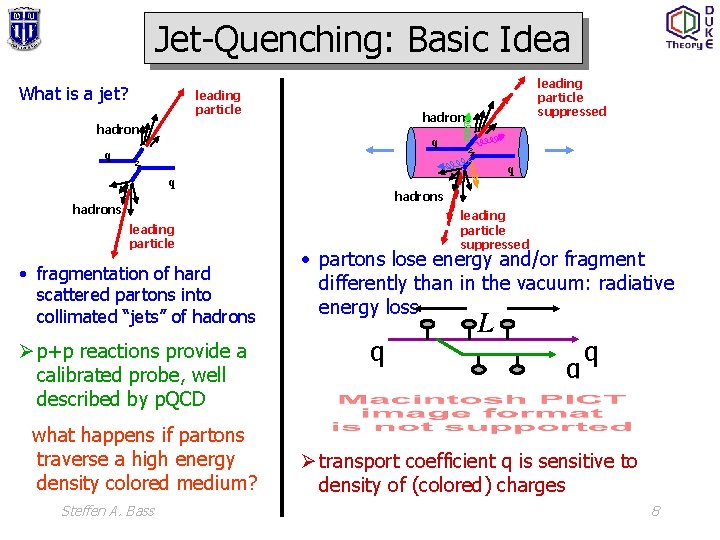
Jet-Quenching: Basic Idea What is a jet? leading particle hadrons q q hadrons leading particle • fragmentation of hard scattered partons into collimated “jets” of hadrons Ø p+p reactions provide a calibrated probe, well described by p. QCD what happens if partons traverse a high energy density colored medium? Steffen A. Bass leading particle suppressed • partons lose energy and/or fragment differently than in the vacuum: radiative energy loss q L g q Ø transport coefficient q is sensitive to density of (colored) charges 8
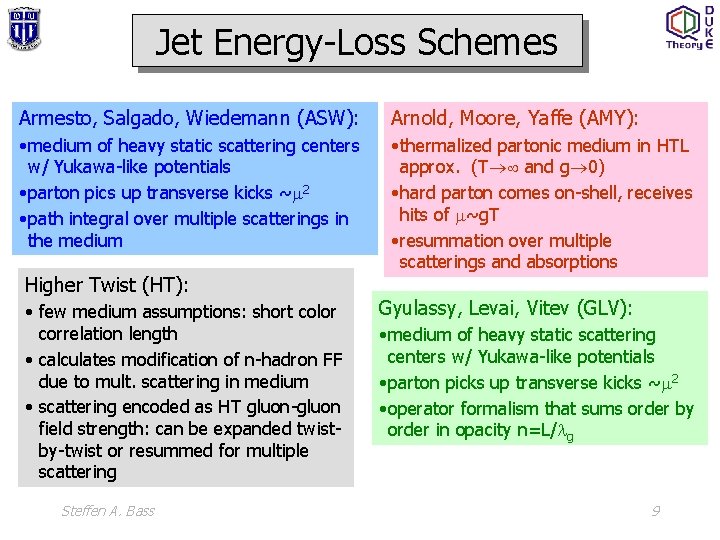
Jet Energy-Loss Schemes Armesto, Salgado, Wiedemann (ASW): Arnold, Moore, Yaffe (AMY): • medium of heavy static scattering centers w/ Yukawa-like potentials • parton pics up transverse kicks ~ 2 • path integral over multiple scatterings in the medium • thermalized partonic medium in HTL approx. (T and g 0) • hard parton comes on-shell, receives hits of ~g. T • resummation over multiple scatterings and absorptions Higher Twist (HT): • few medium assumptions: short color correlation length • calculates modification of n-hadron FF due to mult. scattering in medium • scattering encoded as HT gluon-gluon field strength: can be expanded twistby-twist or resummed for multiple scattering Steffen A. Bass Gyulassy, Levai, Vitev (GLV): • medium of heavy static scattering centers w/ Yukawa-like potentials • parton picks up transverse kicks ~ 2 • operator formalism that sums order by order in opacity n=L/ g 9
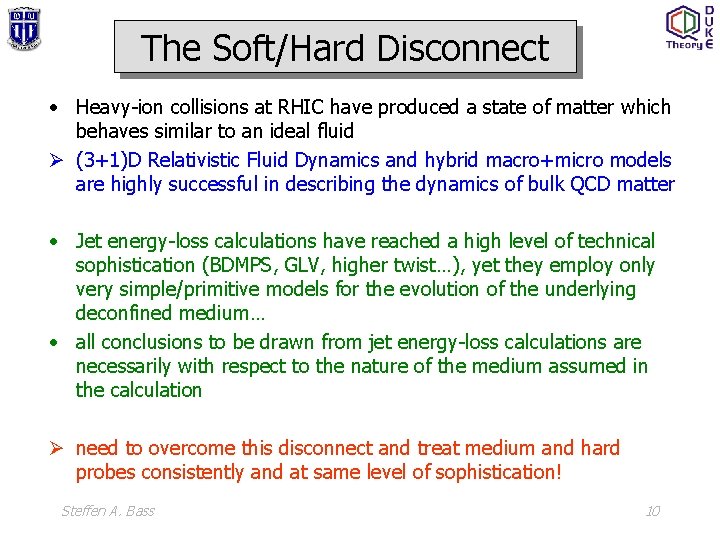
The Soft/Hard Disconnect • Heavy-ion collisions at RHIC have produced a state of matter which behaves similar to an ideal fluid Ø (3+1)D Relativistic Fluid Dynamics and hybrid macro+micro models are highly successful in describing the dynamics of bulk QCD matter • Jet energy-loss calculations have reached a high level of technical sophistication (BDMPS, GLV, higher twist…), yet they employ only very simple/primitive models for the evolution of the underlying deconfined medium… • all conclusions to be drawn from jet energy-loss calculations are necessarily with respect to the nature of the medium assumed in the calculation Ø need to overcome this disconnect and treat medium and hard probes consistently and at same level of sophistication! Steffen A. Bass 10
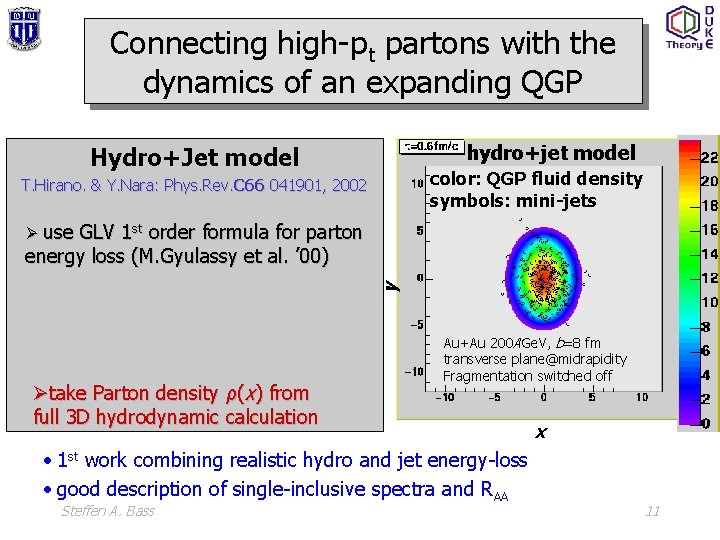
Connecting high-pt partons with the dynamics of an expanding QGP hydro+jet model Hydro+Jet model color: QGP fluid density symbols: mini-jets T. Hirano. & Y. Nara: Phys. Rev. C 66 041901, 2002 GLV 1 st order formula for parton energy loss (M. Gyulassy et al. ’ 00) y Ø use Øtake Parton density ρ(x) from full 3 D hydrodynamic calculation Au+Au 200 AGe. V, b=8 fm transverse plane@midrapidity Fragmentation switched off • 1 st work combining realistic hydro and jet energy-loss • good description of single-inclusive spectra and RAA Steffen A. Bass x 11
Energy-Loss Implementation in 3 D RFD 3 D hydrodynamic evolution provides , T, and QGP as function of ( , x, y, ) BDMPS/ASW: • define local transport coefficient along trajectory (K as parameter to fix opacity of medium): Higher Twist: • fix starting value of q; hadronic phase can be taken into account via coefficient c. HG: AMY: • evolution of jet-momentum distribution is obtained by solving set of coupled rate eqns, with transition rates depending on the coupling constant s, local temperature T and flow velocity Steffen A. Bass 12
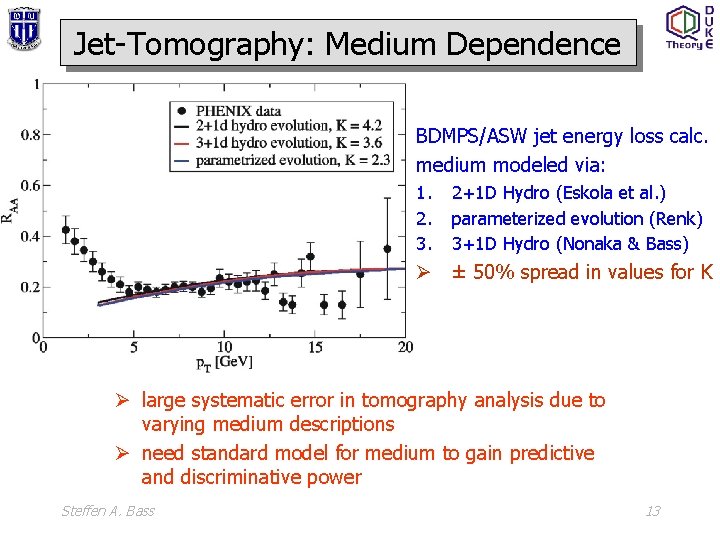
Jet-Tomography: Medium Dependence BDMPS/ASW jet energy loss calc. medium modeled via: 1. 2. 3. 2+1 D Hydro (Eskola et al. ) parameterized evolution (Renk) 3+1 D Hydro (Nonaka & Bass) Ø ± 50% spread in values for K Ø large systematic error in tomography analysis due to varying medium descriptions Ø need standard model for medium to gain predictive and discriminative power Steffen A. Bass 13
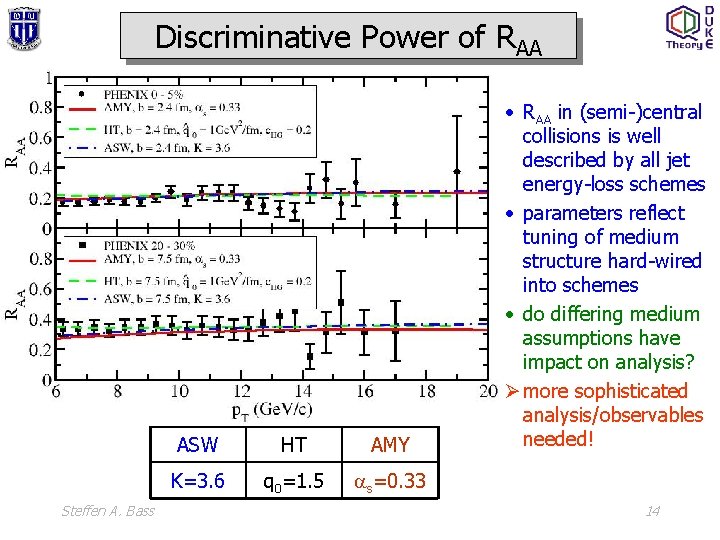
Discriminative Power of RAA AMY & BDMPS Steffen A. Bass ASW HT AMY K=3. 6 q 0=1. 5 s=0. 33 • RAA in (semi-)central collisions is well described by all jet energy-loss schemes • parameters reflect tuning of medium structure hard-wired into schemes • do differing medium assumptions have impact on analysis? Ø more sophisticated analysis/observables needed! 14
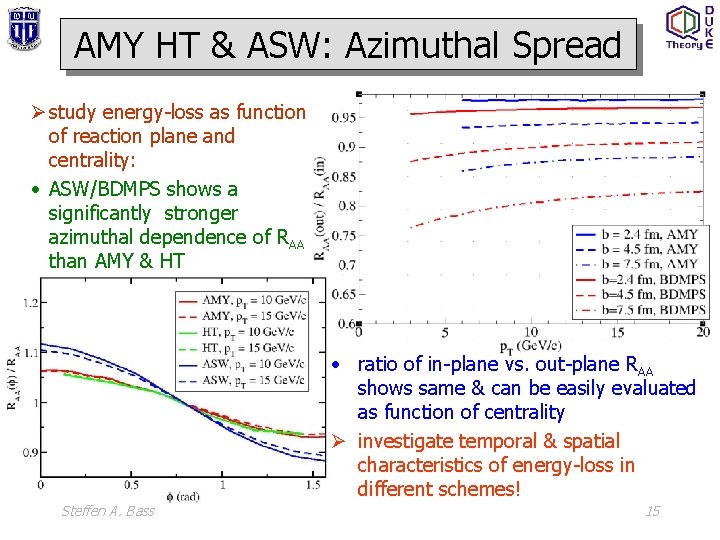
AMY HT & ASW: Azimuthal Spread Ø study energy-loss as function of reaction plane and centrality: • ASW/BDMPS shows a significantly stronger azimuthal dependence of RAA than AMY & HT • ratio of in-plane vs. out-plane RAA shows same & can be easily evaluated as function of centrality Ø investigate temporal & spatial characteristics of energy-loss in different schemes! Steffen A. Bass 15
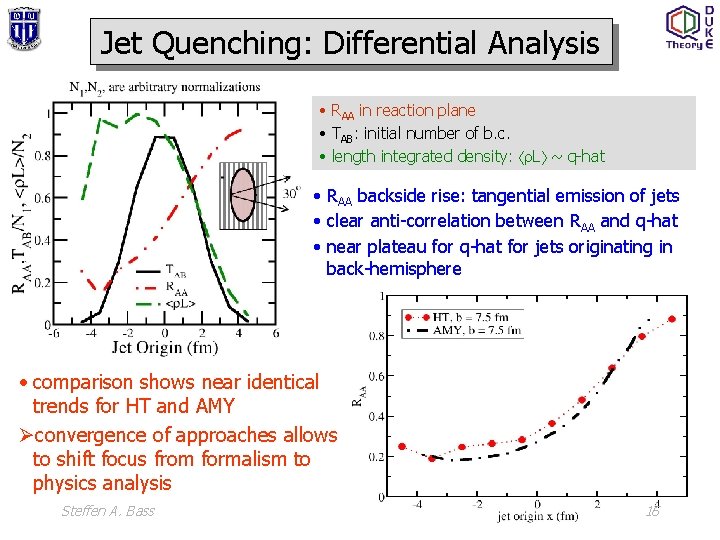
Jet Quenching: Differential Analysis • RAA in reaction plane • TAB: initial number of b. c. • length integrated density: L ~ q-hat • RAA backside rise: tangential emission of jets • clear anti-correlation between RAA and q-hat • near plateau for q-hat for jets originating in back-hemisphere • comparison shows near identical trends for HT and AMY Øconvergence of approaches allows to shift focus from formalism to physics analysis Steffen A. Bass 16
Summary and Outlook • Heavy-Ion collisions at RHIC have produced a state of matter which behaves similar to an ideal fluid and can be well described by RFD • jet energy-loss has developed into a sophisticated tool to probe the properties of QCD matter produced at RHIC • different energy-loss schemes can only be consistently tested and applied to data if the same hydrodynamic evolution is utilized to describe the underlying medium (currently: BDMPS, HT & AMY) • azimuthal dependence of jet energy-loss improves constraints on jettomography schemes and parameters Ø convergence of HT and AMY: formalism under control, now can focus on physics analysis Ø consistent treatment of hard and soft physics crucial for progress! next step: Ø probe dependence of results on equation of state and initial cond. Ø incorporate effects of hard probes on medium Steffen A. Bass 17
Virtual Journal on QCD Matter • digest of preprints on v hot & dense QCD matter v the QGP v relat. heavy-ion collisions • targeted at graduate students & junior postdocs • aims to provide a bigger picture, on how individual publications shape the advancement of the field http: //qgp. phy. duke. edu/ Steffen A. Bass 18
Hot Quarks 2008 - a conference for young scientists • the premier conference for graduate students, postdocs & junior faculty (up to 12 years post Ph. D. ) • all areas of experimental and theoretical relativistic heavy-ion physics will be covered • August 18 -23 2008 • Aspen Lodge at Estes Park, Colorado Steffen A. Bass 19
The End Steffen A. Bass 20
Virtual Journal on QCD Matter • digest of preprints on v hot & dense QCD matter v the QGP v relativistic heavy-ion collisions • targeted at graduate students & junior postdocs • aims to provide a bigger picture, on how individual publications shape the advancement of the field http: //qgp. phy. duke. edu/ Steffen A. Bass 21
Survey of Transport Approaches Steffen A. Bass 22