Comp 512 Spring 2011 Dynamic Compilation in an
- Slides: 14
Comp 512 Spring 2011 Dynamic Compilation in an OOL: The Deutsch-Schiffman Smalltalk-80 Implementation “Efficient Implementation of the Smalltalk-80 System” L. Peter Deutsch and Allan M. Schiffman, POPL 1984 Copyright 2011, Keith D. Cooper & Linda Torczon, all rights reserved. Students enrolled in Comp 512 at Rice University have explicit permission to make copies of these materials for their personal use. Faculty from other educational institutions may use these materials for nonprofit educational purposes, provided this copyright notice is preserved. COMP 512, Rice University 1
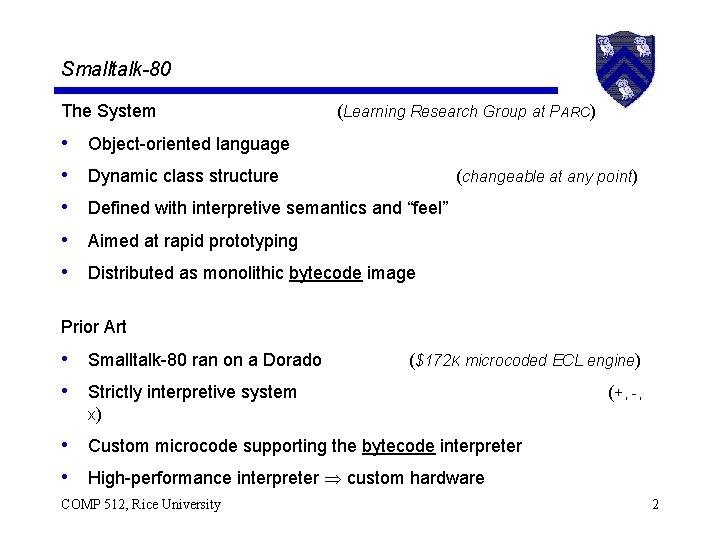
Smalltalk-80 The System • • • ( Learning Research Group at PARC) Object-oriented language Dynamic class structure (changeable at any point) Defined with interpretive semantics and “feel” Aimed at rapid prototyping Distributed as monolithic bytecode image Prior Art • Smalltalk-80 ran on a Dorado • Strictly interpretive system ($172 K microcoded ECL engine) (+, -, x) • Custom microcode supporting the bytecode interpreter • High-performance interpreter custom hardware COMP 512, Rice University 2
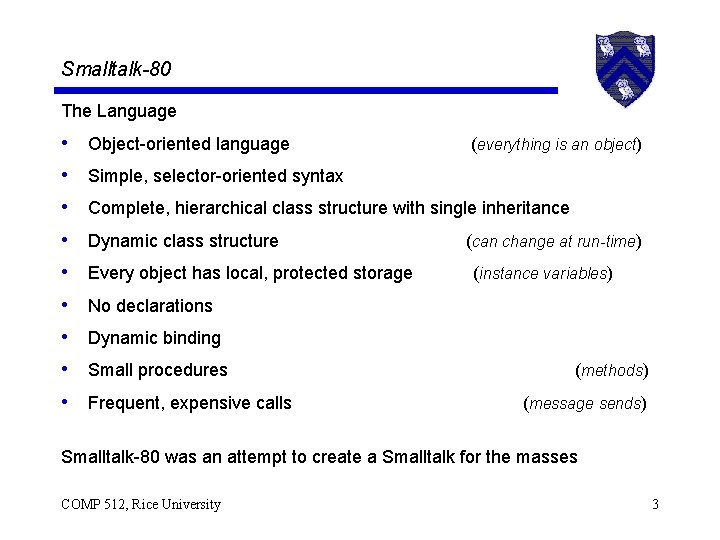
Smalltalk-80 The Language • • • Object-oriented language (everything is an object) Simple, selector-oriented syntax Complete, hierarchical class structure with single inheritance Dynamic class structure Every object has local, protected storage (can change at run-time) (instance variables) No declarations Dynamic binding Small procedures Frequent, expensive calls (methods) (message sends) Smalltalk-80 was an attempt to create a Smalltalk for the masses COMP 512, Rice University 3
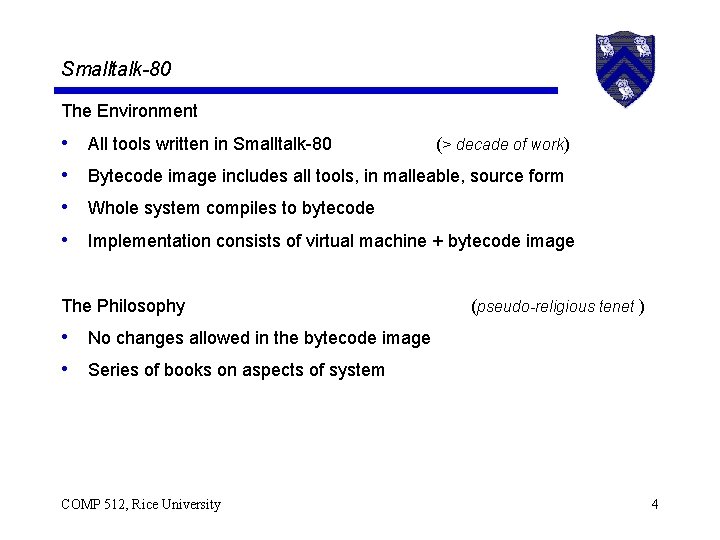
Smalltalk-80 The Environment • • All tools written in Smalltalk-80 (> decade of work) Bytecode image includes all tools, in malleable, source form Whole system compiles to bytecode Implementation consists of virtual machine + bytecode image The Philosophy (pseudo-religious tenet ) • No changes allowed in the bytecode image • Series of books on aspects of system COMP 512, Rice University 4
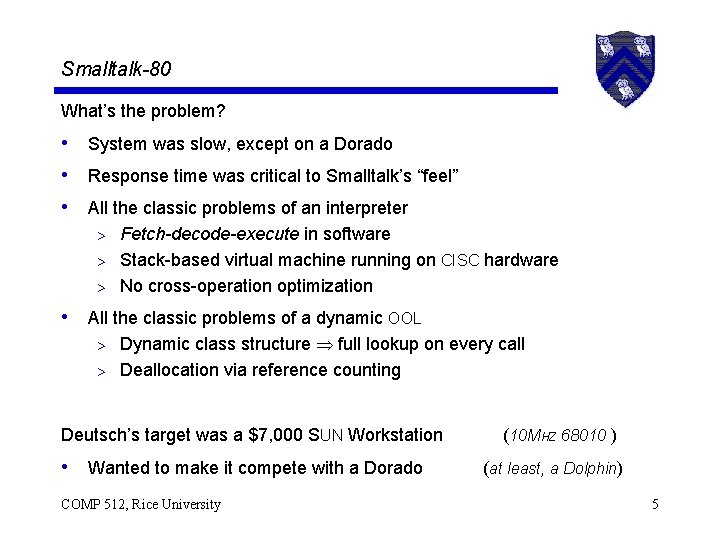
Smalltalk-80 What’s the problem? • System was slow, except on a Dorado • Response time was critical to Smalltalk’s “feel” • All the classic problems of an interpreter Fetch-decode-execute in software > Stack-based virtual machine running on CISC hardware > No cross-operation optimization > • All the classic problems of a dynamic OOL Dynamic class structure full lookup on every call > Deallocation via reference counting > Deutsch’s target was a $7, 000 SUN Workstation • Wanted to make it compete with a Dorado COMP 512, Rice University (10 MHZ 68010 ) (at least, a Dolphin) 5
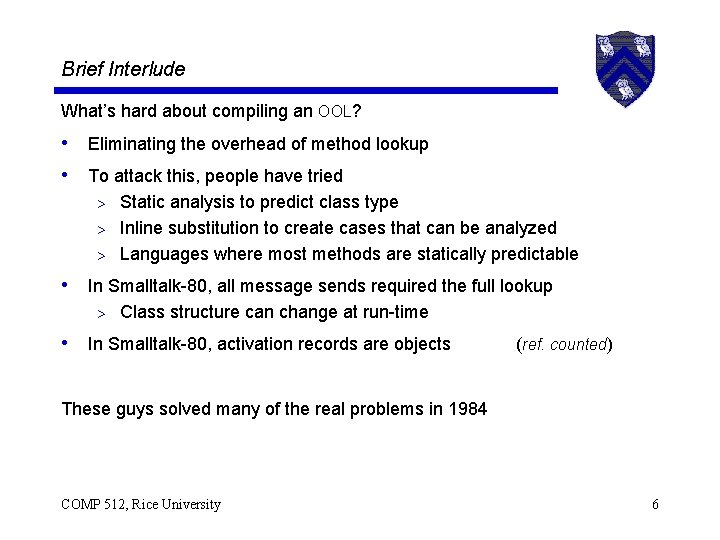
Brief Interlude What’s hard about compiling an OOL? • Eliminating the overhead of method lookup • To attack this, people have tried Static analysis to predict class type > Inline substitution to create cases that can be analyzed > Languages where most methods are statically predictable > • In Smalltalk-80, all message sends required the full lookup > Class structure can change at run-time • In Smalltalk-80, activation records are objects (ref. counted) These guys solved many of the real problems in 1984 COMP 512, Rice University 6
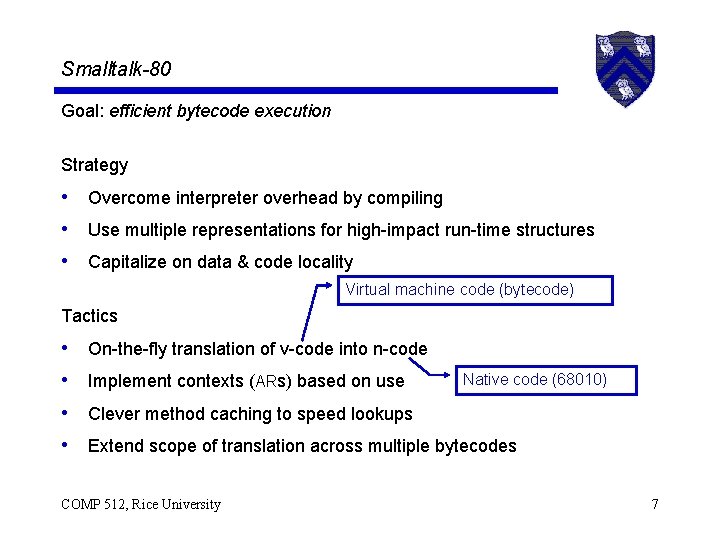
Smalltalk-80 Goal: efficient bytecode execution Strategy • Overcome interpreter overhead by compiling • Use multiple representations for high-impact run-time structures • Capitalize on data & code locality Virtual machine code (bytecode) Tactics • • On-the-fly translation of v-code into n-code Implement contexts (ARs) based on use Native code (68010) Clever method caching to speed lookups Extend scope of translation across multiple bytecodes COMP 512, Rice University 7
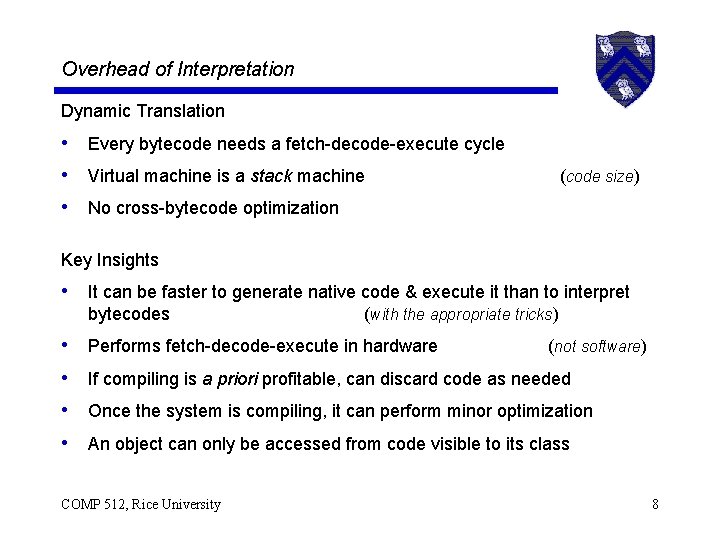
Overhead of Interpretation Dynamic Translation • Every bytecode needs a fetch-decode-execute cycle • Virtual machine is a stack machine • No cross-bytecode optimization ( code size) Key Insights • It can be faster to generate native code & execute it than to interpret bytecodes • • (with the appropriate tricks) Performs fetch-decode-execute in hardware (not software) If compiling is a priori profitable, can discard code as needed Once the system is compiling, it can perform minor optimization An object can only be accessed from code visible to its class COMP 512, Rice University 8
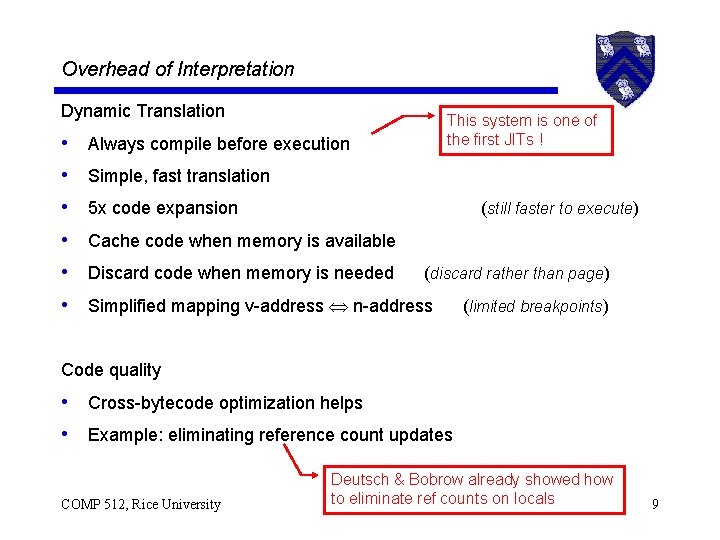
Overhead of Interpretation Dynamic Translation • • • This system is one of the first JITs ! Always compile before execution Simple, fast translation 5 x code expansion (still faster to execute) Cache code when memory is available Discard code when memory is needed (discard rather than page) Simplified mapping v-address n-address (limited breakpoints) Code quality • Cross-bytecode optimization helps • Example: eliminating reference count updates COMP 512, Rice University Deutsch & Bobrow already showed how to eliminate ref counts on locals 9
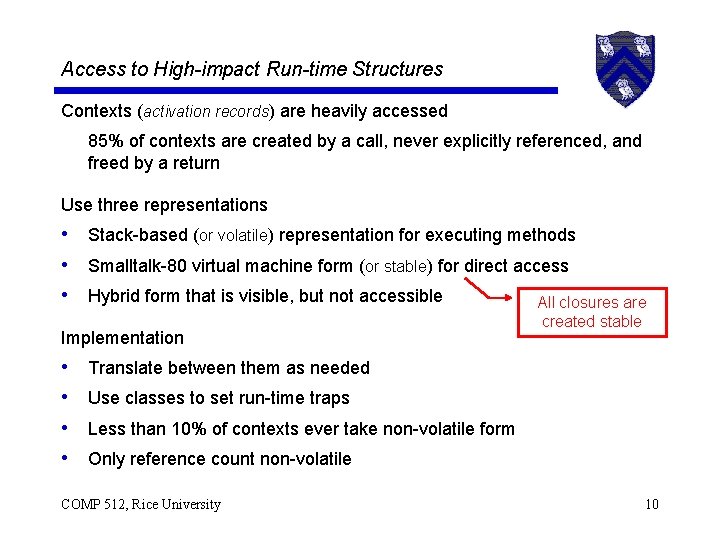
Access to High-impact Run-time Structures Contexts (activation records) are heavily accessed 85% of contexts are created by a call, never explicitly referenced, and freed by a return Use three representations • Stack-based (or volatile) representation for executing methods • Smalltalk-80 virtual machine form (or stable) for direct access • Hybrid form that is visible, but not accessible All closures are Implementation • • created stable Translate between them as needed Use classes to set run-time traps Less than 10% of contexts ever take non-volatile form Only reference count non-volatile COMP 512, Rice University 10
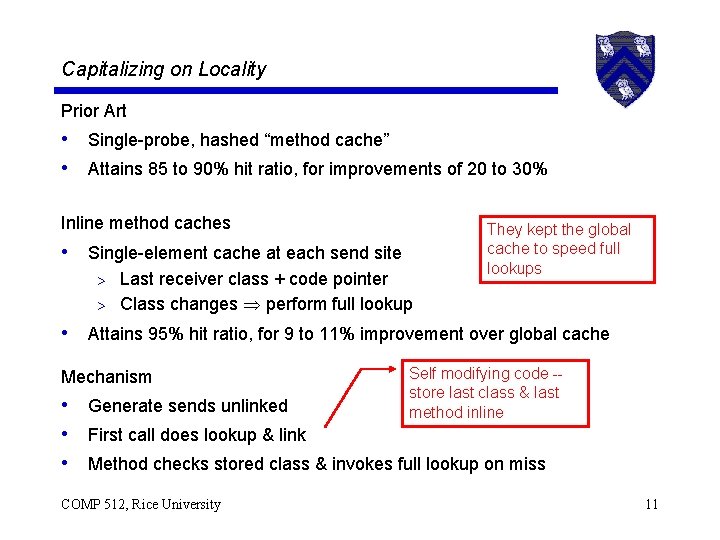
Capitalizing on Locality Prior Art • Single-probe, hashed “method cache” • Attains 85 to 90% hit ratio, for improvements of 20 to 30% Inline method caches • Single-element cache at each send site Last receiver class + code pointer > Class changes perform full lookup > They kept the global cache to speed full lookups • Attains 95% hit ratio, for 9 to 11% improvement over global cache Mechanism Self modifying code -store last class & last method inline • Generate sends unlinked • First call does lookup & link • Method checks stored class & invokes full lookup on miss COMP 512, Rice University 11
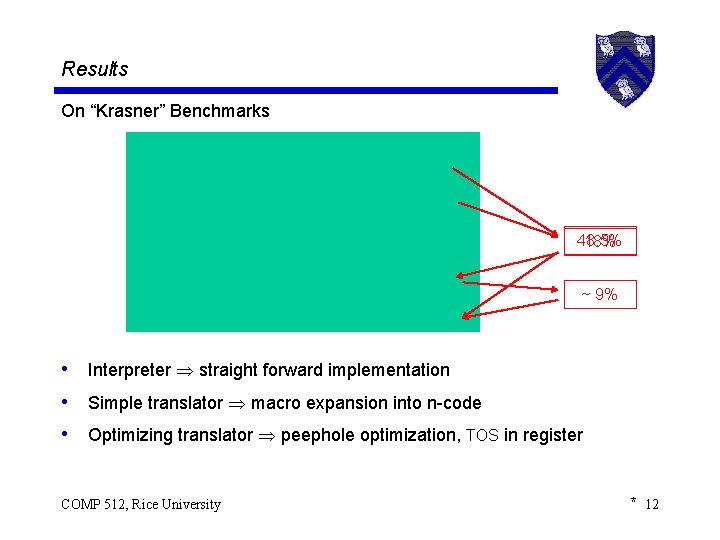
Results On “Krasner” Benchmarks 48. 5% 18% ~ 9% • Interpreter straight forward implementation • Simple translator macro expansion into n-code • Optimizing translator peephole optimization, TOS in register COMP 512, Rice University * 12
Summary Compiler • Throw-away generation of native code (JIT) • Applies a couple of carefully chosen ideas Evaluation • Made Smalltalk-80 practical on a SUN 1. 5 • Near-Dorado performance • Beginning of the end for custom hardware “We have achieved this performance by careful optimization of the observed common cases and by plentiful use of caches and other changes of representation” p. 301 COMP 512, Rice University 13
The Experience Papers (Fortran H, PL. 8, Smalltalk-80) What did these systems have in common? • • • Understanding of the problem Clear goals Addressed specific inefficiencies Focused on high-payoff areas Limited repertoire of transformations All three were successful systems that we remember decades later > You don’t have to do every transformation in the literature COMP 512, Rice University * 14