Comedy of Manners Purpose History Making fun of

- Slides: 8
Comedy of Manners
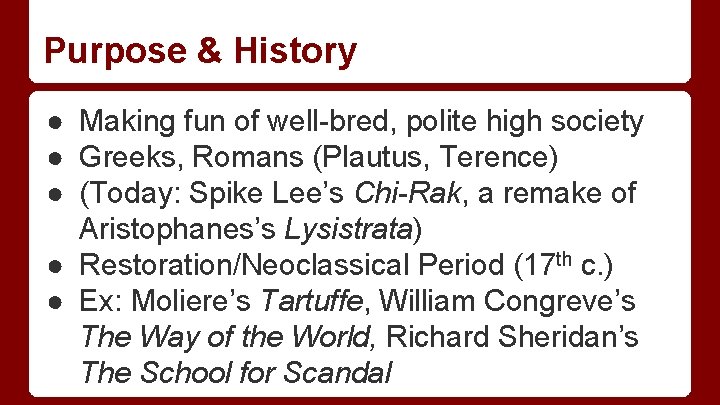
Purpose & History ● Making fun of well-bred, polite high society ● Greeks, Romans (Plautus, Terence) ● (Today: Spike Lee’s Chi-Rak, a remake of Aristophanes’s Lysistrata) ● Restoration/Neoclassical Period (17 th c. ) ● Ex: Moliere’s Tartuffe, William Congreve’s The Way of the World, Richard Sheridan’s The School for Scandal
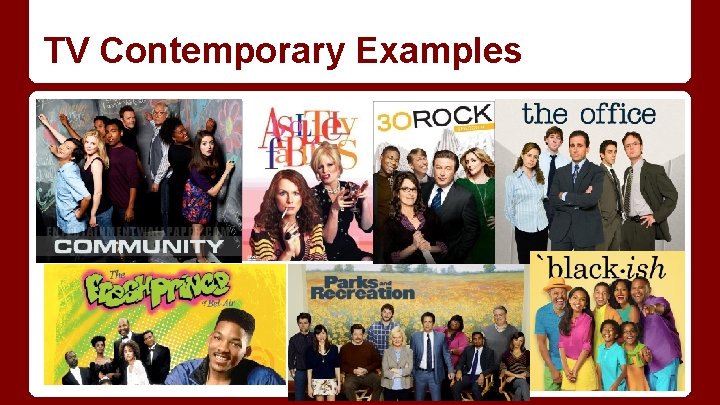
TV Contemporary Examples
Characteristics ● ● ● witty dialogue use of sarcasm or irony contrived situations critiques of society, especially marriage portrayals of class differences contrasts between urban and rural
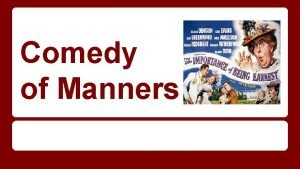
The Importance of Being Earnest ● “This comedy is the fullest embodiment of Wilde’s lifelong assault on commonplace life and commonplace values. ” -- Henry Popkin ● “It is, so to speak, a play that is pure play. ” -- Sylvan Barnet
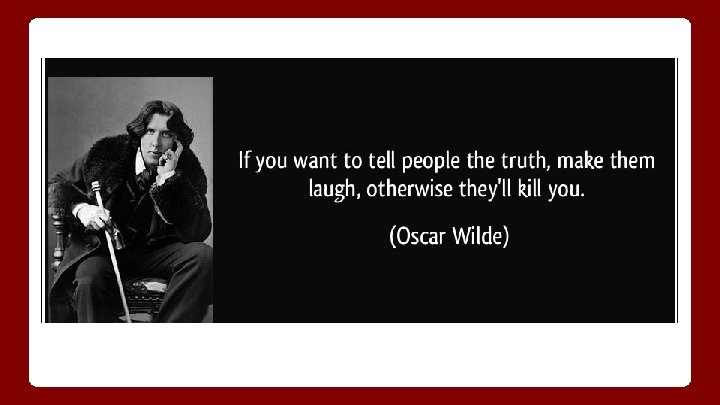
Wilde as OUTSIDER In what ways might we consider Oscar Wilde as an “outsider” in Victorian society?
Bibliography “Comedy of Manners. ” Theatre Lit Wikispaces Classroom, 2015. Kloeppel, Lise. “A Teacher’s Guide to the Signet Classics Edition of The Importance of Being Earnest. ” New York: Penguin, 2012. Mc. Donald, Deanne. “What’s So Funny? : Examining the Popularity of Comedy of Manners. ” Graduate Research Conference. Mankato, MN: Minnesota State U, 2010. Pierson, David P. “A Show About Nothing: Seinfeld and the Modern Comedy of Manners. ” The Journal of Popular Culture, 34 (Summer 2000): 49– 64. Wiley. Web. 27 Apr. 2015. Popkin, Henry. Introduction to The Importance of Being Earnest. By Oscar Wilde. New York: Avon P, 1965. Tidmarsh, Andrew. Genre: A Guide to Writing for Stage and Screen. London: Bloomsbury, 2014.