Colocasia esculenta Elepaio 3613 Lisa Raymond 3615 Origin
- Slides: 10
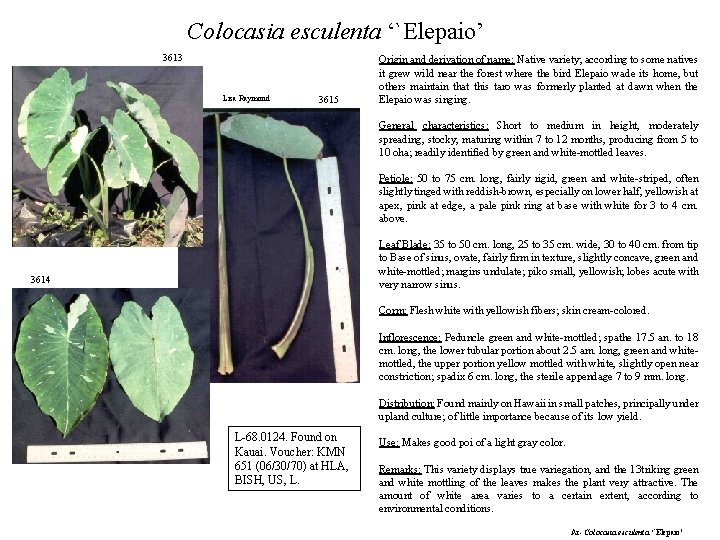
Colocasia esculenta ‘`Elepaio’ 3613 Lisa Raymond 3615 Origin and derivation of name: Native variety; according to some natives it grew wild near the forest where the bird Elepaio wade its home, but others maintain that this taro was formerly planted at dawn when the Elepaio was singing. General characteristics: Short to medium in height, moderately spreading, stocky, maturing within 7 to 12 months, producing from 5 to 10 oha; readily identified by green and white-mottled leaves. Petiole: 50 to 75 cm. long, fairly rigid, green and white-striped, often slightly tinged with reddish-brown, especially on lower half, yellowish at apex, pink at edge, a pale pink ring at base with white for 3 to 4 cm. above. Leaf Blade: 35 to 50 cm. long, 25 to 35 cm. wide, 30 to 40 cm. from tip to Base of sinus, ovate, fairly firm in texture, slightly concave, green and white-mottled; margins undulate; piko small, yellowish; lobes acute with very narrow sinus. 3614 Corm: Flesh white with yellowish fibers; skin cream-colored. Inflorescence: Peduncle green and white-mottled; spathe 17. 5 an. to 18 cm. long, the lower tubular portion about 2. 5 am. long, green and whitemottled, the upper portion yellow mottled with white, slightly open near constriction; spadix 6 cm. long, the sterile appendage 7 to 9 mm. long. Distribution: Found mainly on Hawaii in small patches, principally under upland culture; of little importance because of its low yield. L-68. 0124. Found on Kauai. Voucher: KMN 651 (06/30/70) at HLA, BISH, US, L. Use: Makes good poi of a light gray color. Remarks: This variety displays true variegation, and the 13 triking green and white mottling of the leaves makes the plant very attractive. The amount of white area varies to a certain extent, according to environmental conditions. Ar- Colocasia esculenta ‘`Elepaio’
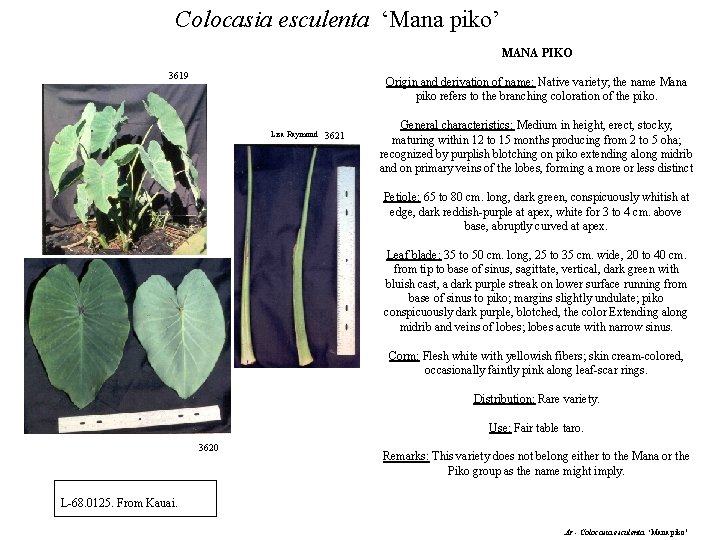
Colocasia esculenta ‘Mana piko’ MANA PIKO 3619 Origin and derivation of name: Native variety; the name Mana piko refers to the branching coloration of the piko. Lisa Raymond 3621 General characteristics: Medium in height, erect, stocky, maturing within 12 to 15 months producing from 2 to 5 oha; recognized by purplish blotching on piko extending along midrib and on primary veins of the lobes, forming a more or less distinct Petiole: 65 to 80 cm. long, dark green, conspicuously whitish at edge, dark reddish-purple at apex, white for 3 to 4 cm. above base, abruptly curved at apex. Leaf blade: 35 to 50 cm. long, 25 to 35 cm. wide, 20 to 40 cm. from tip to base of sinus, sagittate, vertical, dark green with bluish cast, a dark purple streak on lower surface running from base of sinus to piko; margins slightly undulate; piko conspicuously dark purple, blotched, the color Extending along midrib and veins of lobes; lobes acute with narrow sinus. Corm: Flesh white with yellowish fibers; skin cream-colored, occasionally faintly pink along leaf-scar rings. Distribution: Rare variety. Use: Fair table taro. 3620 Remarks: This variety does not belong either to the Mana or the Piko group as the name might imply. L-68. 0125. From Kauai. Ar - Colocasia esculenta ‘Mana piko’
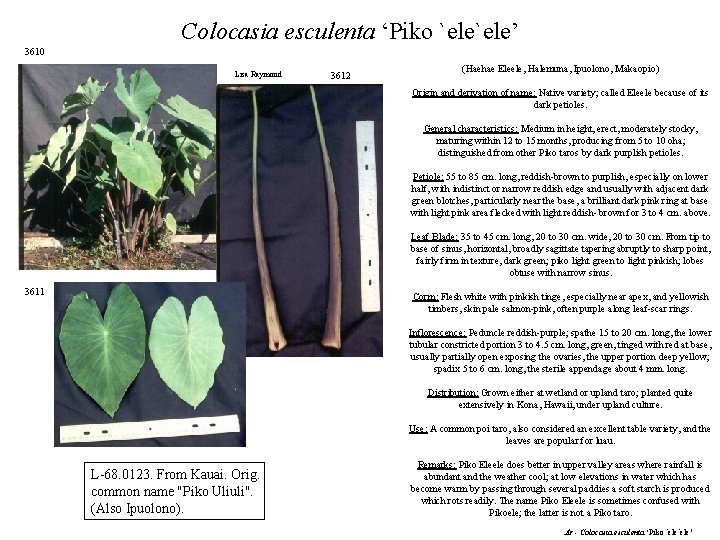
Colocasia esculenta ‘Piko `ele’ 3610 Lisa Raymond 3612 (Haehae Eleele, Halemuna, Ipuolono, Makaopio) Origin and derivation of name: Native variety; called Eleele because of its dark petioles. General characteristics: Medium in height, erect, moderately stocky, maturing within 12 to 15 months, producing from 5 to 10 oha; distinguished from other Piko taros by dark purplish petioles. Petiole: 55 to 85 cm. long, reddish-brown to purplish, especially on lower half, with indistinct or narrow reddish edge and usually with adjacent dark green blotches, particularly near the base, a brilliant dark pink ring at base with light pink area flecked with light reddish- brown for 3 to 4 cm. above. Leaf Blade: 35 to 45 cm. long, 20 to 30 cm. wide, 20 to 30 cm. From tip to base of sinus, horizontal, broadly sagittate tapering abruptly to sharp point, fairly firm in texture, dark green; piko light green to light pinkish; lobes obtuse with narrow sinus. 3611 Corm: Flesh white with pinkish tinge, especially near apex, and yellowish timbers, skin pale salmon-pink, often purple along leaf-scar rings. Inflorescence: Peduncle reddish-purple; spathe 15 to 20 cm. long, the lower tubular constricted portion 3 to 4. 5 cm. long, green, tinged with red at base, usually partially open exposing the ovaries, the upper portion deep yellow; spadix 5 to 6 cm. long, the sterile appendage about 4 mm. long. Distribution: Grown either at wetland or upland taro; planted quite extensively in Kona, Hawaii, under upland culture. Use: A common poi taro, also considered an excellent table variety, and the leaves are popular for luau. L-68. 0123. From Kauai. Orig. common name "Piko Uliuli". (Also Ipuolono). Remarks: Piko Eleele does better in upper valley areas where rainfall is abundant and the weather cool; at low elevations in water which has become warm by passing through several paddies a soft starch is produced which rots readily. The name Piko Eleele is sometimes confused with Pikoele; the latter is not a Piko taro. Ar - Colocasia esculenta ‘Piko `ele’
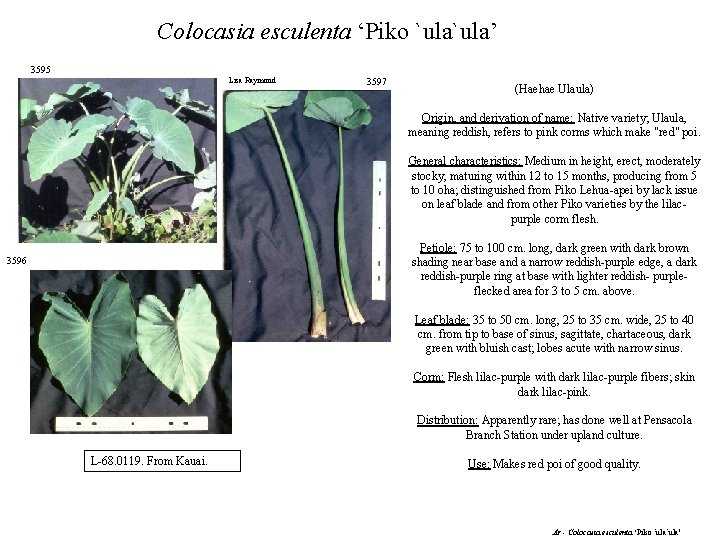
Colocasia esculenta ‘Piko `ula’ 3595 Lisa Raymond 3597 (Haehae Ulaula) Origin, and derivation of name: Native variety; Ulaula, meaning reddish, refers to pink corms which make "red" poi. General characteristics: Medium in height, erect, moderately stocky, maturing within 12 to 15 months, producing from 5 to 10 oha; distinguished from Piko Lehua-apei by lack issue on leaf blade and from other Piko varieties by the lilacpurple corm flesh. Petiole: 75 to 100 cm. long, dark green with dark brown shading near base and a narrow reddish-purple edge, a dark reddish-purple ring at base with lighter reddish- purpleflecked area for 3 to 5 cm. above. 3596 Leaf blade: 35 to 50 cm. long, 25 to 35 cm. wide, 25 to 40 cm. from tip to base of sinus, sagittate, chartaceous, dark green with bluish cast; lobes acute with narrow sinus. Corm: Flesh lilac-purple with dark lilac-purple fibers; skin dark lilac-pink. Distribution: Apparently rare; has done well at Pensacola Branch Station under upland culture. L-68. 0119. From Kauai. Use: Makes red poi of good quality. Ar - Colocasia esculenta ‘Piko `ula’
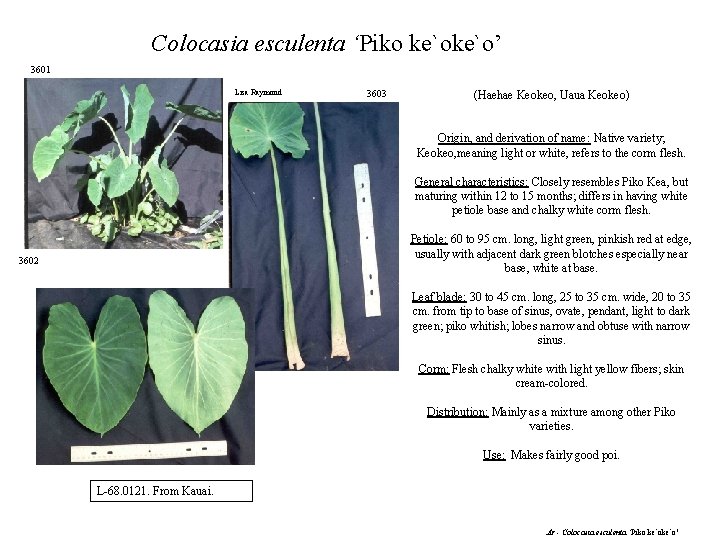
Colocasia esculenta ‘Piko ke`o’ 3601 Lisa Raymond 3603 (Haehae Keokeo, Uaua Keokeo) Origin, and derivation of name: Native variety; Keokeo, meaning light or white, refers to the corm flesh. General characteristics: Closely resembles Piko Kea, but maturing within 12 to 15 months; differs in having white petiole base and chalky white corm flesh. Petiole: 60 to 95 cm. long, light green, pinkish red at edge, usually with adjacent dark green blotches especially near base, white at base. 3602 Leaf blade: 30 to 45 cm. long, 25 to 35 cm. wide, 20 to 35 cm. from tip to base of sinus, ovate, pendant, light to dark green; piko whitish; lobes narrow and obtuse with narrow sinus. Corm: Flesh chalky white with light yellow fibers; skin cream-colored. Distribution: Mainly as a mixture among other Piko varieties. Use: Makes fairly good poi. L-68. 0121. From Kauai. Ar - Colocasia esculenta ‘Piko ke`o’
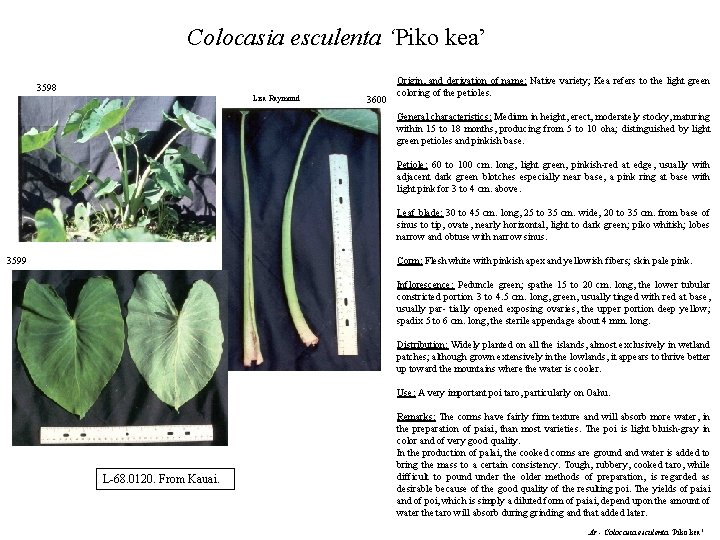
Colocasia esculenta ‘Piko kea’ 3598 Lisa Raymond 3600 Origin, and derivation of name: Native variety; Kea refers to the light green coloring of the petioles. General characteristics: Medium in height, erect, moderately stocky, maturing within 15 to 18 months, producing from 5 to 10 oha; distinguished by light green petioles and pinkish base. Petiole: 60 to 100 cm. long, light green, pinkish-red at edge, usually with adjacent dark green blotches especially near base, a pink ring at base with light pink for 3 to 4 cm. above. Leaf blade: 30 to 45 cm. long, 25 to 35 cm. wide, 20 to 35 cm. from base of sinus to tip, ovate, nearly horizontal, light to dark green; piko whitish; lobes narrow and obtuse with narrow sinus. Corm: Flesh white with pinkish apex and yellowish fibers; skin pale pink. 3599 Inflorescence: Peduncle green; spathe 15 to 20 cm. long, the lower tubular constricted portion 3 to 4. 5 cm. long, green, usually tinged with red at base, usually par- tially opened exposing ovaries, the upper portion deep yellow; spadix 5 to 6 cm. long, the sterile appendage about 4 mm. long. Distribution: Widely planted on all the islands, almost exclusively in wetland patches; although grown extensively in the lowlands, it appears to thrive better up toward the mountains where the water is cooler. Use: A very important poi taro, particularly on Oahu. L-68. 0120. From Kauai. Remarks: The corms have fairly firm texture and will absorb more water, in the preparation of paiai, than most varieties. The poi is light bluish-gray in color and of very good quality. In the production of palai, the cooked corms are ground and water is added to bring the mass to a certain consistency. Tough, rubbery, cooked taro, while difficult to pound under the older methods of preparation, is regarded as desirable because of the good quality of the resulting poi. The yields of paiai and of poi, which is simply a diluted form of paiai, depend upon the amount of water the taro will absorb during grinding and that added later. Ar - Colocasia esculenta ‘Piko kea’
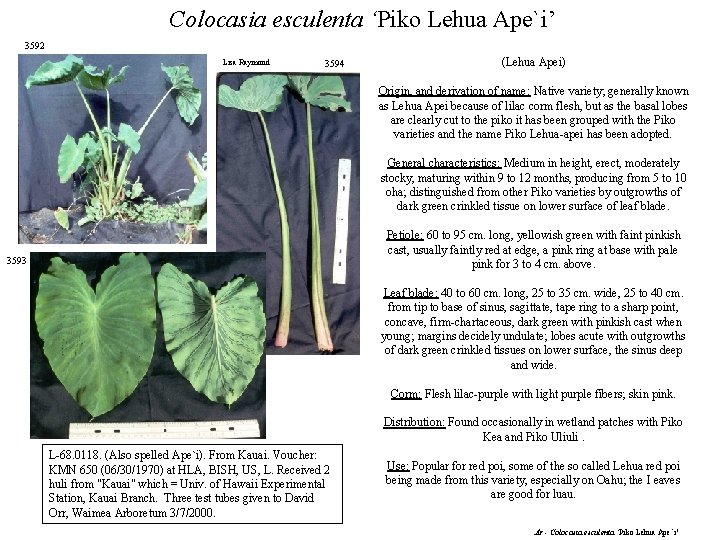
Colocasia esculenta ‘Piko Lehua Ape`i’ 3592 Lisa Raymond 3594 (Lehua Apei) Origin, and derivation of name: Native variety; generally known as Lehua Apei because of lilac corm flesh, but as the basal lobes are clearly cut to the piko it has been grouped with the Piko varieties and the name Piko Lehua-apei has been adopted. General characteristics: Medium in height, erect, moderately stocky, maturing within 9 to 12 months, producing from 5 to 10 oha; distinguished from other Piko varieties by outgrowths of dark green crinkled tissue on lower surface of leaf blade. Petiole: 60 to 95 cm. long, yellowish green with faint pinkish cast, usually faintly red at edge, a pink ring at base with pale pink for 3 to 4 cm. above. 3593 Leaf blade: 40 to 60 cm. long, 25 to 35 cm. wide, 25 to 40 cm. from tip to base of sinus, sagittate, tape ring to a sharp point, concave, firm-chartaceous, dark green with pinkish cast when young; margins decidely undulate; lobes acute with outgrowths of dark green crinkled tissues on lower surface, the sinus deep and wide. Corm: Flesh lilac-purple with light purple fibers; skin pink. Distribution: Found occasionally in wetland patches with Piko Kea and Piko Uliuli. L-68. 0118. (Also spelled Ape`i). From Kauai. Voucher: KMN 650 (06/30/1970) at HLA, BISH, US, L. Received 2 huli from "Kauai" which = Univ. of Hawaii Experimental Station, Kauai Branch. Three test tubes given to David Orr, Waimea Arboretum 3/7/2000. Use: Popular for red poi, some of the so called Lehua red poi being made from this variety, especially on Oahu; the I eaves are good for luau. Ar - Colocasia esculenta ‘Piko Lehua Ape`i’
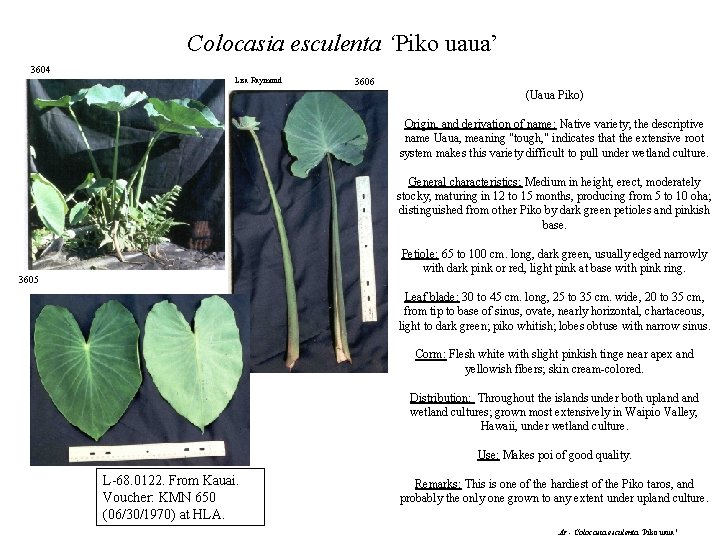
Colocasia esculenta ‘Piko uaua’ 3604 Lisa Raymond 3606 (Uaua Piko) Origin, and derivation of name: Native variety; the descriptive name Uaua, meaning "tough, " indicates that the extensive root system makes this variety difficult to pull under wetland culture. General characteristics; Medium in height, erect, moderately stocky, maturing in 12 to 15 months, producing from 5 to 10 oha; distinguished from other Piko by dark green petioles and pinkish base. Petiole: 65 to 100 cm. long, dark green, usually edged narrowly with dark pink or red, light pink at base with pink ring. 3605 Leaf blade: 30 to 45 cm. long, 25 to 35 cm. wide, 20 to 35 cm, from tip to base of sinus, ovate, nearly horizontal, chartaceous, light to dark green; piko whitish; lobes obtuse with narrow sinus. Corm: Flesh white with slight pinkish tinge near apex and yellowish fibers; skin cream-colored. Distribution: Throughout the islands under both upland wetland cultures; grown most extensively in Waipio Valley, Hawaii, under wetland culture. Use: Makes poi of good quality. L-68. 0122. From Kauai. Voucher: KMN 650 (06/30/1970) at HLA. Remarks: This is one of the hardiest of the Piko taros, and probably the only one grown to any extent under upland culture. Ar - Colocasia esculenta ‘Piko uaua’
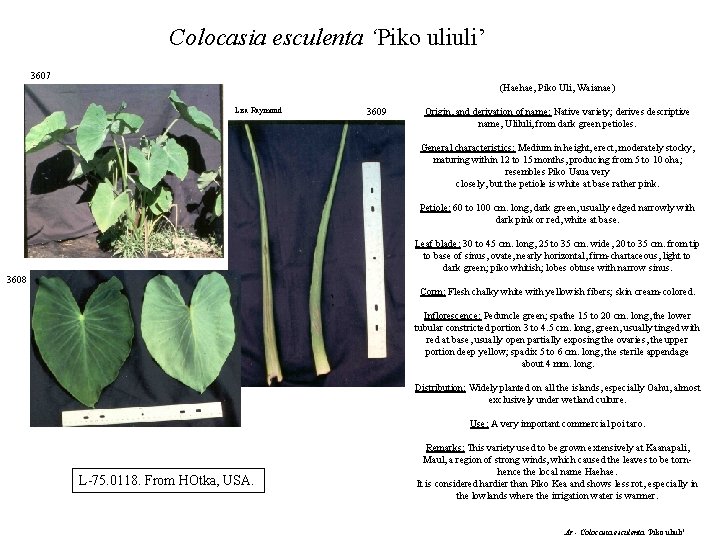
Colocasia esculenta ‘Piko uliuli’ 3607 (Haehae, Piko Uli, Waianae) Lisa Raymond 3609 Origin, and derivation of name: Native variety; derives descriptive name, Uliluli, from dark green petioles. General characteristics: Medium in height, erect, moderately stocky, maturing within 12 to 15 months, producing from 5 to 10 oha; resembles Piko Uaua very closely, but the petiole is white at base rather pink. Petiole: 60 to 100 cm. long, dark green, usually edged narrowly with dark pink or red, white at base. Leaf blade: 30 to 45 cm. long, 25 to 35 cm. wide, 20 to 35 cm. from tip to base of sinus, ovate, nearly horizontal, firm-chartaceous, light to dark green; piko whitish; lobes obtuse with narrow sinus. 3608 Corm: Flesh chalky white with yellowish fibers; skin cream-colored. Inflorescence: Peduncle green; spathe 15 to 20 cm. long, the lower tubular constricted portion 3 to 4. 5 cm. long, green, usually tinged with red at base, usually open partially exposing the ovaries, the upper portion deep yellow; spadix 5 to 6 cm. long, the sterile appendage about 4 mm. long. Distribution: Widely planted on all the islands, especially Oahu, almost exclusively under wetland culture. Use: A very important commercial poi taro. L-75. 0118. From HOtka, USA. Remarks: This variety used to be grown extensively at Kaanapali, Maul, a region of strong winds, which caused the leaves to be tornhence the local name Haehae. It is considered hardier than Piko Kea and shows less rot, especially in the lowlands where the irrigation water is warmer. Ar - Colocasia esculenta ‘Piko uliuli’
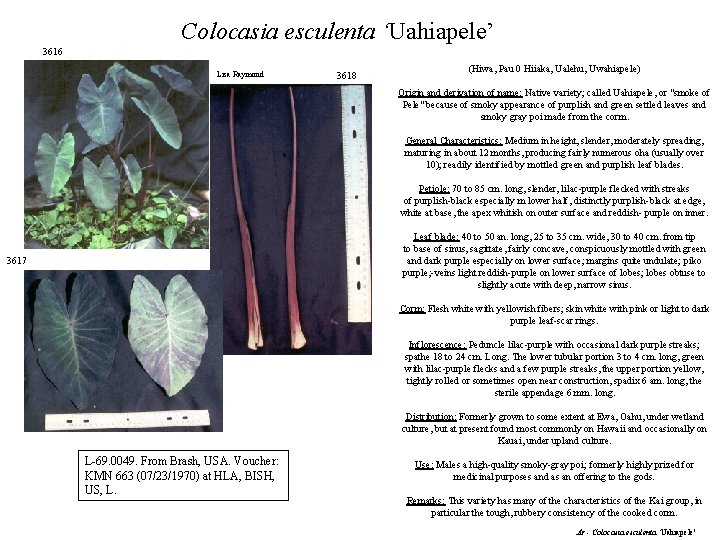
Colocasia esculenta ‘Uahiapele’ 3616 Lisa Raymond 3618 (Hiwa, Pau 0 Hiiaka, Ualehu, Uwahiapele) Origin and derivation of name: Native variety; called Uahiapele, or "smoke of Pele" because of smoky appearance of purplish and green settled leaves and smoky gray poi made from the corm. General Characteristics: Medium in height, slender, moderately spreading, maturing in about 12 months, producing fairly numerous oha (usually over 10); readily identified by mottled green and purplish leaf blades. Petiole: 70 to 85 cm. long, slender, lilac-purple flecked with streaks of purplish-black especially m lower half, distinctly purplish-black at edge, white at base, the apex whitish on outer surface and reddish- purple on inner. Leaf blade: 40 to 50 an. long, 25 to 35 cm. wide, 30 to 40 cm. from tip to base of sinus, sagittate, fairly concave, conspicuously mottled with green and dark purple especially on lower surface; margins quite undulate; piko purple; -veins light reddish-purple on lower surface of lobes; lobes obtuse to slightly acute with deep, narrow sinus. 3617 Corm: Flesh white with yellowish fibers; skin white with pink or light to dark purple leaf-scar rings. Inflorescence: Peduncle lilac-purple with occasional dark purple streaks; spathe 18 to 24 cm. Long. The lower tubular portion 3 to 4 cm. long, green with lilac-purple flecks and a few purple streaks, the upper portion yellow, tightly rolled or sometimes open near construction, spadix 6 am. long, the sterile appendage 6 mm. long. Distribution: Formerly grown to some extent at Ewa, Oahu, under wetland culture, but at present found most commonly on Hawaii and occasionally on Kauai, under upland culture. L-69. 0049. From Brash, USA. Voucher: KMN 663 (07/23/1970) at HLA, BISH, US, L. Use: Males a high-quality smoky-gray poi; formerly highly prized for medicinal purposes and as an offering to the gods. Remarks: This variety has many of the characteristics of the Kai group, in particular the tough, rubbery consistency of the cooked corm. Ar - Colocasia esculenta ‘Uahiapele’