Chapter Two UNDERSTANDING WHITECOLLAR CRIME Definitions Extent and




- Slides: 16
Chapter Two UNDERSTANDING WHITE-COLLAR CRIME: Definitions, Extent, and Consequences Brian K. Payne, White-Collar Crime: The Essentials © 2012 SAGE Publications
Understanding White-Collar Crime Large debate about the definition of white-collar crime • E. A. Ross (1907) originally used the expression “whitecollar criminaloid” o Focused on respectable businessmen engaging in misconduct and crime • Sutherland built on Ross’s idea and focused on the behavior of upper class citizens emphasizing that society’s elite were also capable of committing crime Brian K. Payne, White-Collar Crime: The Essentials © 2012 SAGE Publications
White-Collar Crime: An Evolving Concept Sutherland (1949) defined white-collar crime as: “Crime committed by a person of respectability and high social status in the course of his occupation” Wanted to call attention to criminal behavior that was normally overlooked as being criminal in nature Wanted to modify the usual theories of criminal behavior Brian K. Payne, White-Collar Crime: The Essentials © 2012 SAGE Publications
White-Collar Crime: An Evolving Concept Sutherland’s research and definition of white-collar crime was met with criticism from experts: o Conceptual ambiguity- the definition was too unclear o Empirical ambiguity- research did not accurately reflect reality o Methodical ambiguity- definition focused on upper class, but research focused on all classes o Legal ambiguity- definition did not list specific criminal offenses nor did the definition specify whether the behavior had to be illegal o Policy ambiguity- divide between white-collar crime researchers and policy makers Brian K. Payne, White-Collar Crime: The Essentials © 2012 SAGE Publications
White-Collar Crime: An Evolving Concept Clinard and Quinney (1973) separated white-collar crime into two forms: Corporate crimes: Illegal actions committed by employees of a corporation to benefit the corporation Occupational crimes: “Violations of legal codes in the course of activity in a legitimate occupation” Addressed the ambiguities of Sutherland’s definition Research on white-collar crime increased after the work of Clinard and Quinney However, no common, agreed upon definition of whitecollar crime currently exists Brian K. Payne, White-Collar Crime: The Essentials © 2012 SAGE Publications
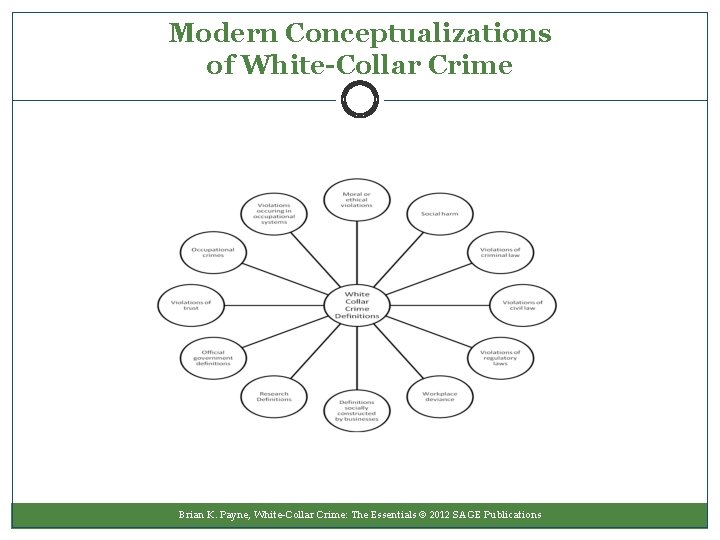
Modern Conceptualizations of White-Collar Crime Brian K. Payne, White-Collar Crime: The Essentials © 2012 SAGE Publications
Extent of White-Collar Crime The true extent of white-collar crime is difficult to identify Only one-third of violations are reported and the definition is still conceptually vague White-collar crime statistics are derived from: Official government statistics National Incident Based Reporting System (NIBRS) FBI’s Uniform Crime Reports (UCR) Victimization surveys National White-Collar Crime Center Victimization Survey Academic research studies Brian K. Payne, White-Collar Crime: The Essentials © 2012 SAGE Publications
Extent of White-Collar Crime According to the UCR, forgery and embezzlement cases increased dramatically between 1990 and 2009 The National White-Collar Crime Center’s (NW 3 C) 2005 victimization survey revealed that : Less than one-fifth of victims report being victimized to police 46. 5% of households reported that they had been victims of white-collar crime in the past year One research study found that one in 30 employees was caught stealing from their employer in 2007 Brian K. Payne, White-Collar Crime: The Essentials © 2012 SAGE Publications
Extent of White-Collar Crime Brian K. Payne, White-Collar Crime: The Essentials © 2012 SAGE Publications
Extent of White-Collar Crime Problems associated with UCR & NIBRS data: Some may not agree that the crimes included are white-collar crimes The database was not created for researchers Many cases are not reported to law enforcement, but instead are reported to regulatory agencies A number of white-collar victims are not aware that they have been victimized Shame may prevent victims from reporting their victimization to law enforcement officials Brian K. Payne, White-Collar Crime: The Essentials © 2012 SAGE Publications
Consequences of White-Collar Crime Individual Economic Losses: Average embezzlement results in $1, 000 in losses, while the average amount lost to street robbery is $1, 032 Societal Economic Losses: White-collar crime costs the U. S. anywhere between $300 and $600 billion annually Emotional Consequences: Moore and Mills (1990) identified three consequences of whitecollar crime: Reduced faith in the free economy and business leaders Erosion of public morality Loss of confidence in political institutions and processes Brian K. Payne, White-Collar Crime: The Essentials © 2012 SAGE Publications
Consequences of White-Collar Crime Physical Harm: May be direct or indirect Positive Consequences: Warning light syndrome: occurrence of crime sends a message that something needs to be fixed Boundary maintenance: people learn to follow the rules by watching other people get caught Social change: Society becomes stronger Community integration: Brings groups together The National White-Collar Crime Center fosters and supports collaborations between agencies and individuals who address white -collar crime Brian K. Payne, White-Collar Crime: The Essentials © 2012 SAGE Publications
Public Attitudes About White-Collar Crime Surveys of the public reveal that adults view: White-collar crime as serious as conventional crime Physically harmful white-collar offenses are more serious than other white-collar crimes Organizational offenses as more serious than individual offenses Offenses with higher status offenders as more serious than offenses with lower status offenders Brian K. Payne, White-Collar Crime: The Essentials © 2012 SAGE Publications
Public Attitudes About White-Collar Crime • Holtfreter and colleagues (2008) surveyed 402 individuals • One-third of those surveyed indicated that white-collar offenders should be punished more harshly than street offenders • Two-thirds of those surveyed said the government should “devote equal or more resources towards whitecollar crime control” Brian K. Payne, White-Collar Crime: The Essentials © 2012 SAGE Publications
Characteristics of White-Collar Offenders White-collar offenders are more likely than traditional offenders to: Be college educated Be White males Be older Have a job Commit fewer offenses Start their criminal careers later in life Be Jewish Brian K. Payne, White-Collar Crime: The Essentials © 2012 SAGE Publications
Characteristics of White-Collar Offenders White-collar crime is more likely than traditional street crime to: Be national or international in scope Involve a large number of victims Have organizations as victims Follow demonstrated patterns Be committed for more than a year Be committed in groups Brian K. Payne, White-Collar Crime: The Essentials © 2012 SAGE Publications