Chapter 8 Purchasing Human Resources Payment Process Recording

- Slides: 20
Chapter 8 Purchasing/ Human Resources/ Payment Process: Recording and Evaluating Expenditure Process Activities Mc. Graw-Hill/Irwin Copyright © 2009 by The Mc. Graw-Hill Companies, Inc. All rights reserved.
What is the Difference between Merchandising and Manufacturing Inventories? • Merchandising § Inventory purchased to be resold § Merchandise Inventory account • Manufacturing § Inventory purchased to be used to make products § Raw Materials Inventory account 8 -2
What is the Difference between Periodic and Perpetual Inventory Systems? • Periodic § Determine ending inventory and cost of goods sold at the end of the period • Perpetual § Determine cost of goods sold and ending inventory on a continuous basis 8 -3
How are Inventory Activities Recorded in a Periodic System? • Purchase § Debit Purchases § Credit Accounts Payable • Return or allowance § Debit Accounts Payable § Credit Purchase Returns and Allowances • Freight or insurance on purchases § Debit Freight-in (Insurance-in) § Credit Accounts Payable (Cash) 8 -4
How are Inventory Activities Recorded in a Perpetual System? • Purchase § Debit Inventory § Credit Accounts Payable • Return or allowance § Debit Accounts Payable § Credit Inventory • Freight or insurance on purchases § Debit Inventory § Credit Accounts Payable (Cash) 8 -5
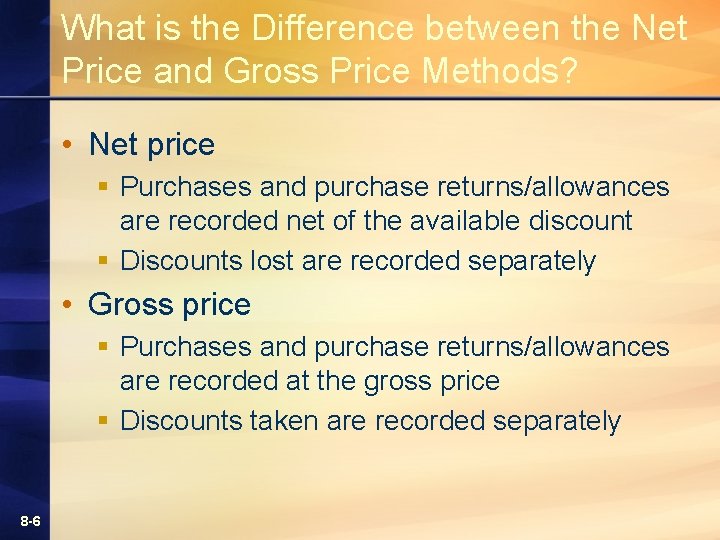
What is the Difference between the Net Price and Gross Price Methods? • Net price § Purchases and purchase returns/allowances are recorded net of the available discount § Discounts lost are recorded separately • Gross price § Purchases and purchase returns/allowances are recorded at the gross price § Discounts taken are recorded separately 8 -6
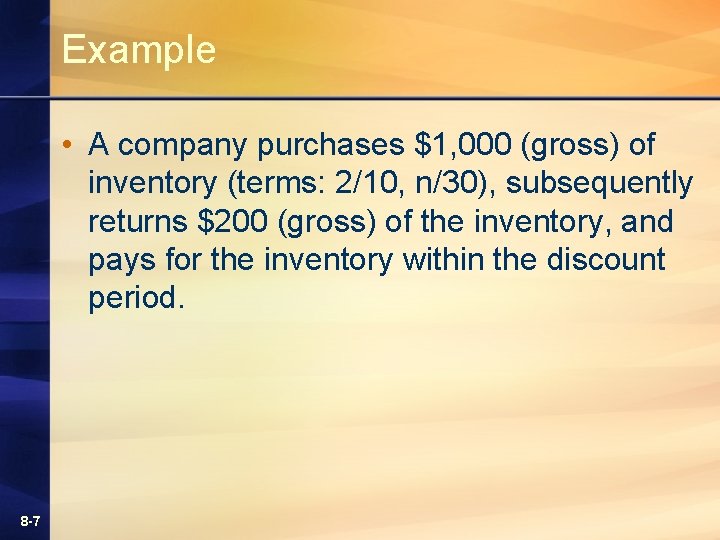
Example • A company purchases $1, 000 (gross) of inventory (terms: 2/10, n/30), subsequently returns $200 (gross) of the inventory, and pays for the inventory within the discount period. 8 -7
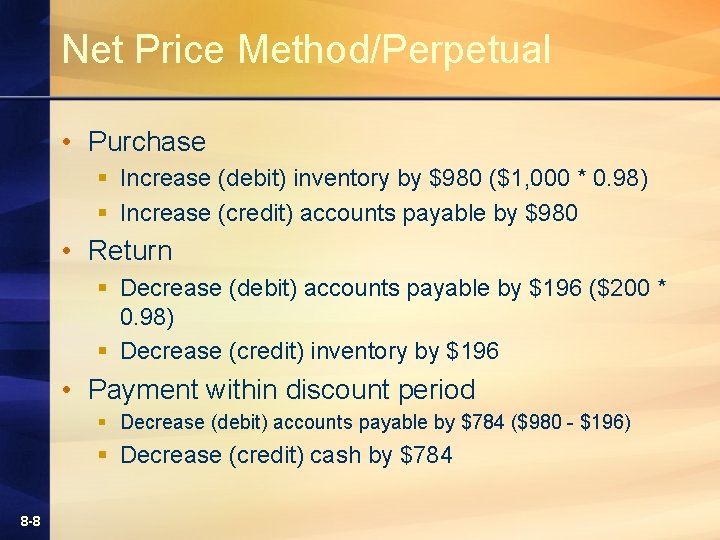
Net Price Method/Perpetual • Purchase § Increase (debit) inventory by $980 ($1, 000 * 0. 98) § Increase (credit) accounts payable by $980 • Return § Decrease (debit) accounts payable by $196 ($200 * 0. 98) § Decrease (credit) inventory by $196 • Payment within discount period § Decrease (debit) accounts payable by $784 ($980 - $196) § Decrease (credit) cash by $784 8 -8
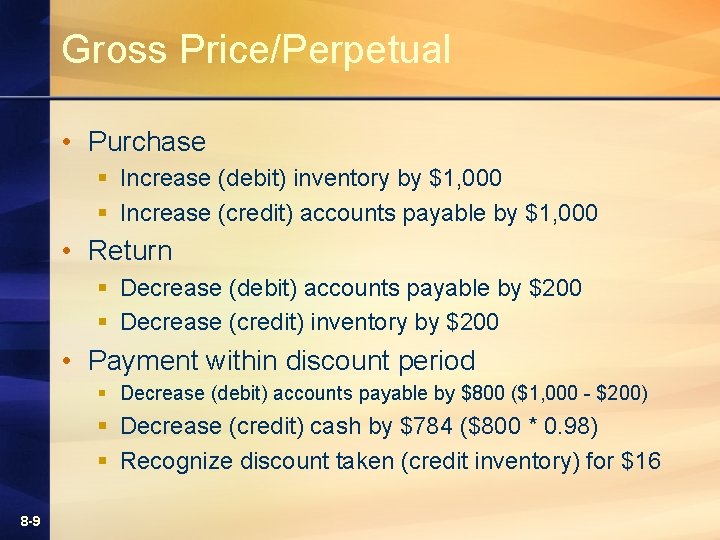
Gross Price/Perpetual • Purchase § Increase (debit) inventory by $1, 000 § Increase (credit) accounts payable by $1, 000 • Return § Decrease (debit) accounts payable by $200 § Decrease (credit) inventory by $200 • Payment within discount period § Decrease (debit) accounts payable by $800 ($1, 000 - $200) § Decrease (credit) cash by $784 ($800 * 0. 98) § Recognize discount taken (credit inventory) for $16 8 -9
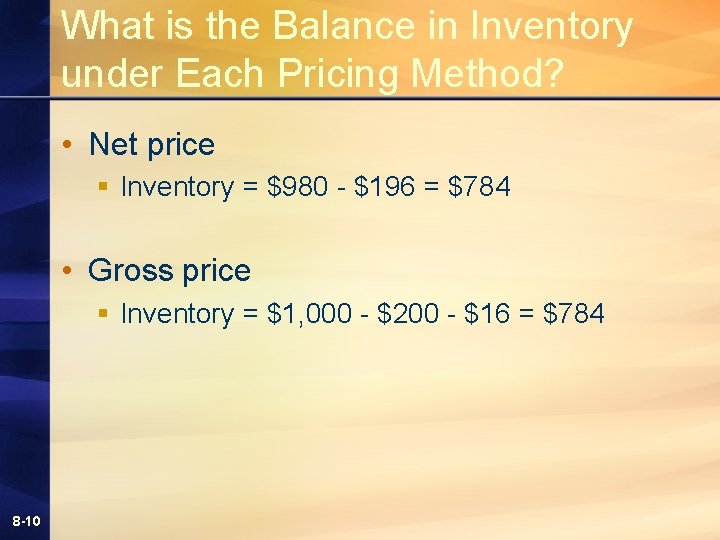
What is the Balance in Inventory under Each Pricing Method? • Net price § Inventory = $980 - $196 = $784 • Gross price § Inventory = $1, 000 - $200 - $16 = $784 8 -10
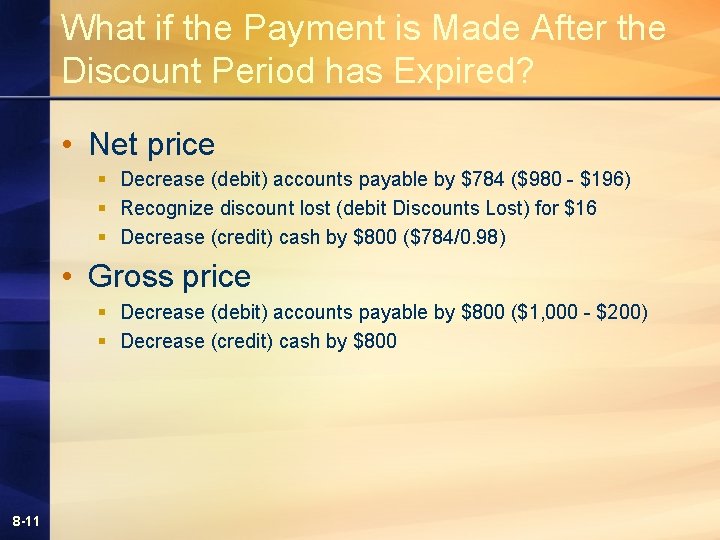
What if the Payment is Made After the Discount Period has Expired? • Net price § Decrease (debit) accounts payable by $784 ($980 - $196) § Recognize discount lost (debit Discounts Lost) for $16 § Decrease (credit) cash by $800 ($784/0. 98) • Gross price § Decrease (debit) accounts payable by $800 ($1, 000 - $200) § Decrease (credit) cash by $800 8 -11
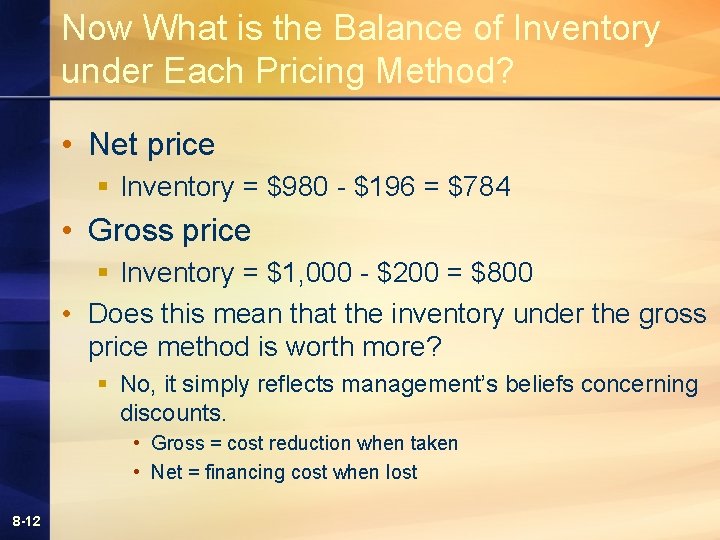
Now What is the Balance of Inventory under Each Pricing Method? • Net price § Inventory = $980 - $196 = $784 • Gross price § Inventory = $1, 000 - $200 = $800 • Does this mean that the inventory under the gross price method is worth more? § No, it simply reflects management’s beliefs concerning discounts. • Gross = cost reduction when taken • Net = financing cost when lost 8 -12
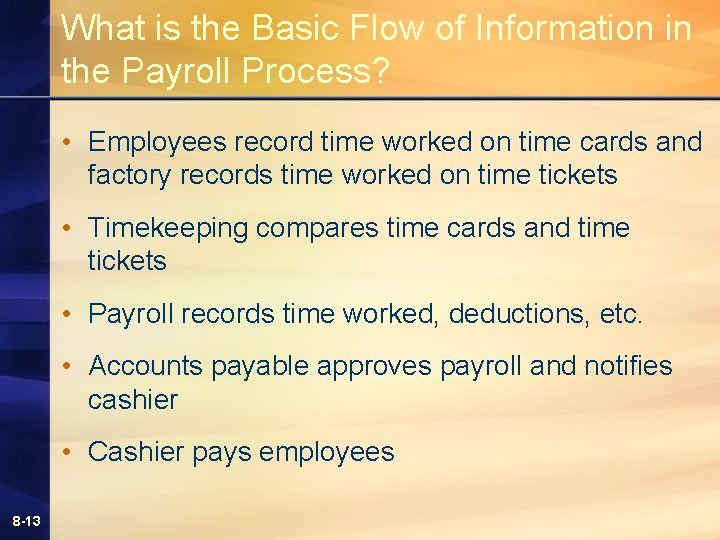
What is the Basic Flow of Information in the Payroll Process? • Employees record time worked on time cards and factory records time worked on time tickets • Timekeeping compares time cards and time tickets • Payroll records time worked, deductions, etc. • Accounts payable approves payroll and notifies cashier • Cashier pays employees 8 -13
What is the Difference between Gross Pay and Net Pay from the Employer’s Point of View? • Gross pay—salary and wage expense (amount incurred in an attempt to generate revenue) • Net pay—cash outflow to employees • Withholdings—liabilities to pay the entity to which the funds belong 8 -14
What is the Difference between Salary/Wage Expense and Payroll Tax Expense? • Salary/wage expense—expense incurred from using employees in an attempt to generate revenue • Payroll tax expense—expense incurred due to having employees (matching FICA and unemployment taxes) 8 -15
When are Expenses Recognized? • When incurred, regardless of when cash is paid. Assume December 31 year for examples that follow. § Example #1—receive a utility bill in December, pay the bill in January, expense is recognized in December § Example #2—pay insurance for 6 months in November, recognize 2 months of insurance expense in December § Example #3—pay the local newspaper in December for an ad to be run in December, recognize expense in December 8 -16
Inventory Example • Inventory is an asset when purchased • When inventory is sold, we recognize the expense, called Cost of Goods Sold 8 -17
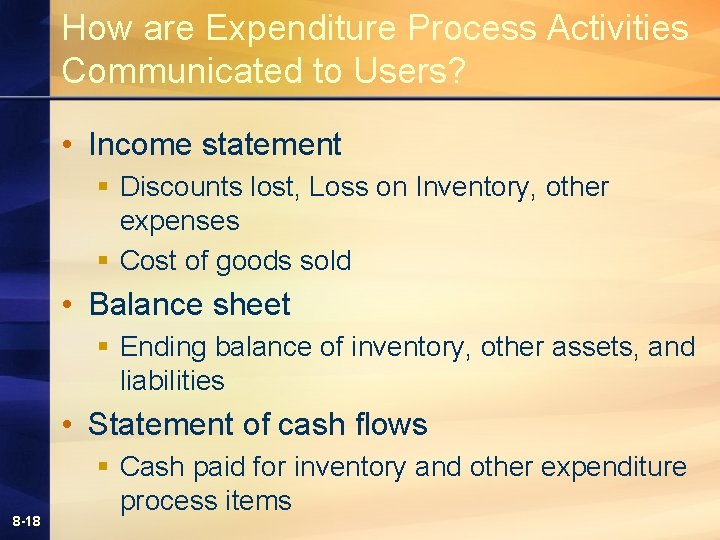
How are Expenditure Process Activities Communicated to Users? • Income statement § Discounts lost, Loss on Inventory, other expenses § Cost of goods sold • Balance sheet § Ending balance of inventory, other assets, and liabilities • Statement of cash flows 8 -18 § Cash paid for inventory and other expenditure process items
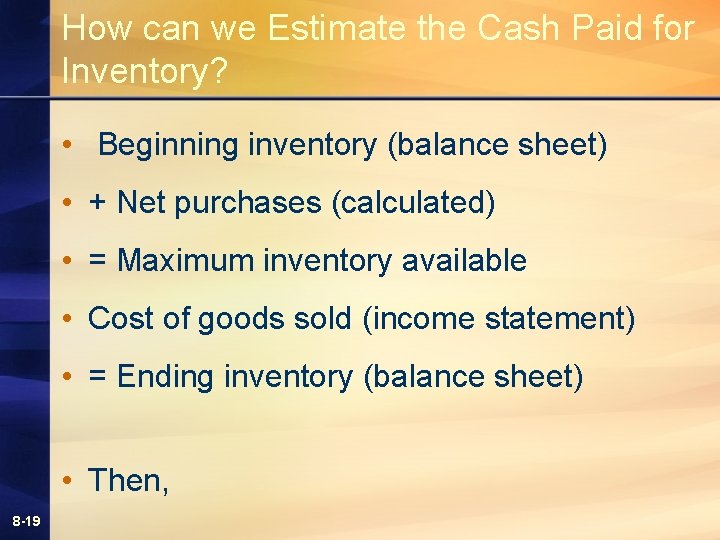
How can we Estimate the Cash Paid for Inventory? • Beginning inventory (balance sheet) • + Net purchases (calculated) • = Maximum inventory available • Cost of goods sold (income statement) • = Ending inventory (balance sheet) • Then, 8 -19
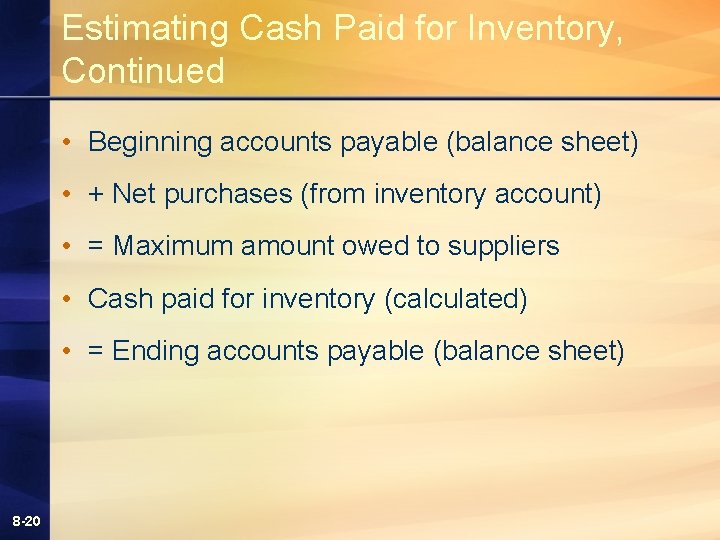
Estimating Cash Paid for Inventory, Continued • Beginning accounts payable (balance sheet) • + Net purchases (from inventory account) • = Maximum amount owed to suppliers • Cash paid for inventory (calculated) • = Ending accounts payable (balance sheet) 8 -20