Chapter 7 Legal Dimensions of Nursing Practice Copyright

- Slides: 35
Chapter 7 Legal Dimensions of Nursing Practice Copyright © 2011 Wolters Kluwer Health | Lippincott Williams & Wilkins
Definition of Law • Standard or rule of conduct established and enforced by government – Designed to protect the rights of the public Copyright © 2015 Wolters Kluwer • All Rights Reserved
Law Terminology • Litigation: process of bringing and trying a lawsuit • Plaintiff: person bringing suit • Defendant: person being accused of a crime – Presumed innocent until proven guilty Copyright © 2015 Wolters Kluwer • All Rights Reserved
Types of Laws • Public law—government is directly involved – Regulates relationships between individuals and government • Private law—civil law – Regulates relationships among people • Criminal law—concerns state and federal criminal statutes – Defines criminal actions (e. g. , murder, theft) Copyright © 2015 Wolters Kluwer • All Rights Reserved
Question Tell whether the following statement is true or false. A body of law known as statutory law has evolved from accumulated judiciary decisions. A. True B. False Copyright © 2015 Wolters Kluwer • All Rights Reserved
Answer: B. False Rationale: A body of law known as common law has evolved from accumulated judiciary decisions. Most law involving malpractice is common law. Copyright © 2015 Wolters Kluwer • All Rights Reserved
Four Sources of Law • Constitutions: serve as guides to legislative bodies • Statutory law: enacted by a legislative body • Administrative law: empowered by executive officers • Common law: judiciary system reconciles controversies, creates body of common law Copyright © 2015 Wolters Kluwer • All Rights Reserved
Professional and Legal Regulation of Nursing Practice • Nurse practice acts • Standards • Credentialing – Accreditation – Licensure – Certification Copyright © 2015 Wolters Kluwer • All Rights Reserved
Question Tell whether the following statement is true or false. The state nurse practice act is the most important law affecting nursing practice. A. True B. False Copyright © 2015 Wolters Kluwer • All Rights Reserved
Answer: A. True Rationale: The state nurse practice act is the most important law affecting nursing practice. Each nurse practice act protects the public by broadly defining the legal scope of nursing practice. Copyright © 2015 Wolters Kluwer • All Rights Reserved
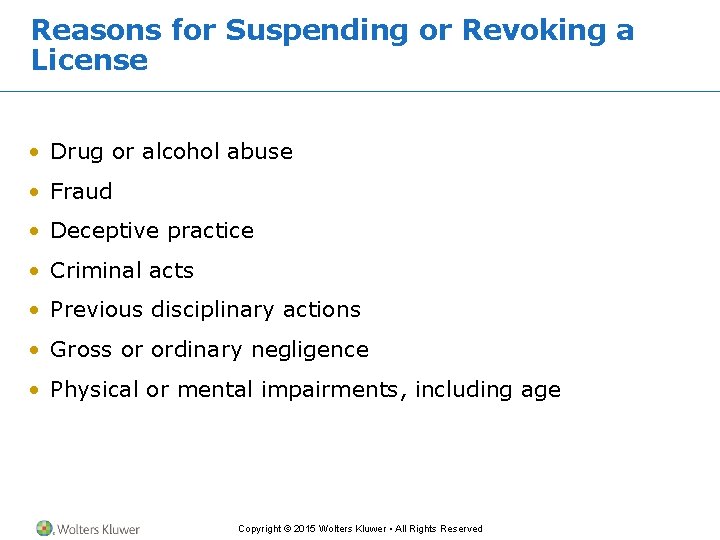
Reasons for Suspending or Revoking a License • Drug or alcohol abuse • Fraud • Deceptive practice • Criminal acts • Previous disciplinary actions • Gross or ordinary negligence • Physical or mental impairments, including age Copyright © 2015 Wolters Kluwer • All Rights Reserved
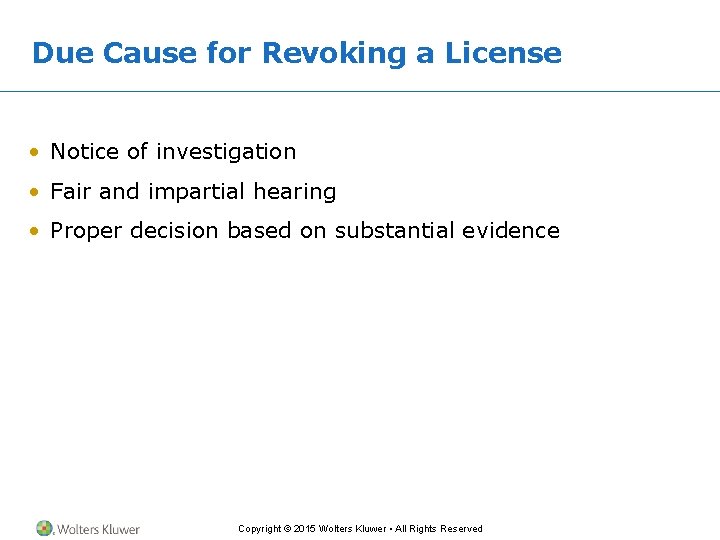
Due Cause for Revoking a License • Notice of investigation • Fair and impartial hearing • Proper decision based on substantial evidence Copyright © 2015 Wolters Kluwer • All Rights Reserved
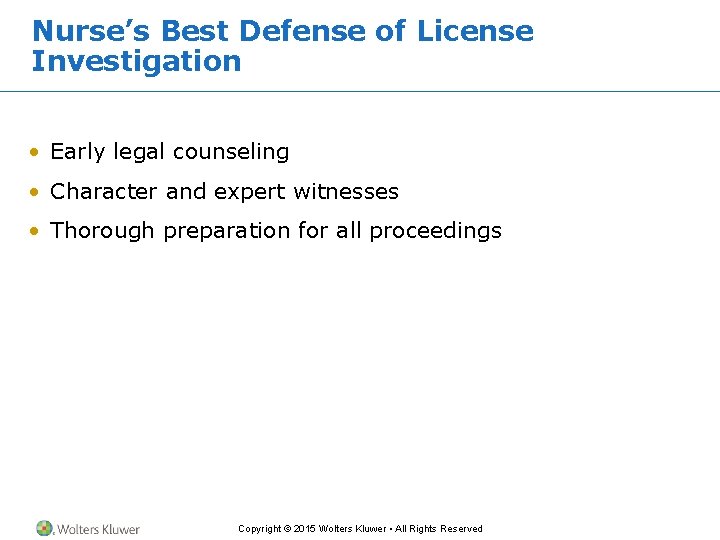
Nurse’s Best Defense of License Investigation • Early legal counseling • Character and expert witnesses • Thorough preparation for all proceedings Copyright © 2015 Wolters Kluwer • All Rights Reserved
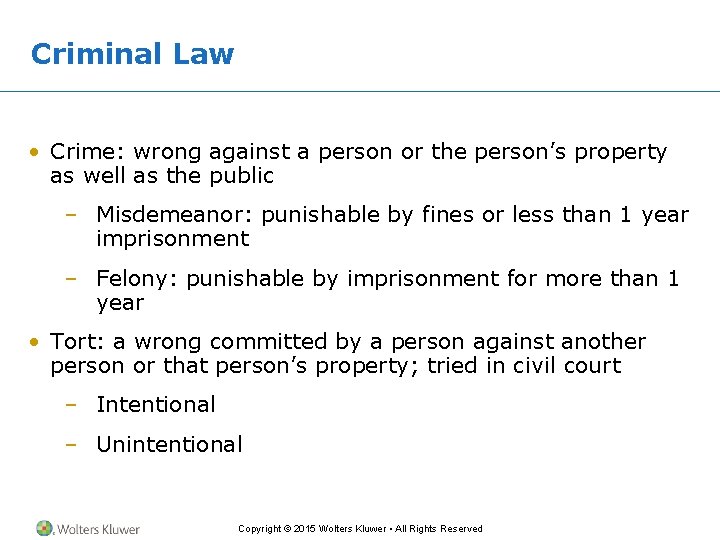
Criminal Law • Crime: wrong against a person or the person’s property as well as the public – Misdemeanor: punishable by fines or less than 1 year imprisonment – Felony: punishable by imprisonment for more than 1 year • Tort: a wrong committed by a person against another person or that person’s property; tried in civil court – Intentional – Unintentional Copyright © 2015 Wolters Kluwer • All Rights Reserved
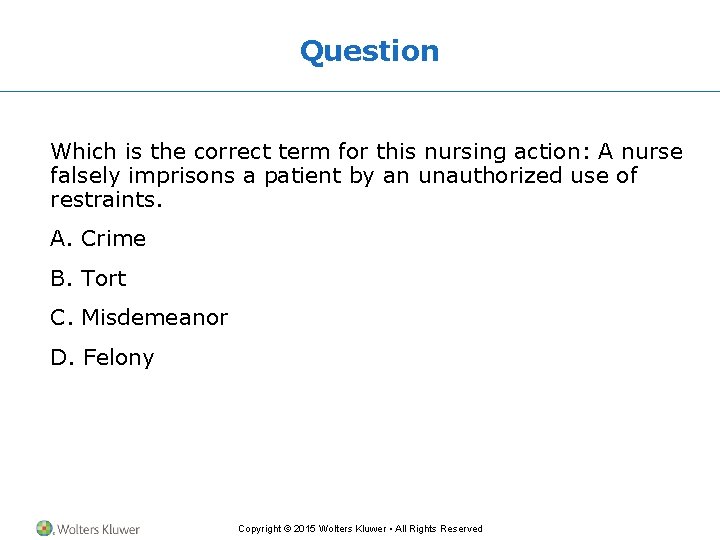
Question Which is the correct term for this nursing action: A nurse falsely imprisons a patient by an unauthorized use of restraints. A. Crime B. Tort C. Misdemeanor D. Felony Copyright © 2015 Wolters Kluwer • All Rights Reserved
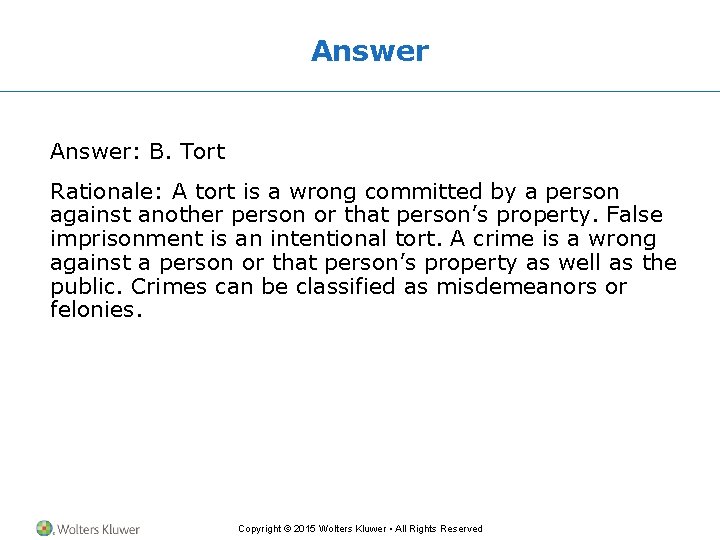
Answer: B. Tort Rationale: A tort is a wrong committed by a person against another person or that person’s property. False imprisonment is an intentional tort. A crime is a wrong against a person or that person’s property as well as the public. Crimes can be classified as misdemeanors or felonies. Copyright © 2015 Wolters Kluwer • All Rights Reserved
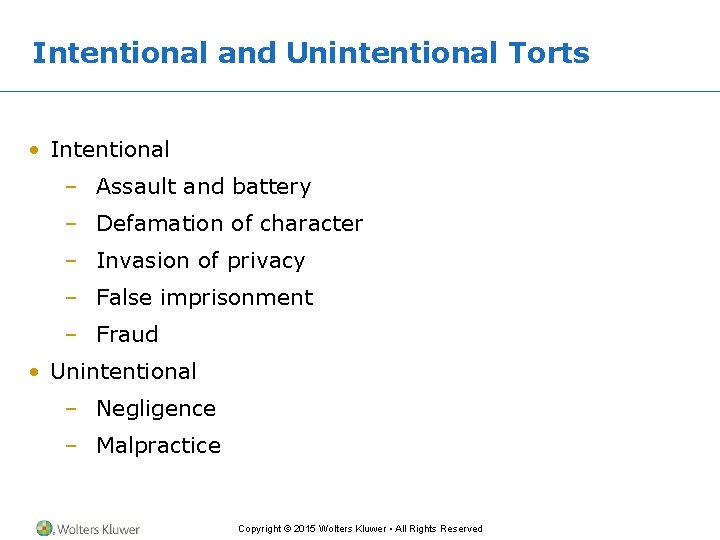
Intentional and Unintentional Torts • Intentional – Assault and battery – Defamation of character – Invasion of privacy – False imprisonment – Fraud • Unintentional – Negligence – Malpractice Copyright © 2015 Wolters Kluwer • All Rights Reserved
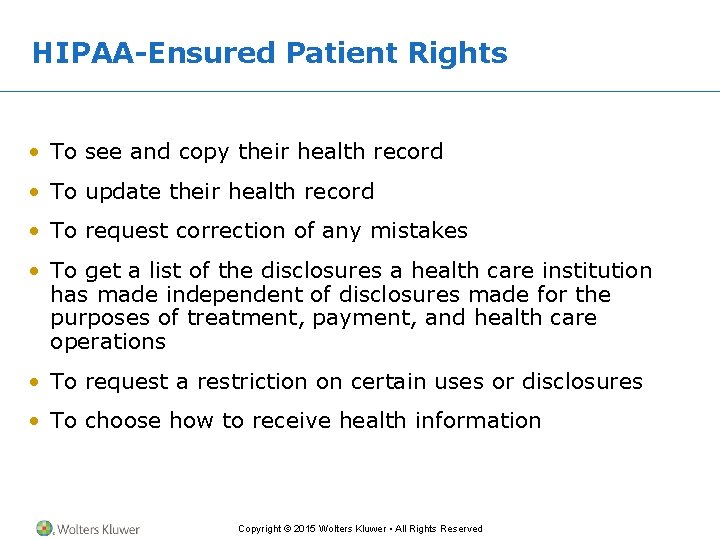
HIPAA-Ensured Patient Rights • To see and copy their health record • To update their health record • To request correction of any mistakes • To get a list of the disclosures a health care institution has made independent of disclosures made for the purposes of treatment, payment, and health care operations • To request a restriction on certain uses or disclosures • To choose how to receive health information Copyright © 2015 Wolters Kluwer • All Rights Reserved
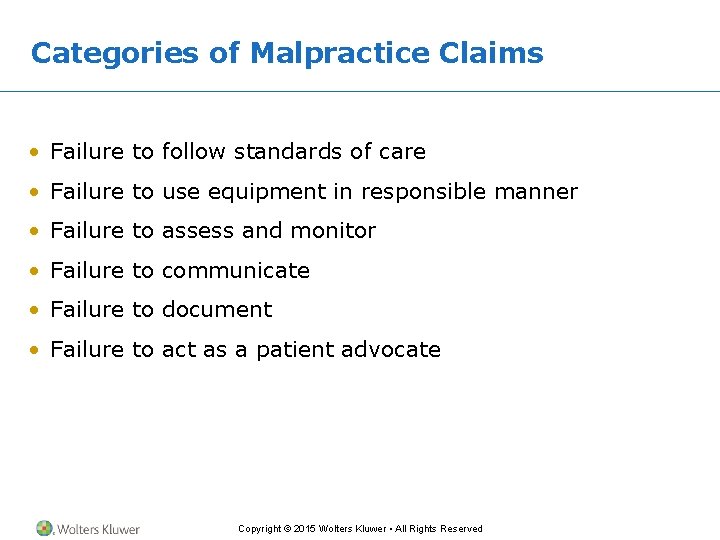
Categories of Malpractice Claims • Failure to follow standards of care • Failure to use equipment in responsible manner • Failure to assess and monitor • Failure to communicate • Failure to document • Failure to act as a patient advocate Copyright © 2015 Wolters Kluwer • All Rights Reserved
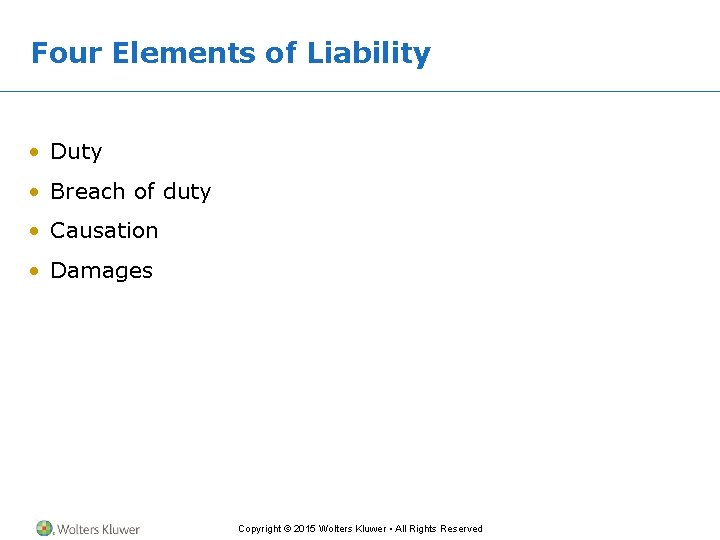
Four Elements of Liability • Duty • Breach of duty • Causation • Damages Copyright © 2015 Wolters Kluwer • All Rights Reserved
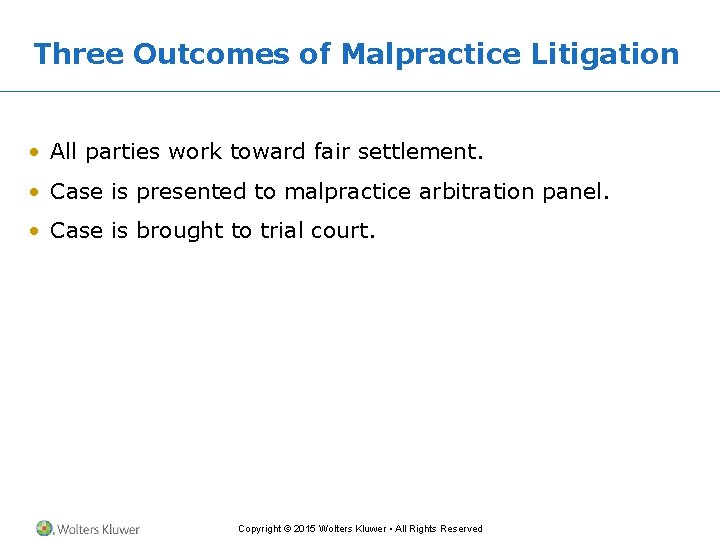
Three Outcomes of Malpractice Litigation • All parties work toward fair settlement. • Case is presented to malpractice arbitration panel. • Case is brought to trial court. Copyright © 2015 Wolters Kluwer • All Rights Reserved
Roles of Nurses in Legal Proceedings • Nurse as defendant • Nurse as fact witness • Nurse as expert witness Copyright © 2015 Wolters Kluwer • All Rights Reserved
Recommendations for Nurse Defendant • Do not discuss the case with those involved in it. • Do not alter patient records. • Cooperate fully with your attorney. • Be courteous on witness stand. • Do not volunteer any information. Copyright © 2015 Wolters Kluwer • All Rights Reserved
Legal Safeguards for Nurses • Competent practice • Informed consent or refusal • Contracts • Collective bargaining • Patient education • Executing physician orders • Documentation Copyright © 2015 Wolters Kluwer • All Rights Reserved
Legal Safeguards for Nurses (cont. ) • Adequate staffing • Whistle-blowing • Professional liability insurance • Risk management programs • Incident, variance, or occurrence reports • Sentinel events and Never events • Patients’ rights • Good Samaritan Laws Copyright © 2015 Wolters Kluwer • All Rights Reserved
Elements of Informed Consent • Disclosure • Comprehension • Competence • Voluntariness Copyright © 2015 Wolters Kluwer • All Rights Reserved
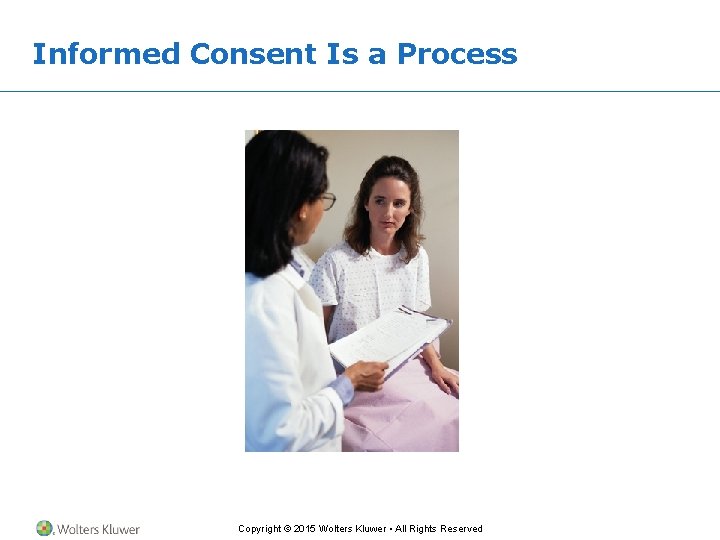
Informed Consent Is a Process Copyright © 2015 Wolters Kluwer • All Rights Reserved
Question Tell whether the following statement is true or false. In all health care agencies, informed and voluntary consent is needed for admission, for specialized diagnostic procedures or medical–surgical treatment, and for any experimental treatments or procedures. A. True B. False Copyright © 2015 Wolters Kluwer • All Rights Reserved
Answer: A. True Rationale: In all health care agencies, informed and voluntary consent is needed for admission, for specialized diagnostic procedures or medical–surgical treatment, and for any experimental treatments or procedures. Copyright © 2015 Wolters Kluwer • All Rights Reserved
Safeguards to Competent Practice • Respecting legal boundaries of practice • Following institutional procedures and policies • Owning personal strengths and weaknesses • Evaluating proposed assignments • Keeping current in nursing knowledge and skills • Respecting patient rights and developing rapport with patients • Keeping careful documentation • Working within agency for management policies Copyright © 2015 Wolters Kluwer • All Rights Reserved
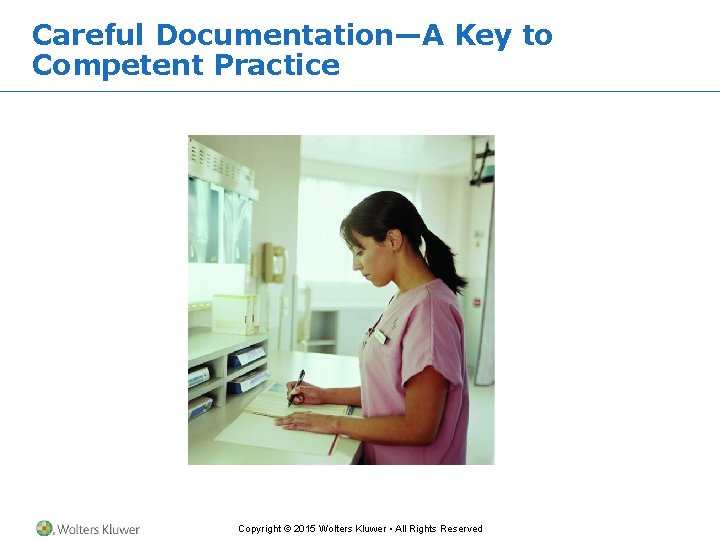
Careful Documentation—A Key to Competent Practice Copyright © 2015 Wolters Kluwer • All Rights Reserved
Types of Risk Management Programs • Safety program • Products safety program • Quality assurance programs Copyright © 2015 Wolters Kluwer • All Rights Reserved
Information Contained in Incident Reports • Complete name of person and names of witnesses • Factual account of incident • Date, time, and place of incident • Pertinent characteristics of person involved • Any equipment or resources being used • Any other important variables • Documentation by physician of medical examination of person involved Copyright © 2015 Wolters Kluwer • All Rights Reserved
OSHA Legal Regulations • Use of electrical equipment • Use of isolation techniques • Use of radiation • Use of chemicals Copyright © 2015 Wolters Kluwer • All Rights Reserved
Laws Affecting Nursing Practice • Occupational Safety and Health • National Practitioner Data Bank • Reporting obligations • Controlled substances • Discrimination and sexual harassment • Health Insurance Portability and Accountability Act (HIPAA) Restraints • People with disabilities • Legal issues related to death and dying (wills, advance directives) Copyright © 2015 Wolters Kluwer • All Rights Reserved