Chapter 6 Theoretical Perspectives on Intercultural Communication Managing

- Slides: 29
Chapter 6 Theoretical Perspectives on Intercultural Communication Managing Organizations in a Global Economy: An Intercultural Perspective First Edition John Saee Copyright by South-Western, a division of Thomson Learning. All rights reserved.
Theories of Intercultural Communication and Adaptation: Origins F Theories of intercultural communication have their origins in trans-disciplinary areas of research.
F True or false: “Intercultural communication competence has to a large extent to do with learning a foreign language. ”
Psychological Theories of Intercultural Communication F Intercultural communication is explained in terms of individual behavioral adaptation. F The main focus: personal and interpersonal traits and attributes, and individual internal psychological responses in intercultural communication situations.
Stages of Cross-Cultural Learning and Adaptation (Harris & Moran 1979, Lysgaard 1955) F Initial contact F Initial culture shock F Superficial adjustment F Depression/isolation F Reintegration/compensation F Autonomy/independence
"Culture Shock" U-curve (Oberg 1960) F “Honeymoon" stage F Stage of hostility F Recovery stage F Final stage
How do foreigners react to the host culture (Bennett 1971; Taft 1977)?
F Value of psychological theories: a useful framework for understanding psychological reactions by sojourners living in the host culture. F Critique: conceptually problematic.
Focus of other theories F Explaining intercultural communication in terms of the development of effective interpersonal relationships and the ability to communicate effectively.
Convergence Theory (Kincaid 1988) F If two or more individuals share information with one another, then they will tend to converge toward one another, leading to a state of greater uniformity. F The main underlying thesis: the provision of opportunity for unrestricted communication.
F Hall 1976; Triandis 1972, 1983; Gudykunst 1983, 1984 Emphasis on “cultural learning”and adaptation as a way of developing intercultural communication competence.
Anxiety/Uncertainty Management (AUM) Theory (Gudykunst) F Theoretical Foundations The Concept of Stranger Uncertainty Anxiety Effective Communication Being Mindful
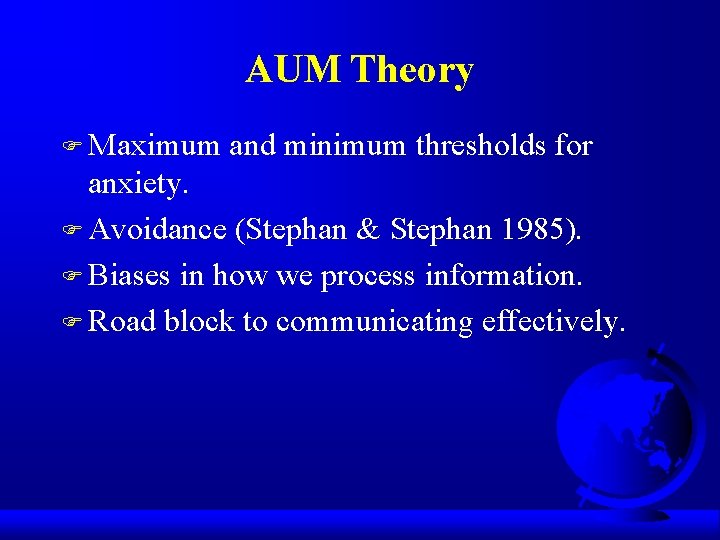
AUM Theory F Maximum and minimum thresholds for anxiety. F Avoidance (Stephan & Stephan 1985). F Biases in how we process information. F Road block to communicating effectively.
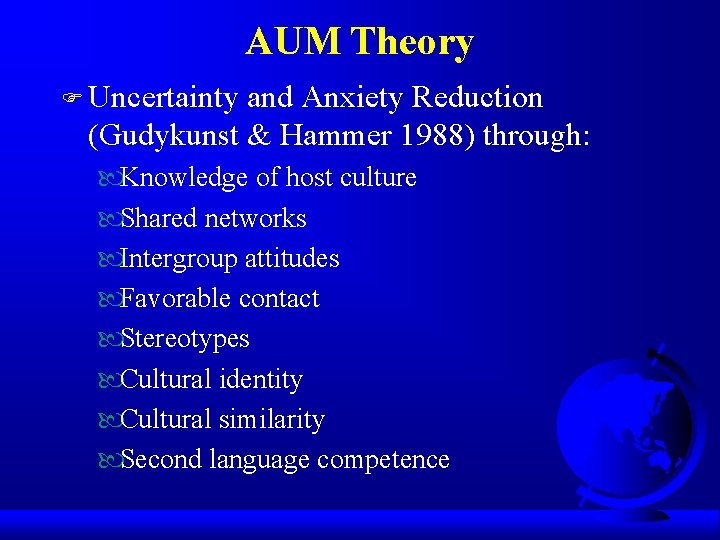
AUM Theory F Uncertainty and Anxiety Reduction (Gudykunst & Hammer 1988) through: Knowledge of host culture Shared networks Intergroup attitudes Favorable contact Stereotypes Cultural identity Cultural similarity Second language competence
AUM Theory F Four variables influence only uncertainty reduction: Intimacy Attraction Display of nonverbal affiliative expressiveness Use of appropriate uncertainty reduction strategies
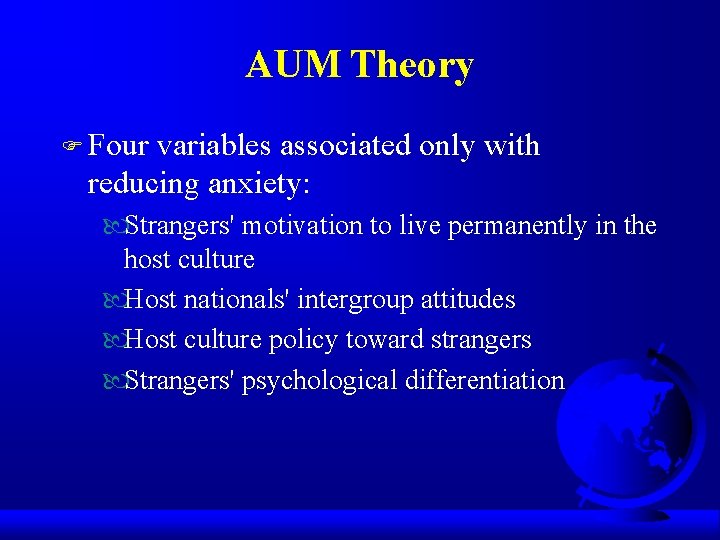
AUM Theory F Four variables associated only with reducing anxiety: Strangers' motivation to live permanently in the host culture Host nationals' intergroup attitudes Host culture policy toward strangers Strangers' psychological differentiation
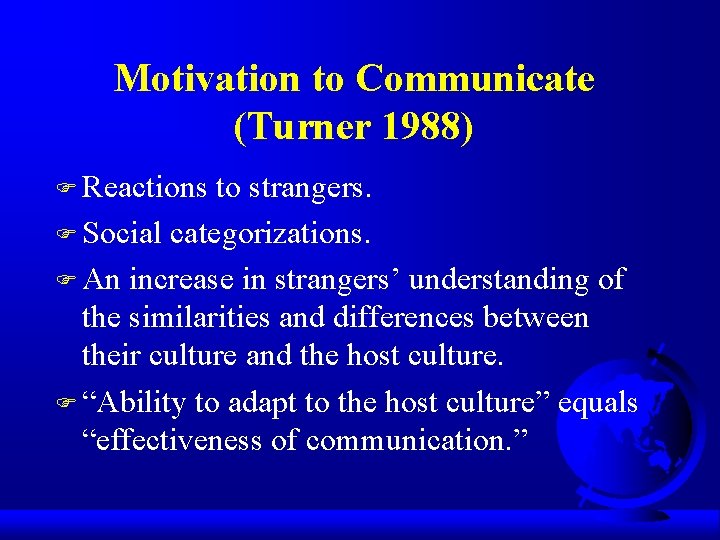
Motivation to Communicate (Turner 1988) F Reactions to strangers. F Social categorizations. F An increase in strangers’ understanding of the similarities and differences between their culture and the host culture. F “Ability to adapt to the host culture” equals “effectiveness of communication. ”
F AUM theory critique: The responsibility for miscommunication rests on the shoulders of the stranger who has not learned or interpreted the host culture sufficiently to adapt to cultural differences.
General Systems Theory (Kim 1988) F The intercultural communication competence: the overall internal capability of an individual to manage differences and unfamiliarity, intergroup posture, and the accompanying experiences of stress.
General Systems Theory (Kim 1988) F Cognitive, affective, and operational adaptability of an individual's internal system in all intercultural communication contexts. F Adaptability of an individual's internal system equals an individual’s growth.
General Systems Theory (Kim 1988) Critique F The processes are one-way, whereas the process of intercultural communication is two-way.
Interpersonal Theory of Intercultural Communication (Irwin 1996) F The ideologies of intimacy (closeness) and performance (competence). F The key features of the communication process: Context Conduct Content
Intercultural communication competence is a difficult concept to define adequately and precisely.
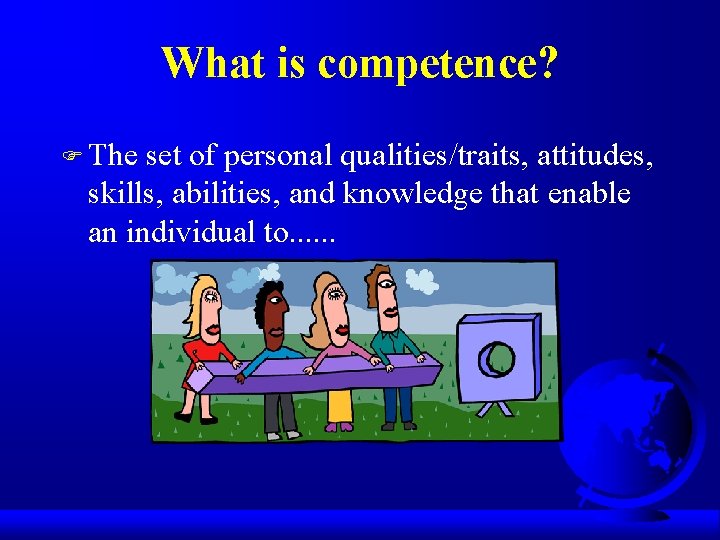
What is competence? F The set of personal qualities/traits, attitudes, skills, abilities, and knowledge that enable an individual to. . .
Ruben and Kealy (1979): F Give individuals empathy F Display respect F Perform role behaviors F Be nonjudgmental F Be open F Be tolerant of ambiguity F Interactively manage
The knowledge component of competence: F Knowledge of: How to gather information Group differences Personal similarities Alternative interpretations for others’ behavior
Skills/Abilities (Berger 1979; Coleman & Depaulo 1991; Bellah et al. 1985; Gudykunst & Kim 1997): F The ability: To be mindful To tolerate ambiguity To calm ourselves To explain and make accurate predictions of strangers’ behavior
Behavioral Dimensions Associated with Perceived Competence (Gudykunst, Wiseman, & Hammer 1977) F Dealing with psychological stress F Communicating effectively F Establishing meaningful interpersonal relationships
Do specific skills/abilities, knowledge and behaviors ensure that we will be perceived as competent in any particular interaction?