Chapter 4 Infinity in Greek Mathematics Fear of

- Slides: 8
Chapter 4 Infinity in Greek Mathematics • • • Fear of Infinity Eudoxus’ Theory of Proportion The Method of Exhaustion The Area of a Parabolic Segment Biographical Notes: Archimedes
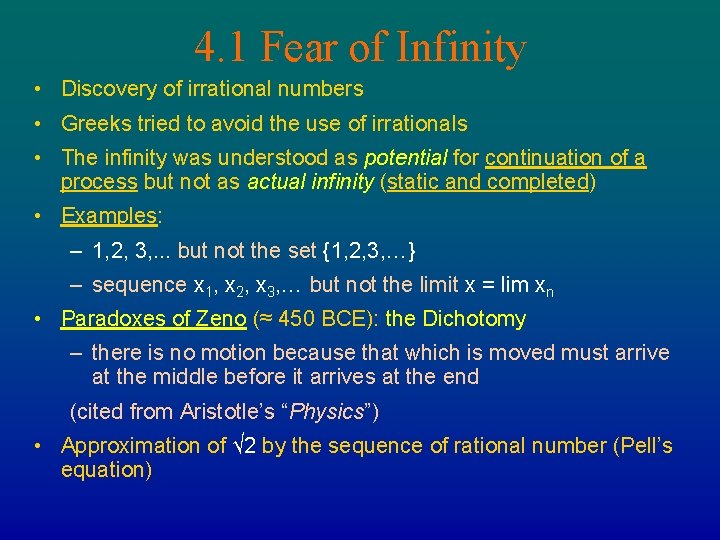
4. 1 Fear of Infinity • Discovery of irrational numbers • Greeks tried to avoid the use of irrationals • The infinity was understood as potential for continuation of a process but not as actual infinity (static and completed) • Examples: – 1, 2, 3, . . . but not the set {1, 2, 3, …} – sequence x 1, x 2, x 3, … but not the limit x = lim xn • Paradoxes of Zeno (≈ 450 BCE): the Dichotomy – there is no motion because that which is moved must arrive at the middle before it arrives at the end (cited from Aristotle’s “Physics”) • Approximation of √ 2 by the sequence of rational number (Pell’s equation)
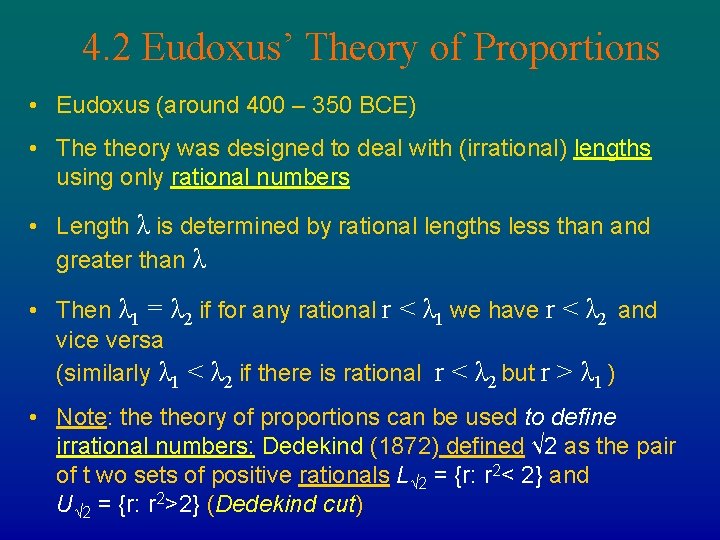
4. 2 Eudoxus’ Theory of Proportions • Eudoxus (around 400 – 350 BCE) • The theory was designed to deal with (irrational) lengths using only rational numbers • Length λ is determined by rational lengths less than and greater than λ • Then λ 1 = λ 2 if for any rational r < λ 1 we have r < λ 2 and vice versa (similarly λ 1 < λ 2 if there is rational r < λ 2 but r > λ 1 ) • Note: theory of proportions can be used to define irrational numbers: Dedekind (1872) defined √ 2 as the pair of t wo sets of positive rationals L√ 2 = {r: r 2< 2} and U√ 2 = {r: r 2>2} (Dedekind cut)
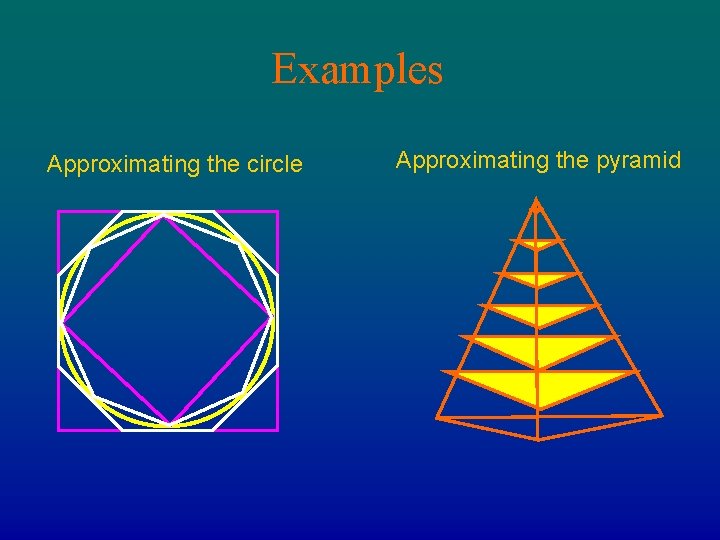
4. 3 The Method of Exhaustion • was designed to find areas and volumes of complicated objects (circles, pyramids, spheres etc. ) using – approximations by simple objects (rectangles, trianlges, prisms) having known areas (or volumes) – the Theory of Proportions
Examples Approximating the circle Approximating the pyramid
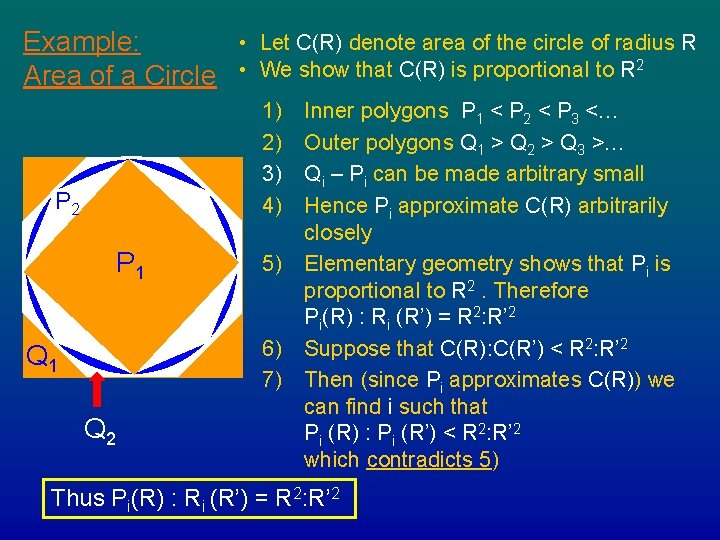
• Example: Area of a Circle • Let C(R) denote area of the circle of radius R We show that C(R) is proportional to R 2 1) 2) 3) 4) P 2 P 1 Q 2 Inner polygons P 1 < P 2 < P 3 <… Outer polygons Q 1 > Q 2 > Q 3 >… Qi – Pi can be made arbitrary small Hence Pi approximate C(R) arbitrarily closely 5) Elementary geometry shows that Pi is proportional to R 2. Therefore Pi(R) : Ri (R’) = R 2: R’ 2 6) Suppose that C(R): C(R’) < R 2: R’ 2 7) Then (since Pi approximates C(R)) we can find i such that Pi (R) : Pi (R’) < R 2: R’ 2 which contradicts 5) Thus Pi(R) : Ri (R’) = R 2: R’ 2
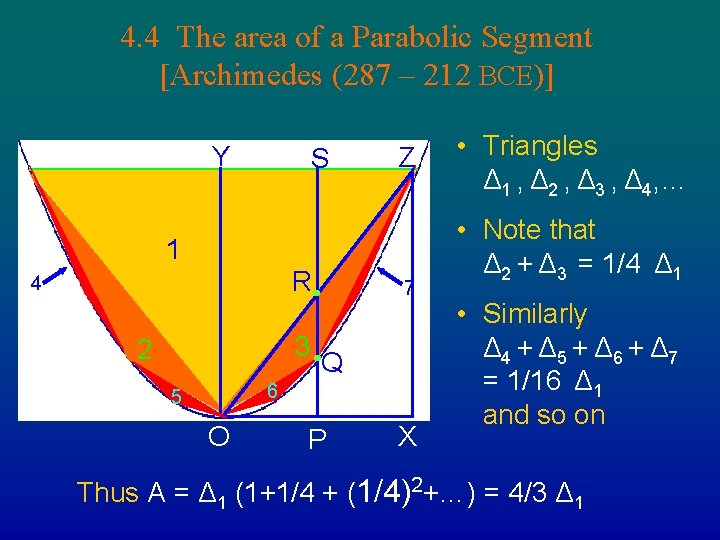
4. 4 The area of a Parabolic Segment [Archimedes (287 – 212 BCE)] Y S Z 1 R 4 3 2 7 Q 6 5 O P X • Triangles Δ 1 , Δ 2 , Δ 3 , Δ 4, … • Note that Δ 2 + Δ 3 = 1/4 Δ 1 • Similarly Δ 4 + Δ 5 + Δ 6 + Δ 7 = 1/16 Δ 1 and so on Thus A = Δ 1 (1+1/4 + (1/4)2+…) = 4/3 Δ 1
4. 5 Biographical Notes: Archimedes • Was born and worked in Syracuse (Greek city in Sicily) 287 BCE and died in 212 BCE • Friend of King Hieron II • “Eureka!” (discovery of hydrostatic law) • Invented many mechanisms, some of which were used for the defence of Syracuse • Other achievements in mechanics usually attributed to Archimedes (the law of the lever, center of mass, equilibrium, hydrostatic pressure) • Used the method of exhaustions to show that the volume of sphere is 2/3 that of the enveloping cylinder • “Stay away from my diagram!”