
Unit 1 Limits THE FOUNDATION OF CALCULUS Lessons
![Intermediate Value Theorem (IVT): A function that is continuous on [a, b] takes on](https://slidetodoc.com/presentation_image/14fd77826cb436ba9e6f1a207595f349/image-81.jpg "Intermediate Value Theorem (IVT): A function that is continuous on [a, b] takes on")
![Intermediate Value Theorem Examples 4) Given that f(x) is continuous on [-1, 6] what](https://slidetodoc.com/presentation_image/14fd77826cb436ba9e6f1a207595f349/image-82.jpg "Intermediate Value Theorem Examples 4) Given that f(x) is continuous on [-1, 6] what")
![Intermediate Value Theorem (IVT): A function that is continuous on [a, b] takes on](https://slidetodoc.com/presentation_image/14fd77826cb436ba9e6f1a207595f349/image-93.jpg "Intermediate Value Theorem (IVT): A function that is continuous on [a, b] takes on")
- Slides: 93
Unit 1: Limits THE FOUNDATION OF CALCULUS
Lessons 1. 2 Definition of a Limit (Graphically and Numerically) 1. 3 A Evaluating Limits Analytically 1. 3 B Properties of Limits 1. 3 C Special Trig Limits 1. 5 Infinite Limits (Vertical Asymptotes) 3. 5 Limits at Infinity (End Behavior) Review on Limits 1. 4 Continuity 1. 5 Continuity and Limits Review
1. 2 Definition of a Limit WHAT IS A LIMIT?
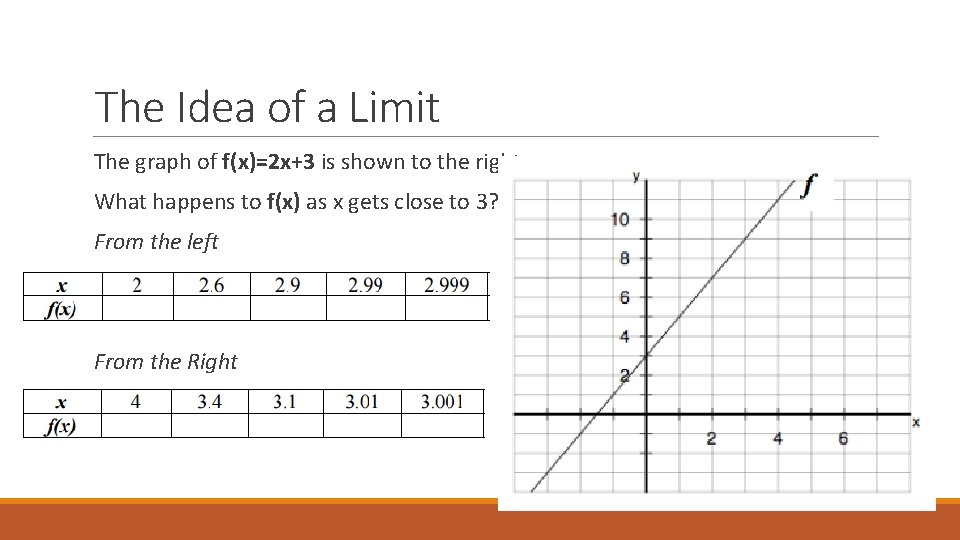
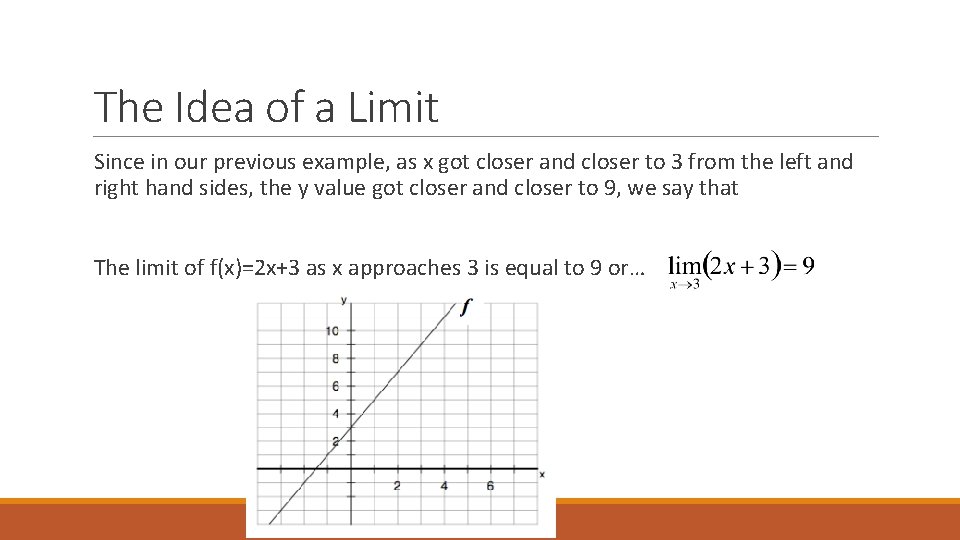
The Idea of a Limit The graph of f(x)=2 x+3 is shown to the right. What happens to f(x) as x gets close to 3? From the left From the Right
The Idea of a Limit Since in our previous example, as x got closer and closer to 3 from the left and right hand sides, the y value got closer and closer to 9, we say that The limit of f(x)=2 x+3 as x approaches 3 is equal to 9 or…
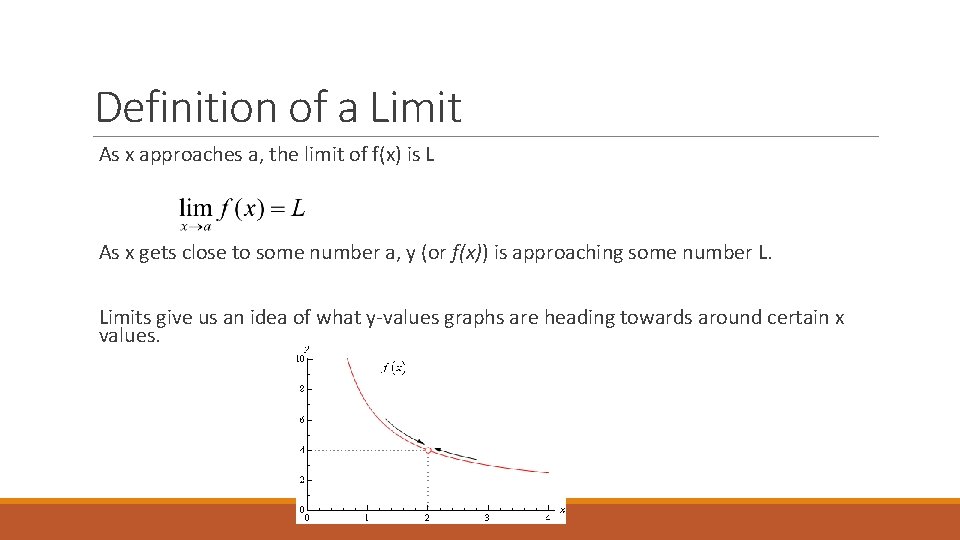
Definition of a Limit As x approaches a, the limit of f(x) is L As x gets close to some number a, y (or f(x)) is approaching some number L. Limits give us an idea of what y-values graphs are heading towards around certain x values.
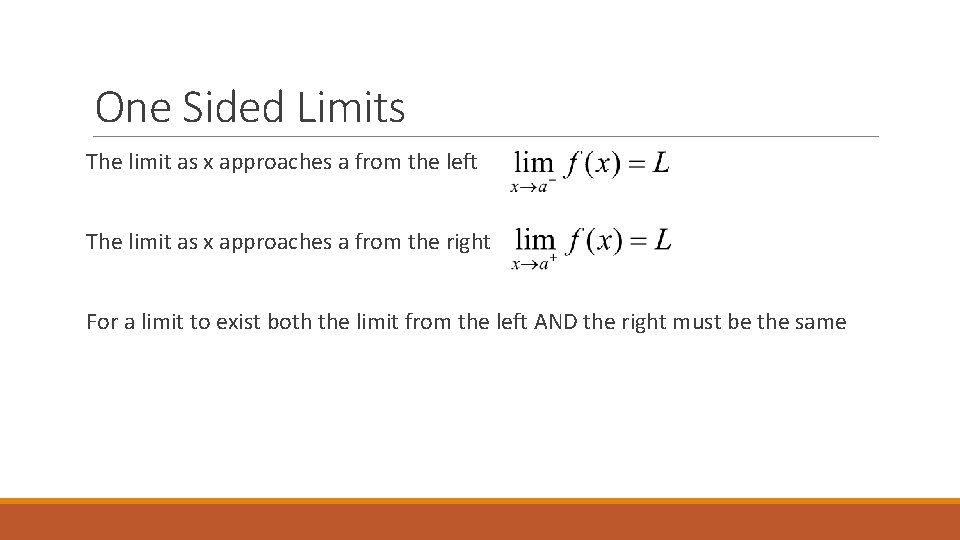
One Sided Limits The limit as x approaches a from the left The limit as x approaches a from the right For a limit to exist both the limit from the left AND the right must be the same
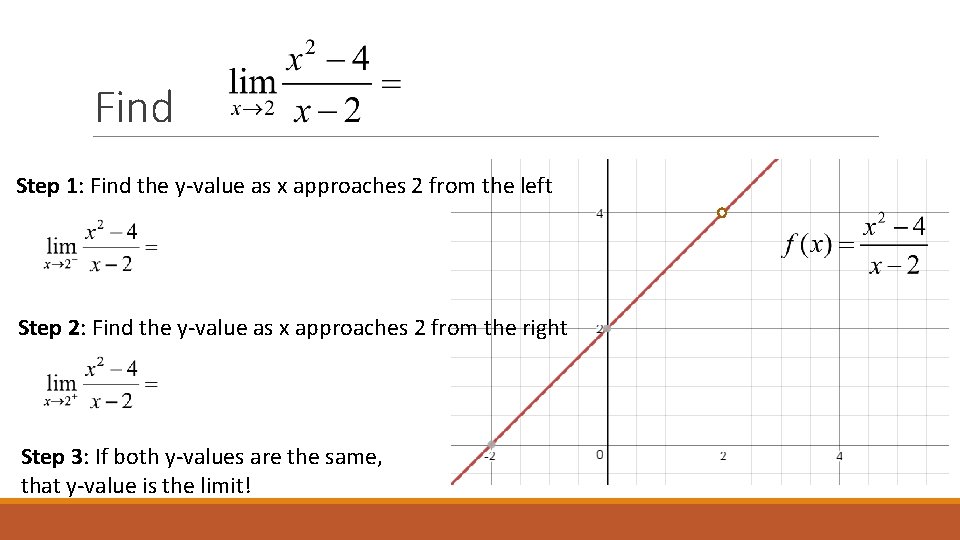
Find Step 1: Find the y-value as x approaches 2 from the left Step 2: Find the y-value as x approaches 2 from the right Step 3: If both y-values are the same, that y-value is the limit!
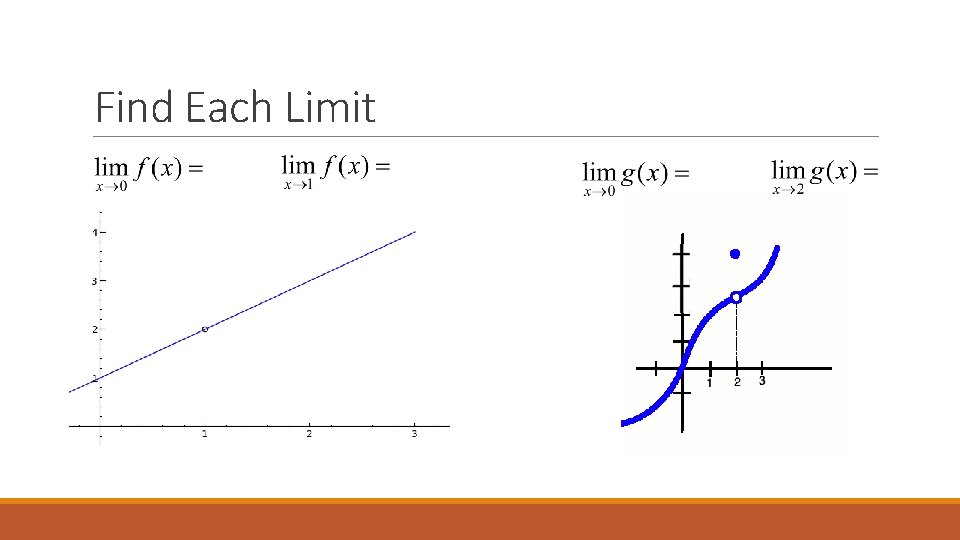
Find Each Limit
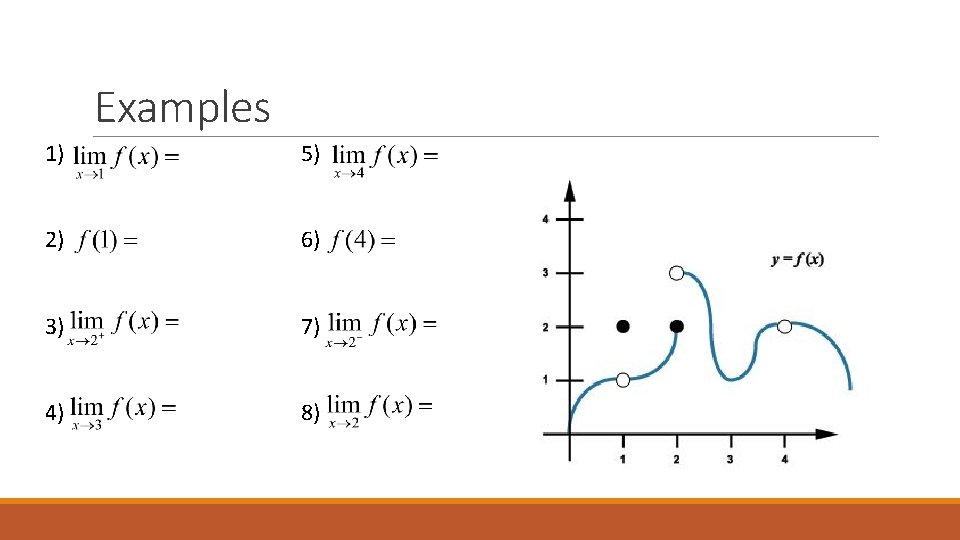
Examples 1) 5) 2) 6) 3) 7) 4) 8)
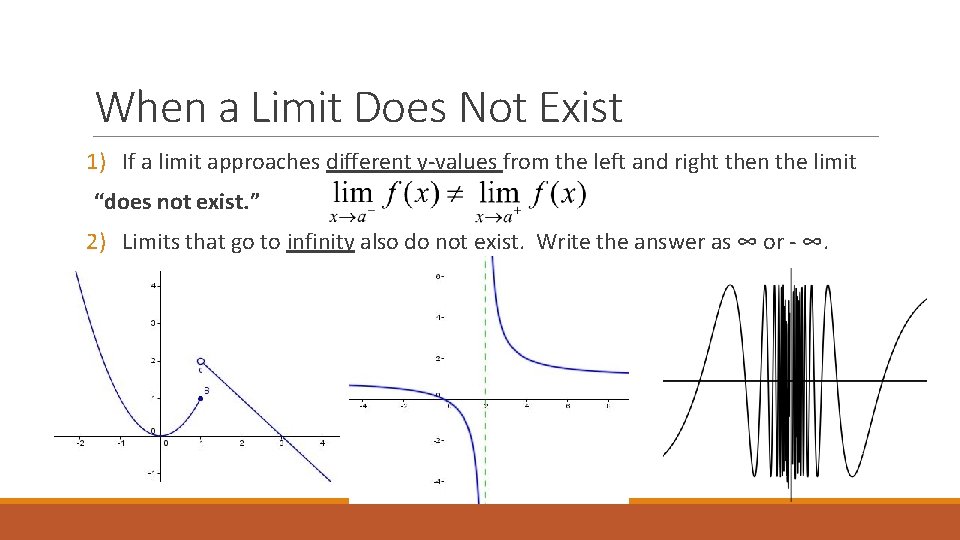
When a Limit Does Not Exist 1) If a limit approaches different y-values from the left and right then the limit “does not exist. ” 2) Limits that go to infinity also do not exist. Write the answer as ∞ or - ∞.
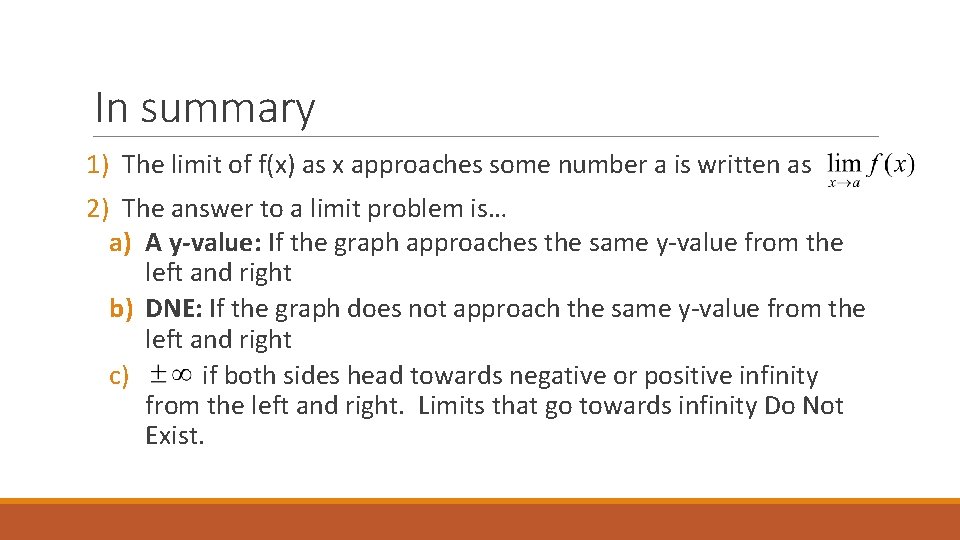
In summary 1) The limit of f(x) as x approaches some number a is written as 2) The answer to a limit problem is… a) A y-value: If the graph approaches the same y-value from the left and right b) DNE: If the graph does not approach the same y-value from the left and right c) if both sides head towards negative or positive infinity from the left and right. Limits that go towards infinity Do Not Exist.
Homework HW 1. 2: pg 54 -58 #9 -16, 25, 26, 49 -52 (Just graph to find limits, don't write paragraph)
1. 3 A Evaluating Limits Analytically HOW DO WE EVALUATE LIMITS USING ALGEBRA?
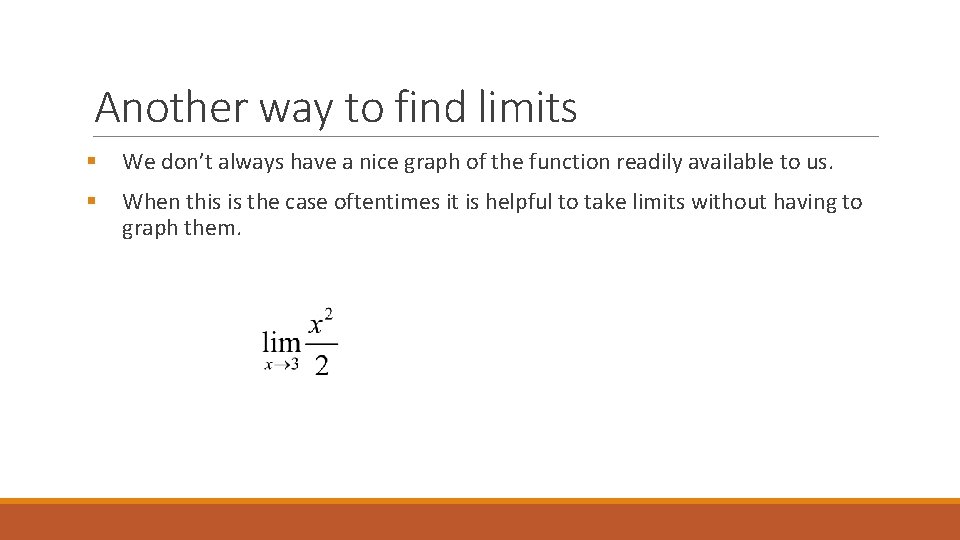
Another way to find limits § We don’t always have a nice graph of the function readily available to us. § When this is the case oftentimes it is helpful to take limits without having to graph them.
Methods we will talk about Today Plan A: Direct Substitution Plan B: Algebraic Simplification Plan C: Multiply by Conjugate (Rationalizing) Plan D: Piecewise Functions
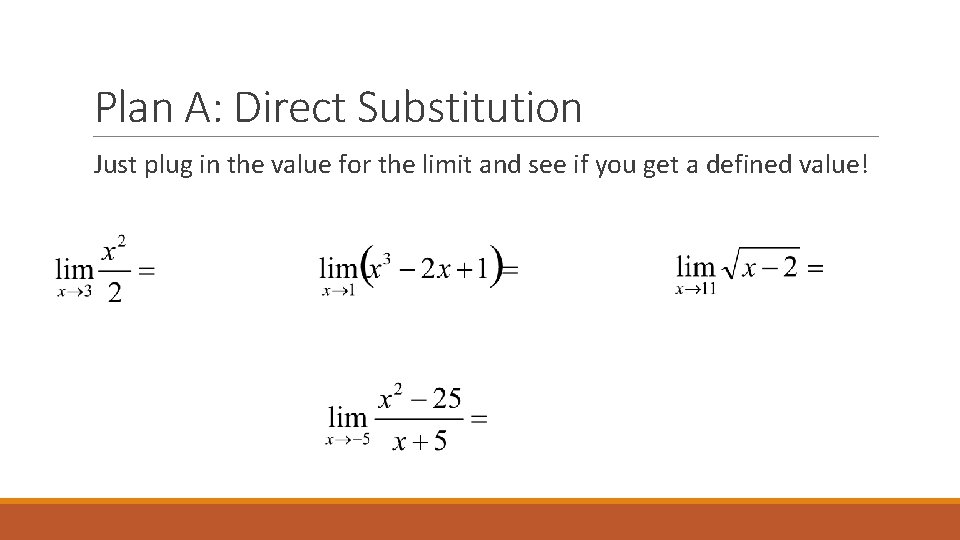
Plan A: Direct Substitution Just plug in the value for the limit and see if you get a defined value!
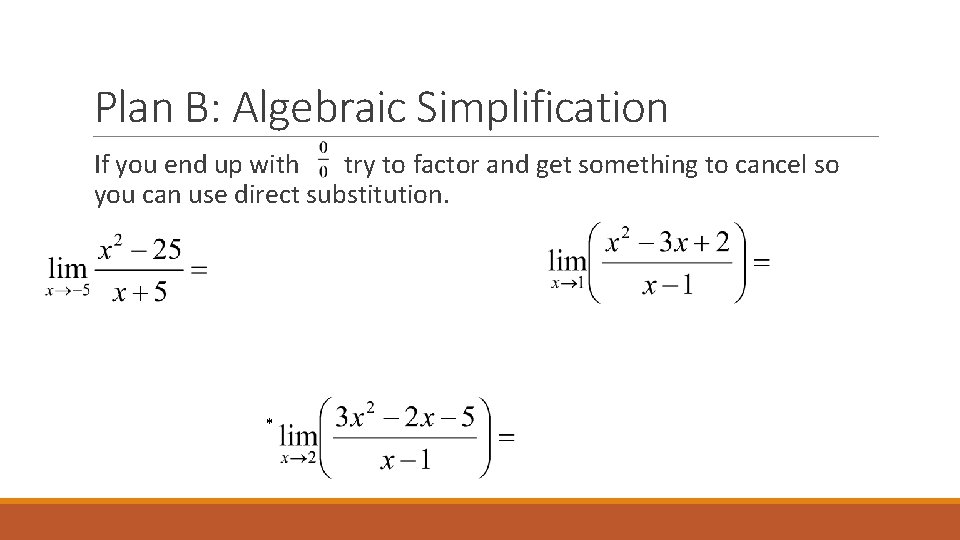
Plan B: Algebraic Simplification If you end up with try to factor and get something to cancel so you can use direct substitution. *
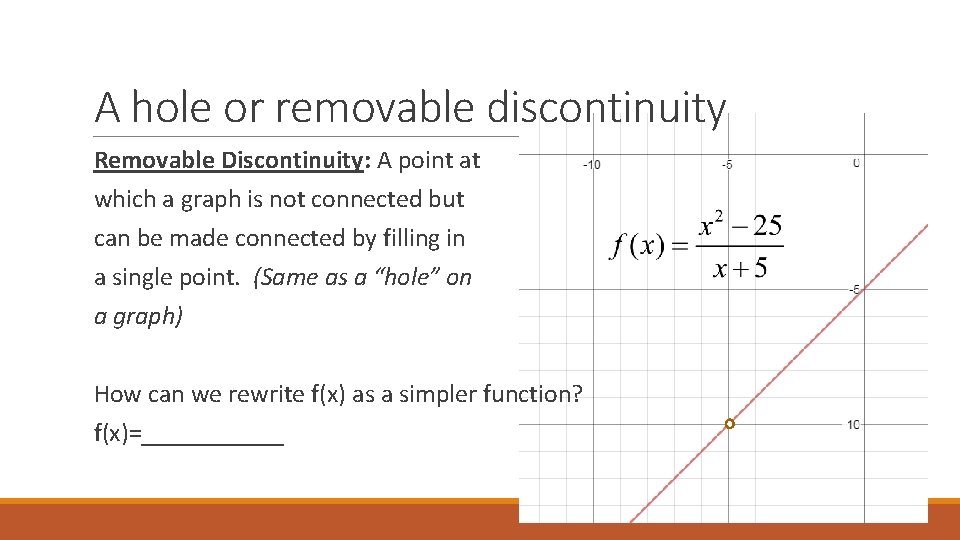
A hole or removable discontinuity Removable Discontinuity: A point at which a graph is not connected but can be made connected by filling in a single point. (Same as a “hole” on a graph) How can we rewrite f(x) as a simpler function? f(x)=______
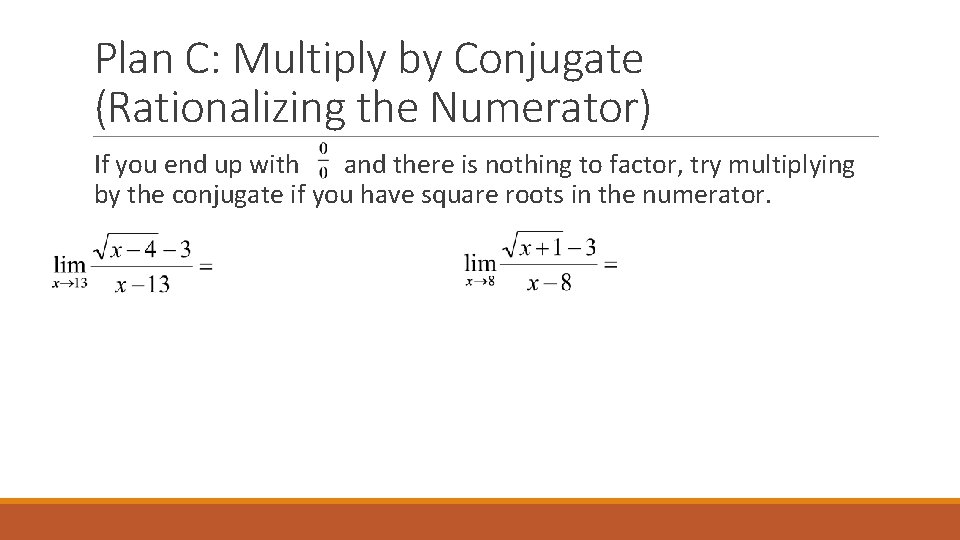
Plan C: Multiply by Conjugate (Rationalizing the Numerator) If you end up with and there is nothing to factor, try multiplying by the conjugate if you have square roots in the numerator.
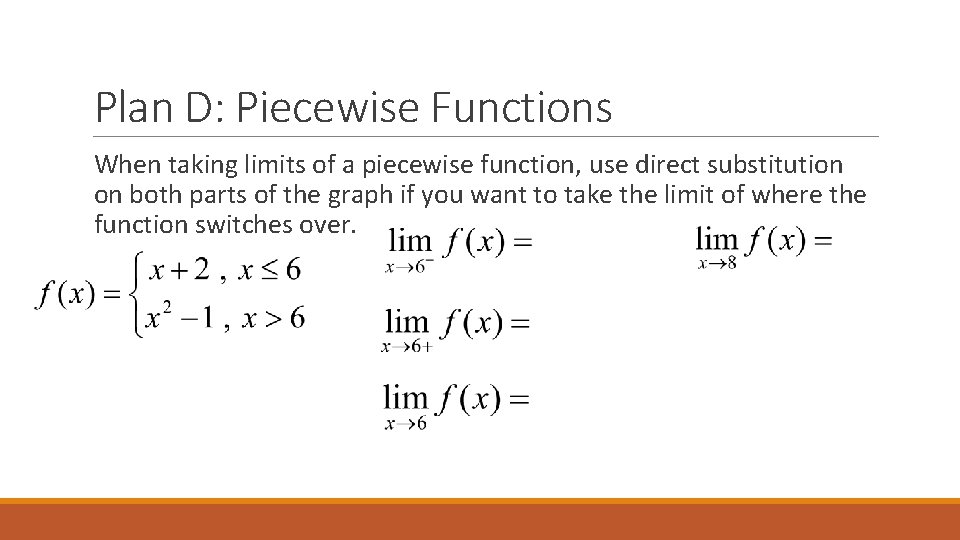
Plan D: Piecewise Functions When taking limits of a piecewise function, use direct substitution on both parts of the graph if you want to take the limit of where the function switches over.
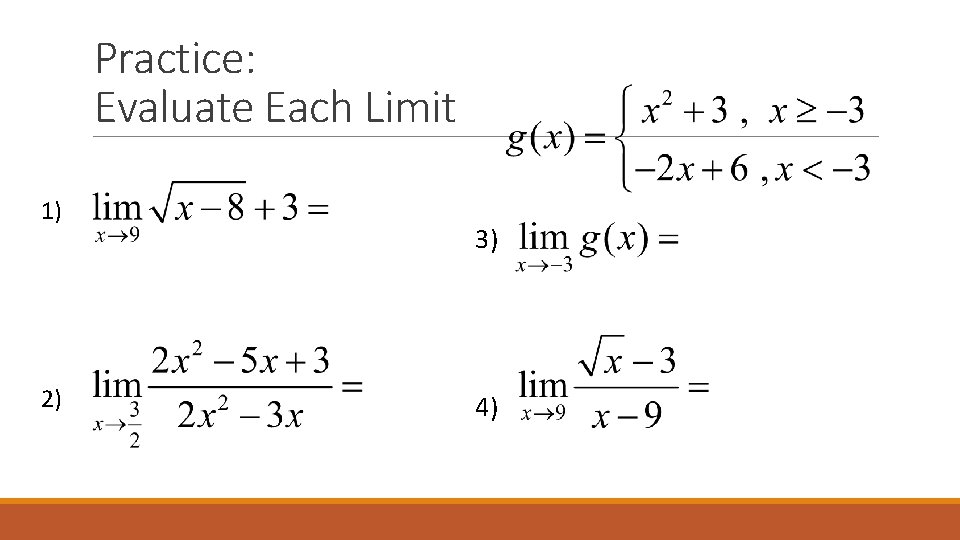
Practice: Evaluate Each Limit 1) 2) 3) 4)
In Summary Plan A: Direct Substitution: Plug in the x value (may not work) Plan B: Algebraic Simplification: Factor and Simplify etc. so that xvalues can be plugged in Plan C: Multiply by Conjugate (Rationalizing the Numerator): Multiply by conjugate of numerator and cancel so that x-values can be plugged in. (Use if you see square roots) Plan D: Piecewise Functions: Make sure to use direct substitution from left AND right hand sides if taking the limit of a place where the function switches over.
Homework HW 1. 3 A: pg 67 -68 #1, 4, 9, 13, 15, 17, 23, 4143, 49, 50, 51, 52, 55
1. 3 B Properties of Limits WHAT ARE SOME PROPERTIES OF LIMITS? HOW DO WE WORK WITH ∆X LIMITS APPROACHING 0?
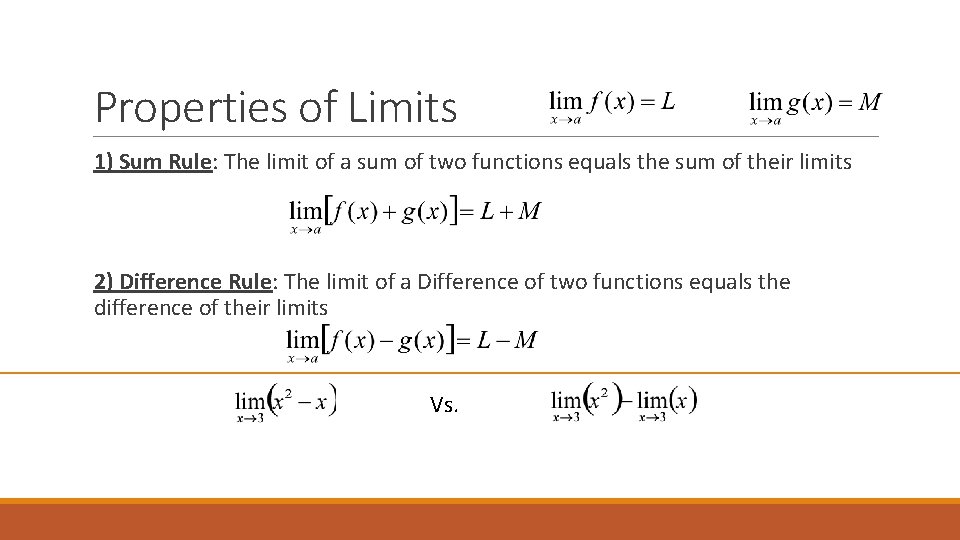
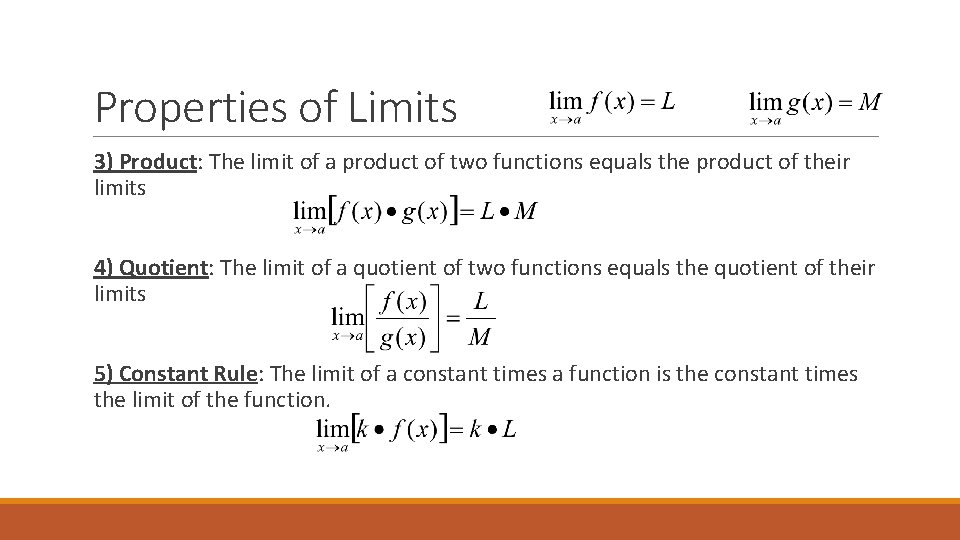
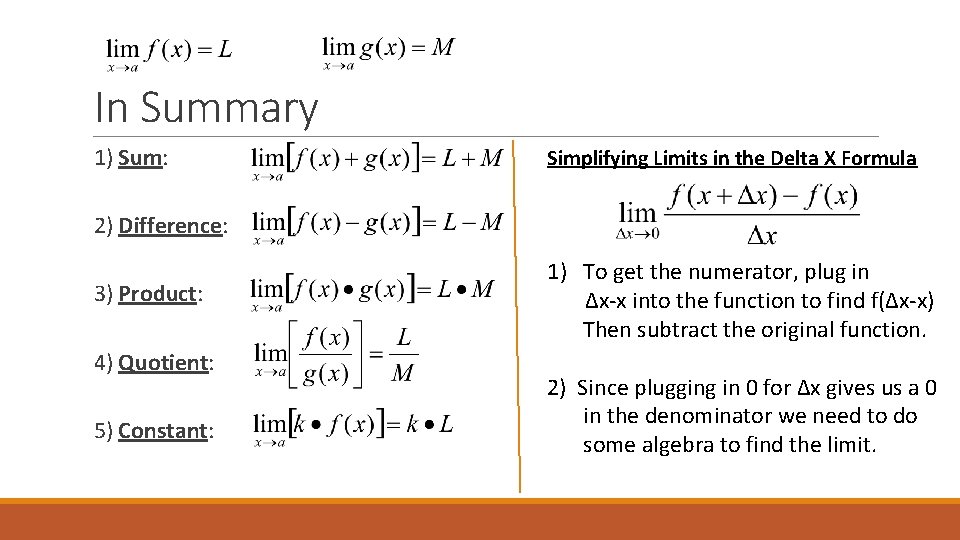
Properties of Limits 1) Sum Rule: The limit of a sum of two functions equals the sum of their limits 2) Difference Rule: The limit of a Difference of two functions equals the difference of their limits Vs.
Properties of Limits 3) Product: The limit of a product of two functions equals the product of their limits 4) Quotient: The limit of a quotient of two functions equals the quotient of their limits 5) Constant Rule: The limit of a constant times a function is the constant times the limit of the function.
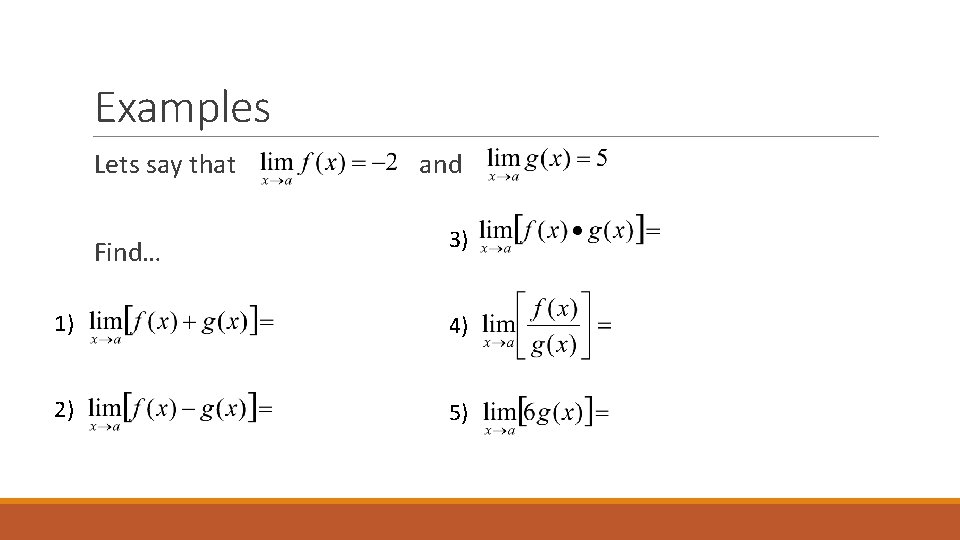
Examples Lets say that and Find… 3) 1) 4) 2) 5)
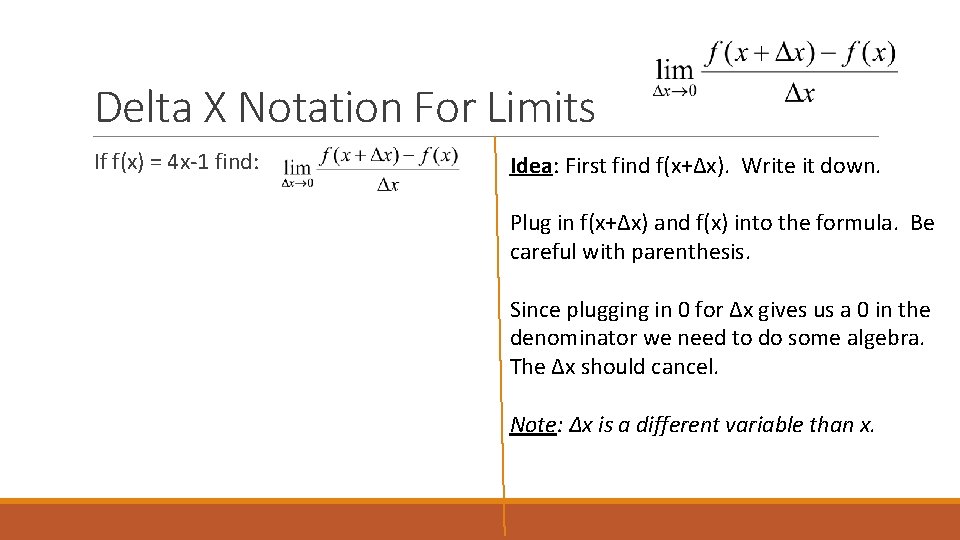
Delta X Notation For Limits If f(x) = 4 x-1 find: Idea: First find f(x+∆x). Write it down. Plug in f(x+∆x) and f(x) into the formula. Be careful with parenthesis. Since plugging in 0 for ∆x gives us a 0 in the denominator we need to do some algebra. The ∆x should cancel. Note: ∆x is a different variable than x.
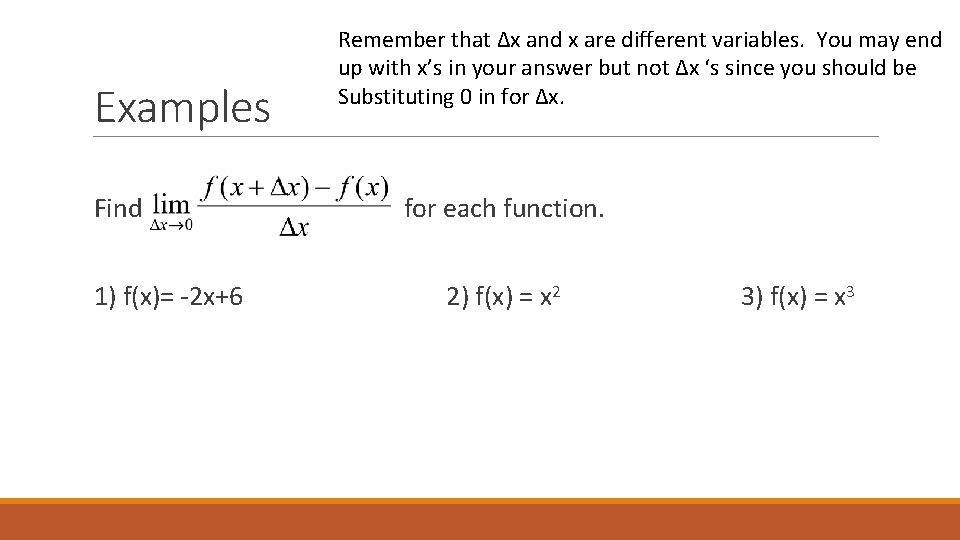
Examples Find 1) f(x)= -2 x+6 Remember that ∆x and x are different variables. You may end up with x’s in your answer but not ∆x ‘s since you should be Substituting 0 in for ∆x. for each function. 2) f(x) = x 2 3) f(x) = x 3
In Summary 1) Sum: Simplifying Limits in the Delta X Formula 2) Difference: 3) Product: 4) Quotient: 5) Constant: 1) To get the numerator, plug in ∆x-x into the function to find f(∆x-x) Then subtract the original function. 2) Since plugging in 0 for ∆x gives us a 0 in the denominator we need to do some algebra to find the limit.
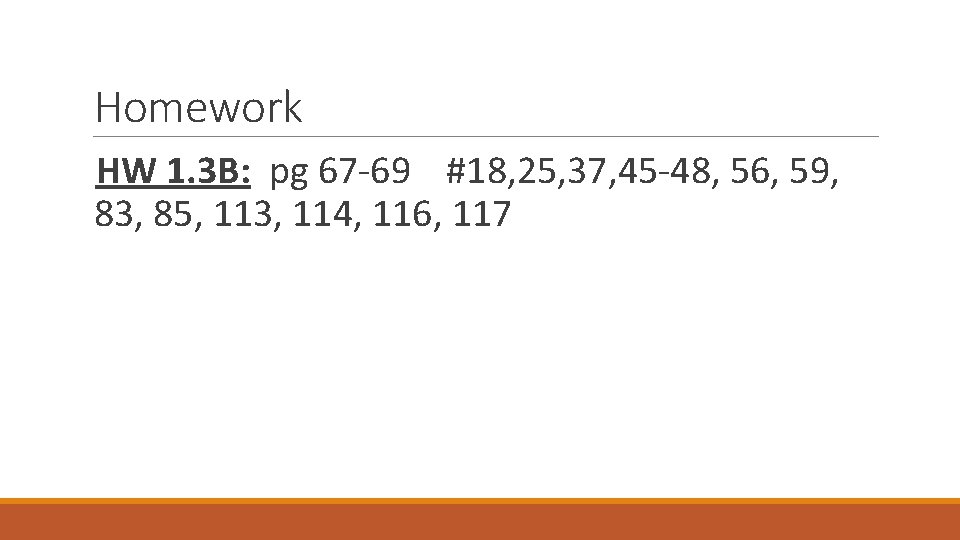
Homework HW 1. 3 B: pg 67 -69 #18, 25, 37, 45 -48, 56, 59, 83, 85, 113, 114, 116, 117
1. 3 C Special Trig Limits WHAT ARE SOME SPECIAL TRIG LIMITS WE NEED TO KNOW? WHAT TRIG IS MOST IMPORTANT TO REMEMBER FOR THE AP TEST?
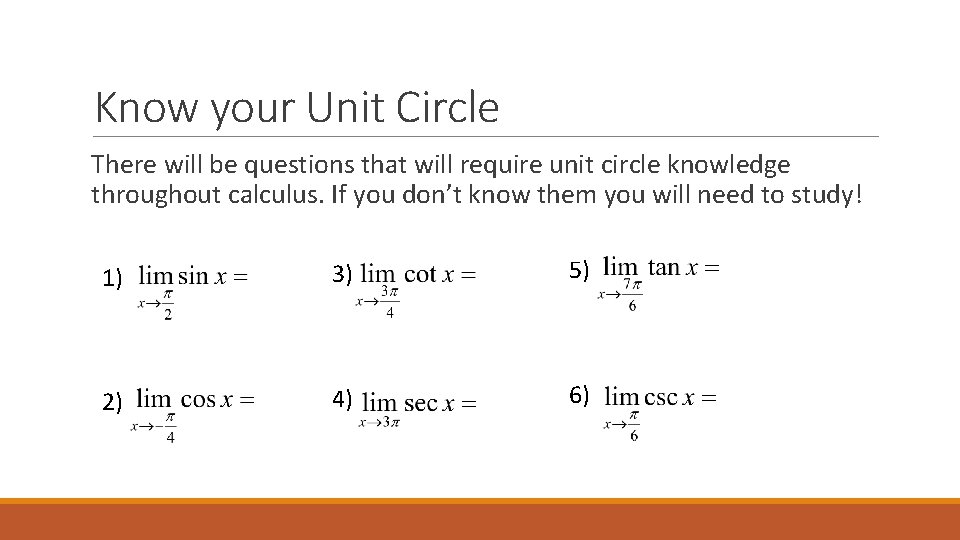
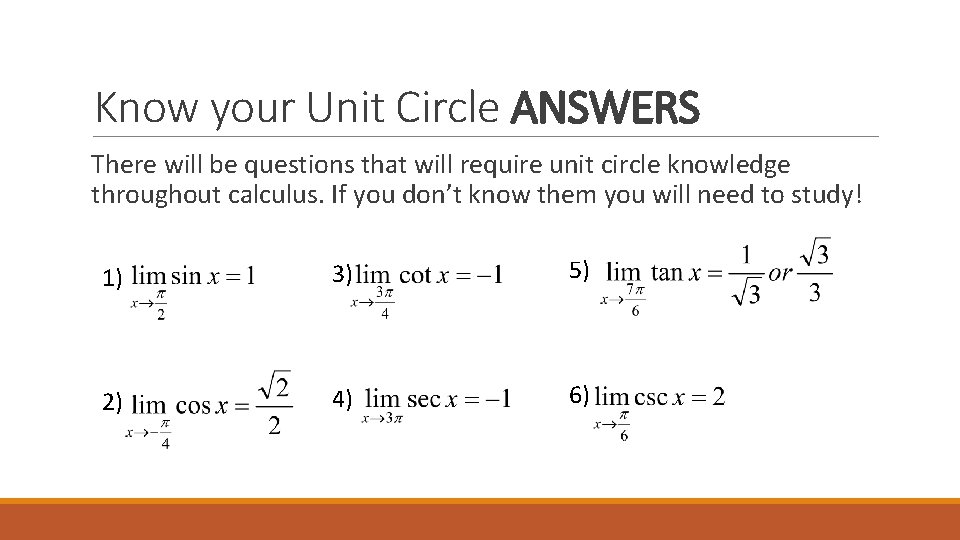
Know your Unit Circle There will be questions that will require unit circle knowledge throughout calculus. If you don’t know them you will need to study! 1) 3) 5) 2) 4) 6)
Know your Unit Circle ANSWERS There will be questions that will require unit circle knowledge throughout calculus. If you don’t know them you will need to study! 1) 3) 5) 2) 4) 6)
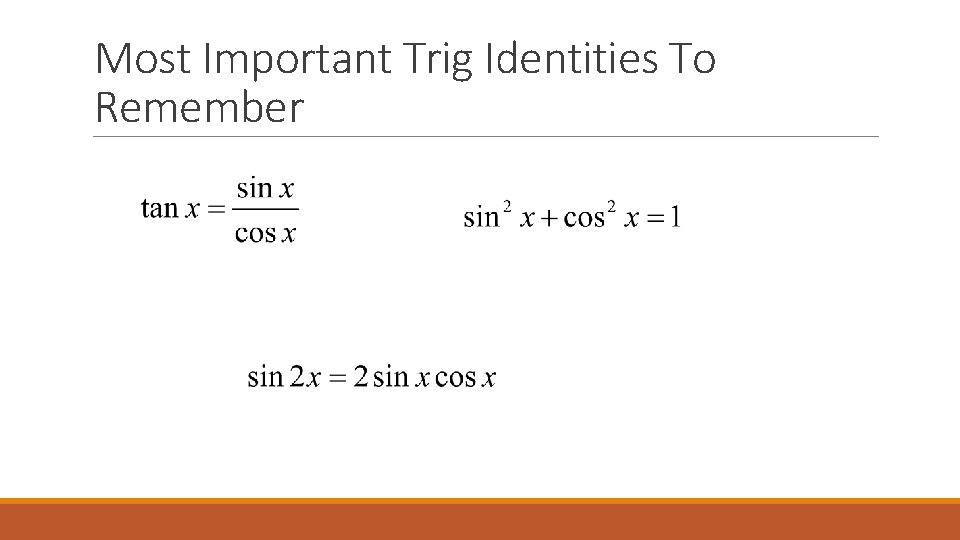
Most Important Trig Identities To Remember
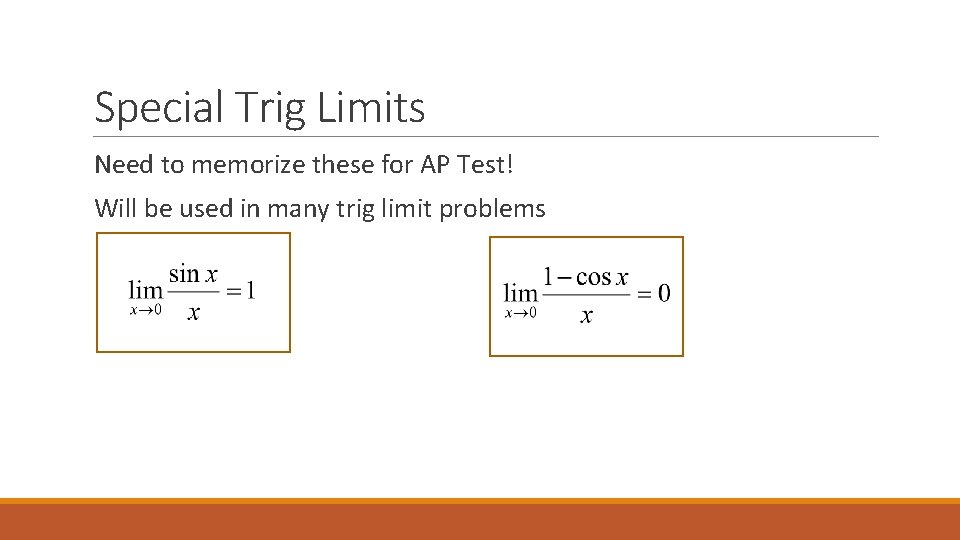
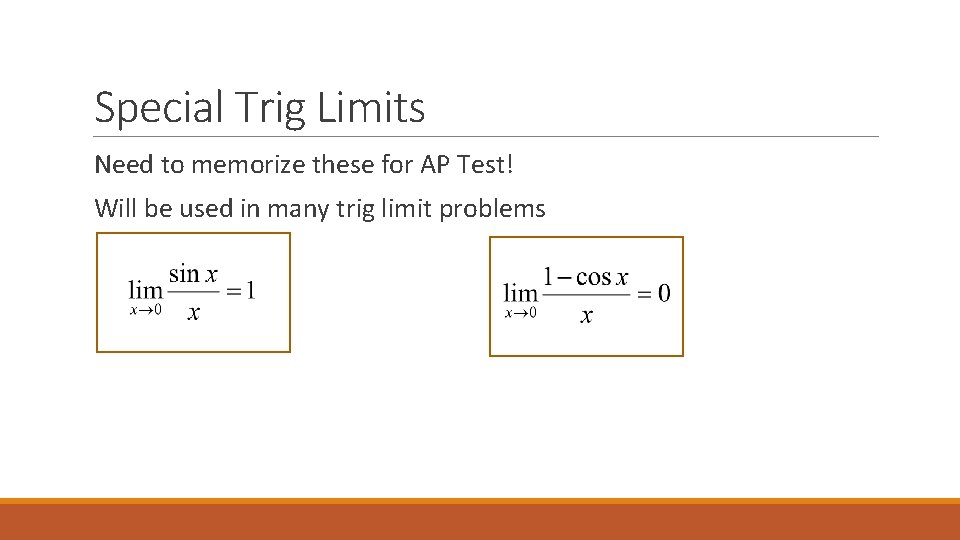
Special Trig Limits Need to memorize these for AP Test! Will be used in many trig limit problems
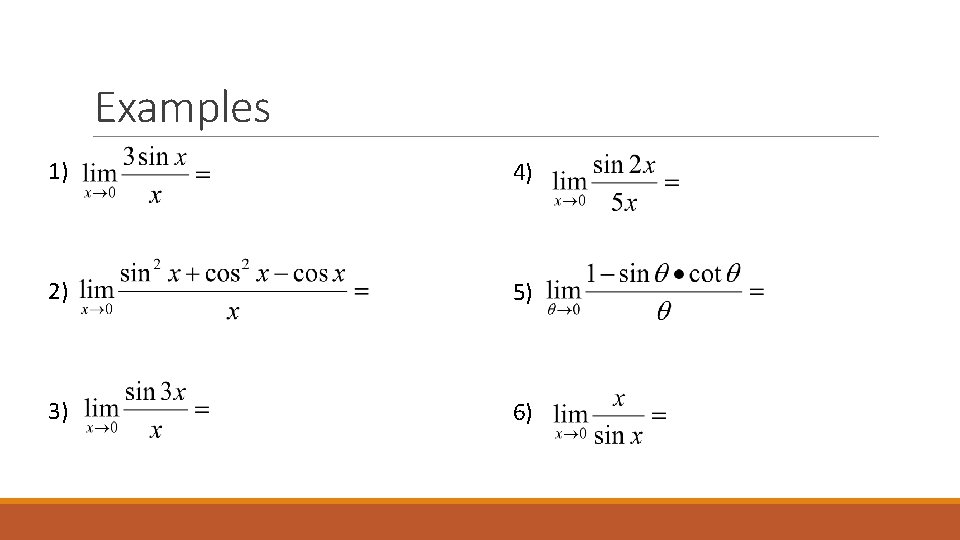
Examples 1) 4) 2) 5) 3) 6)
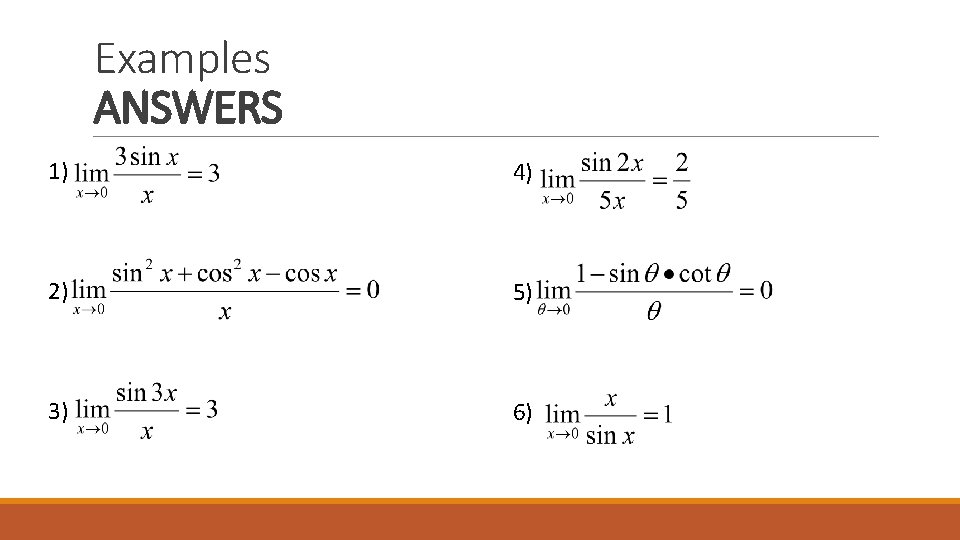
Examples ANSWERS 1) 4) 2) 5) 3) 6)
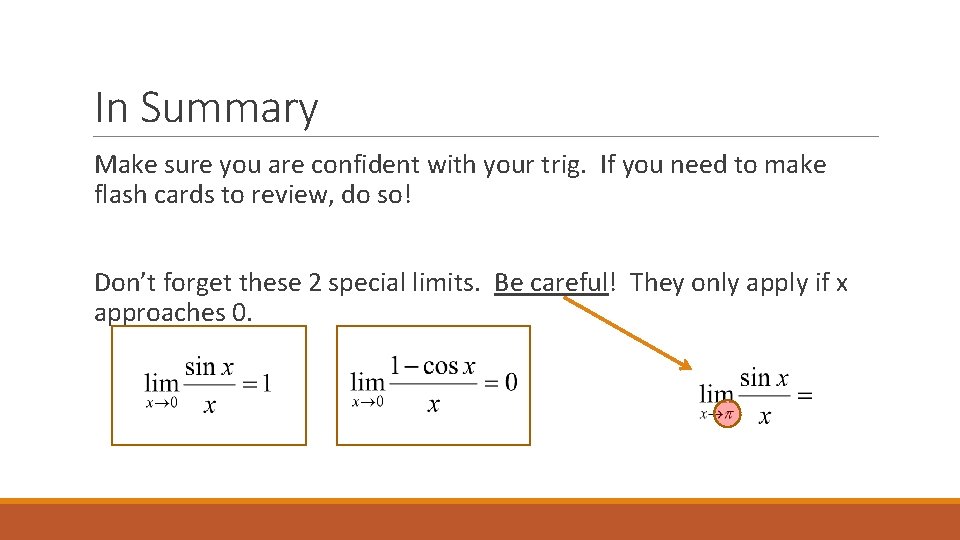
In Summary Make sure you are confident with your trig. If you need to make flash cards to review, do so! Don’t forget these 2 special limits. Be careful! They only apply if x approaches 0.
Homework HW 1. 3 C: pg 67 -69 #3, 27 -36, 67 -75, 77
1. 5 Infinite Limits WHAT ARE SOME PROPERTIES OF LIMITS? HOW DO WE WORK WITH ∆X LIMITS APPROACHING 0?
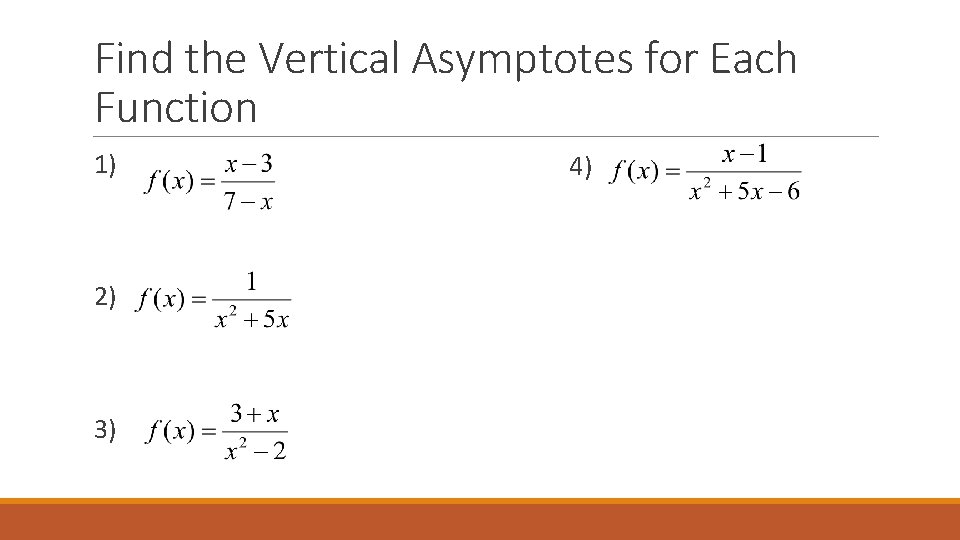
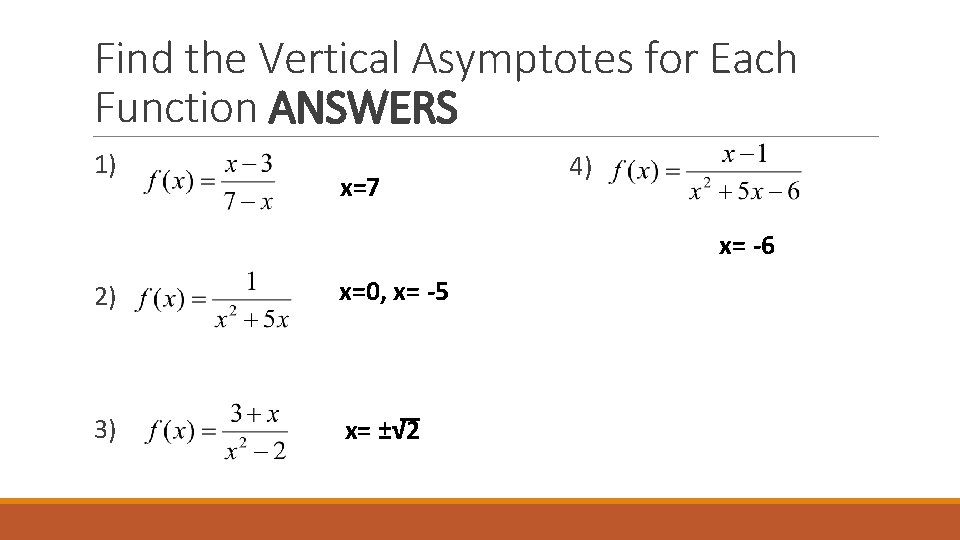
Find the Vertical Asymptotes for Each Function 1) 2) 3) 4)
Find the Vertical Asymptotes for Each Function ANSWERS 1) x=7 4) x= -6 2) x=0, x= -5 3) x= ±√ 2
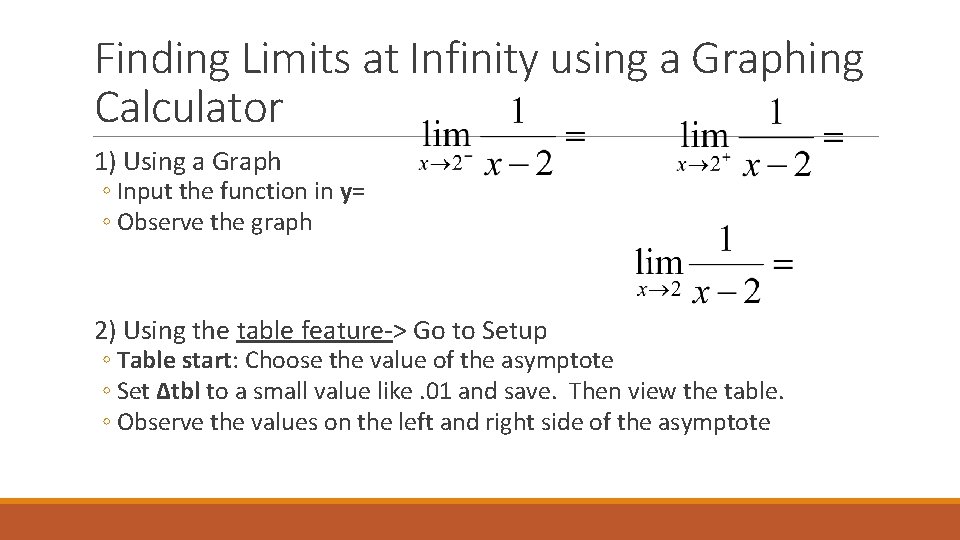
Finding Limits at Infinity using a Graphing Calculator 1) Using a Graph ◦ Input the function in y= ◦ Observe the graph 2) Using the table feature-> Go to Setup ◦ Table start: Choose the value of the asymptote ◦ Set ∆tbl to a small value like. 01 and save. Then view the table. ◦ Observe the values on the left and right side of the asymptote
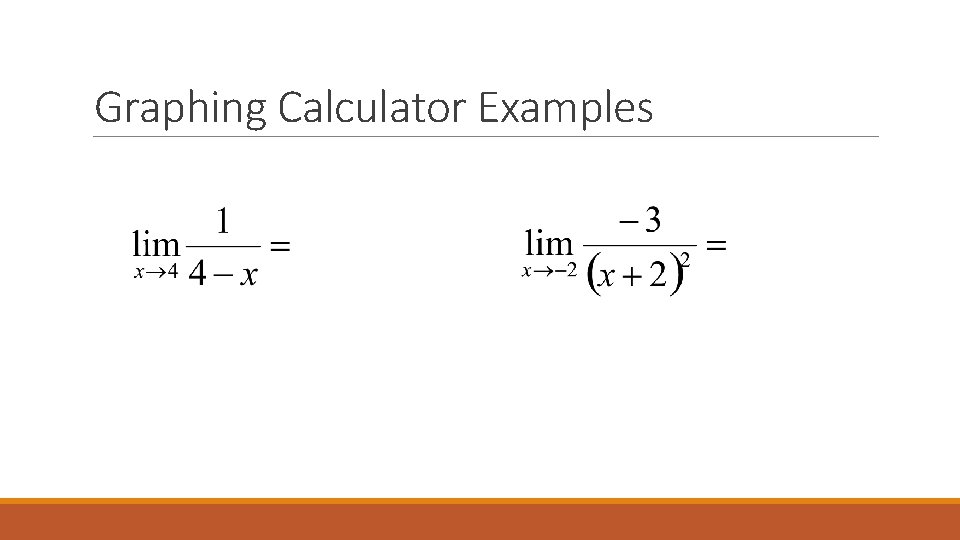
Graphing Calculator Examples
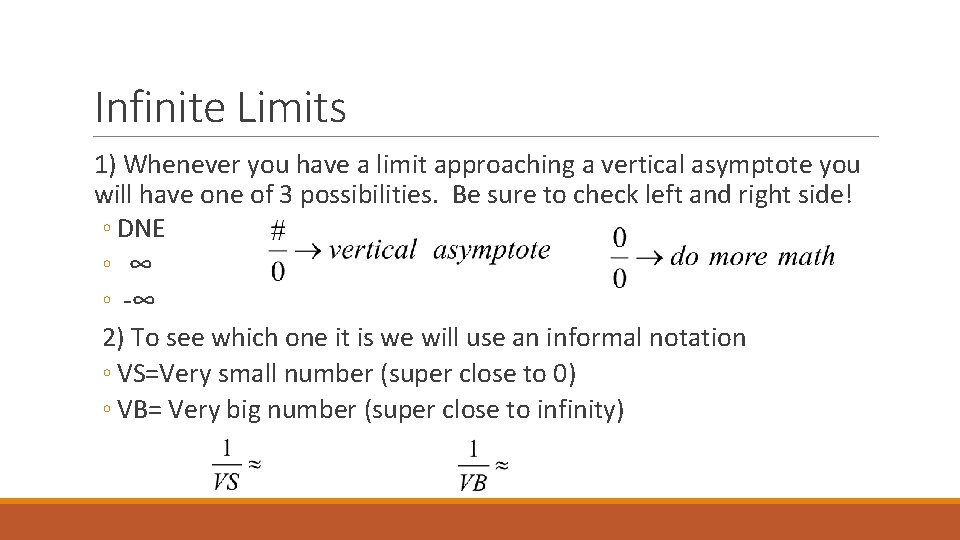
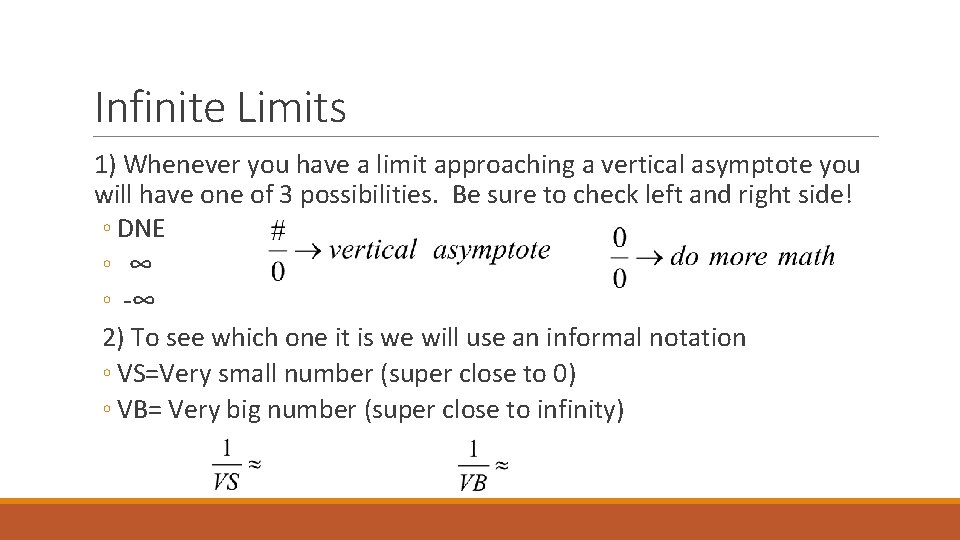
Infinite Limits 1) Whenever you have a limit approaching a vertical asymptote you will have one of 3 possibilities. Be sure to check left and right side! ◦ DNE ◦ ∞ ◦ -∞ 2) To see which one it is we will use an informal notation ◦ VS=Very small number (super close to 0) ◦ VB= Very big number (super close to infinity)
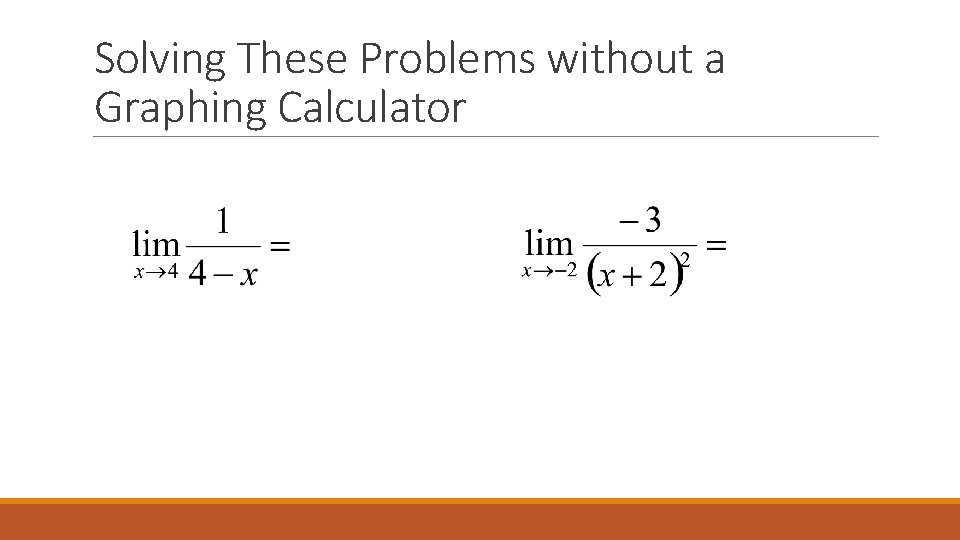
Solving These Problems without a Graphing Calculator
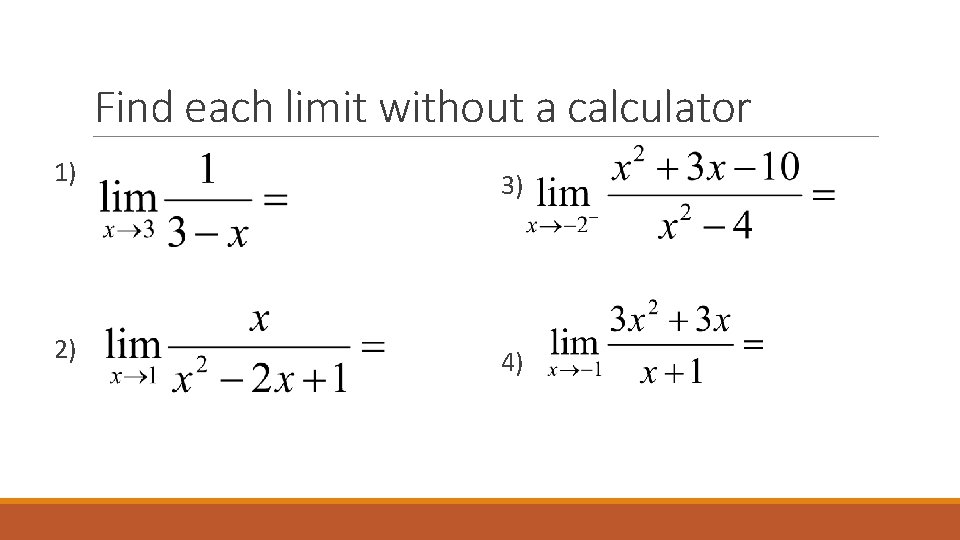
Find each limit without a calculator 1) 3) 2) 4)
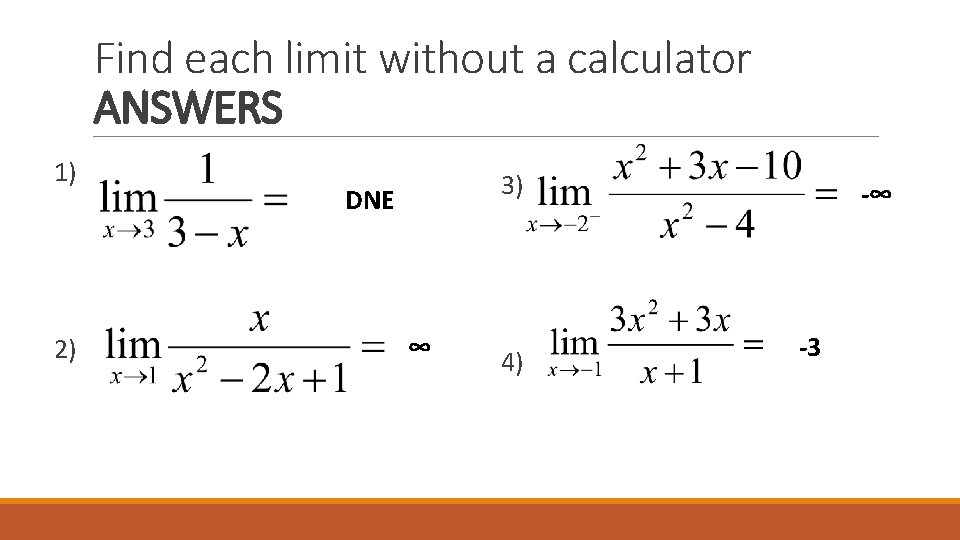
Find each limit without a calculator ANSWERS 1) 2) 3) DNE ∞ 4) -∞ -3
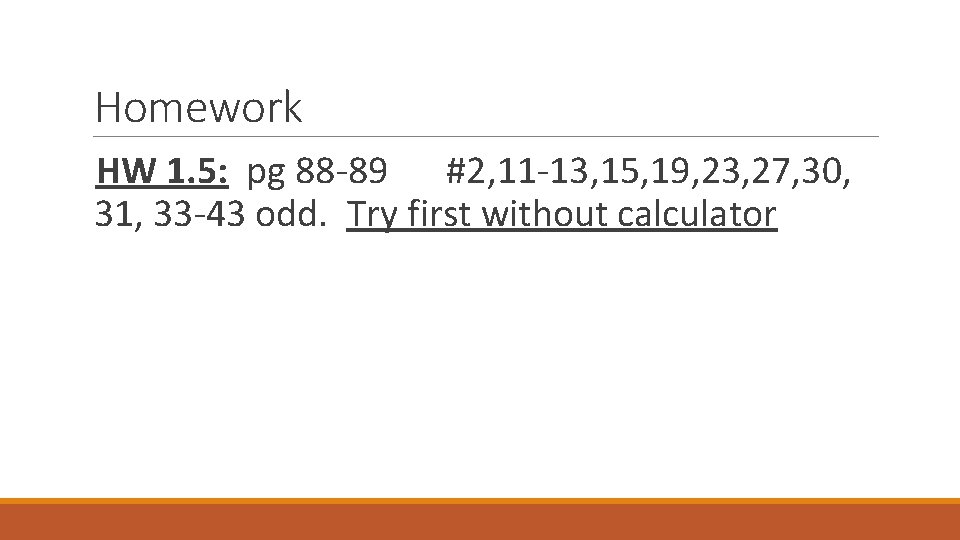
Homework HW 1. 5: pg 88 -89 #2, 11 -13, 15, 19, 23, 27, 30, 31, 33 -43 odd. Try first without calculator
3. 5 Limits at Infinity HOW DO WE EVALUATE LIMITS APPROACHING ∞ ? HOW DO WE EVALUATE ABSOLUTE VALUE LIMITS?
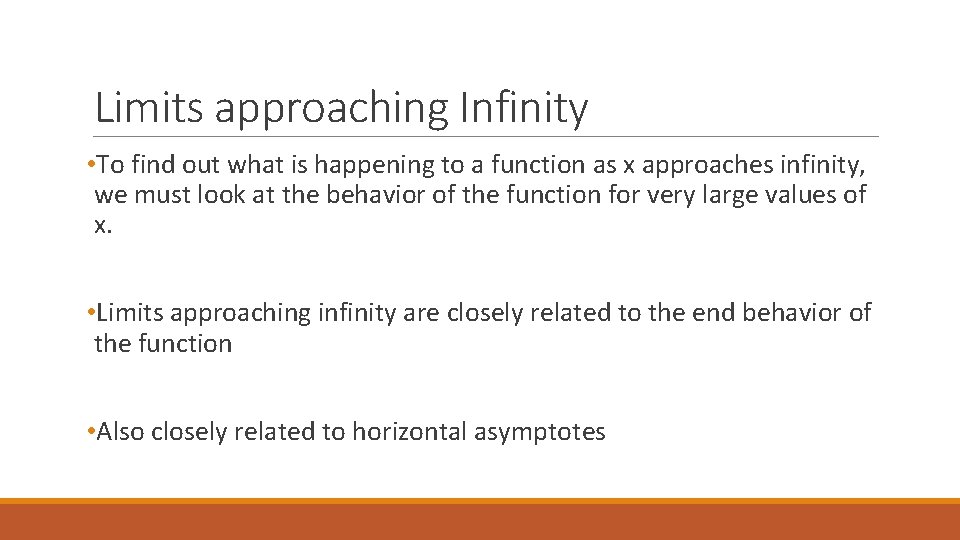
Limits approaching Infinity • To find out what is happening to a function as x approaches infinity, we must look at the behavior of the function for very large values of x. • Limits approaching infinity are closely related to the end behavior of the function • Also closely related to horizontal asymptotes
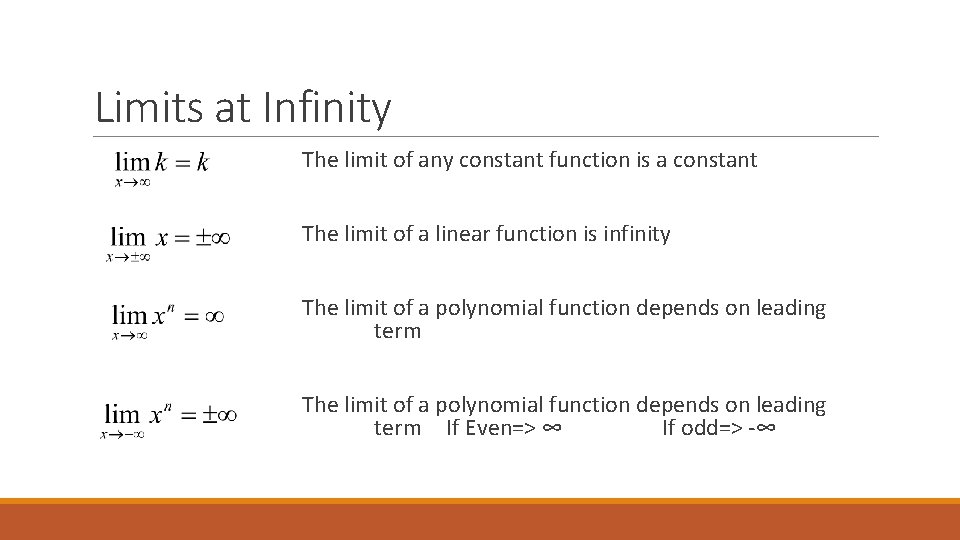
Limits at Infinity The limit of any constant function is a constant The limit of a linear function is infinity The limit of a polynomial function depends on leading term The limit of a polynomial function depends on leading term If Even=> ∞ If odd=> -∞
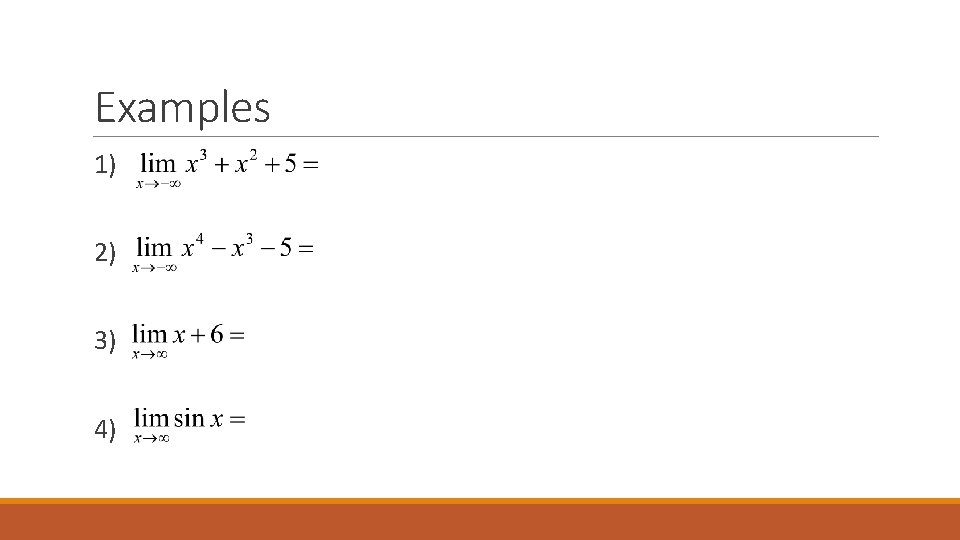
Examples 1) 2) 3) 4)
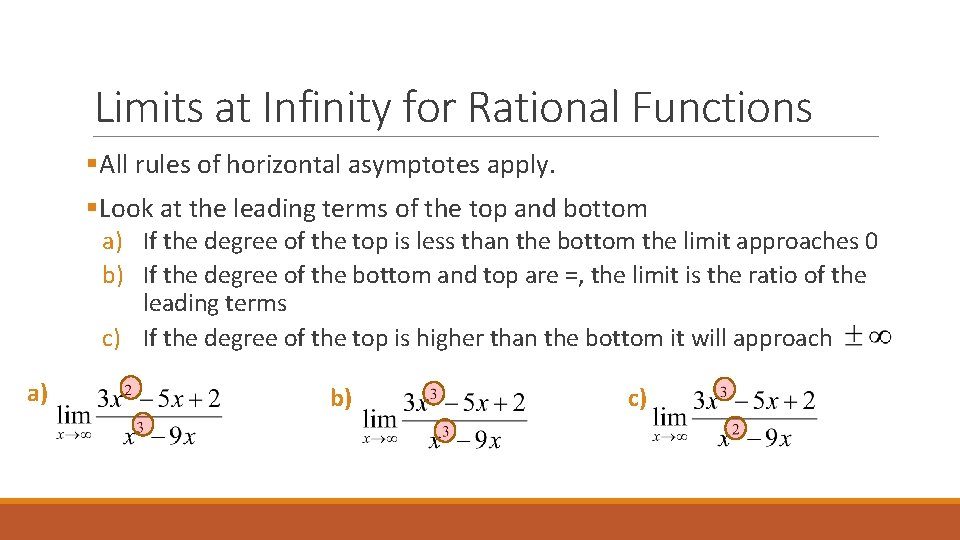
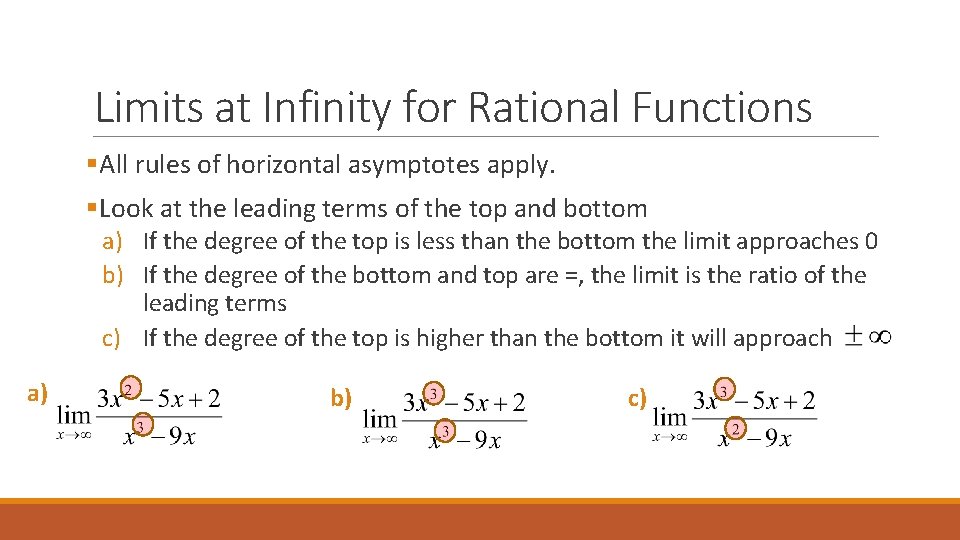
Limits at Infinity for Rational Functions §All rules of horizontal asymptotes apply. §Look at the leading terms of the top and bottom a) If the degree of the top is less than the bottom the limit approaches 0 b) If the degree of the bottom and top are =, the limit is the ratio of the leading terms c) If the degree of the top is higher than the bottom it will approach a) b) c)
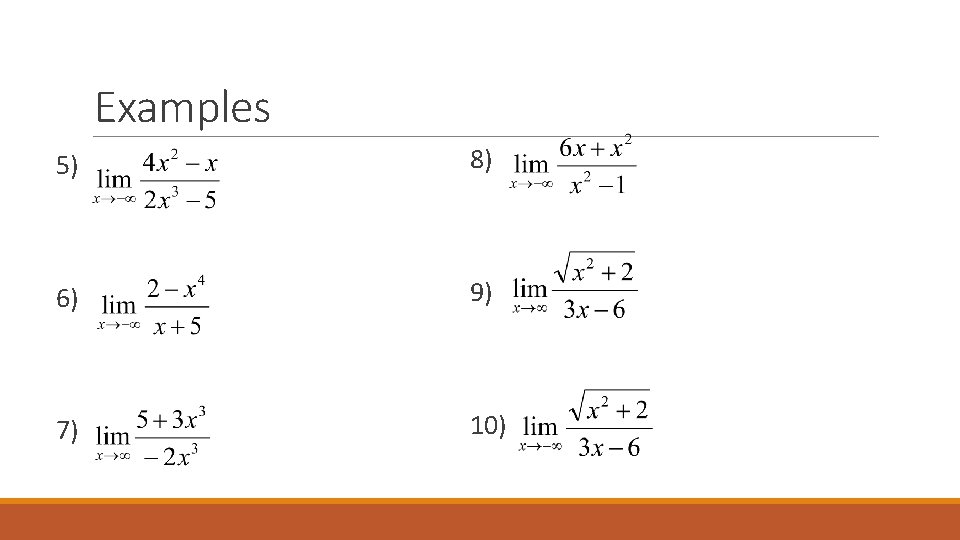
Examples 5) 8) 6) 9) 7) 10)
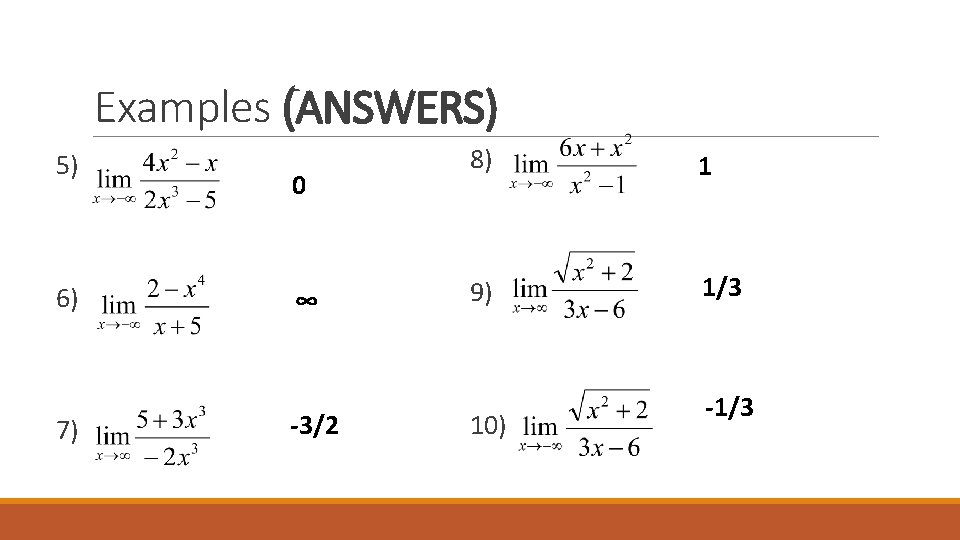
Examples (ANSWERS) 5) 6) 7) 0 ∞ -3/2 8) 1 9) 1/3 10) -1/3
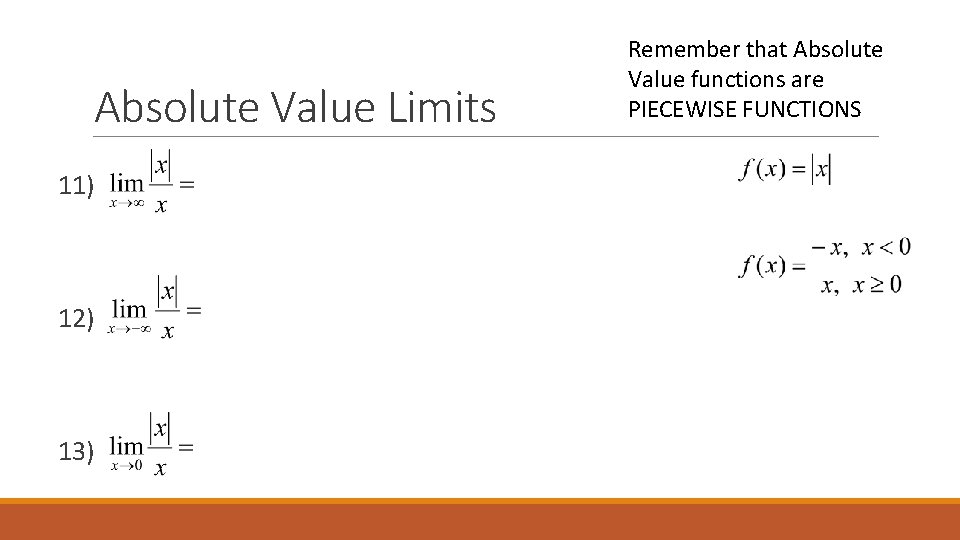
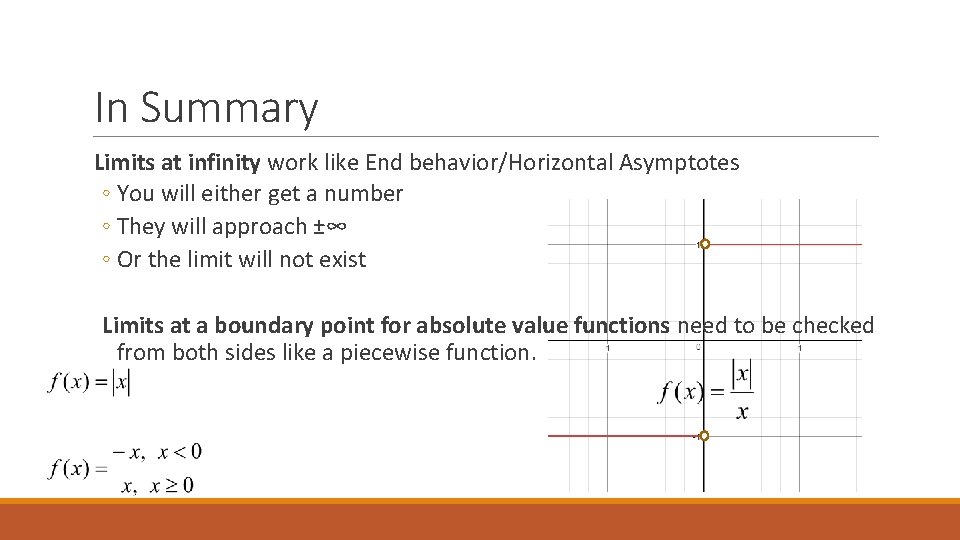
Absolute Value Limits 11) 12) 13) Remember that Absolute Value functions are PIECEWISE FUNCTIONS
In Summary Limits at infinity work like End behavior/Horizontal Asymptotes ◦ You will either get a number ◦ They will approach ±∞ ◦ Or the limit will not exist Limits at a boundary point for absolute value functions need to be checked from both sides like a piecewise function.
Homework HW 3. 5 A: pg 205 -207 34, 58, 65, 69 #17, 18, 20 -27, 30 -32,
Limits Review HOW DO WE FIND ANY LIMIT?
Kahoot Review https: //play. kahoot. it/#/? quiz. Id=e 3 ea 41 e 3 -66 af-4708 -9363 -9 f 97713 d 7152
Homework HW 3. 5 B: Limit Review A Worksheet
Continuity HO W DO W E DETERMINE I F A F UNC TIO N IS CONT INUOUS? WH AT IS T HE INTERMEDIAT E VALU E THEO REM? WH AT A RE S OME TYPES O F DIS CO NTINU ITIES ?
Continuous Functions Can be drawn without picking up your pencil Most real life scenarios involve continuous functions Continuity of a function is an important piece of information in a calculus problem because it allows us to do many other processes that we will learn later.
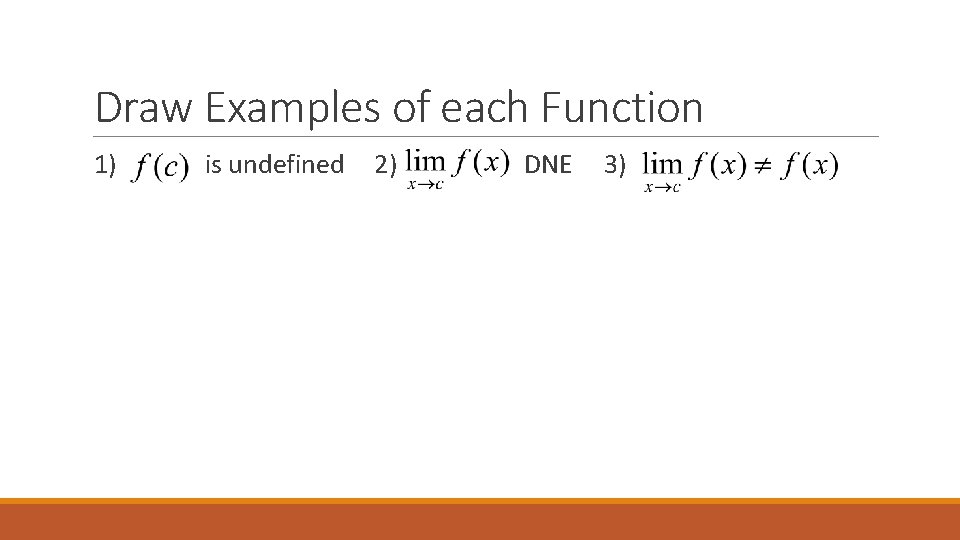
Draw Examples of each Function 1) is undefined 2) DNE 3)
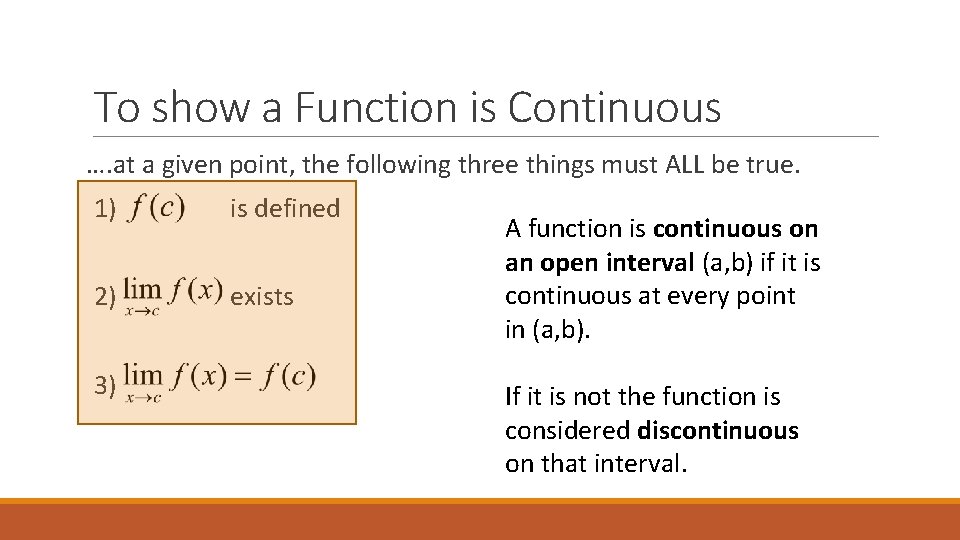
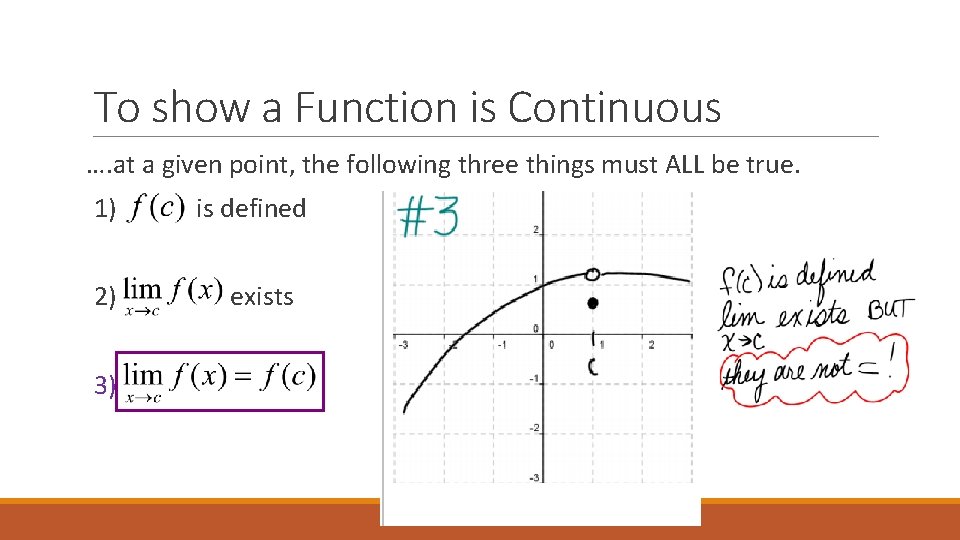
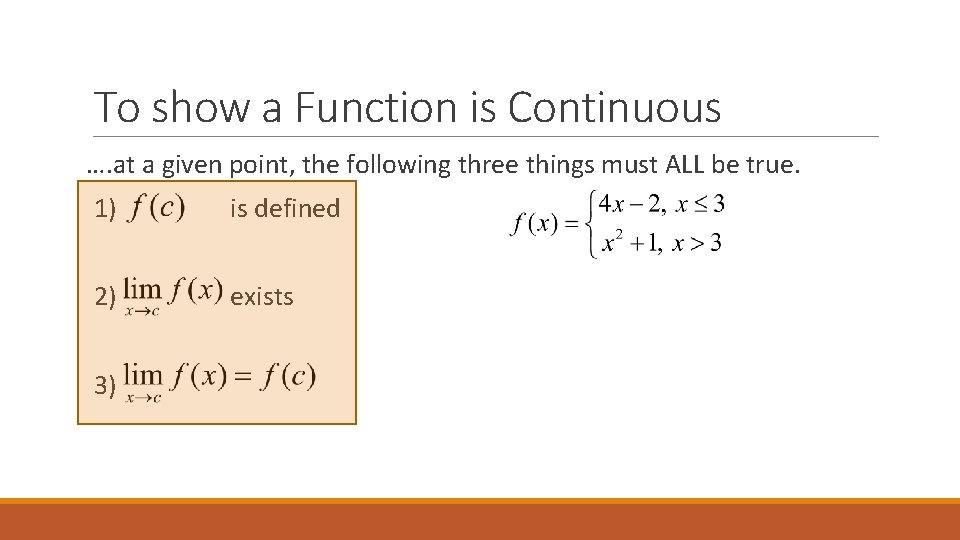
To show a Function is Continuous …. at a given point, the following three things must ALL be true. 1) 2) 3) is defined exists A function is continuous on an open interval (a, b) if it is continuous at every point in (a, b). If it is not the function is considered discontinuous on that interval.
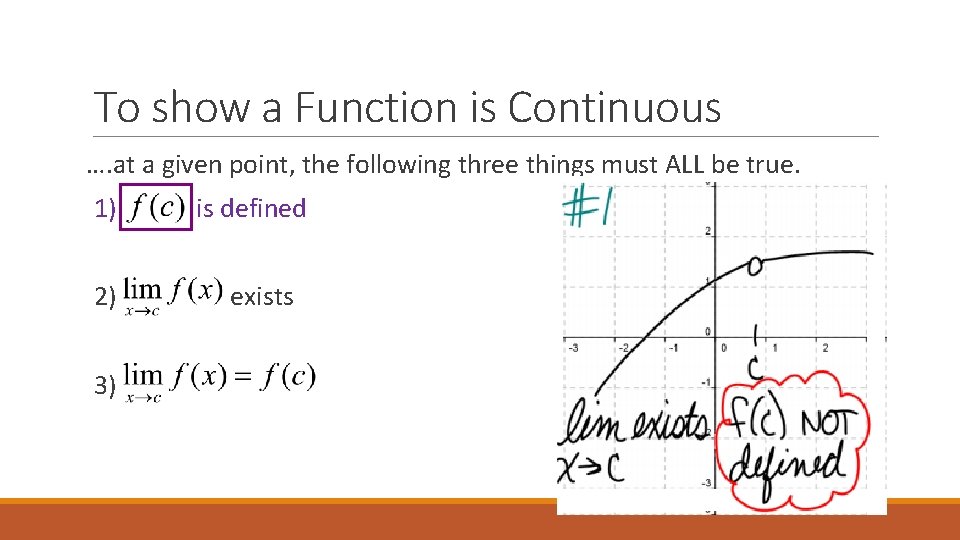
To show a Function is Continuous …. at a given point, the following three things must ALL be true. 1) is defined 2) exists 3)
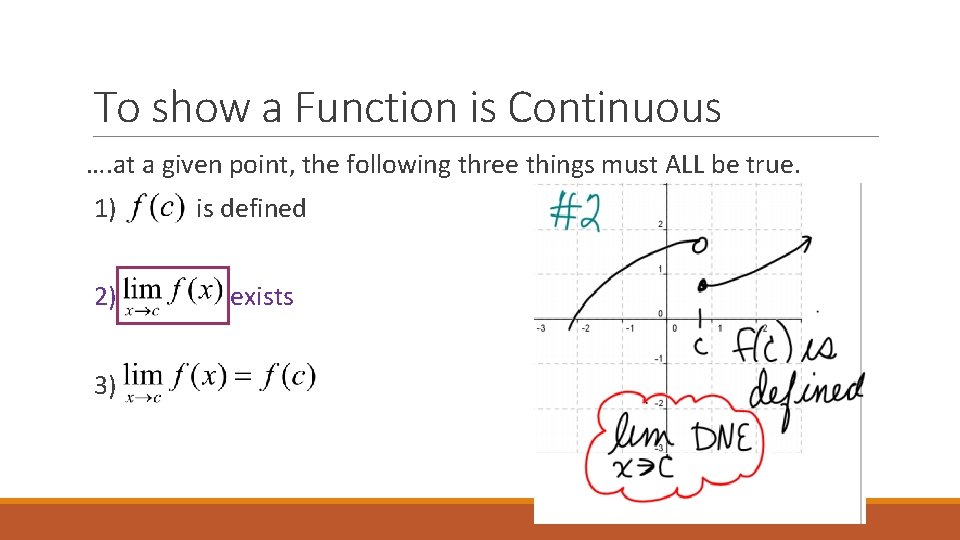
To show a Function is Continuous …. at a given point, the following three things must ALL be true. 1) is defined 2) exists 3)
To show a Function is Continuous …. at a given point, the following three things must ALL be true. 1) is defined 2) exists 3)
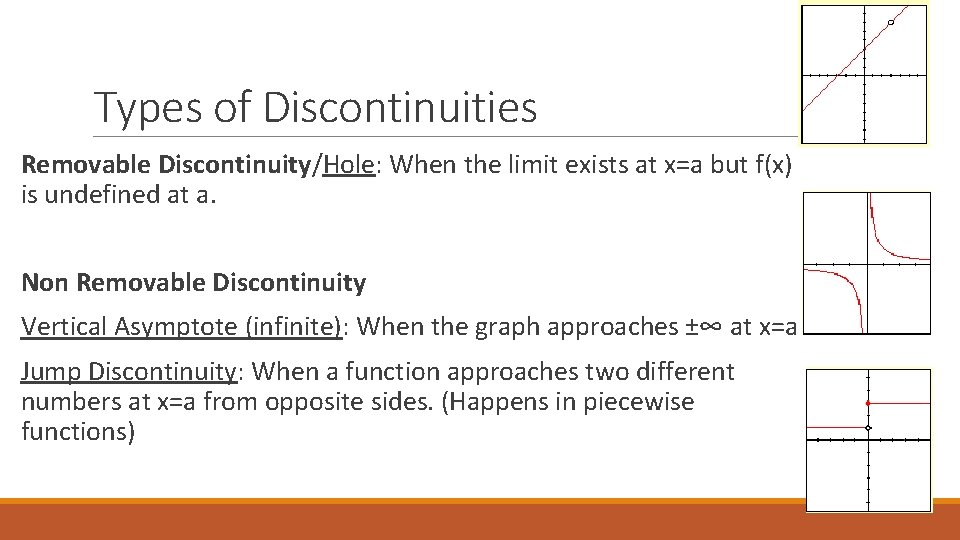
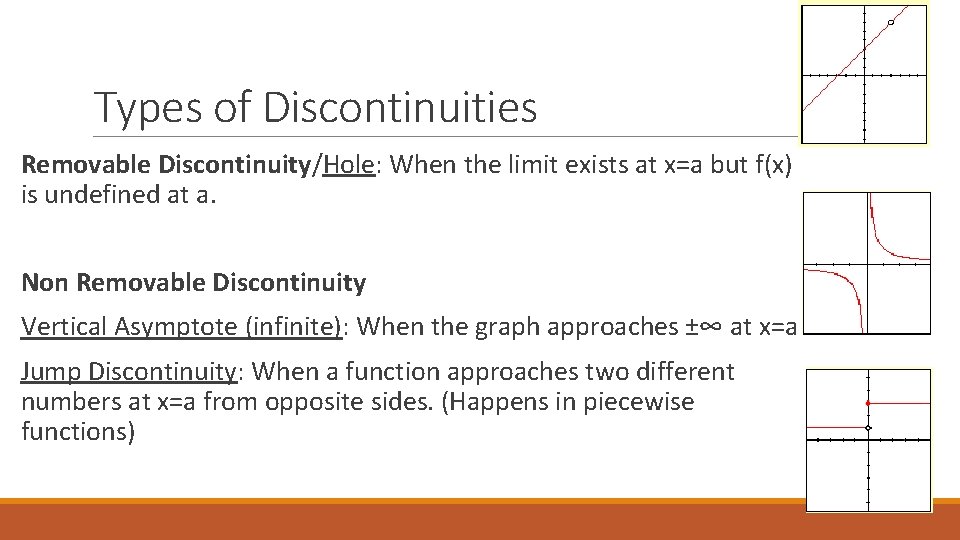
Types of Discontinuities Removable Discontinuity/Hole: When the limit exists at x=a but f(x) is undefined at a. Non Removable Discontinuity Vertical Asymptote (infinite): When the graph approaches ±∞ at x=a Jump Discontinuity: When a function approaches two different numbers at x=a from opposite sides. (Happens in piecewise functions)
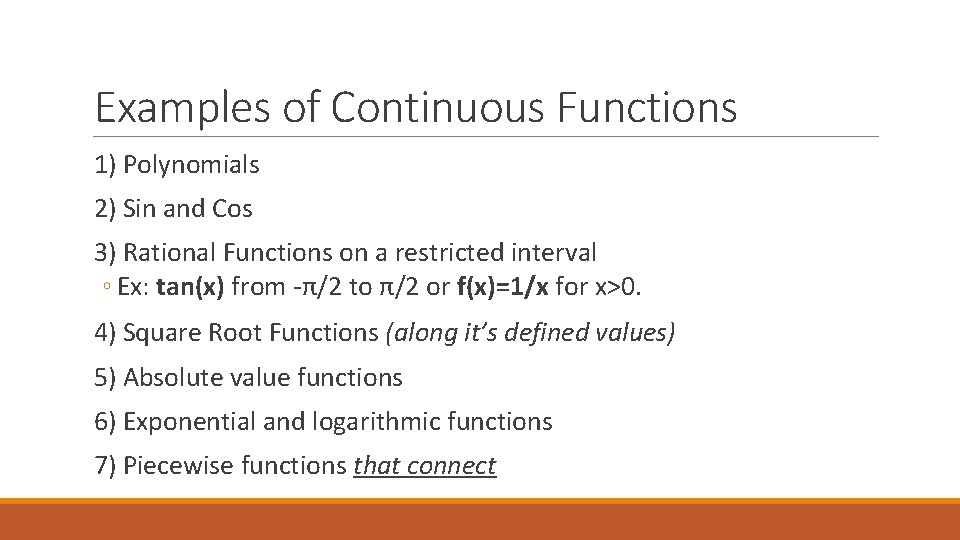
Examples of Continuous Functions 1) Polynomials 2) Sin and Cos 3) Rational Functions on a restricted interval ◦ Ex: tan(x) from -π/2 to π/2 or f(x)=1/x for x>0. 4) Square Root Functions (along it’s defined values) 5) Absolute value functions 6) Exponential and logarithmic functions 7) Piecewise functions that connect
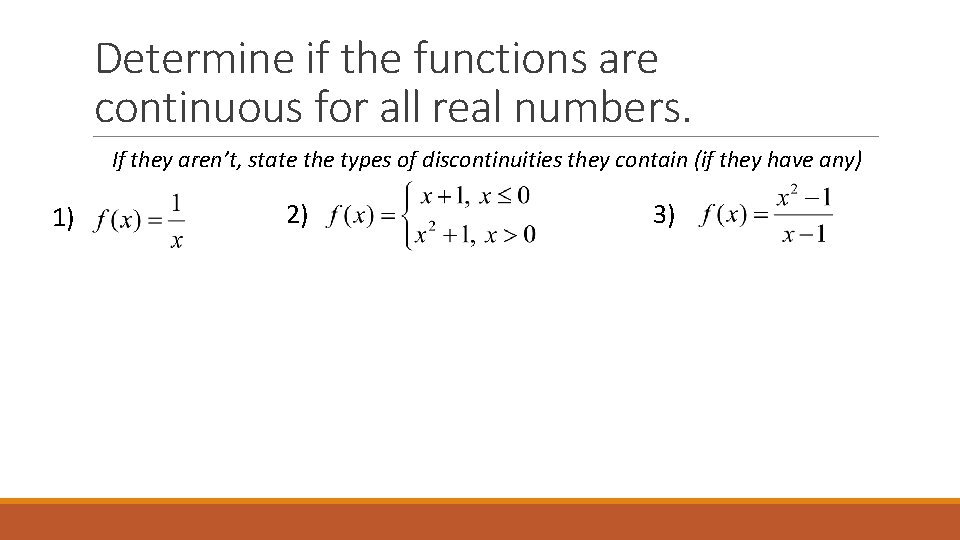
Determine if the functions are continuous for all real numbers. If they aren’t, state the types of discontinuities they contain (if they have any) 1) 2) 3)
Intermediate Value Theorem (IVT): A function that is continuous on [a, b] takes on every y value between f(a) and f(b) on that interval.
Intermediate Value Theorem Examples 4) Given that f(x) is continuous on [-1, 6] what is the minimum number of zeroes that f(x) must have on [-1, 6]?
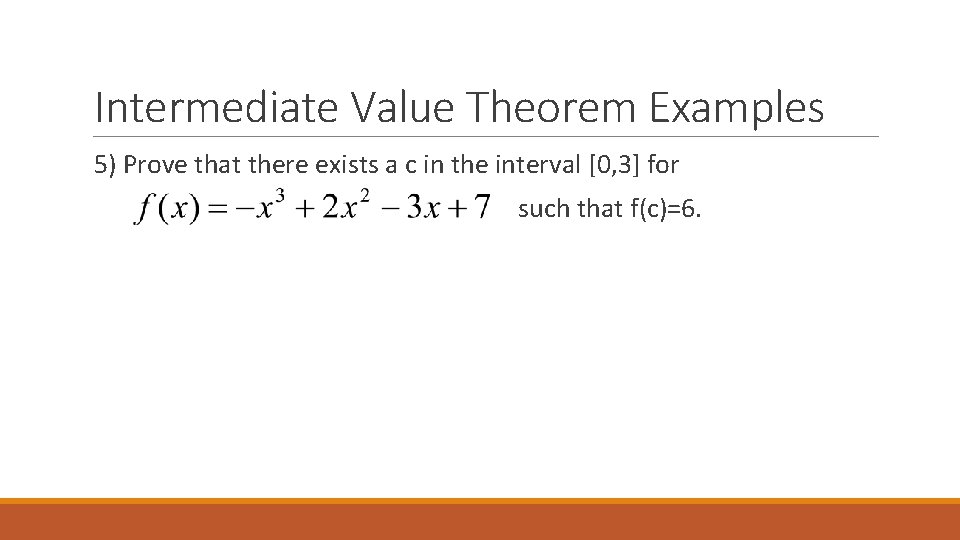
Intermediate Value Theorem Examples 5) Prove that there exists a c in the interval [0, 3] for such that f(c)=6.
Homework HW 1. 4 A: pg 78 -82 #2, 3, 5, 7 -12, 15, 18, 25, 26, 29, 31, 37, 40
Review on Limits WHAT ARE THE BIG IDEAS WITH LIMITS
Review On Limits Plan A: Direct Substitution: Plug in the x value (may not work) Plan B: Algebraic Simplification: Factor and Simplify etc. so that xvalues can be plugged in Plan C: Multiply by Conjugate (Rationalizing the Numerator): Multiply by conjugate of numerator and cancel so that x-values can be plugged in. (Use if you see square roots) Plan D: Piecewise Functions: Make sure to use direct substitution from left AND right hand sides if taking the limit of a place where the function switches over.
Special Trig Limits Need to memorize these for AP Test! Will be used in many trig limit problems
Infinite Limits 1) Whenever you have a limit approaching a vertical asymptote you will have one of 3 possibilities. Be sure to check left and right side! ◦ DNE ◦ ∞ ◦ -∞ 2) To see which one it is we will use an informal notation ◦ VS=Very small number (super close to 0) ◦ VB= Very big number (super close to infinity)
Limits at Infinity for Rational Functions §All rules of horizontal asymptotes apply. §Look at the leading terms of the top and bottom a) If the degree of the top is less than the bottom the limit approaches 0 b) If the degree of the bottom and top are =, the limit is the ratio of the leading terms c) If the degree of the top is higher than the bottom it will approach a) b) c)
To show a Function is Continuous …. at a given point, the following three things must ALL be true. 1) 2) 3) is defined exists
Types of Discontinuities Removable Discontinuity/Hole: When the limit exists at x=a but f(x) is undefined at a. Non Removable Discontinuity Vertical Asymptote (infinite): When the graph approaches ±∞ at x=a Jump Discontinuity: When a function approaches two different numbers at x=a from opposite sides. (Happens in piecewise functions)
Intermediate Value Theorem (IVT): A function that is continuous on [a, b] takes on every y value between f(a) and f(b) on that interval.