Chapter 4 An Agile View of Process 1
- Slides: 24
Chapter 4 An Agile View of Process 1
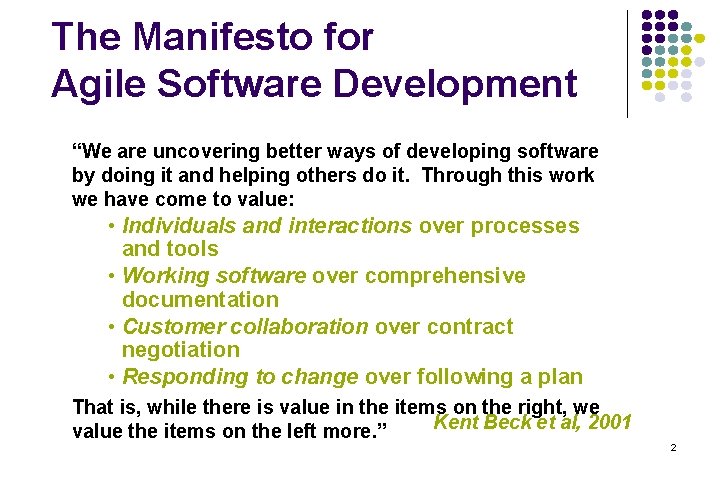
The Manifesto for Agile Software Development “We are uncovering better ways of developing software by doing it and helping others do it. Through this work we have come to value: • Individuals and interactions over processes and tools • Working software over comprehensive documentation • Customer collaboration over contract negotiation • Responding to change over following a plan That is, while there is value in the items on the right, we Kent Beck et al, 2001 value the items on the left more. ” 2
What is “Agility”? Effective (rapid and adaptive) response to change l Effective communication among all stakeholders (managers, customers, end-users) l Drawing the customer onto the team l Organizing a team so that it is in control of the work performed Yielding … l Rapid, incremental delivery of software l 3
What is “Agility”? (cont. ) l l Agility is more than change management Agility means that customers and developers l l need to work together as collaborators on the development team try to build products that can be adapted to a rapidly changing market place 4
An Agile Process l l l Is driven by customer descriptions of what is required (scenarios) Recognizes that plans are short-lived Develops software iteratively with a heavy emphasis on construction activities Delivers multiple ‘software increments’ Adapts as changes occur 5
Characteristics of An Agile Process l Adaptable l l Responsive l l All agile processes are adaptable to manage unpredictable changes that take place during software development projects. Agile processes rely heavily on customer feedback generated by their evaluation of operational prototypes. Incremental l The focus of agile processes is on the delivery of software increments in relatively short timeframes. 6
The Debate -Stick-in-the-muds vs. Glorified hackers 7
Key Traits Among Agile Team l Competence l l Common focus l l l Skill and knowledge of process Deliver a working software increment in time Collaboration Decision-making ability Fuzzy problem-solving ability Mutual trust and respect Self-organization l In control of the work it performs 8
Agile Process Models l l l l Extreme Programming (XP) Adaptive Software Development (ASD) Dynamic Systems Development Method (DSDM) Scrum Crystal Feature Driven Development (FDD) Agile Modeling (AM) 9
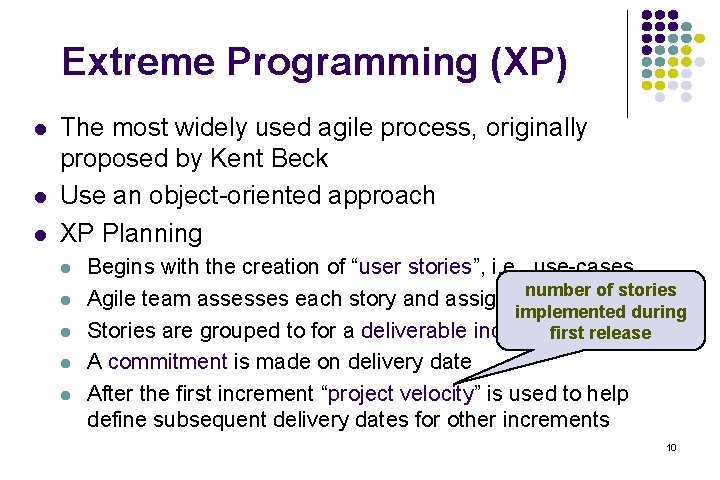
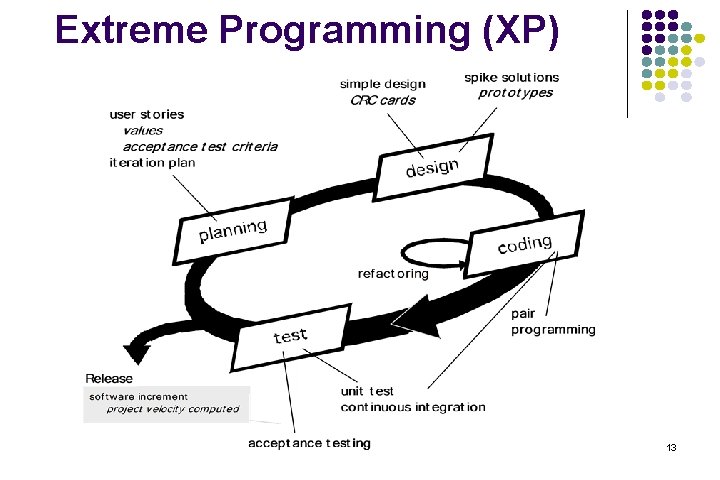
Extreme Programming (XP) l l l The most widely used agile process, originally proposed by Kent Beck Use an object-oriented approach XP Planning l l l Begins with the creation of “user stories”, i. e. , use-cases Agile team assesses each story and assigns number a cost of stories implemented during Stories are grouped to for a deliverable increment first release A commitment is made on delivery date After the first increment “project velocity” is used to help define subsequent delivery dates for other increments 10
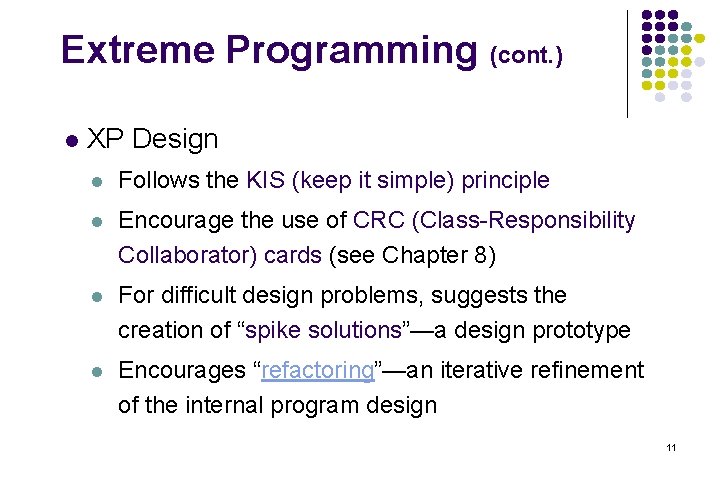
Extreme Programming (cont. ) l XP Design l Follows the KIS (keep it simple) principle l Encourage the use of CRC (Class-Responsibility Collaborator) cards (see Chapter 8) l For difficult design problems, suggests the creation of “spike solutions”—a design prototype l Encourages “refactoring”—an iterative refinement of the internal program design 11
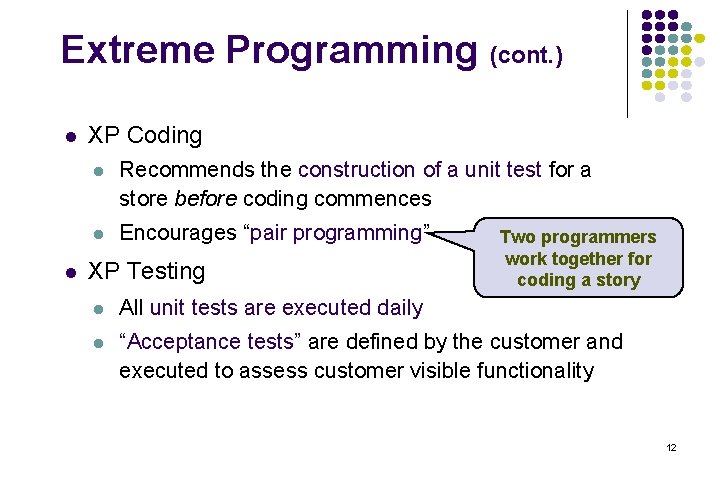
Extreme Programming (cont. ) l l XP Coding l Recommends the construction of a unit test for a store before coding commences l Encourages “pair programming” XP Testing Two programmers work together for coding a story l All unit tests are executed daily l “Acceptance tests” are defined by the customer and executed to assess customer visible functionality 12
Extreme Programming (XP) 13
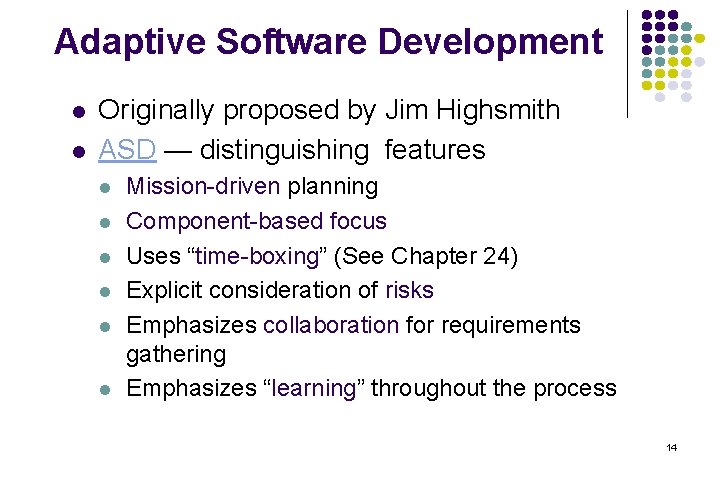
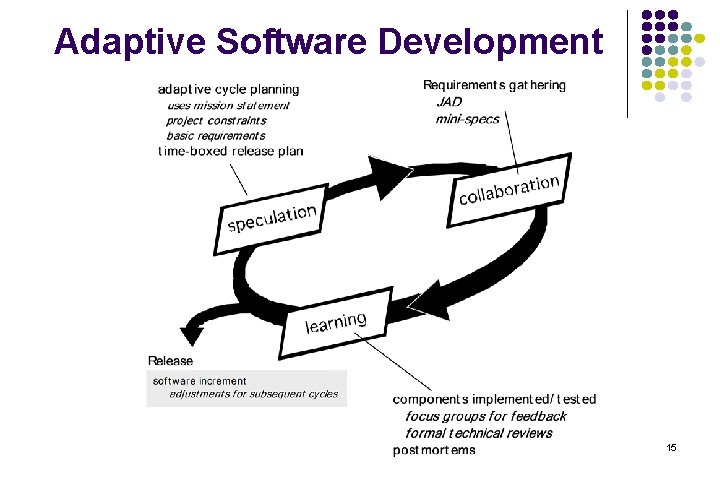
Adaptive Software Development l l Originally proposed by Jim Highsmith ASD — distinguishing features l l l Mission-driven planning Component-based focus Uses “time-boxing” (See Chapter 24) Explicit consideration of risks Emphasizes collaboration for requirements gathering Emphasizes “learning” throughout the process 14
Adaptive Software Development 15
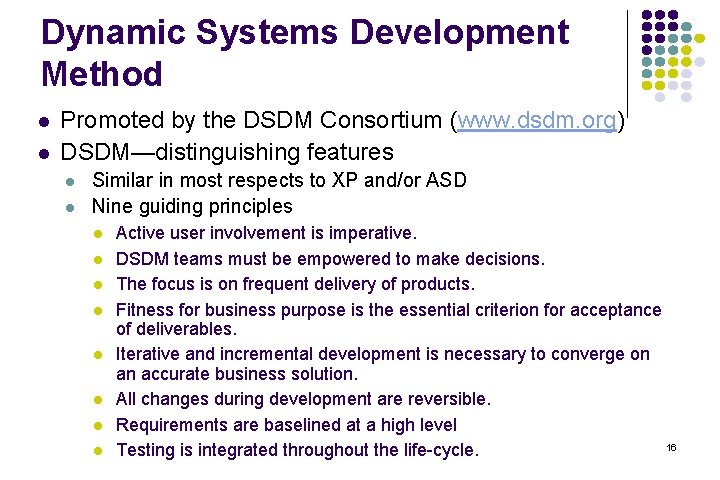
Dynamic Systems Development Method l l Promoted by the DSDM Consortium (www. dsdm. org) DSDM—distinguishing features l l Similar in most respects to XP and/or ASD Nine guiding principles l l l l Active user involvement is imperative. DSDM teams must be empowered to make decisions. The focus is on frequent delivery of products. Fitness for business purpose is the essential criterion for acceptance of deliverables. Iterative and incremental development is necessary to converge on an accurate business solution. All changes during development are reversible. Requirements are baselined at a high level 16 Testing is integrated throughout the life-cycle.
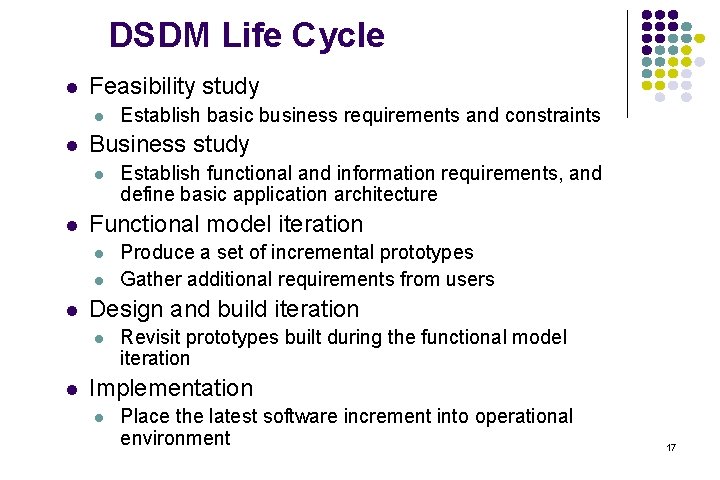
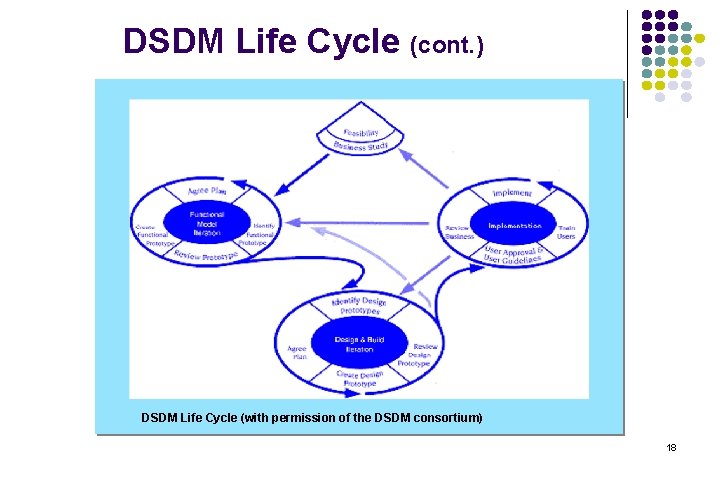
DSDM Life Cycle l Feasibility study l l Business study l l l Produce a set of incremental prototypes Gather additional requirements from users Design and build iteration l l Establish functional and information requirements, and define basic application architecture Functional model iteration l l Establish basic business requirements and constraints Revisit prototypes built during the functional model iteration Implementation l Place the latest software increment into operational environment 17
DSDM Life Cycle (cont. ) DSDM Life Cycle (with permission of the DSDM consortium) 18
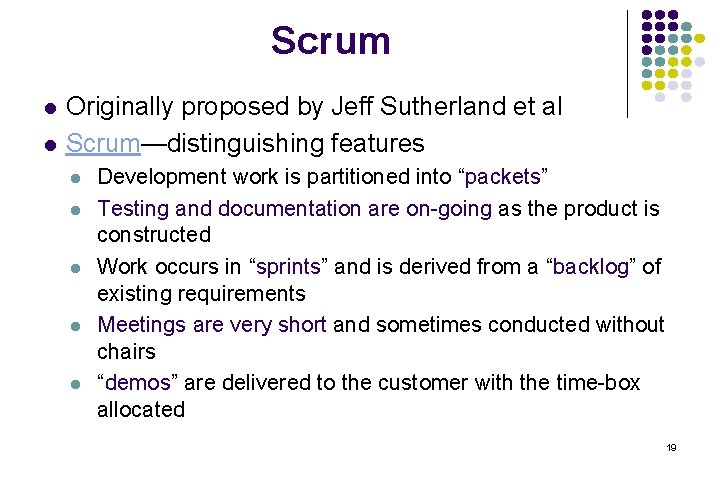
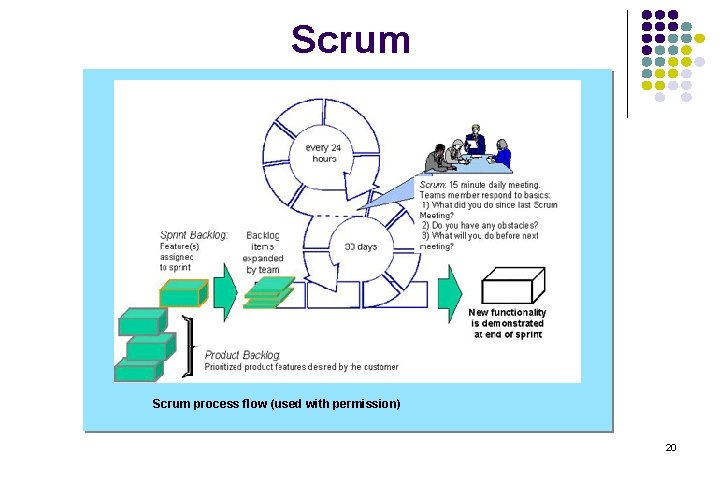
Scrum l l Originally proposed by Jeff Sutherland et al Scrum—distinguishing features l l l Development work is partitioned into “packets” Testing and documentation are on-going as the product is constructed Work occurs in “sprints” and is derived from a “backlog” of existing requirements Meetings are very short and sometimes conducted without chairs “demos” are delivered to the customer with the time-box allocated 19
Scrum process flow (used with permission) 20
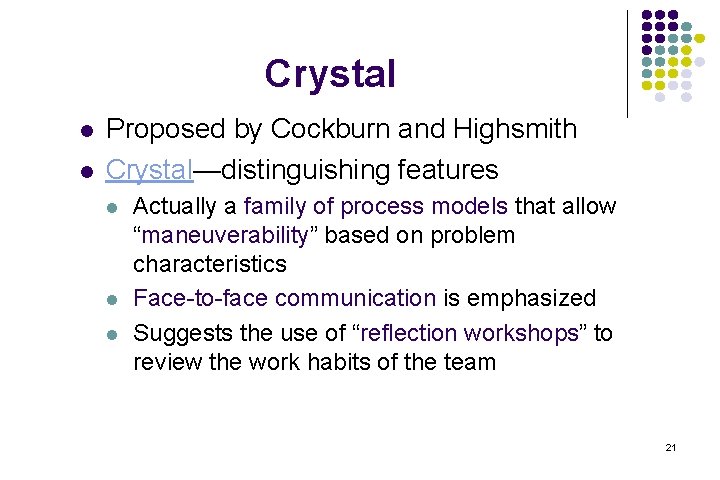
Crystal l l Proposed by Cockburn and Highsmith Crystal—distinguishing features l l l Actually a family of process models that allow “maneuverability” based on problem characteristics Face-to-face communication is emphasized Suggests the use of “reflection workshops” to review the work habits of the team 21
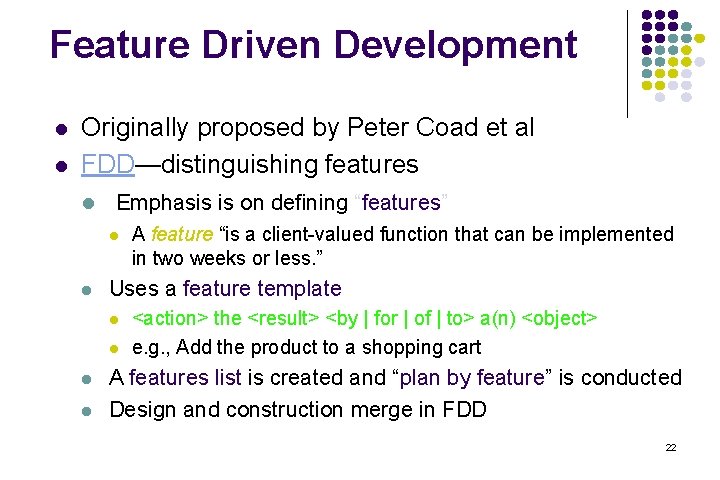
Feature Driven Development l l Originally proposed by Peter Coad et al FDD—distinguishing features l Emphasis is on defining “features” l l Uses a feature template l l A feature “is a client-valued function that can be implemented in two weeks or less. ” <action> the <result> <by | for | of | to> a(n) <object> e. g. , Add the product to a shopping cart A features list is created and “plan by feature” is conducted Design and construction merge in FDD 22
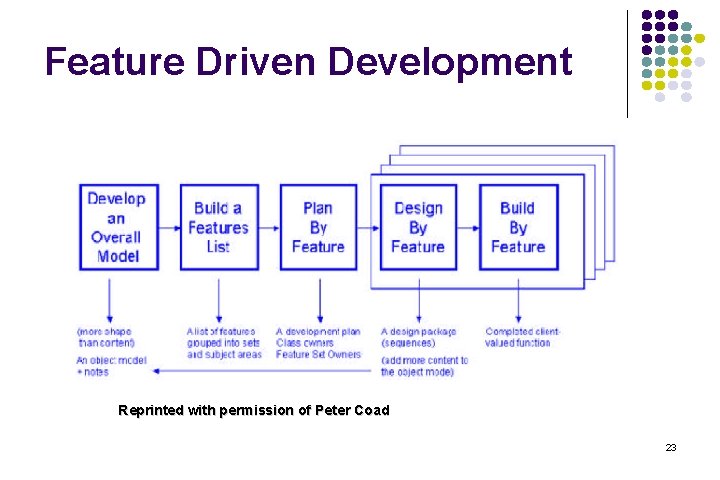
Feature Driven Development Reprinted with permission of Peter Coad 23
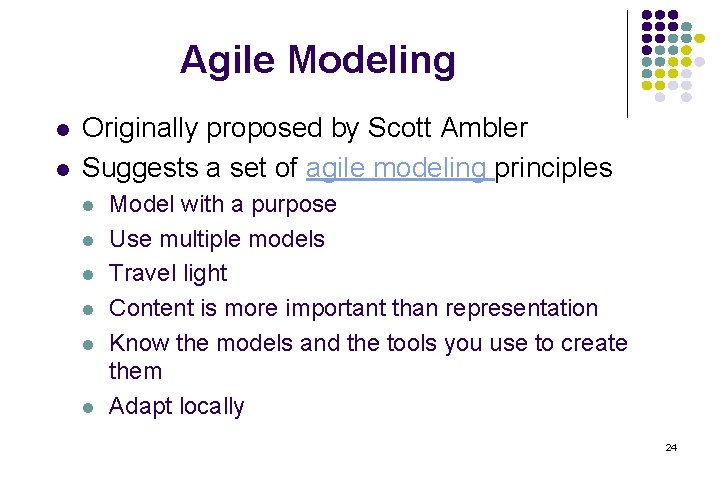
Agile Modeling l l Originally proposed by Scott Ambler Suggests a set of agile modeling principles l l l Model with a purpose Use multiple models Travel light Content is more important than representation Know the models and the tools you use to create them Adapt locally 24