Chapter 32 Admissions Transfers and Discharges Copyright 2017


- Slides: 9
Chapter 32 Admissions, Transfers, and Discharges Copyright © 2017, Elsevier, Inc. All rights reserved.
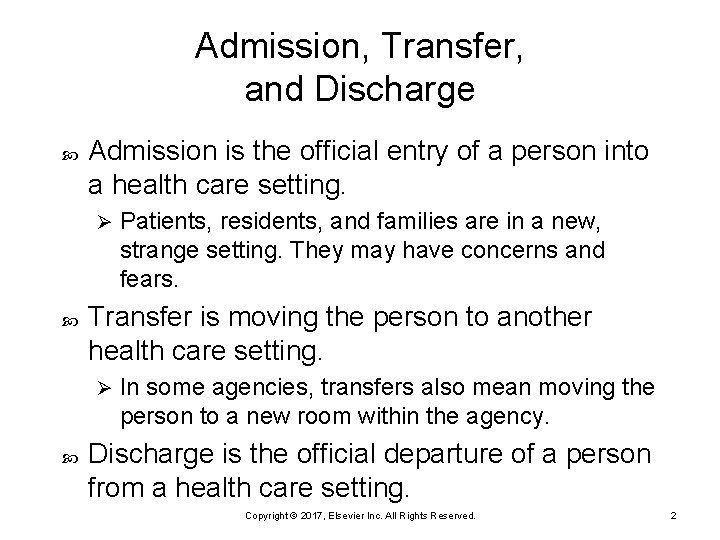
Admission, Transfer, and Discharge Admission is the official entry of a person into a health care setting. Ø Transfer is moving the person to another health care setting. Ø Patients, residents, and families are in a new, strange setting. They may have concerns and fears. In some agencies, transfers also mean moving the person to a new room within the agency. Discharge is the official departure of a person from a health care setting. Copyright © 2017, Elsevier Inc. All Rights Reserved. 2
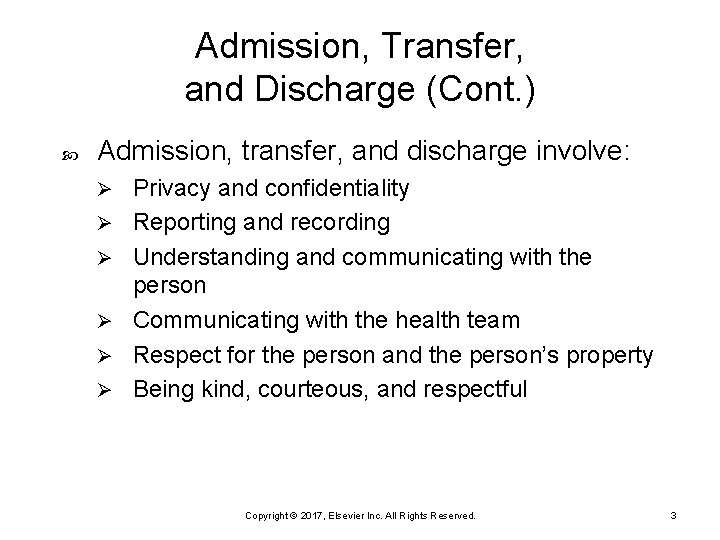
Admission, Transfer, and Discharge (Cont. ) Admission, transfer, and discharge involve: Ø Ø Ø Privacy and confidentiality Reporting and recording Understanding and communicating with the person Communicating with the health team Respect for the person and the person’s property Being kind, courteous, and respectful Copyright © 2017, Elsevier Inc. All Rights Reserved. 3
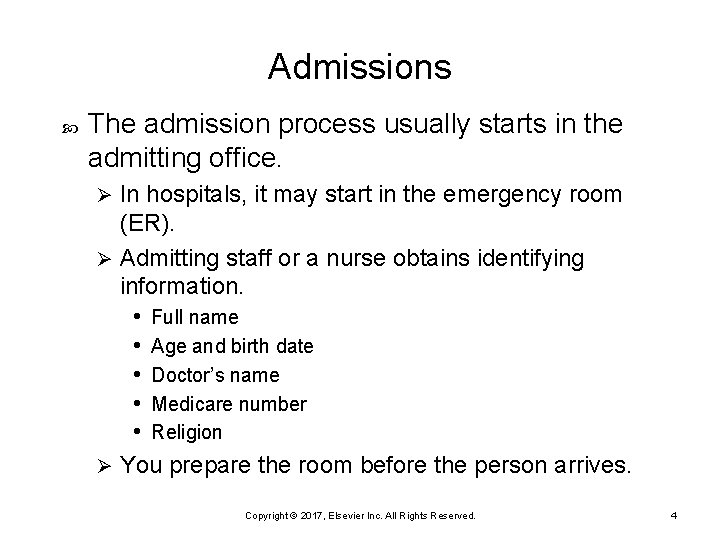
Admissions The admission process usually starts in the admitting office. In hospitals, it may start in the emergency room (ER). Ø Admitting staff or a nurse obtains identifying information. • Full name • Age and birth date • Doctor’s name • Medicare number • Religion Ø You prepare the room before the person arrives. Ø Copyright © 2017, Elsevier Inc. All Rights Reserved. 4
Admissions (Cont. ) Ø Admitting the person • A nurse usually greets and escorts the person and family to the room. The nurse may ask you to do so if the person has no discomfort or distress. • Admission is your first chance to make a good impression. You must: Greet the person by name and title. Introduce yourself by name and title. Make roommate introductions. Act in a professional manner. Treat the person with dignity and respect. Copyright © 2017, Elsevier Inc. All Rights Reserved. 5
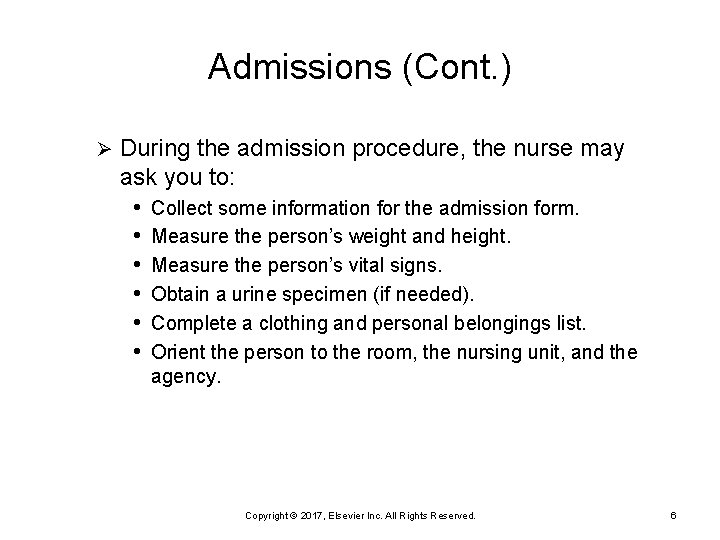
Admissions (Cont. ) Ø During the admission procedure, the nurse may ask you to: • Collect some information for the admission form. • Measure the person’s weight and height. • Measure the person’s vital signs. • Obtain a urine specimen (if needed). • Complete a clothing and personal belongings list. • Orient the person to the room, the nursing unit, and the agency. Copyright © 2017, Elsevier Inc. All Rights Reserved. 6
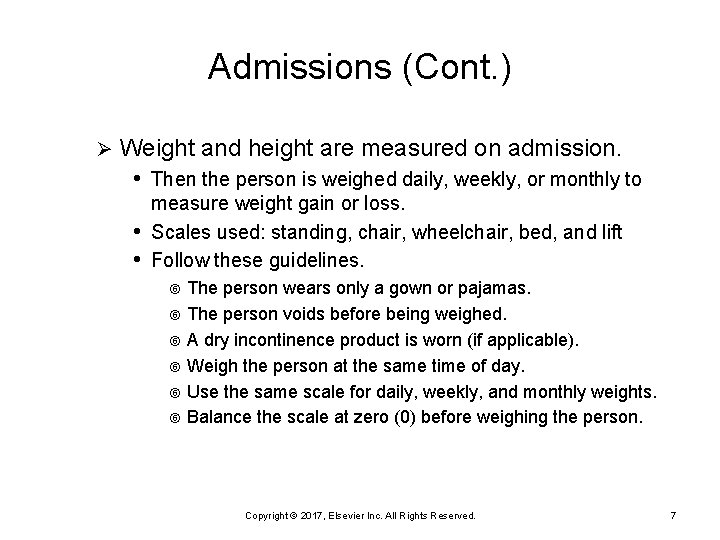
Admissions (Cont. ) Ø Weight and height are measured on admission. • Then the person is weighed daily, weekly, or monthly to measure weight gain or loss. • Scales used: standing, chair, wheelchair, bed, and lift • Follow these guidelines. The person wears only a gown or pajamas. The person voids before being weighed. A dry incontinence product is worn (if applicable). Weigh the person at the same time of day. Use the same scale for daily, weekly, and monthly weights. Balance the scale at zero (0) before weighing the person. Copyright © 2017, Elsevier Inc. All Rights Reserved. 7
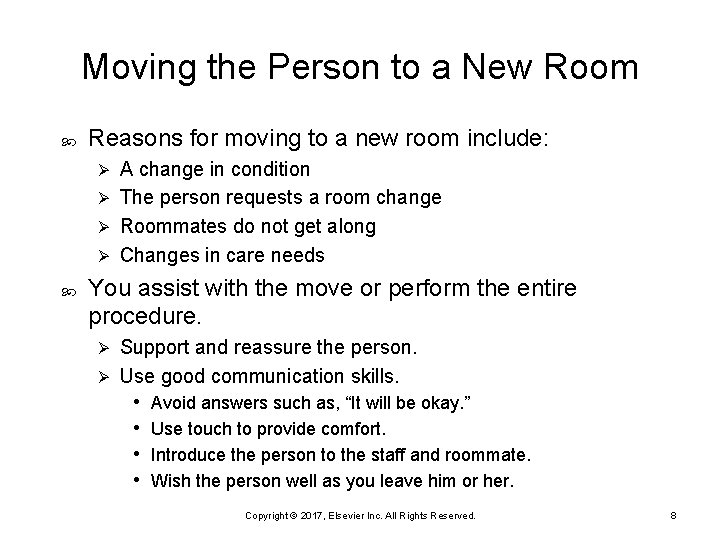
Moving the Person to a New Room Reasons for moving to a new room include: A change in condition Ø The person requests a room change Ø Roommates do not get along Ø Changes in care needs Ø You assist with the move or perform the entire procedure. Support and reassure the person. Ø Use good communication skills. Ø • • Avoid answers such as, “It will be okay. ” Use touch to provide comfort. Introduce the person to the staff and roommate. Wish the person well as you leave him or her. Copyright © 2017, Elsevier Inc. All Rights Reserved. 8
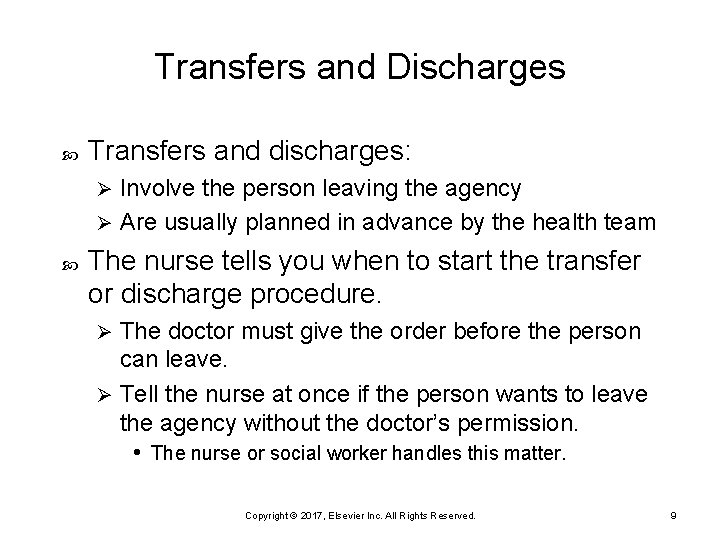
Transfers and Discharges Transfers and discharges: Involve the person leaving the agency Ø Are usually planned in advance by the health team Ø The nurse tells you when to start the transfer or discharge procedure. The doctor must give the order before the person can leave. Ø Tell the nurse at once if the person wants to leave the agency without the doctor’s permission. • The nurse or social worker handles this matter. Ø Copyright © 2017, Elsevier Inc. All Rights Reserved. 9