Chapter 3 The Mechanical Advantage Force Work and
- Slides: 25
Chapter 3 The Mechanical Advantage
Force, Work, and Power • Force (F): a push or pull that acts on an object to initiate or change it’s motion or to cause deformation. • Contact forces: forces transmitted from one physical object to another object through physical contact.
Force, Work, and Power • Long-range forces: forces that act on an object without physical contact (gravity and magnetism). • Effort force: input force that serves to impart energy into a machine or system. • Load: weight of the object that needs to be moved.
Force, Work, and Power • Work (W): measure of the amount of energy that is transferred when a force acts on an object, causing the object to move or deform. • Displacement: measure of how far an object moves as measured along a straight line from start to finish.
Force, Work, and Power • Scalar quantity: magnitude only. • Distance: measure of length. • Power (P): measure of the amount of work that is accomplished per unit time. • One horsepower (hp) is equal to approximately 746 watts.
Mechanical Advantage • Mechanical advantage: ratio of the output force produced by a machine to the input force that is applied to the machine. • Ideal mechanical advantage (IMA): ratio between the distance across which an effort force acts and the resulting distance across which the load acts.
Mechanical Advantage • Ideal effort force: input force that is needed to move a load in which a machine operates at 100% efficiency. • Friction: resistance force that results when two objects move against each other.
Mechanical Advantage • Actual mechanical advantage (AMA): ratio between the load force and the actual effort force. • Actual effort force: input force that is needed to move a load in which a machine operates at less than 100% efficiency. • Efficiency: ratio between a machine’s actual and ideal mechanical advantage.
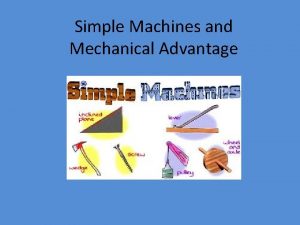
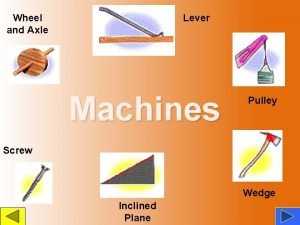
The Six Simple Machines • Simple machine: mechanical device that is used to change the direction or the magnitude of a single applied force. • Six Classical Mechanical Devices: –Inclined plane –Wedge –Lever –Wheel and axle –Pulley –Screw
The Six Simple Machines • Simple machines: –Move a heavy load over a short distance using a small effort force. –Move a small load over a large distance using a greater effort force. –Change the direction or magnitude of an effort force.
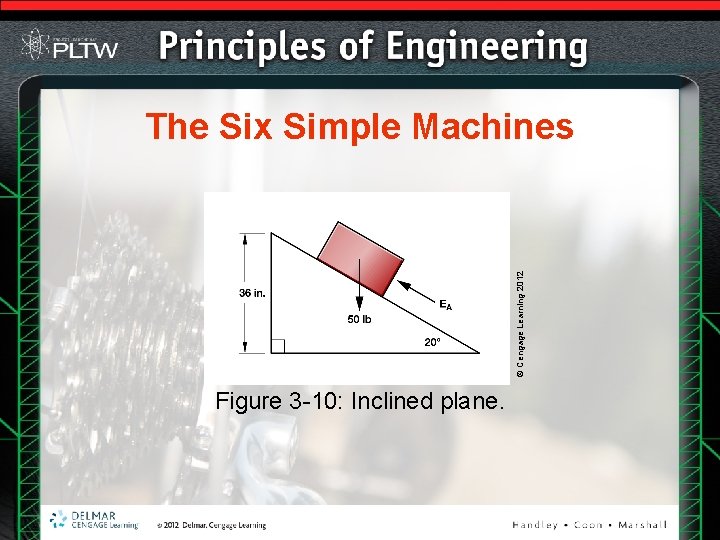
The Six Simple Machines • Inclined plane: stationary, flat surface that is set at an angle; it is used to bridge two planes that are offset by some vertical distance. • Wedge: rigid object with sloping sides that moves against or through a load to exert a force. –Cutting tools are examples of wedges.
© Cengage Learning 2012 The Six Simple Machines Figure 3 -10: Inclined plane.
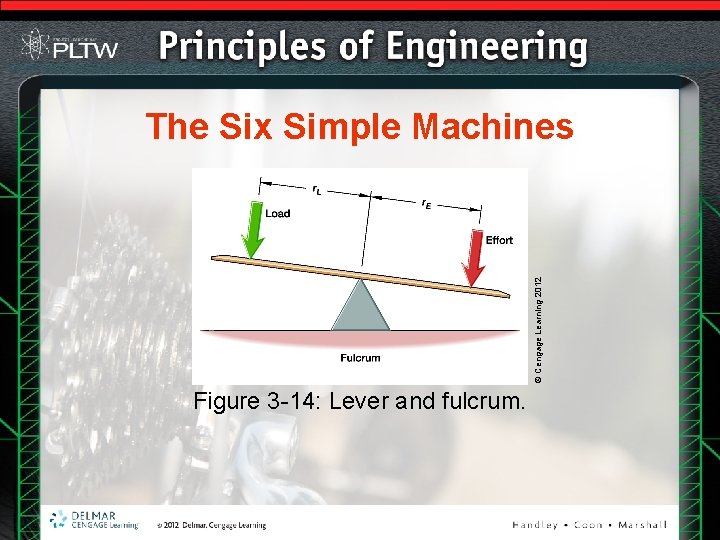
The Six Simple Machines • Lever: rigid bar that is allowed to rotate at some angle about a pivot point called the fulcrum. • Levers are divided into three categories: 1 st-class, 2 nd-class, and 3 rd-class levers.
© Cengage Learning 2012 The Six Simple Machines Figure 3 -14: Lever and fulcrum.
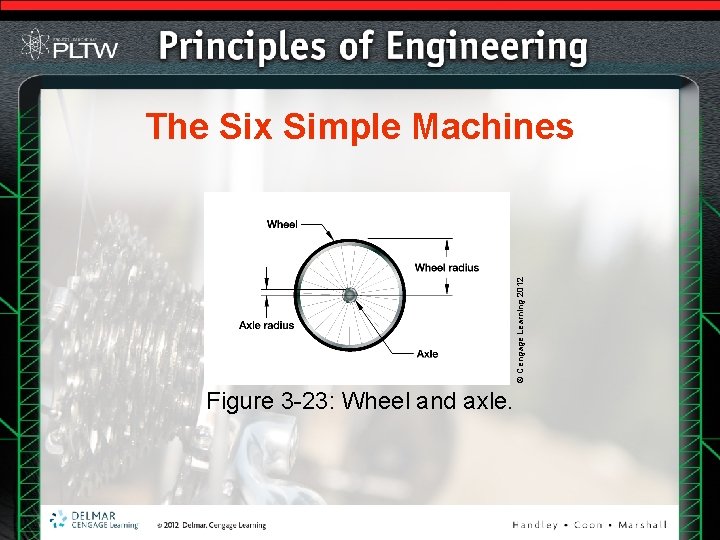
The Six Simple Machines • Wheel and axle: rotating device that consists of a wheel or crank that is attached to a smaller diameter axle. • Ideal mechanical advantage of a wheel and axle is a ratio between the wheel radius and the axle radius.
© Cengage Learning 2012 The Six Simple Machines Figure 3 -23: Wheel and axle.
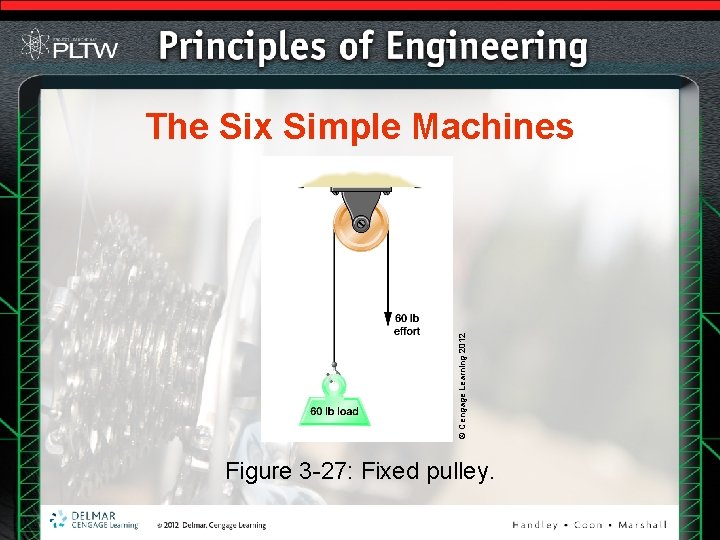
The Six Simple Machines • Pulley: free-spinning wheel (usually grooved) around which a rope, chain, or belt is passed. –Fixed is the simplest of all pulley systems. • Support cable: carries all or part of the load force. • Effort cable: effort force is applied.
© Cengage Learning 2012 The Six Simple Machines Figure 3 -27: Fixed pulley.
The Six Simple Machines • Block and tackle: an arrangement of two or more pulleys that are strung together to lift or move a load. • A compound pulley system: all of the pulleys act as independently moving runners.
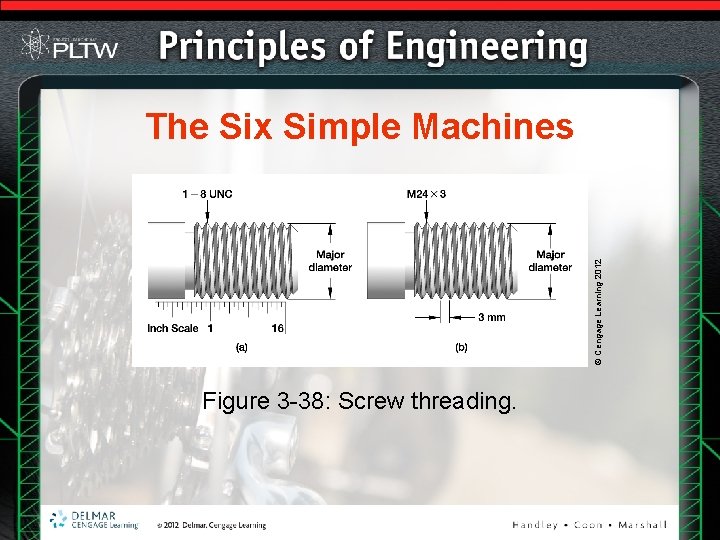
The Six Simple Machines • Screw: a cylinder about which a helical groove or thread is wound. –It is used to convert rotary motion into linear motion and is capable of generating extremely large output forces. –Pitch (p): the linear distance that the screw travels in one revolution.
© Cengage Learning 2012 The Six Simple Machines Figure 3 -38: Screw threading.
Compound Machines • Compound machine: a combination of two or more simple machines that work together to accomplish a task.
Summary • Force (F) is a push or pull that acts on an object to initiate or change its motion or to cause deformation. • Work (W) is achieved when a force is applied to an object, causing the object to be displaced. • Power (P) is the measure of the amount of work that is accomplished per unit time.
Summary • Mechanical advantage is the ratio of the output force produced by a machine to the input force that is applied to the machine. • Ideal mechanical advantage (IMA) is what a machine would exhibit under ideal circumstances.
Summary • The inclined plane, wedge, lever, wheel and axle, pulley, and screw make up the six simple machines. • A compound machine is a combination of two or more simple machines that work together to accomplish a task.