Chapter 2 Marketing Strategies and Plans 1 Learning
- Slides: 40
Chapter 2 Marketing Strategies and Plans 1
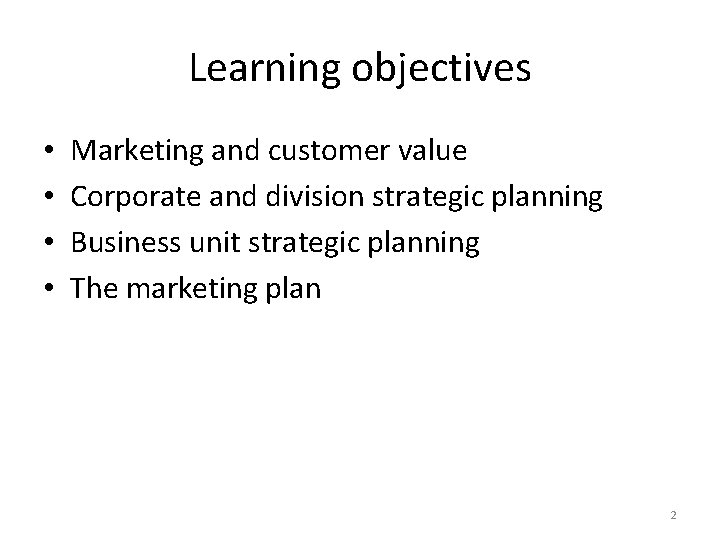
Learning objectives • • Marketing and customer value Corporate and division strategic planning Business unit strategic planning The marketing plan 2
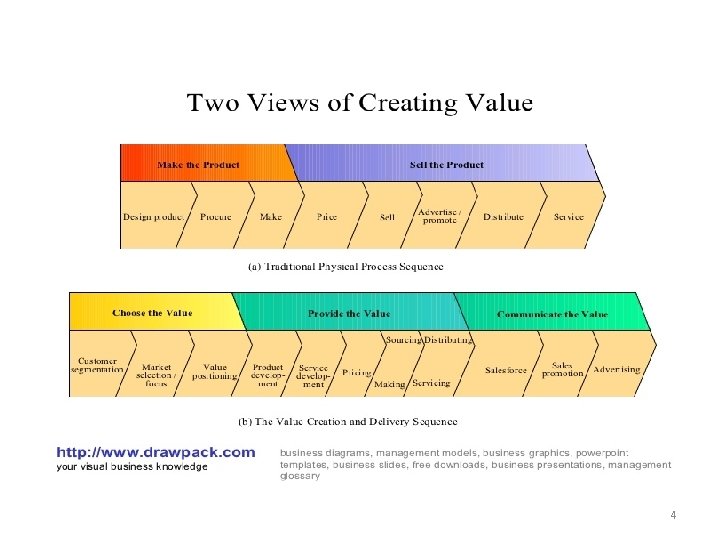
Value delivery process can be divided into three phases: • Choosing the value • Providing the value • Communicating the value 3
4
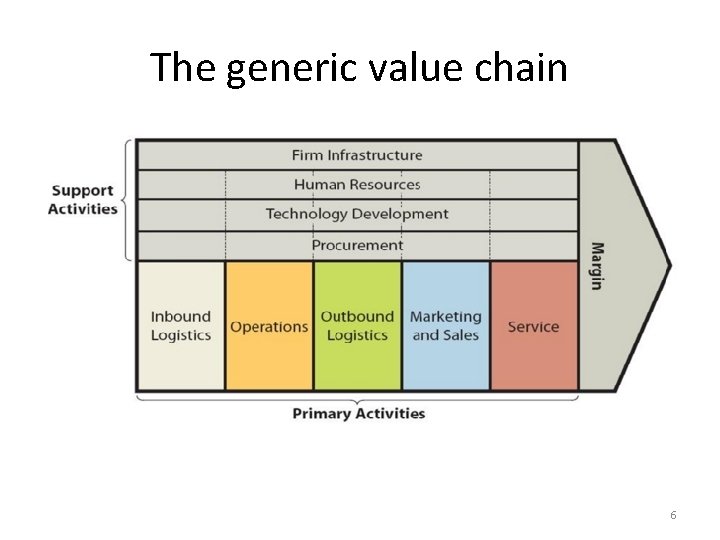
The value chain is a tool for identifying ways to create more customer value. Every firm is a synthesis of activities performed to design, produce, market, deliver, and support its product. The value chain has got nine strategically relevant activities. • The primary activities: inbound activities, operations, outbound activities, marketing and sales, and service • The support activities: procurement, technology development, human resource management, and firm infrastructure. 5
The generic value chain 6
Core business processes The firm’s success depends not only on how well each department performs its work, but also on how well the company coordinates departmental activities to conduct core business processes. These processes include: • The market-sensing process- gathering and acting upon information about the market • The new-offering realization process- researching, developing, and launching new high-quality offerings quickly and within budget • The customer acquisition process- defining target markets and prospecting for new customers • The customer relationship management process- building deeper understanding of relationships with, and offering for individual customers • The fulfillment management process-receiving and approving orders, shipping goods on time, and collecting payment. 7
Characteristics of core competencies The key, then, is to own and nurture the resources and competencies that make up the essence of the business. Many textile, chemical, and computer/electronic product firms do not manufacture their own products because offshore manufacturers are more competent in this task. Instead, they focus on product design and development and marketing, their core competencies. A core competency has three characteristics: • A source of competitive advantage • Applications in a wide variety of markets • Difficult to imitate. 8
Maximizing core competencies Business realignment may be necessary to maximize core competencies. It has three steps: • (Re)define the business concept or “big idea” • (Re)shaping the business scope • (Re)positioning the company’s brand identity. 9
The central role of strategic planning Creating, providing, and communicating value requires many different marketing activities. To ensure that the proper activities are selected and executed, strategic planning is essential. Strategic planning calls for action in three key areas: • Managing company’s businesses as an investment portfolio • Assessing each business' strength by considering the market’s growth rate and the company’s position • Establishing a strategy. 10
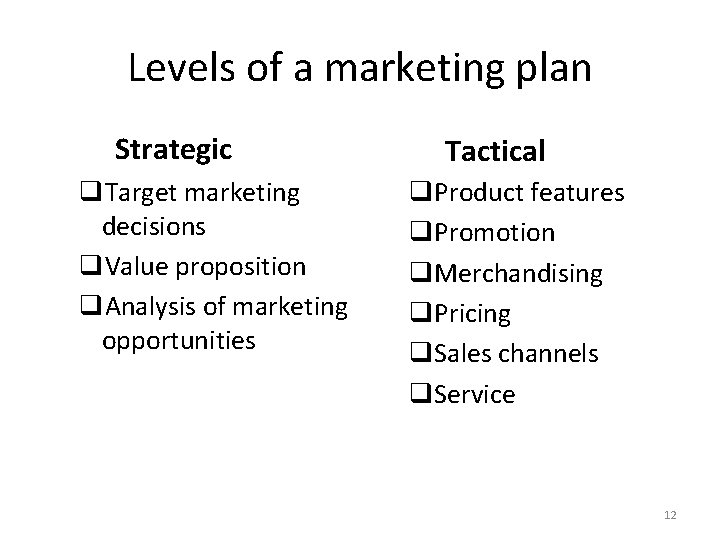
What is a marketing plan? A marketing plan is the central instrument for directing and coordinating the marketing effort. It operates at a strategic and tactical levels. The strategic marketing plan lays out the target markets and the firm’s value proposition, based on an analysis of the best market opportunities. The tactical marketing plan specifies the marketing tactics, including product features, promotion, merchandising, pricing, sales channels, and service. 11
Levels of a marketing plan Strategic q. Target marketing decisions q. Value proposition q. Analysis of marketing opportunities Tactical q. Product features q. Promotion q. Merchandising q. Pricing q. Sales channels q. Service 12
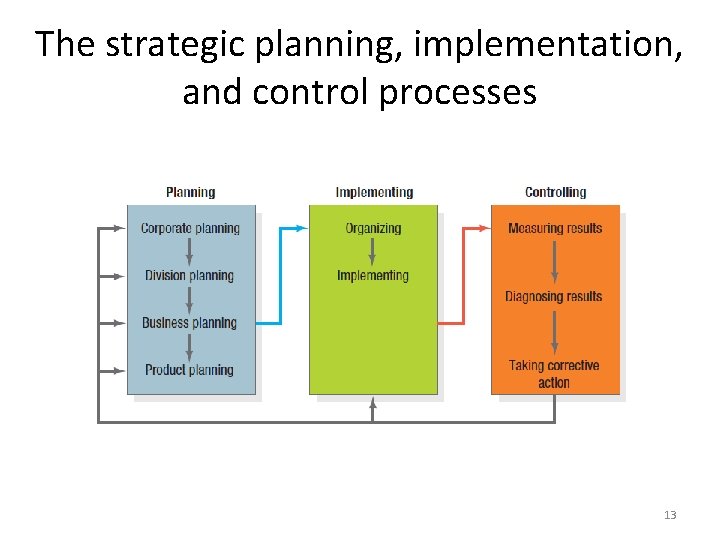
The strategic planning, implementation, and control processes 13
Corporate and division strategic planning Some corporations give their business units freedom to set their own sales and profit goals and strategies. Others set goals for their business units but let them develop their own strategies. Still others set the goals and participate in developing individual business unit strategies. All corporate headquarters undertake four planning activities: • Define the corporate mission • Establish strategic business units (SBUs) • Assign resources to each SBU • Assess growth opportunities. 14
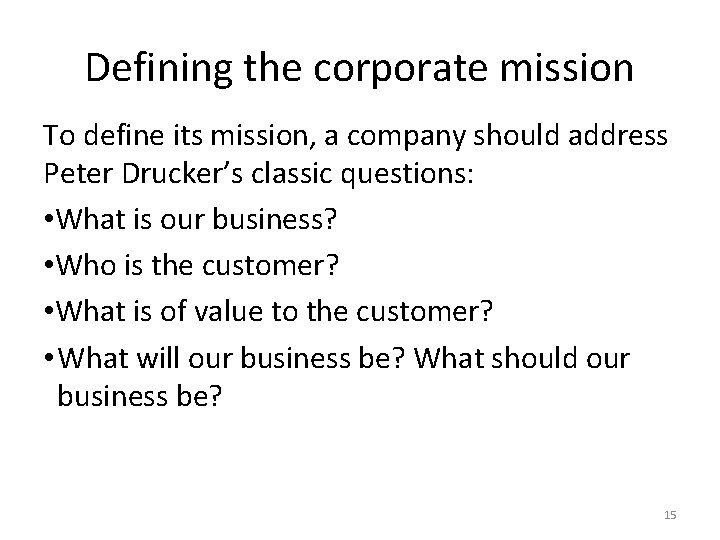
Defining the corporate mission To define its mission, a company should address Peter Drucker’s classic questions: • What is our business? • Who is the customer? • What is of value to the customer? • What will our business be? What should our business be? 15
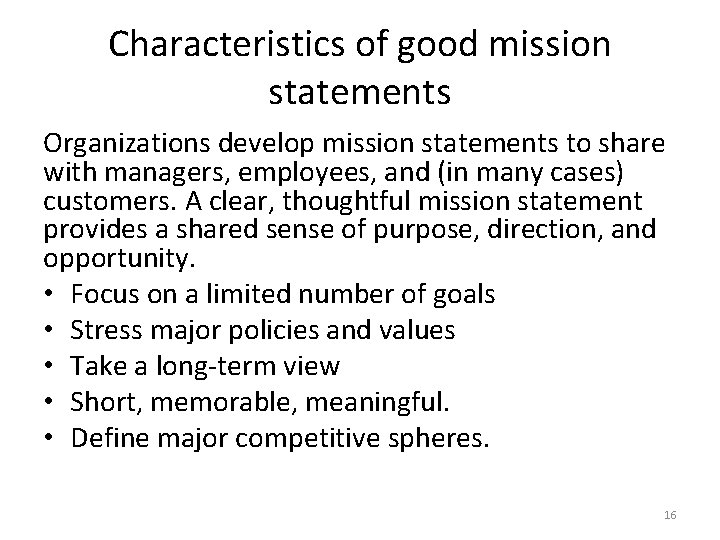
Characteristics of good mission statements Organizations develop mission statements to share with managers, employees, and (in many cases) customers. A clear, thoughtful mission statement provides a shared sense of purpose, direction, and opportunity. • Focus on a limited number of goals • Stress major policies and values • Take a long-term view • Short, memorable, meaningful. • Define major competitive spheres. 16
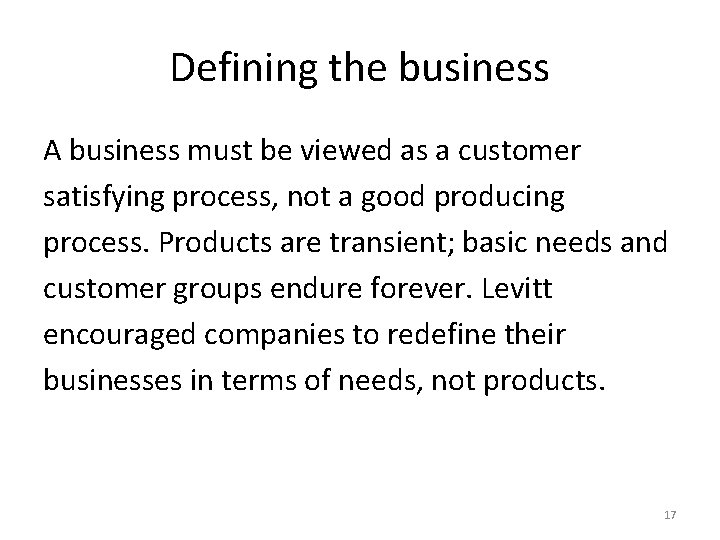
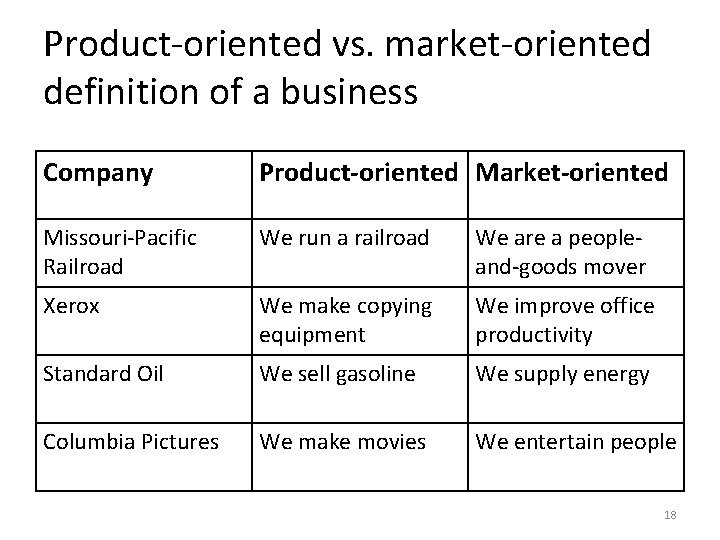
Defining the business A business must be viewed as a customer satisfying process, not a good producing process. Products are transient; basic needs and customer groups endure forever. Levitt encouraged companies to redefine their businesses in terms of needs, not products. 17
Product-oriented vs. market-oriented definition of a business Company Product-oriented Market-oriented Missouri-Pacific Railroad We run a railroad We are a peopleand-goods mover Xerox We make copying equipment We improve office productivity Standard Oil We sell gasoline We supply energy Columbia Pictures We make movies We entertain people 18
Strategic business units (SBUs) Large companies normally manage quite different businesses, each requiring its own strategy. Strategic business unit (SBU) is a unit of the company that has a separate mission and objectives that can be planned separately from other company businesses. • Company division • Product line within a division • Single product or brand SBUs have three characteristics: • It has its own set of competitors • It has a manager who is responsible for strategic planning and profit • Performance and who controls most of the factors affecting profit. 19
Strategic business units (SBUs) 20
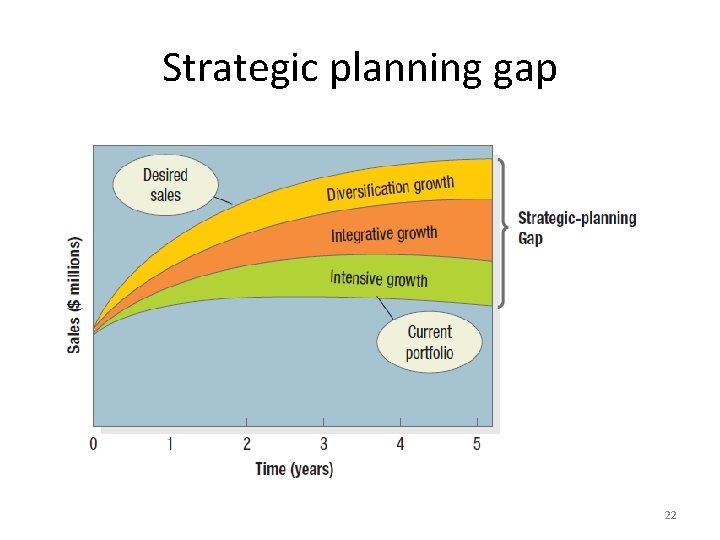
Assessing growth opportunities involves planning new businesses, downsizing, or terminating older businesses. The company’s plans for existing businesses allow it to project total sales and profits. If there is a gap between future desired sales and projected sales, corporate management will have to develop or acquire new businesses to fill it. 21
Strategic planning gap 22
Assessing growth opportunities • Intensive growth: Improving existing businesses. • Integrative growth: backward, forward, and horizontal integration with its industry. • Diversification growth: moving out of the present businesses. • Downsizing and divesting older businesses: pruning, harvesting, or divesting old businesses. 23
What is corporate culture? Strategic planning happens within the context of the organization. A company’s organization consists of its structures, policies, and corporate culture, all of which can become dysfunctional in a rapidly changing business environment. Whereas managers can change structures and policies (though with difficulty), the company’s culture is very hard to change. Yet adapting the culture is often the key to successfully implementing a new strategy. Walk into any company and the first thing that strikes you is the corporate culture—the way people dress, talk to one another, and greet customers. What exactly is a corporate culture? Corporate culture is the shared experiences, stories, beliefs, and norms that characterize an organization. 24
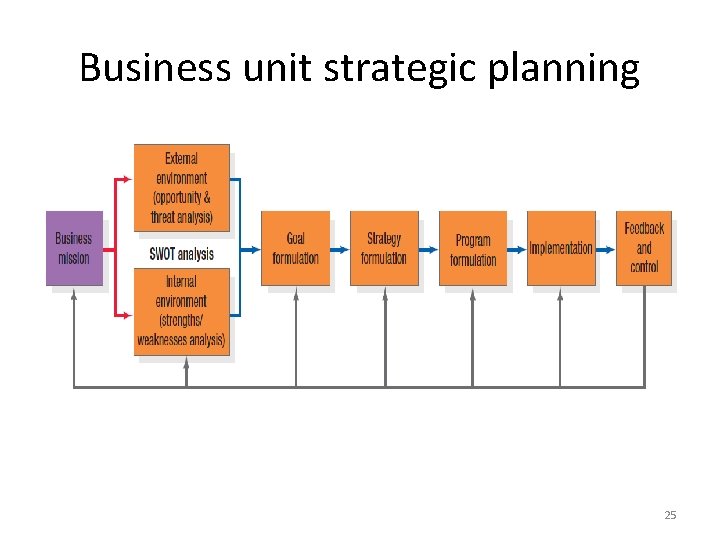
Business unit strategic planning 25
Business unit strategic planning The business mission : Each business unit needs to define its specific mission within the broader company mission. 26
SWOT Analysis (strengths, weaknesses, opportunities, and threats) External environment (opportunity and threat) Analysis: A business unit has to monitor key macro environment forces (demographic, economic, natural, technological, politicallegal, and social-cultural) and significant micro environment actors ( customers, competitors, suppliers, distributors, dealers) that affect its ability to earn profits. A marketing opportunity is an era of buyer needs and interest in which there is a high probability that a company can probably satisfy that need. 27
Market opportunity analysis (MAO) To evaluate opportunities, companies can use Market Opportunity Analysis (MAO) to determine the attractiveness and probability of success: • Can the benefits involved in the opportunity be articulated convincingly to a defined target market? • Can the target market be located and reached with cost-effective media and trade channels? • Does the company possess or have access to the critical capabilities and resources needed to deliver the customer benefits? 28
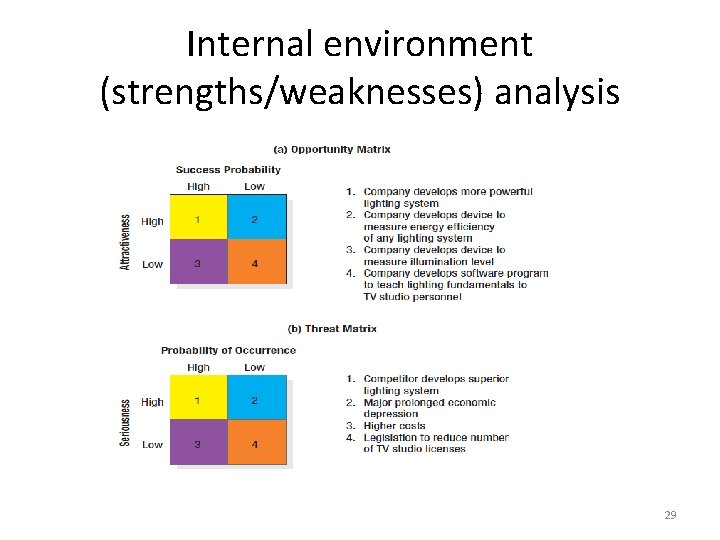
Internal environment (strengths/weaknesses) analysis 29
Goal formulation Once a company has performed a SWOT analysis, it can proceed to develop specific goals for the planning period. This stage of the process is called goal formulation. Most business units pursue a mix of objectives, including profitability, sales growth, market share improvement, risk containment, innovation, and reputation. The business unit sets these objectives and then manages by objectives (MBO). For an MBO system to work, the unit’s objectives must meet four criteria: • Unit’s objectives must be hierarchical • Objectives should be quantitative • Goals should be realistic • Objectives must be consistent 30
Strategy formulation Goals indicate what business unit wants to achieve, strategy is a game plan for getting there. Every business must design a strategy for achieving its goals, consisting of a marketing strategy, and a compatible technology strategy and sourcing strategy. 31
Porter’s generic strategies Michael Porter has proposed three generic strategies: • Overall cost leadership: The business works hard to achieve the lowest production and distribution costs so that it can price lower than its competitors and win a large market share. They need less skill in marketing. • Differentiation: The business focus on achieving superior performance in an important customer benefit area valued by a large part of the market. • Focus: The business focuses on one or more narrow market segments. The company gets to know these segments intimately and pursues either cost leadership or differentiation within the target segment. 32
Strategic alliances Many strategic alliances take the form of marketing alliances. These fall into four major categories. 1. Product or service alliances: One company licenses another to produce its product, or two companies jointly market their complementary products or a new product. 2. Promotional alliances: One company agrees to carry a promotion for another company’s product or service. 3. Logistics alliances: One company offers logistical services for another company’s product. 4. Pricing collaborations: One or more companies join in a special pricing collaboration. 33
Marketing plan contents • • • Executive summary Table of contents Situation analysis Marketing strategy Financial projections Implementation controls 34
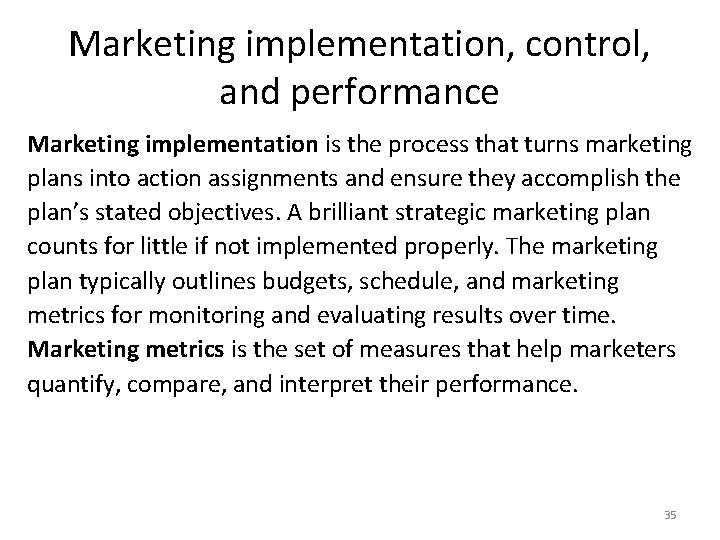
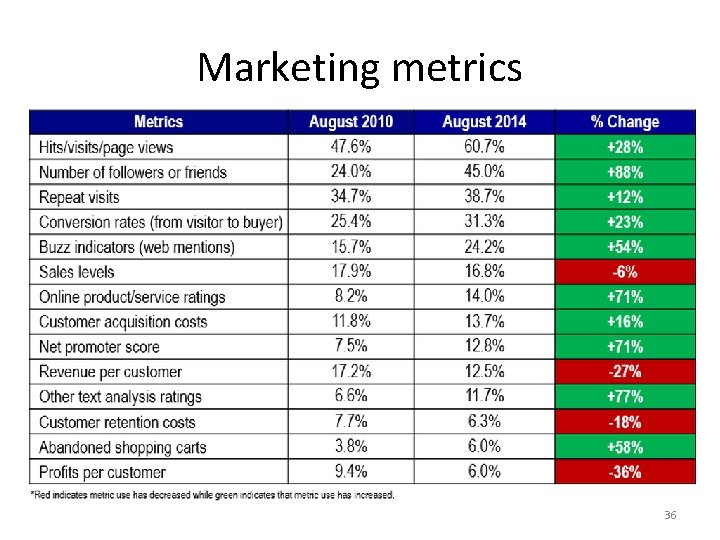
Marketing implementation, control, and performance Marketing implementation is the process that turns marketing plans into action assignments and ensure they accomplish the plan’s stated objectives. A brilliant strategic marketing plan counts for little if not implemented properly. The marketing plan typically outlines budgets, schedule, and marketing metrics for monitoring and evaluating results over time. Marketing metrics is the set of measures that help marketers quantify, compare, and interpret their performance. 35
Marketing metrics 36
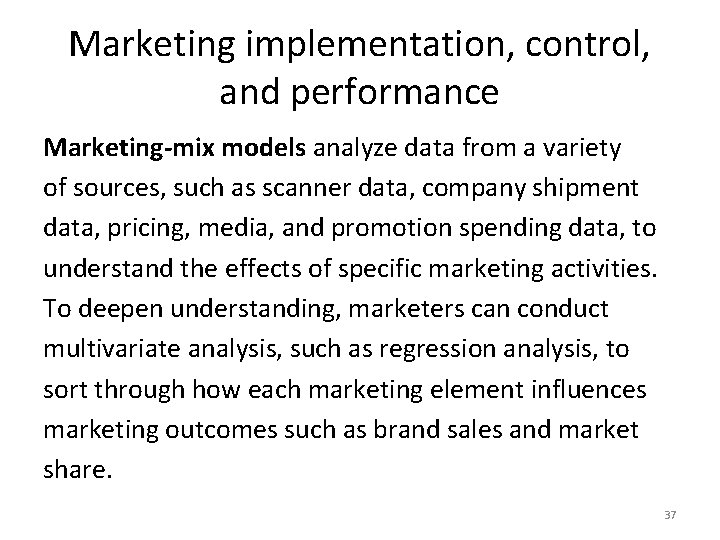
Marketing implementation, control, and performance Marketing-mix models analyze data from a variety of sources, such as scanner data, company shipment data, pricing, media, and promotion spending data, to understand the effects of specific marketing activities. To deepen understanding, marketers can conduct multivariate analysis, such as regression analysis, to sort through how each marketing element influences marketing outcomes such as brand sales and market share. 37
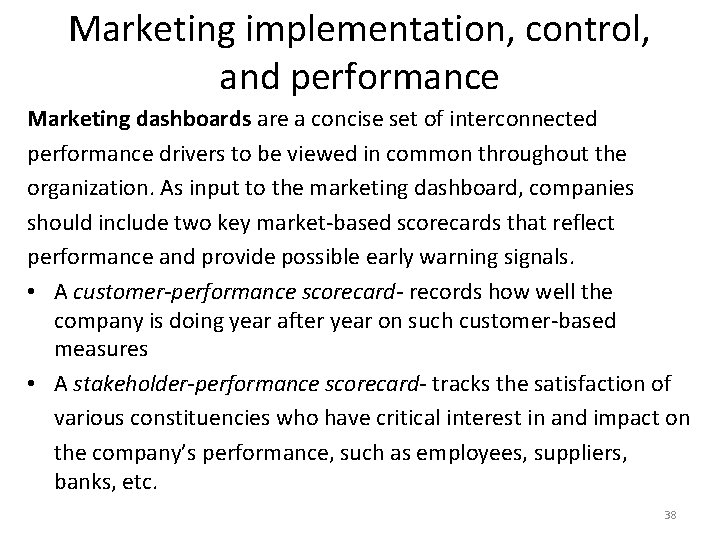
Marketing implementation, control, and performance Marketing dashboards are a concise set of interconnected performance drivers to be viewed in common throughout the organization. As input to the marketing dashboard, companies should include two key market-based scorecards that reflect performance and provide possible early warning signals. • A customer-performance scorecard- records how well the company is doing year after year on such customer-based measures • A stakeholder-performance scorecard- tracks the satisfaction of various constituencies who have critical interest in and impact on the company’s performance, such as employees, suppliers, banks, etc. 38
Marketing implementation, control, and performance Marketing control: is the process by which firms assess the effects of their marketing activities and make necessary changes and adjustments. Marketing audit: is a comprehensive, systematic, independent, and periodic examination of a company’s or business unit’s marketing environment, objectives, strategies, and activities, to identify problem areas and opportunities and recommend a plan for improving marketing performance. 39
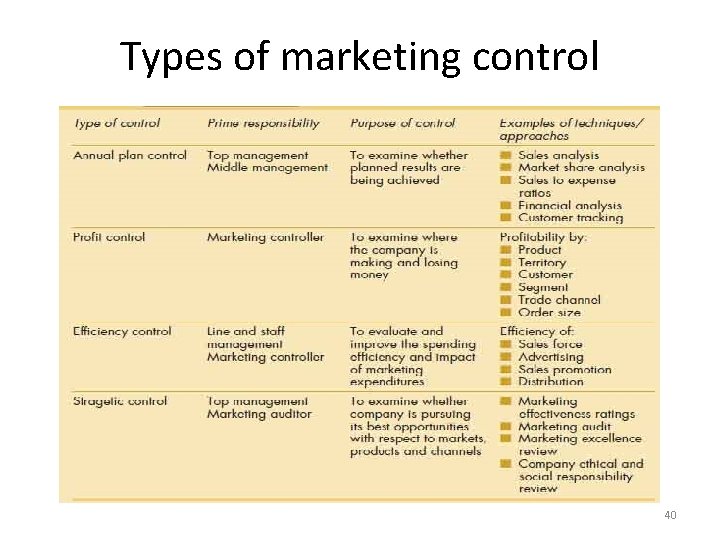
Types of marketing control 40