Chapter 2 Information Systems in Organizations Information and
- Slides: 42
Chapter 2 Information Systems in Organizations Information and Organizations
Organizations and Information Systems q Organization § A formal collection of people and other resources established to accomplish a set of goals Information and Organizations
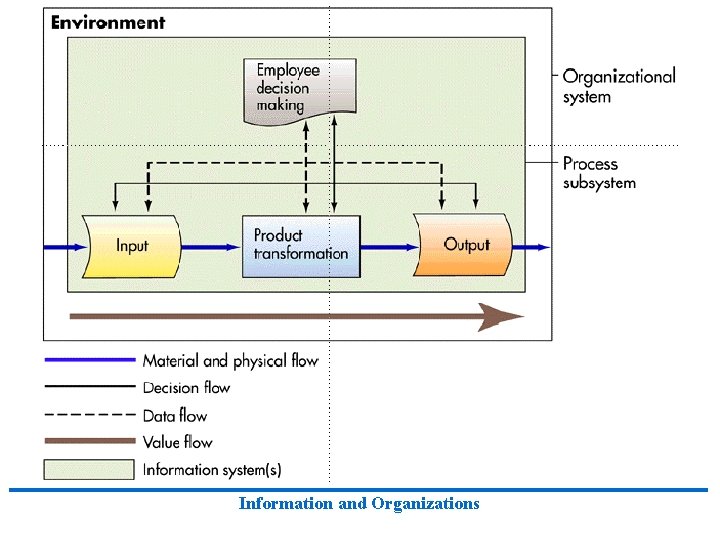
General Model of an Organization q (next slide) Information and Organizations
Information and Organizations
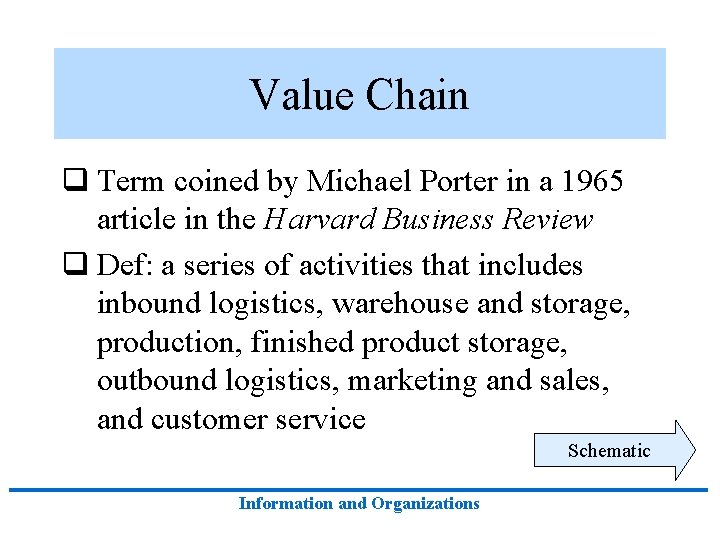
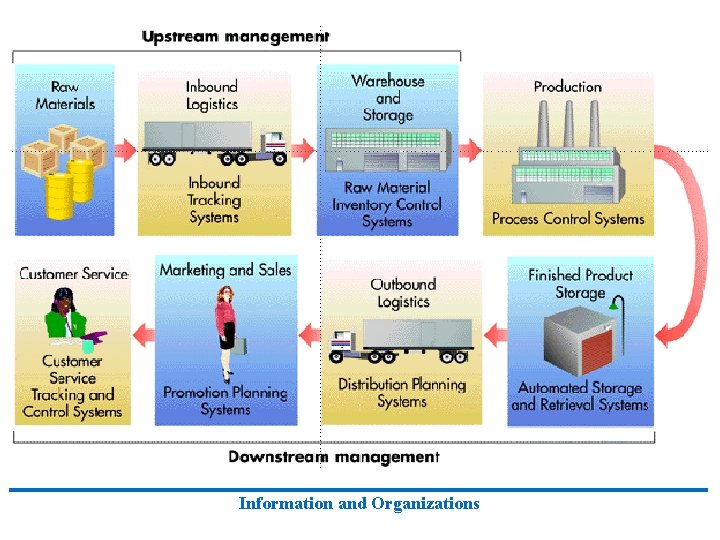
Value Chain q Term coined by Michael Porter in a 1965 article in the Harvard Business Review q Def: a series of activities that includes inbound logistics, warehouse and storage, production, finished product storage, outbound logistics, marketing and sales, and customer service Schematic Information and Organizations
Information and Organizations
Organizations q Organizational structure § Organizational subunits and the way they are related to the overall organization q Traditional organizational structure § Major department heads report to a president or top-level manager Schematic Information and Organizations
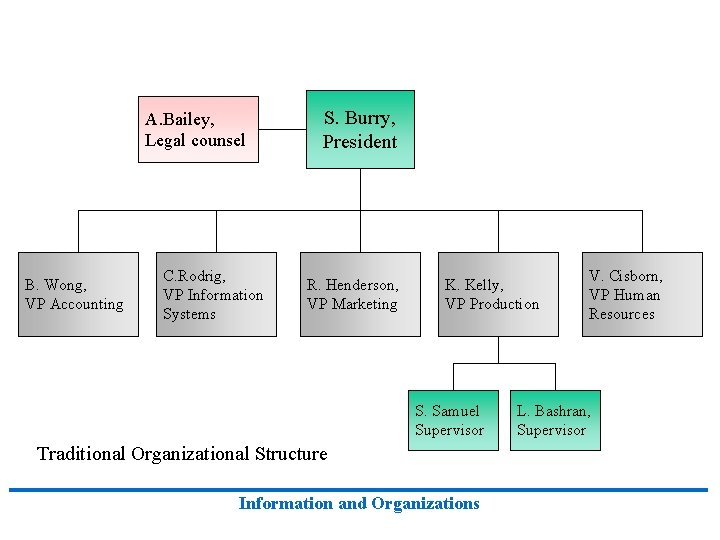
A. Bailey, Legal counsel B. Wong, VP Accounting C. Rodrig, VP Information Systems S. Burry, President R. Henderson, VP Marketing K. Kelly, VP Production S. Samuel Supervisor Traditional Organizational Structure Information and Organizations V. Cisborn, VP Human Resources L. Bashran, Supervisor
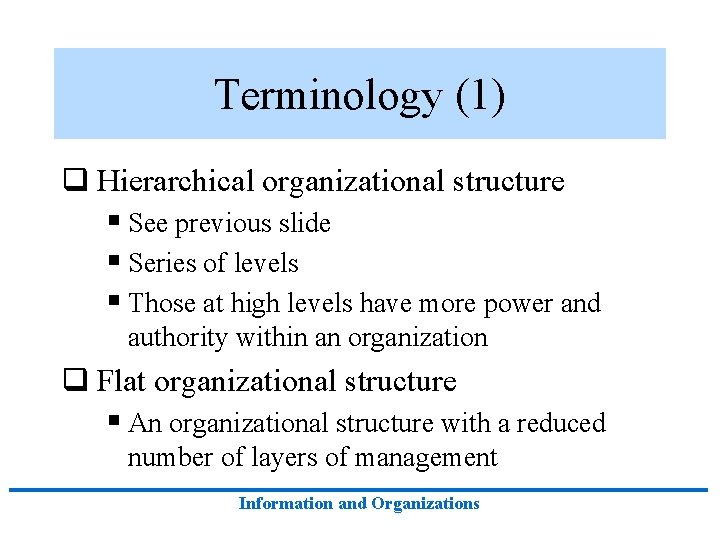
Terminology (1) q Hierarchical organizational structure § See previous slide § Series of levels § Those at high levels have more power and authority within an organization q Flat organizational structure § An organizational structure with a reduced number of layers of management Information and Organizations
Terminology (2) q Empowerment § Giving employees and their managers more power, responsibility, and authority to make decisions, take certain actions, and have more control over their jobs Information and Organizations
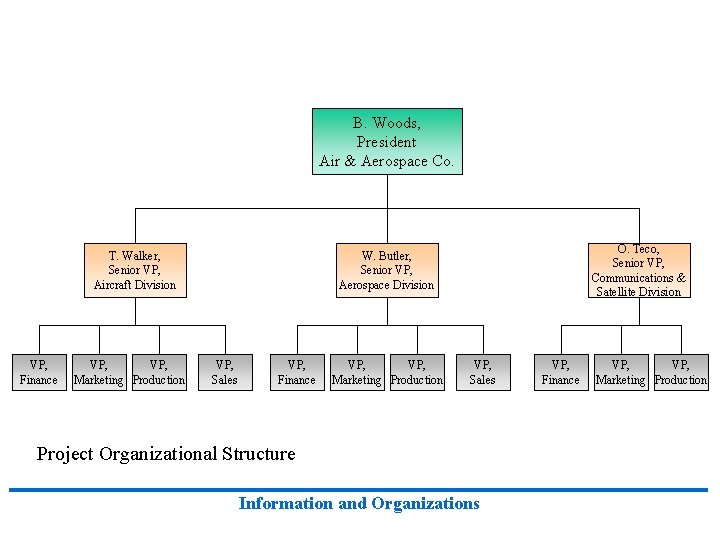
Other Organizational Structures (1) Schematic q Project organizational structure § An organization structure centred on major products or services § Contrast with traditional structure q Team organizational structure § An organizational structure centred on work teams or groups Information and Organizations
B. Woods, President Air & Aerospace Co. T. Walker, Senior VP, Aircraft Division VP, Finance VP, Marketing Production O. Teco, Senior VP, Communications & Satellite Division W. Butler, Senior VP, Aerospace Division VP, Sales VP, Finance VP, Marketing Production VP, Sales Project Organizational Structure Information and Organizations VP, Finance VP, Marketing Production
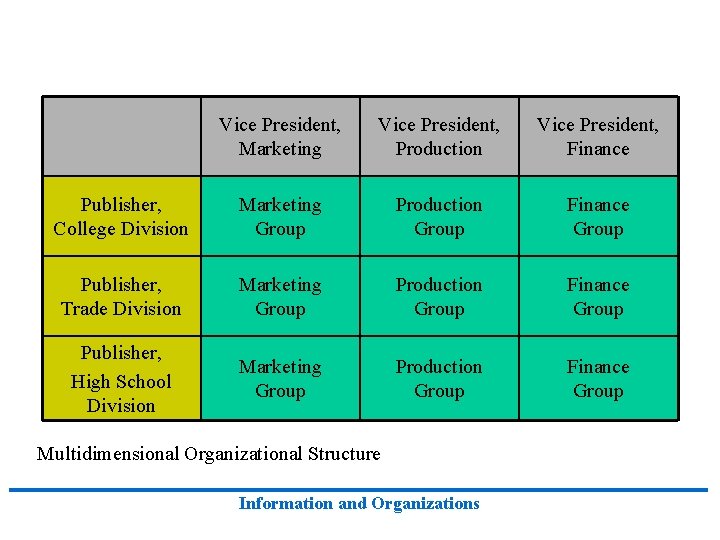
Other Organizational Structures (2) q Multidimensional organizational structure § A structure that may incorporate several structures at the same time Information and Organizations Schematic
Vice President, Marketing Vice President, Production Vice President, Finance Publisher, College Division Marketing Group Production Group Finance Group Publisher, Trade Division Marketing Group Production Group Finance Group Publisher, High School Division Marketing Group Production Group Finance Group Multidimensional Organizational Structure Information and Organizations
Other Organizational Structures (3) q Advantages and disadvantages of different organizational structures § Read the book! Information and Organizations
Organizational Culture and Change (1) q Culture § A set of major understandings and assumptions shared by a group q Organizational culture § The major understandings and assumptions for a business, a corporation, or an organization Information and Organizations
Organizational Culture and Change (1) q Organizational change § Deals with how for-profit and non-profit organizations plan for, implement, and handle change q Organizational learning § The way organizations adapt to new conditions or alter their practices over time Information and Organizations
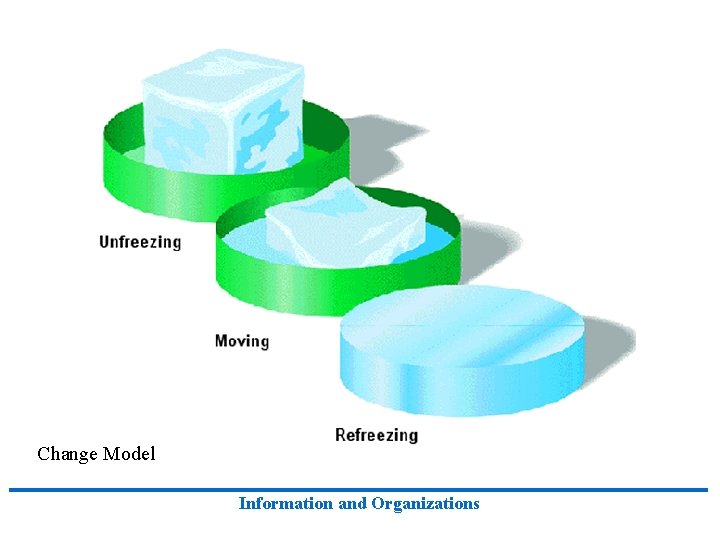
Models of Change q ‘Change model’ § A representation of change theories developed by Kurt Lewin and Edgar Schein in 1969 § Three-stage approach • Unfreezing • Moving • Refreezing Schematic Information and Organizations
Change Model Information and Organizations
Reengineering q Also called ‘Process redesign’ § The radical redesign of business processes, § organizational structures, information systems, and values of the organization to achieve a breakthrough in business results For example, to… • Reduce delivery time • Increase product and service quality • Improve customer satisfaction • Increase revenues and profitability Information and Organizations
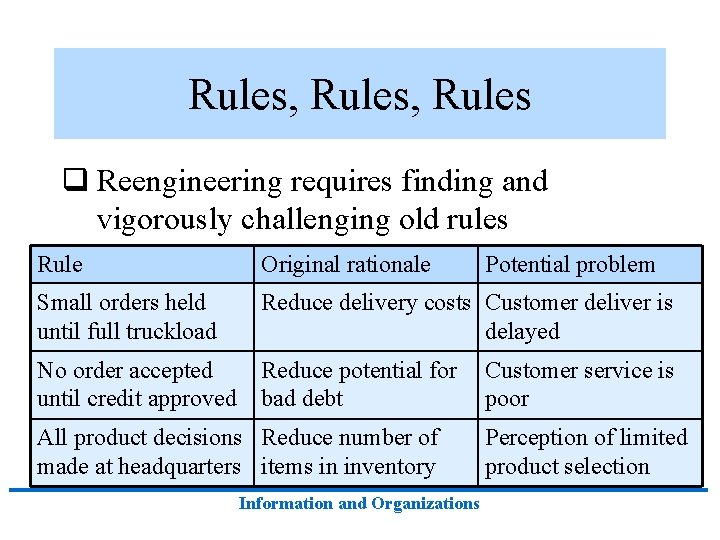
Rules, Rules q Reengineering requires finding and vigorously challenging old rules Rule Original rationale Small orders held until full truckload Reduce delivery costs Customer deliver is delayed No order accepted until credit approved Reduce potential for bad debt All product decisions Reduce number of made at headquarters items in inventory Information and Organizations Potential problem Customer service is poor Perception of limited product selection
Other Models q Continuous improvement § Constantly seeking ways to improve the business processes to add value to products and services Information and Organizations
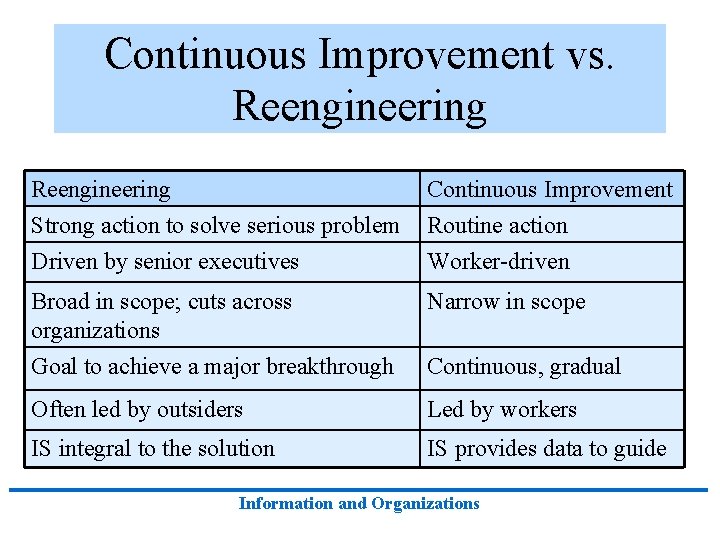
Continuous Improvement vs. Reengineering Strong action to solve serious problem Driven by senior executives Continuous Improvement Routine action Worker-driven Broad in scope; cuts across organizations Narrow in scope Goal to achieve a major breakthrough Continuous, gradual Often led by outsiders Led by workers IS integral to the solution IS provides data to guide Information and Organizations
Total Quality Management q Quality § The ability of a product (including service) to meet or exceed customer expectations q TQM § A collection of approaches, tools, and techniques, that offers a commitment to quality throughout the organization Information and Organizations
Outsourcing and Downsizing q Outsourcing § Contracting with outside professional services to meet specific business needs E. g. , advertising, hiring § q Downsizing § Reducing the number of employees to cut costs § Also called ‘rightsizing’ § May have serious side effects • E. g. , low employee morale, a need for expensive consultants, lost time, waning productivity Information and Organizations
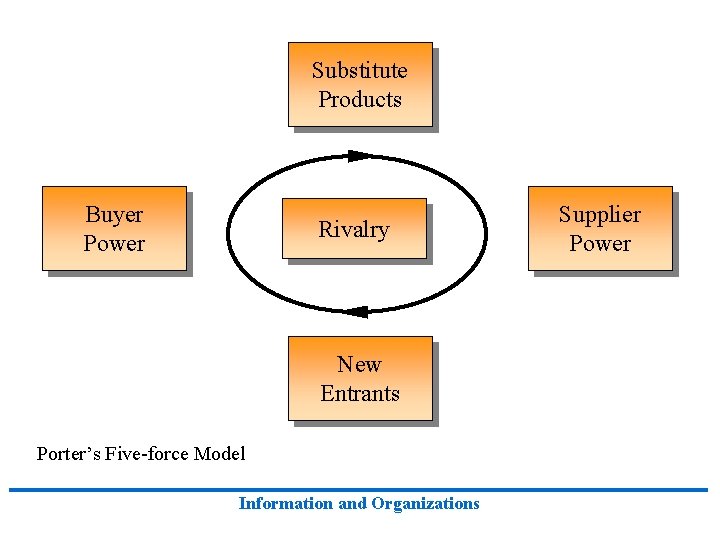
Competitive Advantage q Competitive advantage § A position, product, service, etc. , within a business that improves a position within a market with respect to competitors q Porter’s ‘Five force’ model of competitive advantage § Identifies factors that lead to competitiveness Schematic Information and Organizations
Substitute Products Buyer Power Rivalry New Entrants Porter’s Five-force Model Information and Organizations Supplier Power
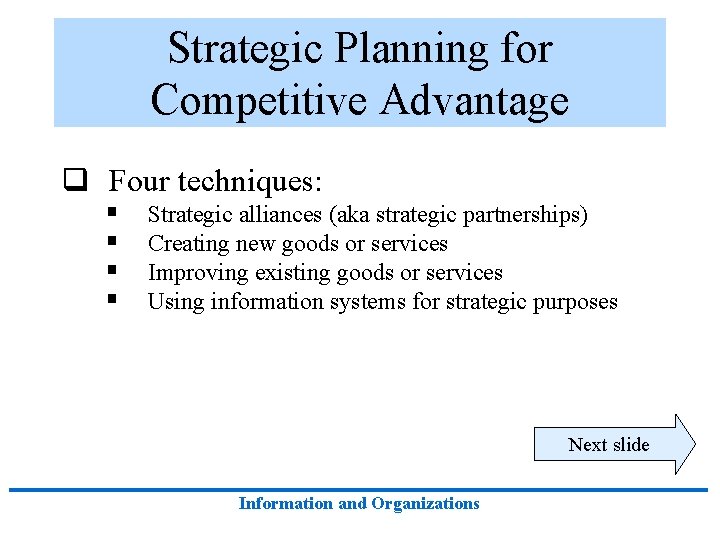
Strategic Planning for Competitive Advantage q Four techniques: § § Strategic alliances (aka strategic partnerships) Creating new goods or services Improving existing goods or services Using information systems for strategic purposes Next slide Information and Organizations
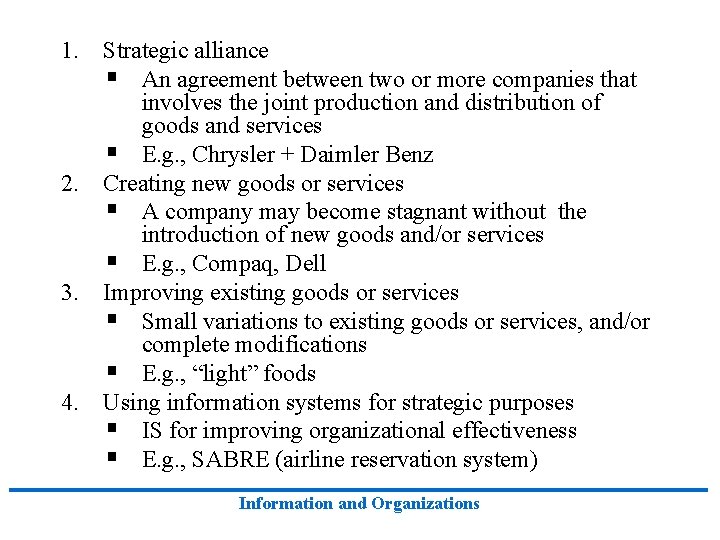
1. Strategic alliance § An agreement between two or more companies that involves the joint production and distribution of goods and services § E. g. , Chrysler + Daimler Benz 2. Creating new goods or services § A company may become stagnant without the introduction of new goods and/or services § E. g. , Compaq, Dell 3. Improving existing goods or services § Small variations to existing goods or services, and/or complete modifications § E. g. , “light” foods 4. Using information systems for strategic purposes § IS for improving organizational effectiveness § E. g. , SABRE (airline reservation system) Information and Organizations
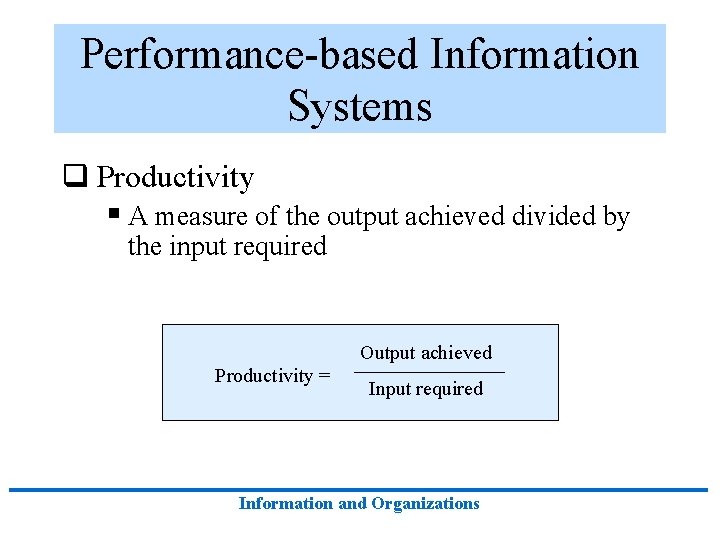
Performance-based Information Systems q Productivity § A measure of the output achieved divided by the input required Output achieved Productivity = Input required Information and Organizations
Productivity q An example is given in the top paragraph on p. 65 q This is a bad example! q Why? Information and Organizations
Return on Investments (ROI) and the Value of IS q Return on investment (ROI) represents § A measure of IS value that investigates the additional profits or benefits that are generated as a percentage of the investment in information systems technology Information and Organizations
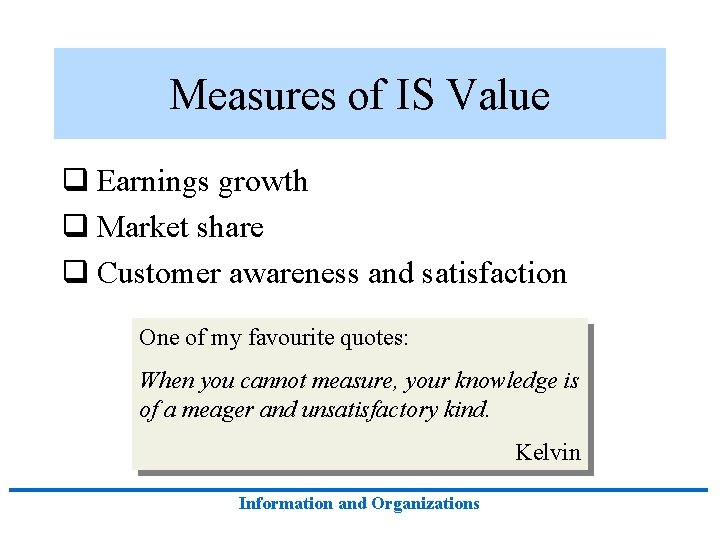
Measures of IS Value q Earnings growth q Market share q Customer awareness and satisfaction One of my favourite quotes: When you cannot measure, your knowledge is of a meager and unsatisfactory kind. Kelvin Information and Organizations
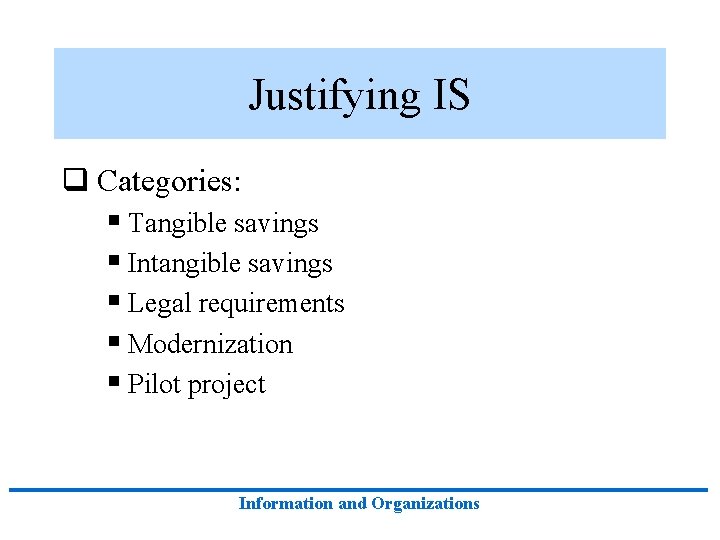
Justifying IS q Categories: § Tangible savings § Intangible savings § Legal requirements § Modernization § Pilot project Information and Organizations
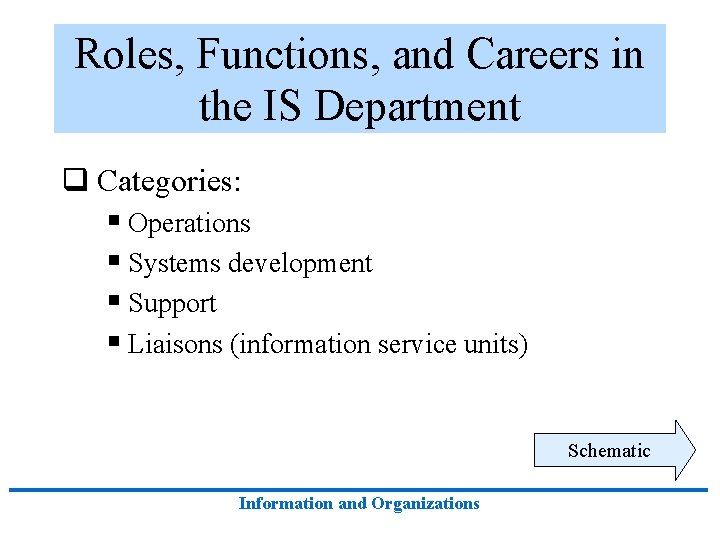
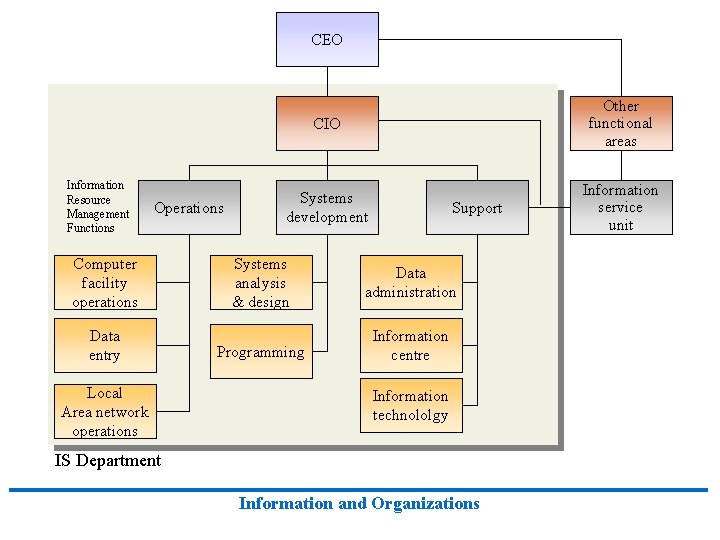
Roles, Functions, and Careers in the IS Department q Categories: § Operations § Systems development § Support § Liaisons (information service units) Schematic Information and Organizations
CEO Information Resource Management Functions Operations Computer facility operations Data entry Local Area network operations CIO Other functional areas Systems development Information service unit Support Systems analysis & design Data administration Programming Information centre Information technololgy IS Department Information and Organizations
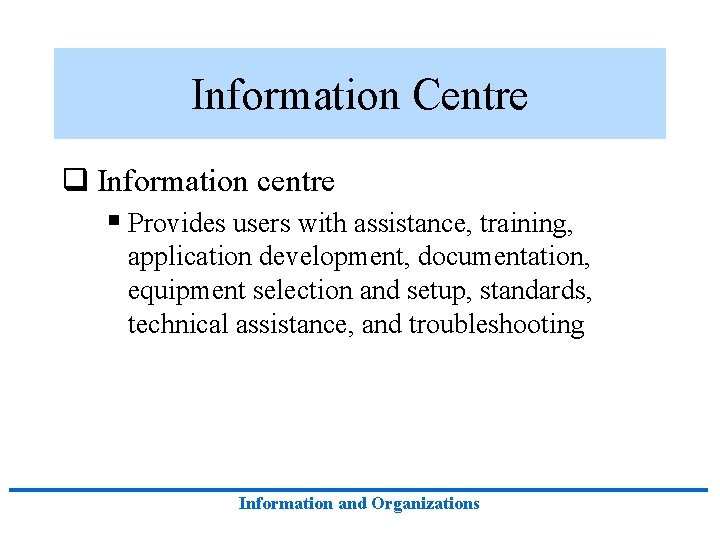
Information Centre q Information centre § Provides users with assistance, training, application development, documentation, equipment selection and setup, standards, technical assistance, and troubleshooting Information and Organizations
Information Service Unit q Information service unit § Attached to a functional area of the business. § Acts as a local information support organization within a functional area. § Performs the critical role of liaison between the functional area and IS Information and Organizations
Chief Information Officer (CIO) q Chief Information Officer (CIO) § A manager at the vice-president level responsible for IS planning, policy, and standards § Focused on supporting corporate goals Information and Organizations
Other IS Roles § Database Administrator § Systems Programmer § Network Specialist § LAN Administrator § Webmaster § Trainer Information and Organizations
IS Principles § Use of IS strongly influenced by organizational structure and problem orientations § IS are often intertwined within the value-added processes § IS usage may require change that could meet with resistance § Value-added IS needs to be continually sought Information and Organizations
End of Chapter 2 Chapter 3 Information and Organizations