
Chapter 8 Business Organizations Section 4 Objectives 1
Chapter 8: Business Organizations Section 4
Objectives 1. Identify the different types of cooperative organizations. 2. Understand the purpose of nonprofit organizations, including professional and business organizations. Chapter 8, Section 4 Copyright © Pearson Education, Inc. Slide 2

Key Terms • cooperative: a business organization owned and operated by a group of individuals for their shared benefit • consumer cooperative: a retail outlet owned and operated by consumers that sells merchandise to members at reduced rates • service cooperative: a type of cooperative that provides a service rather than a good • producer cooperative: an agricultural marketing cooperative that helps members sell their products Chapter 8, Section 4 Copyright © Pearson Education, Inc. Slide 3

Key Terms, cont. • nonprofit organization: an institution that functions much like a business, but does not operate for the purpose of making a profit • professional organization: a nonprofit organization that works to improve the image, working conditions, and skill levels of people in particular occupations • business association: a group organized to promote the collective business interests of an area or group of similar business interests • trade association: nonprofit organizations that promote the interests of particular industries Chapter 8, Section 4 Copyright © Pearson Education, Inc. Slide 4
Introduction • How are some businesses organized to help others? – Cooperatives are businesses created by a group of individuals who share benefits. – Nonprofit organizations are run like a business but their goal is not to make a profit. Instead these organizations seek to benefit the public in some way. Chapter 8, Section 4 Copyright © Pearson Education, Inc. Slide 5
Cooperatives • A cooperative is a type of business organization owned and operated by a group of individuals for their shared benefit. – First instituted by Benjamin Franklin, cooperatives are based on the following principles: • Voluntary and open membership • Control of the organization by its members • Sharing of contributions and benefits by members Chapter 8, Section 4 Copyright © Pearson Education, Inc. Slide 6
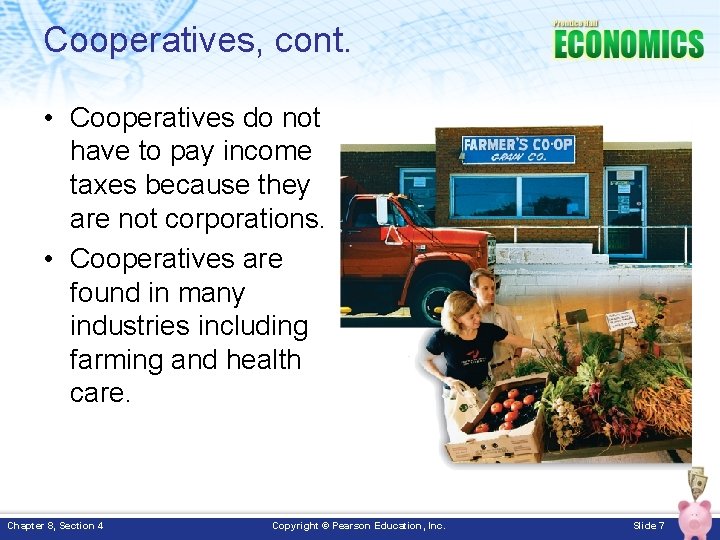
Cooperatives, cont. • Cooperatives do not have to pay income taxes because they are not corporations. • Cooperatives are found in many industries including farming and health care. Chapter 8, Section 4 Copyright © Pearson Education, Inc. Slide 7
Consumer Cooperatives • There are three kinds of cooperatives. – Consumer cooperatives are retail outlets owned and operated by consumers. • They sell merchandise to members at reduced prices. • Examples of consumer cooperatives include discount price clubs and housing co-ops. • Some co-ops require members to work a small number of hours to maintain membership. Chapter 8, Section 4 Copyright © Pearson Education, Inc. Slide 8
Service and Producer Cooperatives • Service cooperatives are co-ops that provide a service. – Some service co-ops offer discounted insurance, health care, or legal help. – Credit unions are an example of a service co-op. • Producer cooperatives are agricultural marketing co-ops that help members sell their products. – Members focus their attention on their crops or livestock while the co-op markets the goods for the highest possible price. Chapter 8, Section 4 Copyright © Pearson Education, Inc. Slide 9
Nonprofits • Nonprofit organizations function like a business but do not operate for the purpose of generating profit. – Examples of nonprofits include museums, public schools, the American Red Cross, hospitals, churches, and many other groups and charities. – Nonprofits, like co-ops, are exempt from paying income taxes, but the nonprofit must meet certain requirements to qualify for tax-exempt status. – Nonprofits have limits on their political activity. Chapter 8, Section 4 Copyright © Pearson Education, Inc. Slide 10
Professional Organizations • Some nonprofits provide support to particular occupations or geographical areas. – Professional organizations work to improve the image, working conditions, and skill levels of people in particular occupations such as the National Education Association for educators. – Keep members up-to-date on industry trends. – Set codes of conduct that members must follow. Chapter 8, Section 4 Copyright © Pearson Education, Inc. Slide 11

Business Associations • Promote the collective business interests of a city, state, or other geographical area. – The Better Business Bureau (BBB), which aims to protect consumers by promoting an ethical and fair marketplace is an example of a business association. Chapter 8, Section 4 Copyright © Pearson Education, Inc. Slide 12
Trade Associations • Trade associations promote the interests of particular industries. • Many trade associations hire lobbyists to work with state legislatures and Congress to try to influence laws that affect an industry. Chapter 8, Section 4 Copyright © Pearson Education, Inc. Slide 13
Review • Now that you have learned how some businesses are organized to help others, go back and answer the Chapter Essential Question. – Why do some businesses succeed and others fail? Chapter 8, Section 4 Copyright © Pearson Education, Inc. Slide 14
- Slides: 14