Chapter 19 Letters and Employment Correspondence Technical Communication
- Slides: 13
Chapter 19 Letters and Employment Correspondence Technical Communication, 9/e John M. Lannon Power. Point prepared by Jimidene Murphy © 2003 Pearson Education, Inc. , publishing as Longman Publishers. 1
When a Letter is Better than a Memo or Email Use a letter when you need to Ø Ø Ø Personalize your message Convey a dignified, professional impression Act as a representative of your company Present a carefully constructed case Respond to clients, customers, or anyone outside your organization Provide an official notice or record of an announcement or legal action © 2003 Pearson Education, Inc. , publishing as Longman Publishers. 2
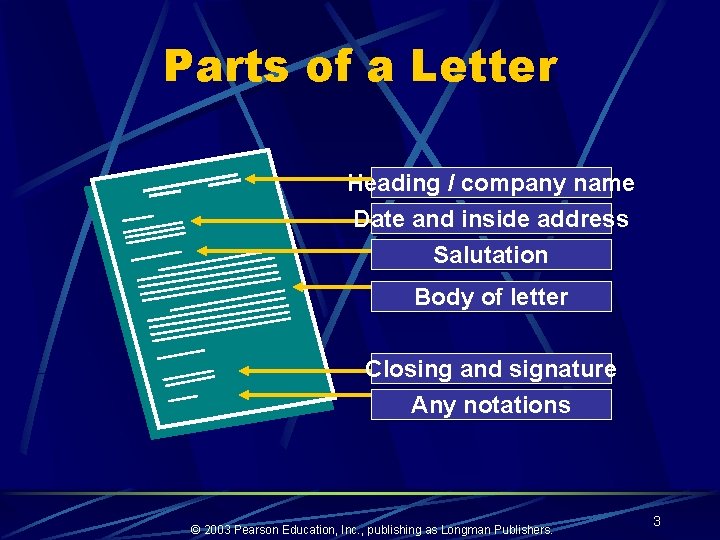
Parts of a Letter Heading / company name Date and inside address Salutation Body of letter Closing and signature Any notations © 2003 Pearson Education, Inc. , publishing as Longman Publishers. 3
Special Parts of a Letter Ø Attention line Ø Subject line Ø Typist’s initials Ø Enclosure notation Ø Distribution notation Ø Postscript © 2003 Pearson Education, Inc. , publishing as Longman Publishers. 4
Design Factors Ø Quality stationary Ø Uniform margins and spacing Ø Appropriate headings for multiple pages Ø Appropriate envelopes © 2003 Pearson Education, Inc. , publishing as Longman Publishers. 5
Interpersonal Considerations Ø Focus on the reader’s perspective Ø Use plain English Ø Focus on the human connection Ø Anticipate the reader’s react Ø Decide on the direct or the indirect plan © 2003 Pearson Education, Inc. , publishing as Longman Publishers. 6
Types of Letters Ø Inquiry letters Ø Letters requesting an informative interview Ø Answers to telephone and email inquiries Ø Claim letters Ø Routine Ø Arguable © 2003 Pearson Education, Inc. , publishing as Longman Publishers. 7
Preparing a Résumé Ø Gather contact information Ø Statement of objective Ø Education Ø Work experience Ø Personal data Ø Interests, achievements, awards, and skills Ø References © 2003 Pearson Education, Inc. , publishing as Longman Publishers. 8
Organizing a Résumé Give some advantages and disadvantages of each of the following ways to organize a résumé. When would you want to use each? Reverse chronological order Functional Combination © 2003 Pearson Education, Inc. , publishing as Longman Publishers. 9
Job Application Letter Image Target audience Two types Ø Solicited Ø Unsolicited © 2003 Pearson Education, Inc. , publishing as Longman Publishers. 10
Electronic Job Hunting Online employment resources Electronic scanning of résumés Ø Preparing content for a scannable résumé Ø Designing a scannable résumé Hyperlinking a résumé Protecting your privacy © 2003 Pearson Education, Inc. , publishing as Longman Publishers. 11
Support for the Application Ø Dossier Ø Portfolio Ø Interviews Ø Follow-up letters Ø Letters of acceptance Ø Letters of refusal © 2003 Pearson Education, Inc. , publishing as Longman Publishers. 12
Any Questions? For additional help reviewing this chapter, please visit the Companion Website for your text at http: //www. ablongman. com/lannon. © 2003 Pearson Education, Inc. , publishing as Longman Publishers. 13