
UNCONSCIOUS BIAS The Hon Dame Linda Dobbs DBE
UNCONSCIOUS BIAS The Hon. Dame Linda Dobbs DBE
LORD BINGHAM “A judge must free himself of prejudice and partiality and so conduct himself, in court and out of it, as to give no ground for doubting his ability and willingness to decide cases coming before him solely on their legal and factual merits as they appear to him in the exercise of an objective, independent and impartial judgment. ”
DEFINITION OF BIAS Oxford English Dictionary: “An inclination, leaning, bent, predisposition towards, predilection, prejudice. ”
HOW INFORMATION IS PROCESSED • Scientists estimate that we are exposed to as many as 11 million pieces of information at any one time. Our brains can only deal with about 40 at a time. • We do it by developing a perceptual lens that filters out certain things and lets in others depending on certain perceptions, interpretations, preferences and biases we have adapted in our lives. Our perceptive lens allows us to see and miss certain things.
THE DANGERS • According to research, this natural human process of categorising like objects together and related cognitive biases can result in individual’s implicit reliance on stereotypes. • This implicit reliance on stereotypes can influence how incoming information is interpreted and remembered. • It has been found that this can make people remember stereotype behaviour that did not occur and less readily remember stereotype inconsistent behaviour which did occur.
WHAT IS UNCONSCIOUS BIAS? (1) • Unconscious bias, hidden bias, implicit bias, subconscious bias, automatic bias all relate to the same thing. It is a concept that individuals have a preference at a subconscious level that unintentionally influences decision-making.
WHAT IS UNCONSCIOUS BIAS? (2) • Unconscious processing happens automatically and is sometimes described by those in the field as fast thinking. Conscious processing requires sequential attention to data and deliberate processing and is sometimes described as slow thinking. Fast thinking makes for efficient processing of information but this efficiency is at a cost when the results suffer from bias.

ADVERTISING

ADVERTISING
RESULTS OF SOME STUDIES (1) • Car sales men were influenced by race and gender in the prices they offered for the same car – the most favourable price being given to the white man, then white women, black women and black men.
RESULTS OF SOME STUDIES (2) • Similar tests have been done using the same CV but changing the names – the more white sounding names were more likely to be brought back for interview than Afro-American names. • Accents were also found to be a factor – it was found that people with minority accents were less likely to be believed than those with the dominant accent.
DIFFERENT CATEGORIES OF BIAS (1) • “Affinity bias” or “mini me” syndrome – making choices based on affinity/similarity. • “Confirmational” behaviour – we make decisions largely in a way that is designed to confirm beliefs we already have. • “Assimilation bias” – an inclination to interpret ambiguous information in a way that is consistent with previously held beliefs.
DIFFERENT CATEGORIES OF BIAS (2) • “Belief perseverance” – keeping held beliefs after evidence on which they were founded have been shown to be invalid or false. This could be as a result of a tendency to ignore or filter out evidence that disconfirm our beliefs. • This is a particularly pertinent issue with regard to judging. How much do we select evidence that suits our view and leave out possibly relevant material which does not support our view?
DIFFERENT CATEGORIES OF BIAS (3) • “Argument from authority” – believing that an idea posited by a likeable source is true and that an argument put forward by an unlikeable source is not. • “Argument from novelty” – because it is new, it must be better – like mobile phones and i. Pads.
DIFFERENT CATEGORIES OF BIAS (4) • “Arguments from antiquity” – arguing that something is right because it has always been that way – e. g. the place of women is in the home because that is how it has always been. • “Bandwagon bias” – tendency to assume that the opinion of the majority is the valid opinion.
DIFFERENT CATEGORIES OF BIAS (5) • “Argument from ignorance” – thinking that because something has not been proved to be false, then it must be true or vice versa – the lack of the evidence for the existence of Gods means they do not exist.
DIFFERENT CATEGORIES OF BIAS (6) • “Correspondence bias” – this also has some relevance – the tendency to explains others behaviours overemphasising their personal disposition and downplaying the relevance of the situation. E. g. thinking that when other people break the law it is because of their criminal personality disregarding the situational factors that could have had an impact on their behaviour.
DIFFERENT CATEGORIES OF BIAS (7) • “The gamblers fallacy” – the belief that if a given outcome has not occurred for a while then it is due to take place.
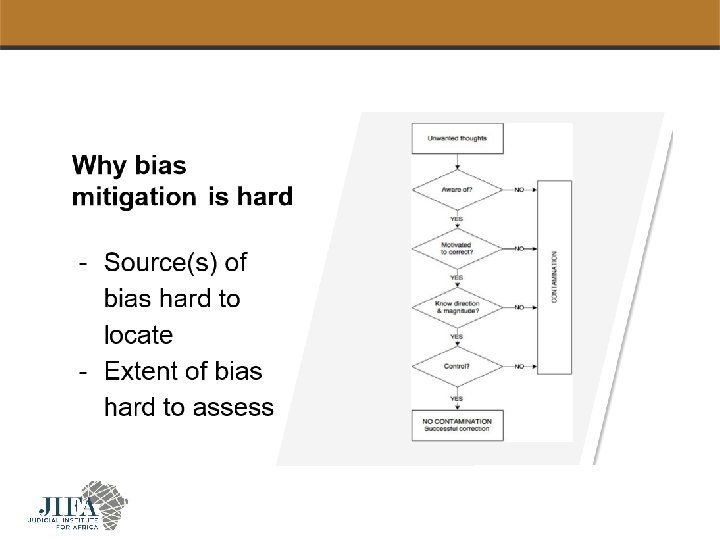
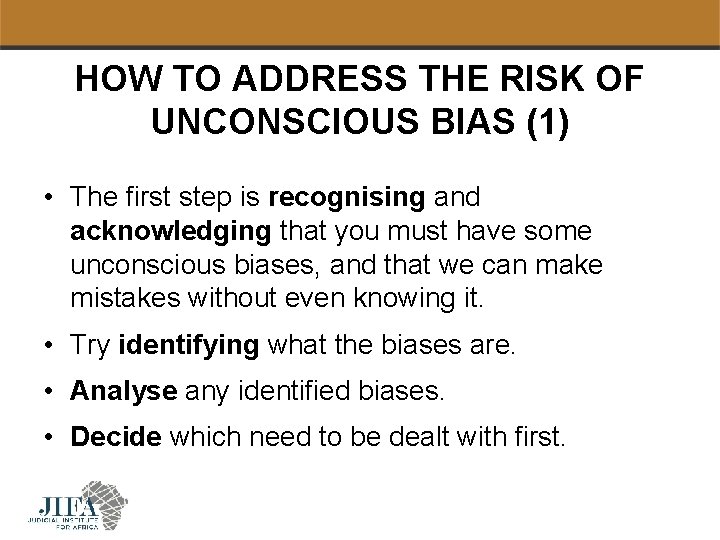
HOW TO ADDRESS THE RISK OF UNCONSCIOUS BIAS (1) • The first step is recognising and acknowledging that you must have some unconscious biases, and that we can make mistakes without even knowing it. • Try identifying what the biases are. • Analyse any identified biases. • Decide which need to be dealt with first.
HOW TO ADDRESS THE RISK OF UNCONSCIOUS BIAS (2) • If you are serious about addressing it, try some of the online unconscious bias tests to give you an idea of the extent of the problem. • Try formulating some questions for yourself related to your work and answer them honestly
HOW TO ADDRESS THE RISK OF UNCONSCIOUS BIAS (3) • Get some honest feedback from colleagues or court staff about how you come over in relation to “preferences”. • When case papers come in, test to see whether any preliminary view you may have come to is influenced in any way by your views and beliefs as opposed to the merits of the case.
HOW TO ADDRESS THE RISK OF UNCONSCIOUS BIAS (4) • Similarly when it comes to judgments, analyse your reasoning and ask yourself whether your decision may have been affected by any prejudice you may hold. • Whilst carrying out your duties, confront yourself regularly about the issue to ensure that it is a live one in your mind.
HOW TO ADDRESS THE RISK OF UNCONSCIOUS BIAS (5) • Remind yourself to be fair and objective – have a note on your desk in court! • Try putting yourself in their shoes to have a better understanding.
HOW TO ADDRESS THE RISK OF UNCONSCIOUS BIAS (6) • Remind yourself of stories which bust the myths – such as a good story about an unemployed person or previously convicted defendant. • Ensure that you are feeling well and eating an appropriate diet, because research has shown that when we are stressed, frustrated or angry our emotions overwhelm our ability to manage any bias.
- Slides: 25