Chapter 18 ShortTerm Finance and Planning Mc GrawHillIrwin

- Slides: 25
Chapter 18 Short-Term Finance and Planning Mc. Graw-Hill/Irwin Copyright © 2007 by The Mc. Graw-Hill Companies, Inc. All rights reserved.
Key Concepts and Skills o Understand the components of the cash cycle and why it is important o Understand the pros and cons of the various short-term financing policies o Be able to prepare a cash budget o Understand the various options for short-term financing Mc. Graw-Hill/Irwin Copyright © 2007 by The Mc. Graw-Hill Companies, Inc. All rights reserved.
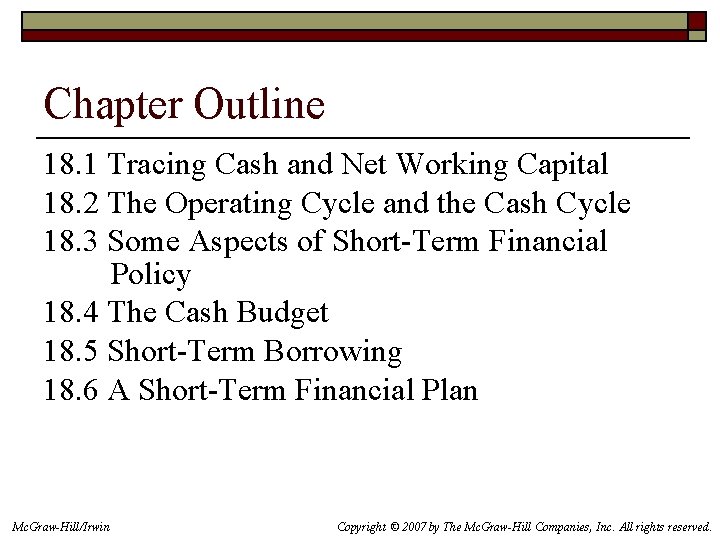
Chapter Outline 18. 1 Tracing Cash and Net Working Capital 18. 2 The Operating Cycle and the Cash Cycle 18. 3 Some Aspects of Short-Term Financial Policy 18. 4 The Cash Budget 18. 5 Short-Term Borrowing 18. 6 A Short-Term Financial Plan Mc. Graw-Hill/Irwin Copyright © 2007 by The Mc. Graw-Hill Companies, Inc. All rights reserved.
Balance Sheet Model of the Firm Current Assets Fixed Assets 1 Tangible 2 Intangible Mc. Graw-Hill/Irwin Current Liabilities Net Working Capital How much shortterm cash flow does a company need to pay its bills? Long-Term Debt Shareholders’ Equity Copyright © 2007 by The Mc. Graw-Hill Companies, Inc. All rights reserved.
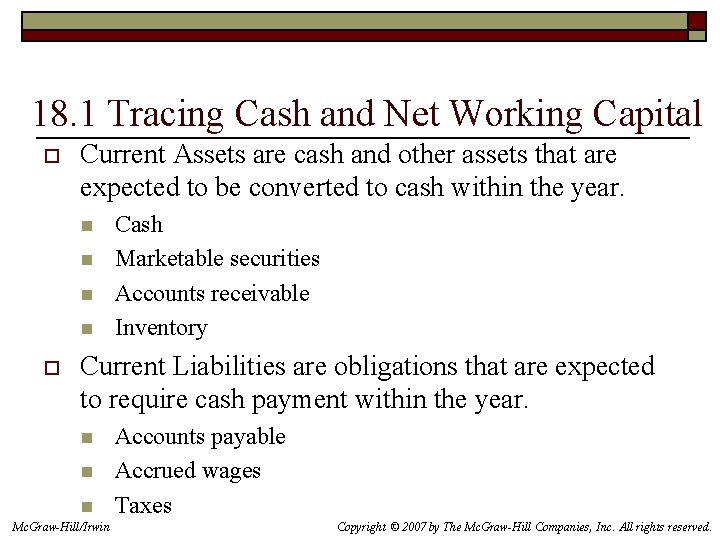
18. 1 Tracing Cash and Net Working Capital o Current Assets are cash and other assets that are expected to be converted to cash within the year. n n o Cash Marketable securities Accounts receivable Inventory Current Liabilities are obligations that are expected to require cash payment within the year. n n n Mc. Graw-Hill/Irwin Accounts payable Accrued wages Taxes Copyright © 2007 by The Mc. Graw-Hill Companies, Inc. All rights reserved.
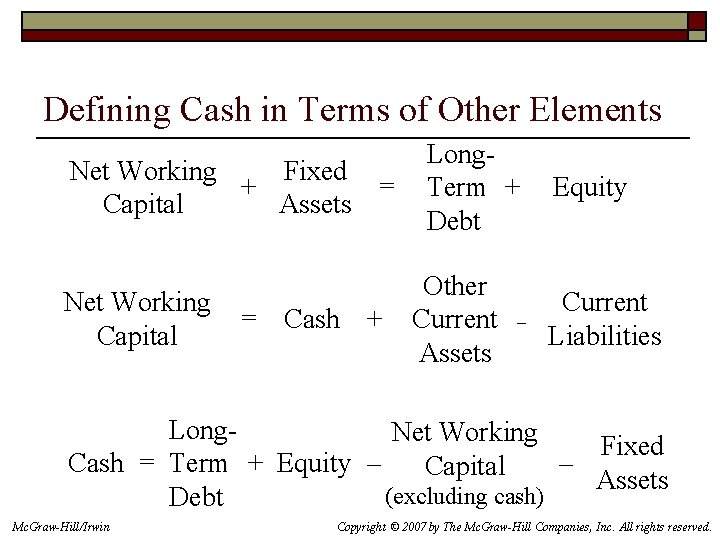
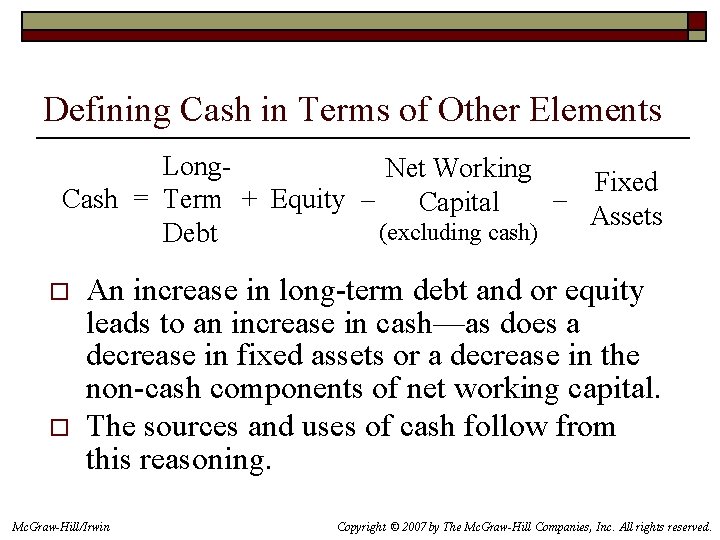
Defining Cash in Terms of Other Elements Net Working Fixed + = Capital Assets Net Working Capital = Cash + Long. Term + Debt Other Current Assets – Equity Current Liabilities Long. Net Working Fixed Cash = Term + Equity – – Capital Assets (excluding cash) Debt Mc. Graw-Hill/Irwin Copyright © 2007 by The Mc. Graw-Hill Companies, Inc. All rights reserved.
Defining Cash in Terms of Other Elements Long. Net Working Fixed Cash = Term + Equity – – Capital Assets (excluding cash) Debt o o An increase in long-term debt and or equity leads to an increase in cash—as does a decrease in fixed assets or a decrease in the non-cash components of net working capital. The sources and uses of cash follow from this reasoning. Mc. Graw-Hill/Irwin Copyright © 2007 by The Mc. Graw-Hill Companies, Inc. All rights reserved.
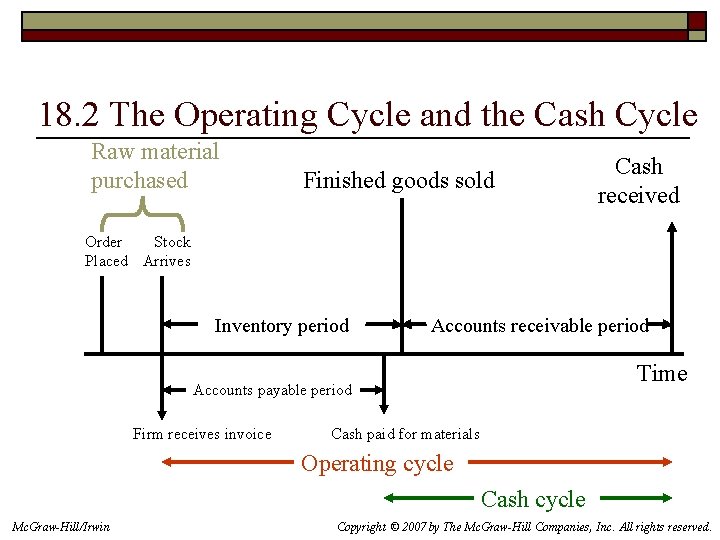
18. 2 The Operating Cycle and the Cash Cycle Raw material purchased Finished goods sold Cash received Order Stock Placed Arrives Inventory period Accounts receivable period Time Accounts payable period Firm receives invoice Cash paid for materials Operating cycle Cash cycle Mc. Graw-Hill/Irwin Copyright © 2007 by The Mc. Graw-Hill Companies, Inc. All rights reserved.
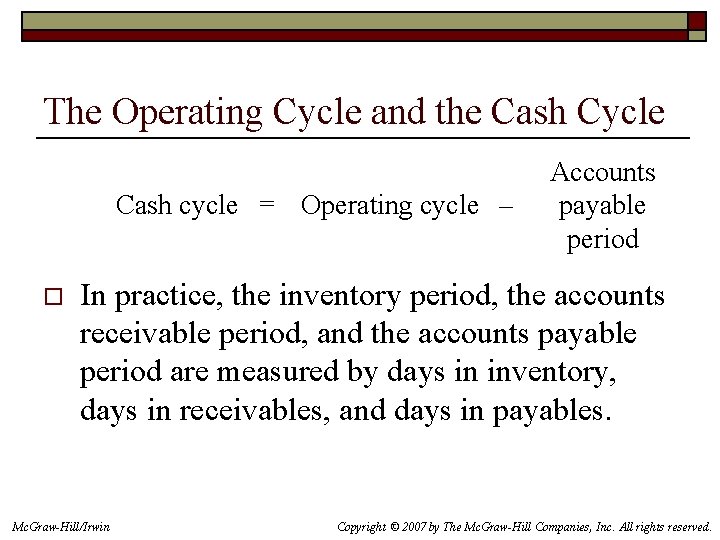
The Operating Cycle and the Cash Cycle Cash cycle = Operating cycle – o Accounts payable period In practice, the inventory period, the accounts receivable period, and the accounts payable period are measured by days in inventory, days in receivables, and days in payables. Mc. Graw-Hill/Irwin Copyright © 2007 by The Mc. Graw-Hill Companies, Inc. All rights reserved.
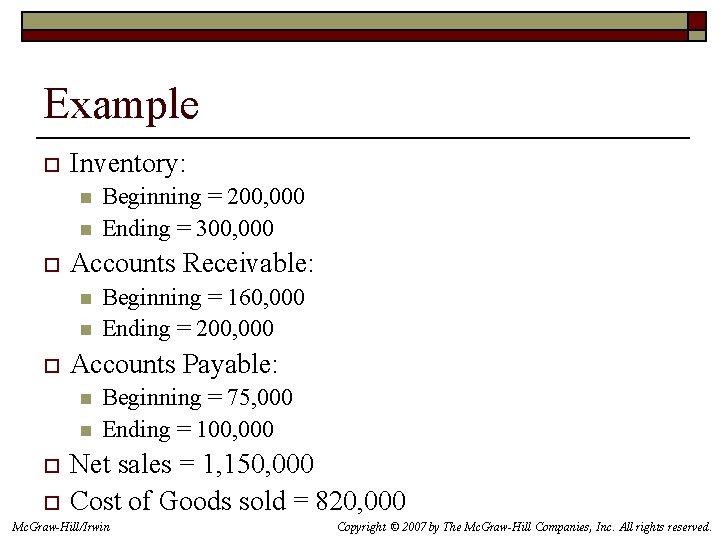
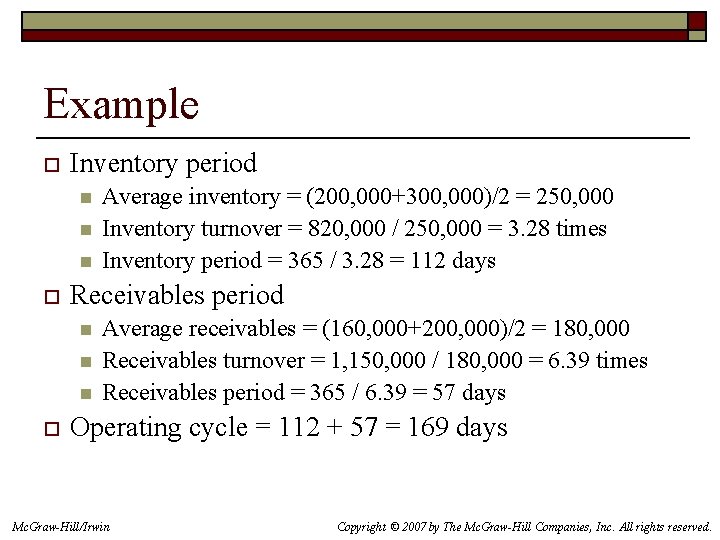
Example o Inventory: n n o Accounts Receivable: n n o Beginning = 160, 000 Ending = 200, 000 Accounts Payable: n o Beginning = 200, 000 Ending = 300, 000 Beginning = 75, 000 Ending = 100, 000 Net sales = 1, 150, 000 Cost of Goods sold = 820, 000 Mc. Graw-Hill/Irwin Copyright © 2007 by The Mc. Graw-Hill Companies, Inc. All rights reserved.
Example o Inventory period n n n o Receivables period n n n o Average inventory = (200, 000+300, 000)/2 = 250, 000 Inventory turnover = 820, 000 / 250, 000 = 3. 28 times Inventory period = 365 / 3. 28 = 112 days Average receivables = (160, 000+200, 000)/2 = 180, 000 Receivables turnover = 1, 150, 000 / 180, 000 = 6. 39 times Receivables period = 365 / 6. 39 = 57 days Operating cycle = 112 + 57 = 169 days Mc. Graw-Hill/Irwin Copyright © 2007 by The Mc. Graw-Hill Companies, Inc. All rights reserved.
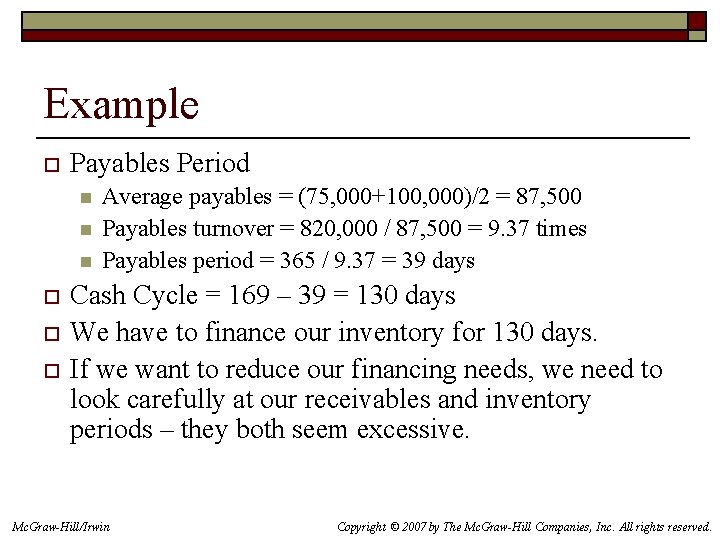
Example o Payables Period n n n o o o Average payables = (75, 000+100, 000)/2 = 87, 500 Payables turnover = 820, 000 / 87, 500 = 9. 37 times Payables period = 365 / 9. 37 = 39 days Cash Cycle = 169 – 39 = 130 days We have to finance our inventory for 130 days. If we want to reduce our financing needs, we need to look carefully at our receivables and inventory periods – they both seem excessive. Mc. Graw-Hill/Irwin Copyright © 2007 by The Mc. Graw-Hill Companies, Inc. All rights reserved.
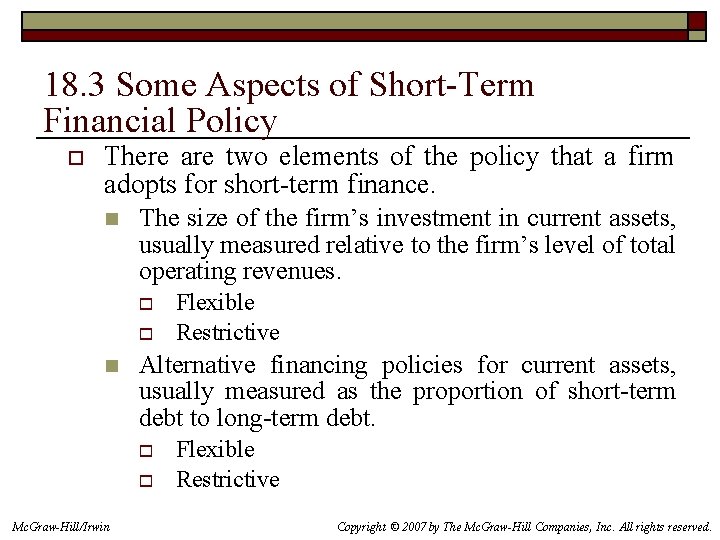
18. 3 Some Aspects of Short-Term Financial Policy o There are two elements of the policy that a firm adopts for short-term finance. n The size of the firm’s investment in current assets, usually measured relative to the firm’s level of total operating revenues. o o n Alternative financing policies for current assets, usually measured as the proportion of short-term debt to long-term debt. o o Mc. Graw-Hill/Irwin Flexible Restrictive Copyright © 2007 by The Mc. Graw-Hill Companies, Inc. All rights reserved.
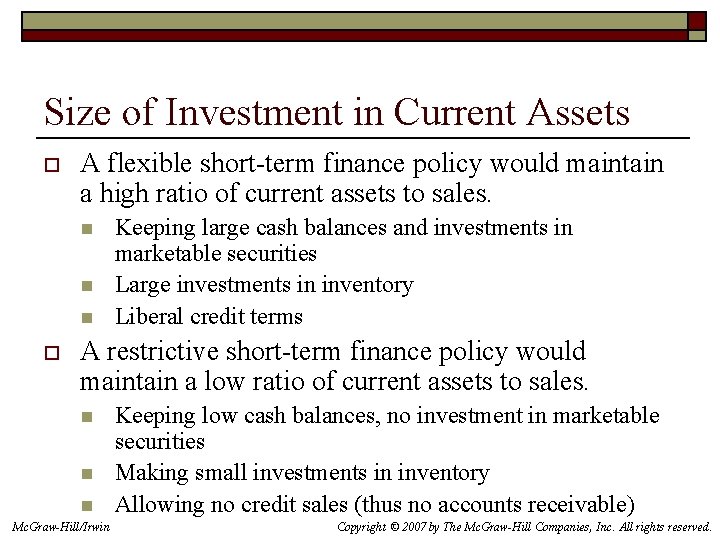
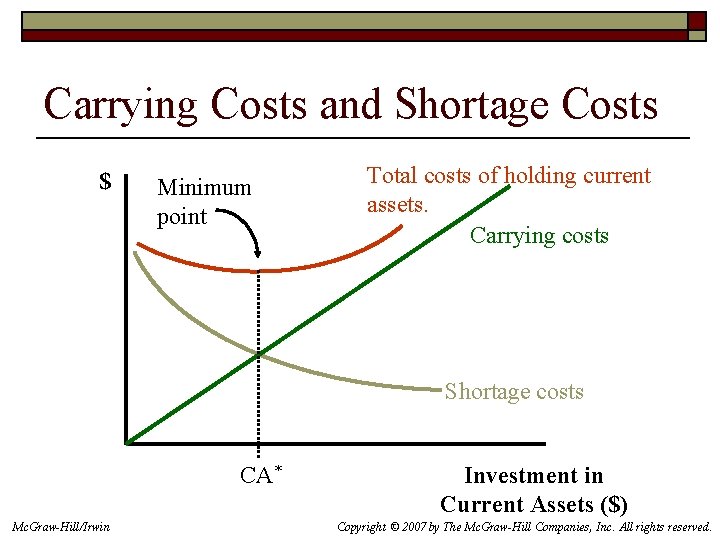
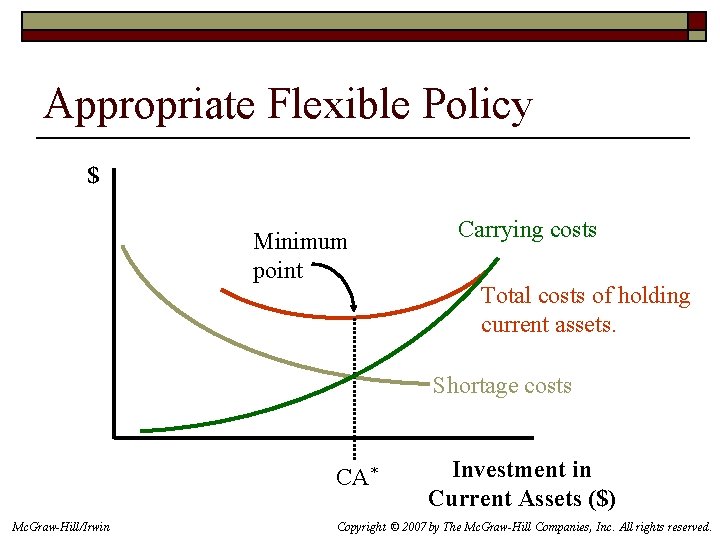
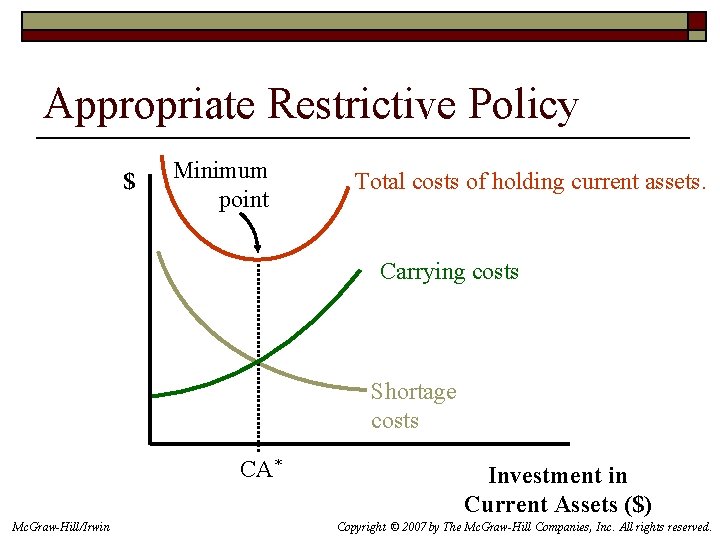
Size of Investment in Current Assets o A flexible short-term finance policy would maintain a high ratio of current assets to sales. n n n o Keeping large cash balances and investments in marketable securities Large investments in inventory Liberal credit terms A restrictive short-term finance policy would maintain a low ratio of current assets to sales. n n n Mc. Graw-Hill/Irwin Keeping low cash balances, no investment in marketable securities Making small investments in inventory Allowing no credit sales (thus no accounts receivable) Copyright © 2007 by The Mc. Graw-Hill Companies, Inc. All rights reserved.
Carrying Costs and Shortage Costs $ Minimum point Total costs of holding current assets. Carrying costs Shortage costs CA* Mc. Graw-Hill/Irwin Investment in Current Assets ($) Copyright © 2007 by The Mc. Graw-Hill Companies, Inc. All rights reserved.
Appropriate Flexible Policy $ Minimum point Carrying costs Total costs of holding current assets. Shortage costs CA* Mc. Graw-Hill/Irwin Investment in Current Assets ($) Copyright © 2007 by The Mc. Graw-Hill Companies, Inc. All rights reserved.
Appropriate Restrictive Policy $ Minimum point Total costs of holding current assets. Carrying costs Shortage costs CA* Mc. Graw-Hill/Irwin Investment in Current Assets ($) Copyright © 2007 by The Mc. Graw-Hill Companies, Inc. All rights reserved.
Alternative Financing Policies o o o A flexible short-term finance policy means a low proportion of short-term debt relative to long-term financing. A restrictive short-term finance policy means a high proportion of short-term debt relative to long-term financing. In an ideal world, short-term assets are always financed with short-term debt, and long-term assets are always financed with long-term debt. n Mc. Graw-Hill/Irwin In this world, net working capital is zero. Copyright © 2007 by The Mc. Graw-Hill Companies, Inc. All rights reserved.
18. 4 The Cash Budget o o o A cash budget is a primary tool of short-run financial planning. The idea is simple: Record the estimates of cash receipts and disbursements. Cash Receipts n o Arise from sales, but we need to estimate when we actually collect Cash Outflow n n Mc. Graw-Hill/Irwin Payments of Accounts Payable Wages, Taxes, and other Expenses Capital Expenditures Long-Term Financial Planning Copyright © 2007 by The Mc. Graw-Hill Companies, Inc. All rights reserved.
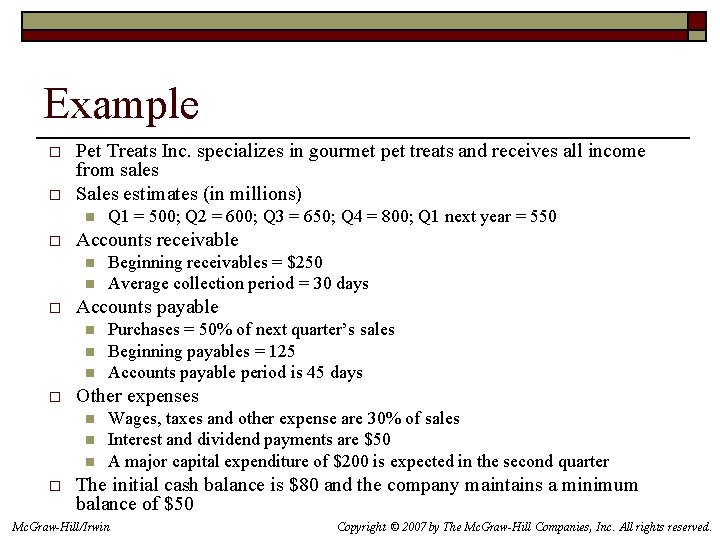
Example o o Pet Treats Inc. specializes in gourmet pet treats and receives all income from sales Sales estimates (in millions) n o Accounts receivable n n o n n Purchases = 50% of next quarter’s sales Beginning payables = 125 Accounts payable period is 45 days Other expenses n n n o Beginning receivables = $250 Average collection period = 30 days Accounts payable n o Q 1 = 500; Q 2 = 600; Q 3 = 650; Q 4 = 800; Q 1 next year = 550 Wages, taxes and other expense are 30% of sales Interest and dividend payments are $50 A major capital expenditure of $200 is expected in the second quarter The initial cash balance is $80 and the company maintains a minimum balance of $50 Mc. Graw-Hill/Irwin Copyright © 2007 by The Mc. Graw-Hill Companies, Inc. All rights reserved.
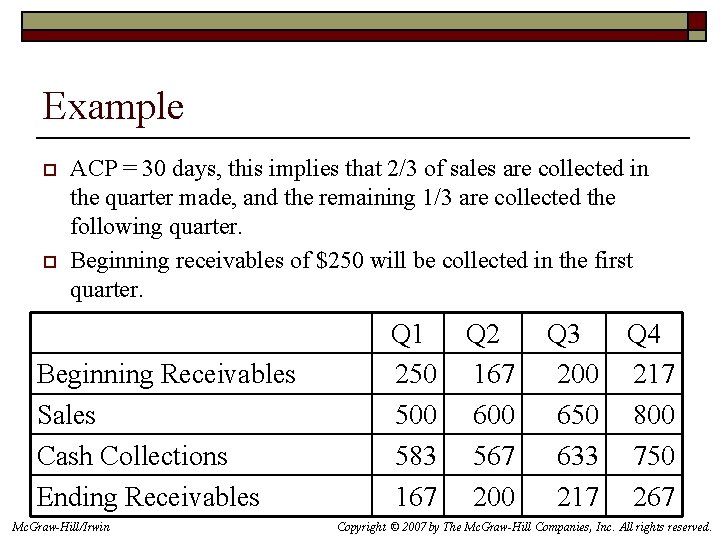
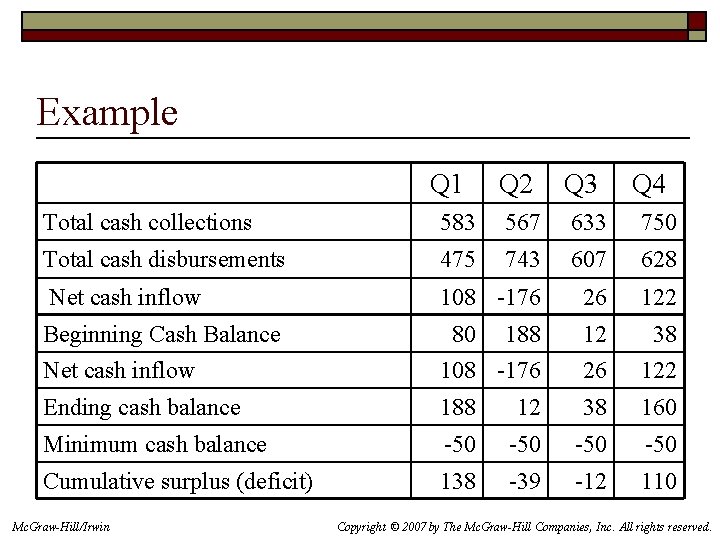
Example o o ACP = 30 days, this implies that 2/3 of sales are collected in the quarter made, and the remaining 1/3 are collected the following quarter. Beginning receivables of $250 will be collected in the first quarter. Beginning Receivables Sales Cash Collections Ending Receivables Mc. Graw-Hill/Irwin Q 1 250 500 583 167 Q 2 167 600 567 200 Q 3 200 650 633 217 Q 4 217 800 750 267 Copyright © 2007 by The Mc. Graw-Hill Companies, Inc. All rights reserved.
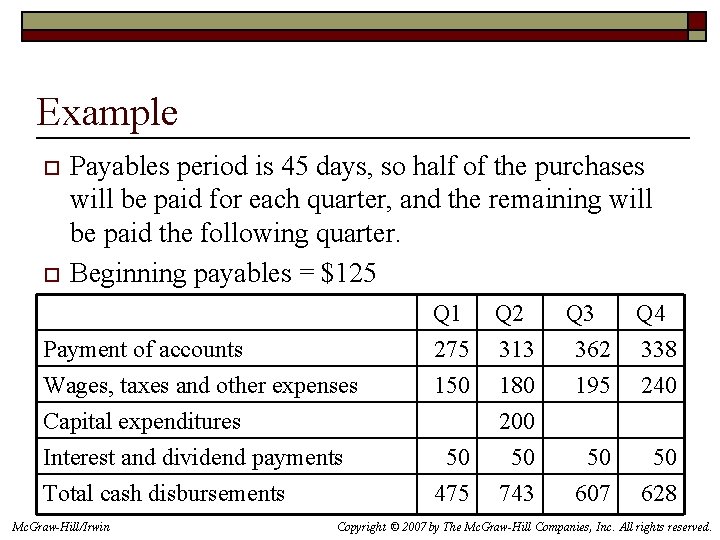
Example o o Payables period is 45 days, so half of the purchases will be paid for each quarter, and the remaining will be paid the following quarter. Beginning payables = $125 Payment of accounts Wages, taxes and other expenses Capital expenditures Interest and dividend payments Total cash disbursements Mc. Graw-Hill/Irwin Q 1 275 150 Q 2 313 180 200 Q 3 362 195 Q 4 338 240 50 475 50 743 50 607 50 628 Copyright © 2007 by The Mc. Graw-Hill Companies, Inc. All rights reserved.
Example Q 1 Q 2 Q 3 Q 4 Total cash collections 583 567 633 750 Total cash disbursements 475 743 607 628 Net cash inflow 108 -176 26 122 188 12 38 Net cash inflow 108 -176 26 122 Ending cash balance 188 12 38 160 Minimum cash balance -50 -50 Cumulative surplus (deficit) 138 -39 -12 110 Beginning Cash Balance Mc. Graw-Hill/Irwin 80 Copyright © 2007 by The Mc. Graw-Hill Companies, Inc. All rights reserved.
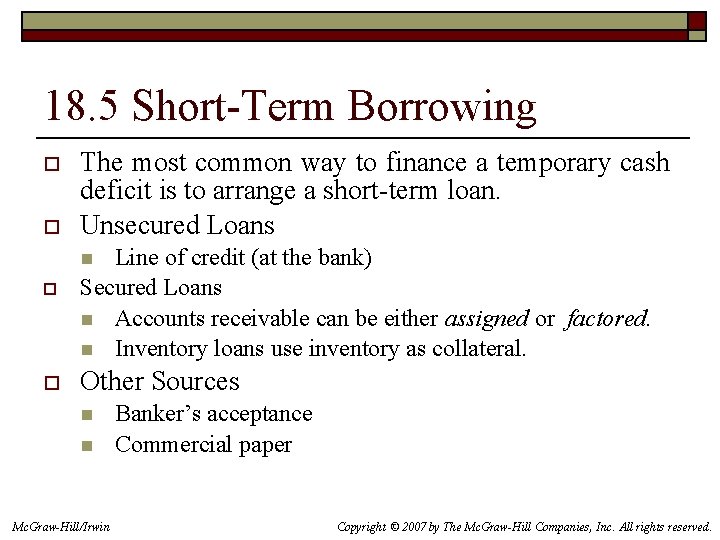
18. 5 Short-Term Borrowing o o The most common way to finance a temporary cash deficit is to arrange a short-term loan. Unsecured Loans Line of credit (at the bank) Secured Loans n Accounts receivable can be either assigned or factored. n Inventory loans use inventory as collateral. n o o Other Sources n n Mc. Graw-Hill/Irwin Banker’s acceptance Commercial paper Copyright © 2007 by The Mc. Graw-Hill Companies, Inc. All rights reserved.
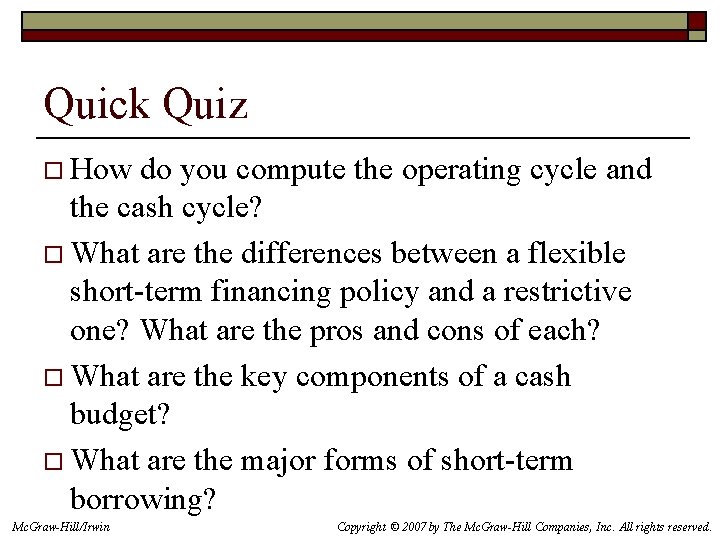
Quick Quiz o How do you compute the operating cycle and the cash cycle? o What are the differences between a flexible short-term financing policy and a restrictive one? What are the pros and cons of each? o What are the key components of a cash budget? o What are the major forms of short-term borrowing? Mc. Graw-Hill/Irwin Copyright © 2007 by The Mc. Graw-Hill Companies, Inc. All rights reserved.