Chapter 18 Renewing the Sectional Struggle 1848 1854

- Slides: 8
Chapter 18 Renewing the Sectional Struggle 1848 – 1854
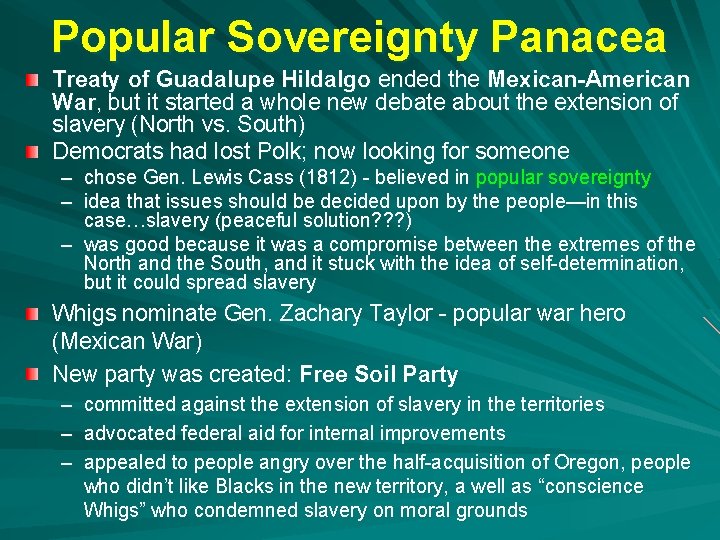
Popular Sovereignty Panacea Treaty of Guadalupe Hildalgo ended the Mexican-American War, but it started a whole new debate about the extension of slavery (North vs. South) Democrats had lost Polk; now looking for someone – – chose Gen. Lewis Cass (1812) - believed in popular sovereignty idea that issues should be decided upon by the people—in this case…slavery (peaceful solution? ? ? ) – was good because it was a compromise between the extremes of the North and the South, and it stuck with the idea of self-determination, but it could spread slavery Whigs nominate Gen. Zachary Taylor - popular war hero (Mexican War) New party was created: Free Soil Party – – – committed against the extension of slavery in the territories advocated federal aid for internal improvements appealed to people angry over the half-acquisition of Oregon, people who didn’t like Blacks in the new territory, a well as “conscience Whigs” who condemned slavery on moral grounds
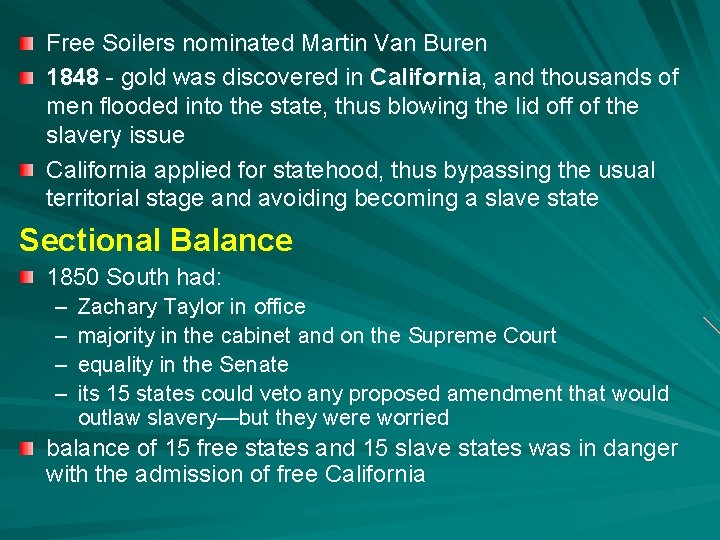
Free Soilers nominated Martin Van Buren 1848 - gold was discovered in California, and thousands of men flooded into the state, thus blowing the lid off of the slavery issue California applied for statehood, thus bypassing the usual territorial stage and avoiding becoming a slave state Sectional Balance 1850 South had: – – Zachary Taylor in office majority in the cabinet and on the Supreme Court equality in the Senate its 15 states could veto any proposed amendment that would outlaw slavery—but they were worried balance of 15 free states and 15 slave states was in danger with the admission of free California
Underground Railroad secret organization that took runaway states north to Canada, was taking more and more slaves from the South Harriet Tubman freed more than 300 slaves during 19 trips to the South demanded a stricter fugitive slave law Problems on Capitol Hill Congress 1850 - California demanding admission as a free state 3 giants met together for the last time to engineer a compromise: – Henry Clay, John C. Calhoun, Daniel Webster Clay urged the North for a fugitive slave law Calhoun pleaded for slavery to be left alone, for the return of runaway slaves, the restoration of the rights of the South Webster proclaimed that the new land could not hold slaves anyway, since it couldn’t cultivate cotton
Pres. Taylor had vetoed any compromises on slavery – Died suddenly from intestinal problems Pres. Willard Fillmore took over – signed a series of agreements that came to be known as the Compromise of 1850 North got the better deal – California was admitted as a free state, permanently tipping the balance – The Utah and New Mexico Territories could decide, with popular sovereignty, over slavery – Texas lost its disputed territory to New Mexico and (now) Oklahoma but was paid $10 million – The District of Columbia could not have slave trade, but slavery was still legal
South got the Fugitive Slave Law of 1850 – fleeing slaves couldn’t testify on their own behalf – federal commissioner who handled the case got $5 if the slave was free and $10 if not – people who were ordered to help catch slaves had to do so, even if they didn’t want to Northerners pledged not to follow the new law, and the Underground Railroad stepped up its timetable
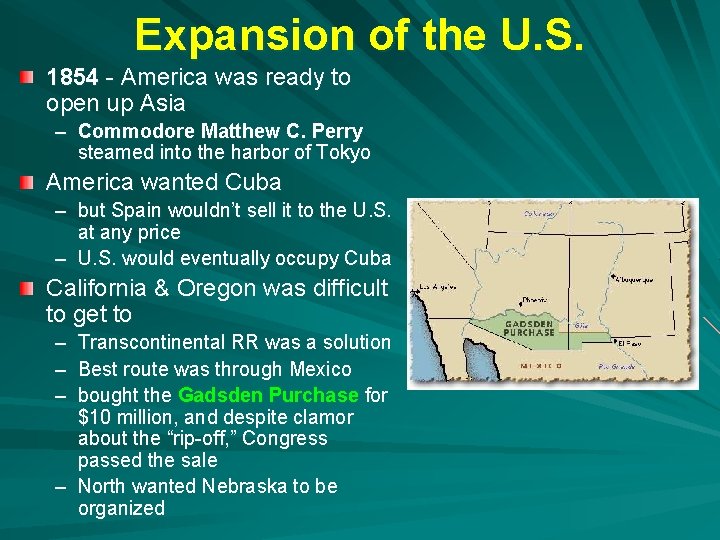
Expansion of the U. S. 1854 - America was ready to open up Asia – Commodore Matthew C. Perry steamed into the harbor of Tokyo America wanted Cuba – but Spain wouldn’t sell it to the U. S. at any price – U. S. would eventually occupy Cuba California & Oregon was difficult to get to – – – Transcontinental RR was a solution Best route was through Mexico bought the Gadsden Purchase for $10 million, and despite clamor about the “rip-off, ” Congress passed the sale – North wanted Nebraska to be organized
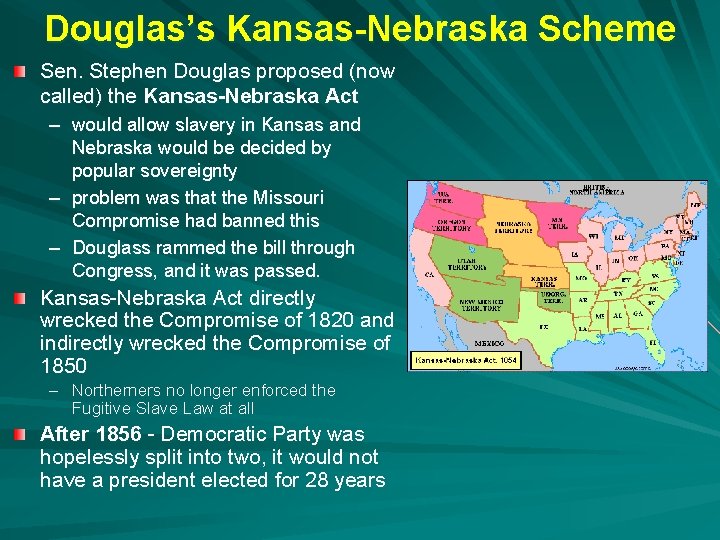
Douglas’s Kansas-Nebraska Scheme Sen. Stephen Douglas proposed (now called) the Kansas-Nebraska Act – would allow slavery in Kansas and Nebraska would be decided by popular sovereignty – problem was that the Missouri Compromise had banned this – Douglass rammed the bill through Congress, and it was passed. Kansas-Nebraska Act directly wrecked the Compromise of 1820 and indirectly wrecked the Compromise of 1850 – Northerners no longer enforced the Fugitive Slave Law at all After 1856 - Democratic Party was hopelessly split into two, it would not have a president elected for 28 years