
Oscar Fingal OFlahertie Wills Wilde 1854 1900 born
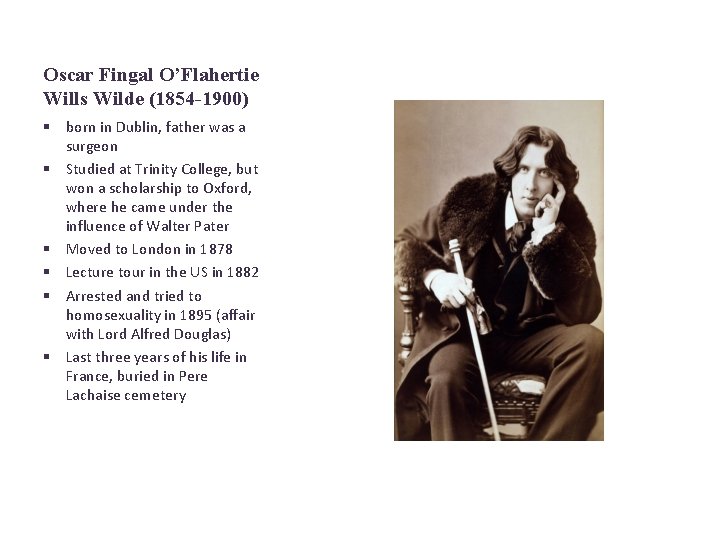
Oscar Fingal O’Flahertie Wills Wilde (1854 -1900) § born in Dublin, father was a surgeon § Studied at Trinity College, but won a scholarship to Oxford, where he came under the influence of Walter Pater § Moved to London in 1878 § Lecture tour in the US in 1882 § Arrested and tried to homosexuality in 1895 (affair with Lord Alfred Douglas) § Last three years of his life in France, buried in Pere Lachaise cemetery
„Pater was…sceptical about all fixed positions, doctrines, or theories; human life was fleeting and uncertain and instead of pursuing inaccessible ultimate truths man should strive to refine and purify his sensations and passing impressions. ” from Oxford Illustrated History of English Literature
„To burn always with this hard, gemlike flame, to maintain this ecstasy is success in life…Not to discriminate at every moment some passionate attitude in those about us, and in the very brilliancy of their gifts some tragic dividing of forces on their ways is, on this short day of frost and sun, to sleep before evening. ” from Epilogue to Studies in the History of the Renaissance by Walter Pater „IT IS MY GOLDEN BOOK; I NEVER TRAVEL ANYWHERE WITHOUT IT. BUT IT IS THE VERY FLOWER OF DECADENCE; THE LAST TRUMPET SHOULD HAVE SOUNDED THE MOMENT IT WAS WRITTEN. ” –OSCAR WILDE
Oscar Wilde in De Profundis called The Renaissance, „that book which has had such a strange influence over my life. ”
Pursuing inaccessible truths and refining/purifying sensations and passing impressions=mutually exclusive?
„By the same token we should seek out artists and craftsmen whose natural gifts enable them to discern true beauty and grace. Then we shall have a salubrious climate in which our young may dwell and benefit from all their surroundings, where works of beauty are conveyed to eye and ear like breezes bringing health from wholesome places. In this way, from early childhood on, they would easily live in harmony and friendship with beauty and reason, coming finally to resemble them. ” –Plato, The Republic, Book III
“It is through its very incompleteness that Art becomes complete in beauty, and so addresses itself, not to the faculty of recognition nor to the faculty of reason, but to the aesthetic sense alone, which, while accepting both reason and recognition as stages of apprehension, subordinates them both to a pure synthetic impression of the work of art as a whole, and taking whatever alien emotional elements the work may possess, uses their very complexity as a means by which a richer unity may be added to the ultimate impression itself. ” Oscar Wilde, The Critic as Artist, 1896 •
“…it is the function of Literature to create, from the rough material of actual existence, a new world that will be more marvelous, more enduring, and more true than the world that common eyes look upon, and through which common natures seek to realize their perfection. ” Oscar Wilde, The Critic as Artist, 1692
“Beauty has as many meanings as man has moods…Beauty reveals everything, because it expresses nothing. When it shows us itself, it shows us the whole fiery-coloured world…the one characteristic of a beautiful form is that one can put into it whatever one wishes, and see in it whatever one chooses to see. ” Oscar Wilde, The Critic as Artist, 1695
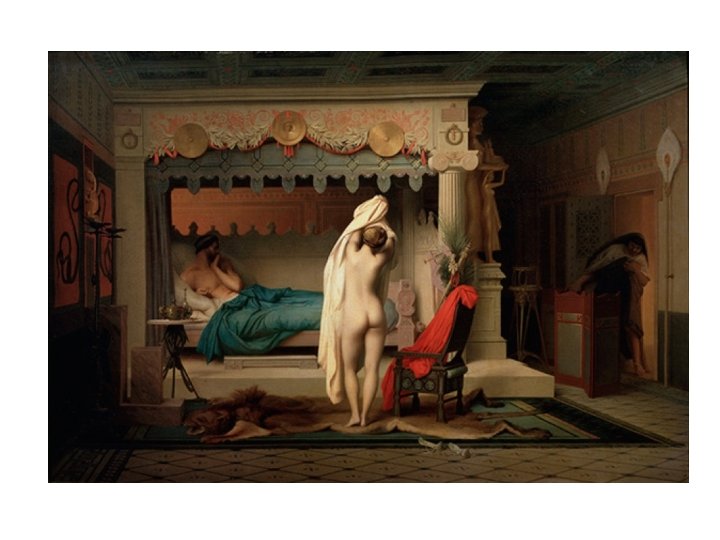
Beautiful form=the myth of the Ring of Gyges, Dorian Gray and The Importance of Being Earnest?
The Picture of Dorian Gray Dorian Basil Hallward Lord Henry Wotton Sibyl Vane James Vane
„Lord Henry philosophically had earlier said to him that: "Crime belongs exclusively to the lower orders. . I should fancy that crime was to them what art is to us, simply a method of procuring extraordinary sensations"—implying that Dorian is two men, a refined aesthete and a coarse criminal. That authorial observation is a thematic link to the double life recounted in The Strange Case of Dr Jekyll and Mr Hyde (1886), by Robert Louis Stevenson, a novella admired by Oscar Wilde”—Penguin Classics, introduction to Dorian Gray
The Importance of Being Earnest Algernon Moncrieff John Worthing Gwendolen Fairfax Cecily Cardew
“It has as its philosophy…that we should treat all the trivial things of life seriously, and all the serious things of life with sincere and studied triviality. ” before his death he remarked that he wished it might have had a “higher seriousness of intent. ” from The Norton Anthology of English Literature
- Slides: 15