CHAPTER 10 Politics and the Copper Kings 1889

- Slides: 20
CHAPTER 10 Politics and the Copper Kings 1889 -1904
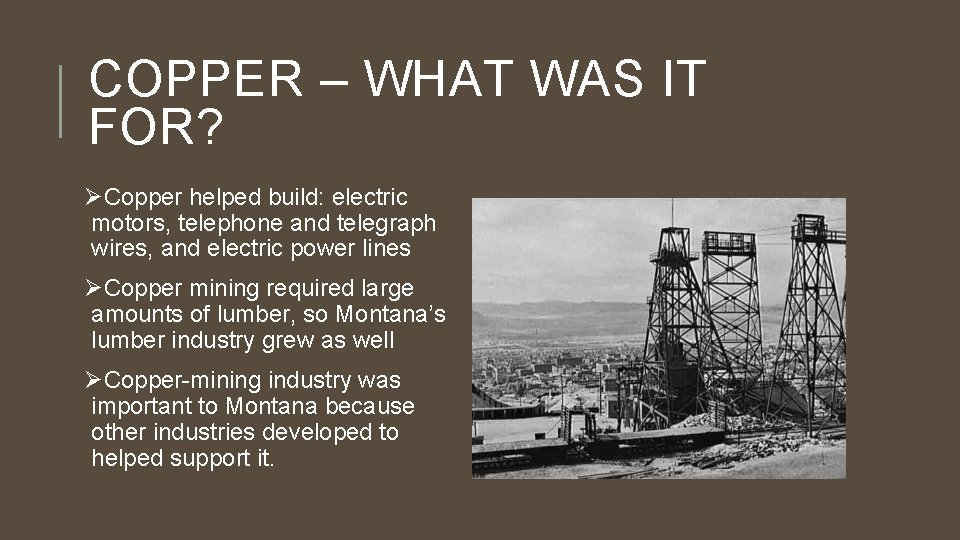
COPPER – WHAT WAS IT FOR? ØCopper helped build: electric motors, telephone and telegraph wires, and electric power lines ØCopper mining required large amounts of lumber, so Montana’s lumber industry grew as well ØCopper-mining industry was important to Montana because other industries developed to helped support it.
MONTANA BECOMES A STATE ØEuro-American immigrants wanted statehood because: 1. They wanted voting privileges for their governor and federal representatives 2. They wanted to keep money from natural resources in the state 3. They wanted land grants to fund education ØMontana’s territorial representatives could lobby (try to influence) Congress, but they could not vote
IF MONTANA BECAME A STATE… ØIt could control it’s own funds ØMontanans could elect their own governor, judges, and state officers ØIt would gain one seat in the U. S. House of Representatives and two seats in the U. S. Senate ØStatehood came with a large land grant
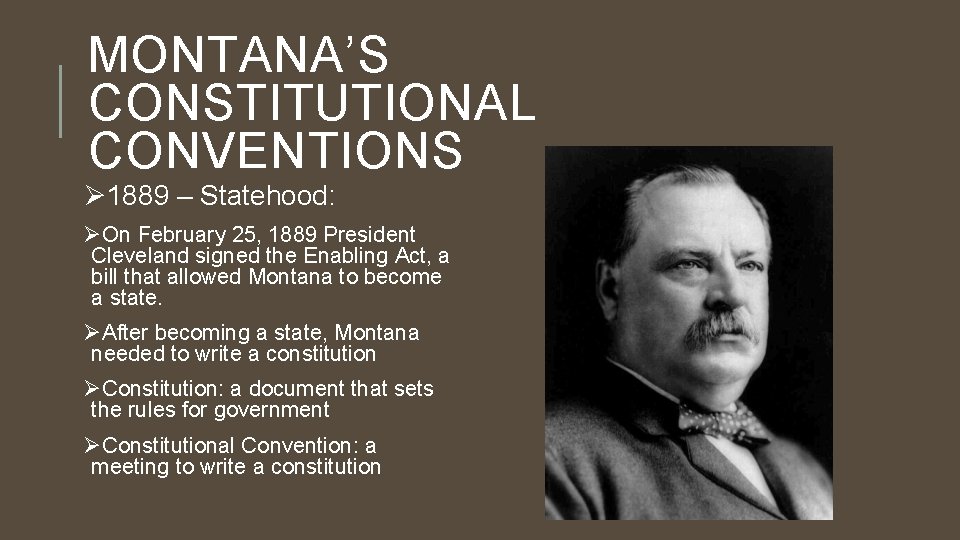
MONTANA’S CONSTITUTIONAL CONVENTIONS Ø 1889 – Statehood: ØOn February 25, 1889 President Cleveland signed the Enabling Act, a bill that allowed Montana to become a state. ØAfter becoming a state, Montana needed to write a constitution ØConstitution: a document that sets the rules for government ØConstitutional Convention: a meeting to write a constitution
MONTANA’S CONSTITUTION ØBefore a constitution can be signed into law, it had to be ratified Ø 1889 Constitutional Convention: Ø 75 delegates (representatives of the people) 39 Democrats and 36 Republicans gathered ØFights broke out, there was a strong disagreement between mining and agricultural interests ØIncluded a special provision for the mining industry: kept taxes much lower for mines than for other industries. ØDecided women could not vote in the state (Women did not receive suffrage (the right to vote) until 1914
COPPER KINGS ØCopper Kings were Marcus Daly and William A. Clark ØThey were called this because they were so rich and owned so many mines ØBoth men worked together to keep mining taxes low and both were democrats at the 1889 Constitutional Convention ØOther than that, they disagreed on everything else ØExtremely competitive and stubborn ØTheir arguments became known as the War of the Copper Kings
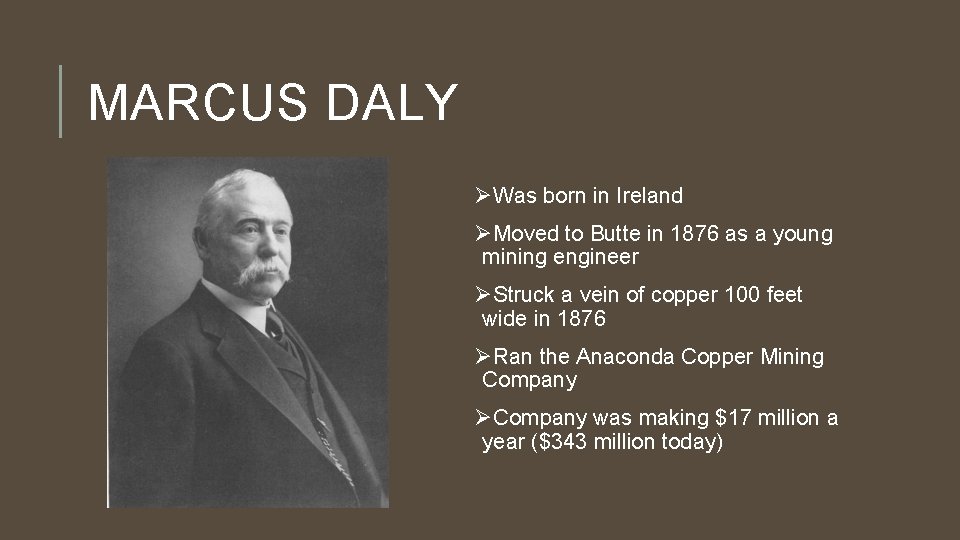
MARCUS DALY ØWas born in Ireland ØMoved to Butte in 1876 as a young mining engineer ØStruck a vein of copper 100 feet wide in 1876 ØRan the Anaconda Copper Mining Company ØCompany was making $17 million a year ($343 million today)
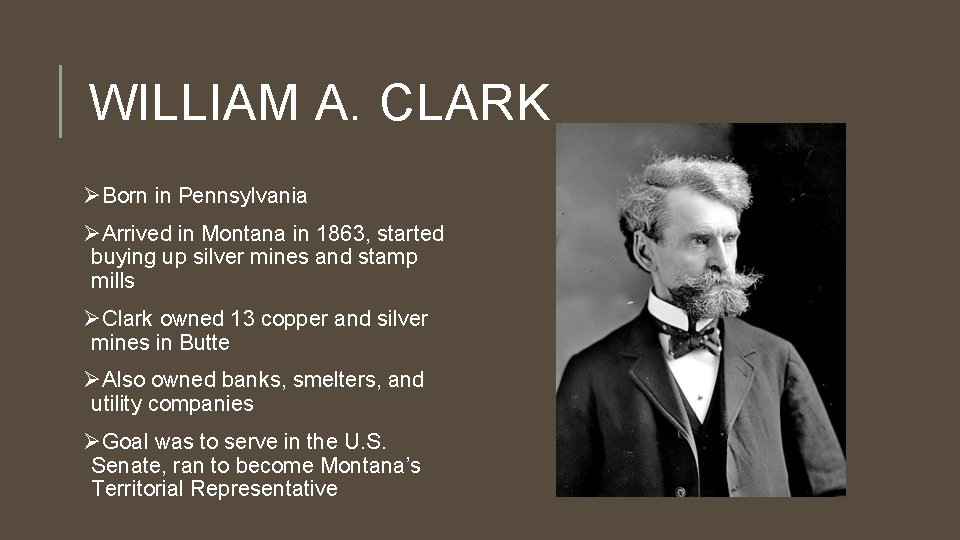
WILLIAM A. CLARK ØBorn in Pennsylvania ØArrived in Montana in 1863, started buying up silver mines and stamp mills ØClark owned 13 copper and silver mines in Butte ØAlso owned banks, smelters, and utility companies ØGoal was to serve in the U. S. Senate, ran to become Montana’s Territorial Representative
DALY RUNS INTO TROUBLE ØOwned lumber companies that had been illegally cutting timber on public lands, his companies were in trouble with the government ØDaly knew that if Clark became the territorial representative, he would not have protection for his business interests ØHe worked hard to promote Clark’s opponent, Thomas H. Carter ØThis is why Montana adopted a secret voting ballot in 1889, the workers wanted to keep their employers from knowing how they voted. (Some employees didn’t vote for their boss, Clark) ØClark lost the election to become the territorial representative, they become bitter enemies.
CLARK’S POLITICS BATTLE Ø 1890 – Clark is elected but is sent home by the Republican-controlled Senate ØFour representatives (2 Republicans and 2 Democrats) are sent to Washington, D. C. because the Montana government could not decide on two of them ØThe U. S. Senate (controlled by the Republicans that year) sent the two Democrats home ØIn the 1893 election, Clark spends a lot of time and effort bribing voters with money, while Daly spent more money to bribe those voters against Clark. ØClark lost again, by three votes.
THE BATTLE FOR THE CAPITAL LOCATION ØThe town that becomes the state capital gets a lot of money, receives payment for land buildings, creates jobs in the area and gives local residents constant access to their state leaders ØThe race was between Helena and Anaconda ØWilliam A. Clark – Helena ØMarcus Daly – Anaconda ØTactics they used to persuade voters: 1. Buying newspapers 2. Sponsoring parades and social clubs 3. Distributing money and gifts to voters
CLARK CONTINUES HIS FIGHT ØClark runs for Senate again in 1899 ØFred Whiteside, a senator from Flathead County, accused Clark of Bribery ØClark was investigated and found guilty of bribing ØTo avoid the charges, Clark resigned from his Senate seat
LABOR UNIONS ØLabor Unions: organizations of employees that bargain with employers ØOrdinary citizens could fight corporate control of politics by joining labor unions ØLabor Unions had a voice because they could control whether or not the work was done ØIf conditions got too bad, unions would call strikes (an organized protest in which workers refuse to work) ØStrikes forced companies to improve working conditions.
POPULISM ØPopulism – the belief that common people deserve more power ØPopulist Party – a political party formed in the 1890’s that protested corporate control ØPopulist Party supported laws governing mine safety
AMALGAMATED COPPER COMPANY ØA holding company (a corporation that owns other corporations) owned by Henry H. Rogers and William Rockefeller ØOwned big Montana Copper Companies, Clark’s mines and smelters ØWhen Marcus Daly died in 1900, his company fell under the control of the Amalgamated Copper Company ØThe company changed after Daly’s death because the corporation had no sympathy for Montana laborers ØAmalgamated demonstrated control in Montana by shutting down it’s operation whenever they wanted something. They were so powerful because they held a Monopoly in Montana. ØMining unions lost strength in the 1900’s because the monopoly made it hard to fight
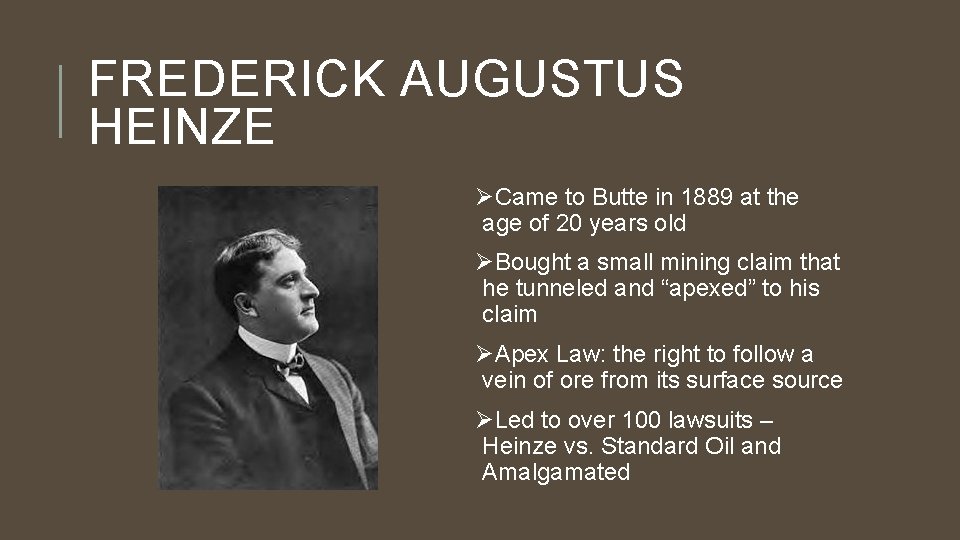
FREDERICK AUGUSTUS HEINZE ØCame to Butte in 1889 at the age of 20 years old ØBought a small mining claim that he tunneled and “apexed” to his claim ØApex Law: the right to follow a vein of ore from its surface source ØLed to over 100 lawsuits – Heinze vs. Standard Oil and Amalgamated
HOW HEINZE COMPETED: ØHeinze competed against the Standard Oil Company by: 1. Utilizing federal mining laws to tunnel underground to other mines 2. Spending his money in Montana to support local businesses 3. Convincing Montanans that Standard Oil wanted to control everything in the state
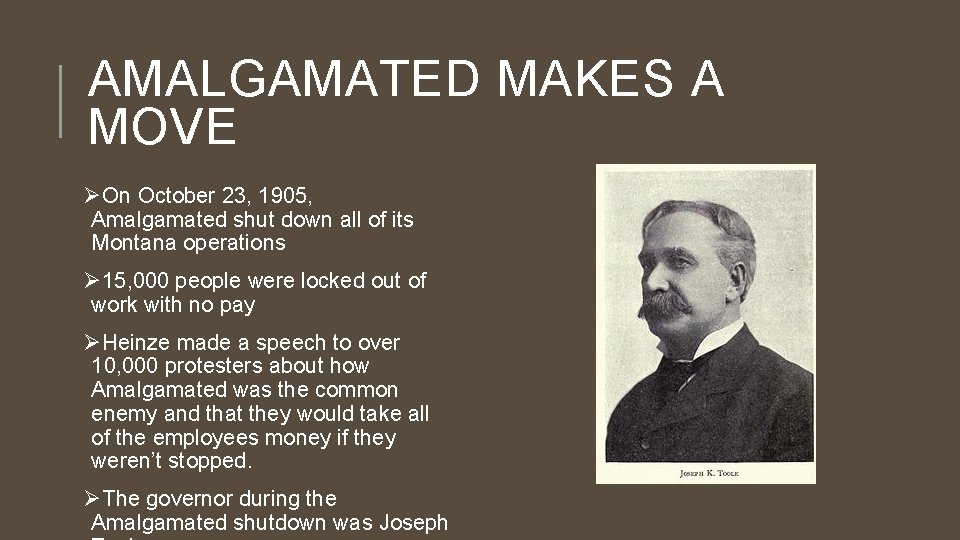
AMALGAMATED MAKES A MOVE ØOn October 23, 1905, Amalgamated shut down all of its Montana operations Ø 15, 000 people were locked out of work with no pay ØHeinze made a speech to over 10, 000 protesters about how Amalgamated was the common enemy and that they would take all of the employees money if they weren’t stopped. ØThe governor during the Amalgamated shutdown was Joseph
HOW DID THE STANDOFF END? ØToole received thousands of letters but he could not re-open the mine ØBut he did have all of Amalgamated’s court cases moved out of Butte, where Heinze controlled the judges. Now Amalgamated could sue Heinze in any other city in Montana. ØAmalgamated opened it’s operations back up the next day ØBoth Heinze and William Clark sold their operations to Amalgamated, it eventually became one single company: the Anaconda Copper Mining Company