Chapter 10 Competitive Advantage in Mature Industries Prof


- Slides: 11
Chapter 10 Competitive Advantage in Mature Industries Prof. Luciano Thomé e Castro
2 © 2013 Robert M. Grant www. contemporarystrategyanalysis. com
Competitive Advantage in Mature Industries OUTLINE • Competitive advantage in mature industries • Strategic implementation in mature industries: Structure, Systems, Style • Strategies for declining industries © 2013 Robert M. Grant www. contemporarystrategyanalysis. com 3
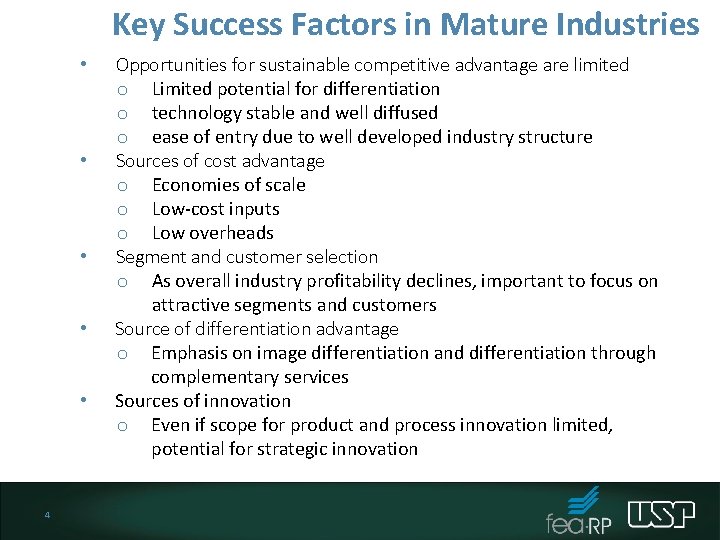
Key Success Factors in Mature Industries • • • 4 Opportunities for sustainable competitive advantage are limited o Limited potential for differentiation o technology stable and well diffused o ease of entry due to well developed industry structure Sources of cost advantage o Economies of scale o Low-cost inputs o Low overheads Segment and customer selection o As overall industry profitability declines, important to focus on attractive segments and customers Source of differentiation advantage o Emphasis on image differentiation and differentiation through complementary services Sources of innovation o Even if scope for product and process innovation limited, potential for strategic innovation
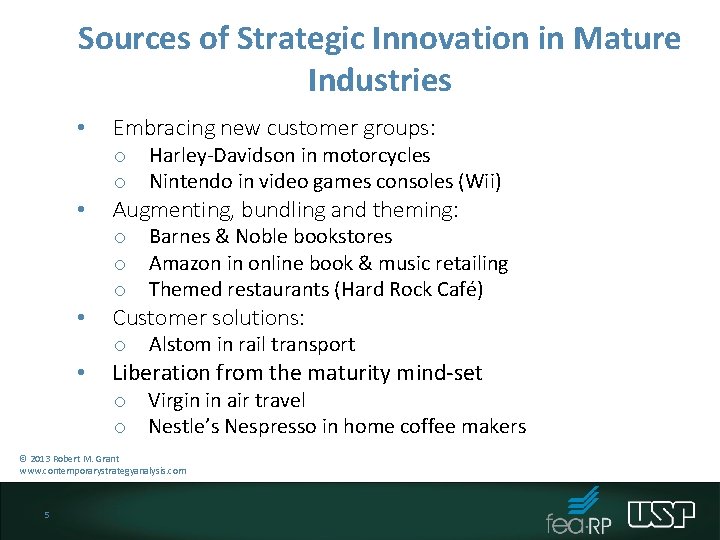
Sources of Strategic Innovation in Mature Industries • • Embracing new customer groups: o o Harley-Davidson in motorcycles Nintendo in video games consoles (Wii) o o o Barnes & Noble bookstores Amazon in online book & music retailing Themed restaurants (Hard Rock Café) o Alstom in rail transport Augmenting, bundling and theming: Customer solutions: Liberation from the maturity mind-set o Virgin in air travel o Nestle’s Nespresso in home coffee makers © 2013 Robert M. Grant www. contemporarystrategyanalysis. com 5
Sources of Strategic Innovation in Mature Industries Who are the strategic innovators? • New entrants: • • o o CNN in news broadcasting Dyson in domestic appliances o Sun Records in rock ’n’ roll music o Fuji Film in cosmetics Existing firms on the periphery: Firms from adjacent industries: Why not leading incumbents? They are constrained by conventional thinking (“industry recipes”), relationships with existing customers, resources & capabilities that support past strategies © 2013 Robert M. Grant www. contemporarystrategyanalysis. com 6
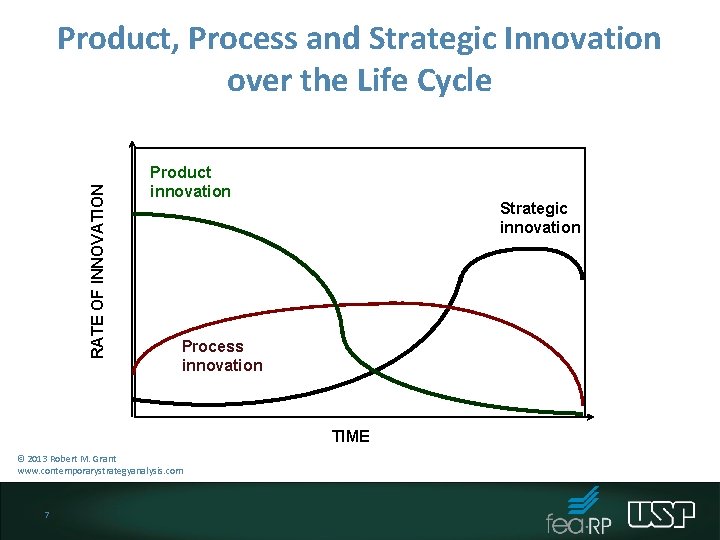
RATE OF INNOVATION Product, Process and Strategic Innovation over the Life Cycle Product innovation Strategic innovation Process innovation TIME © 2013 Robert M. Grant www. contemporarystrategyanalysis. com 7
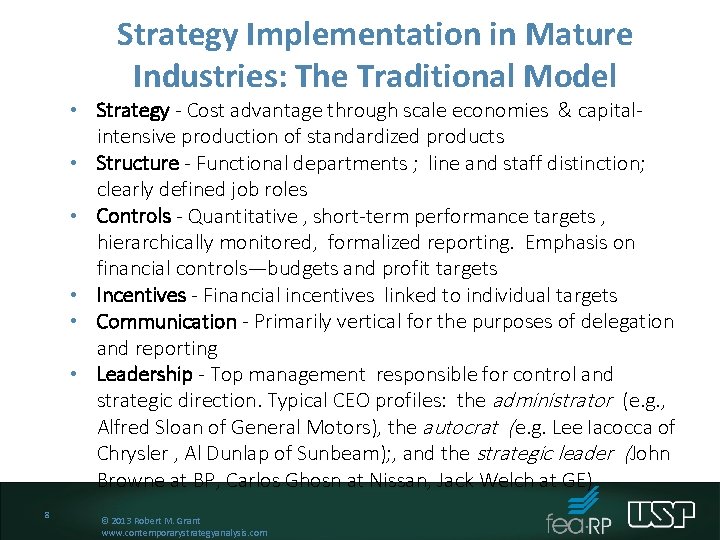
Strategy Implementation in Mature Industries: The Traditional Model • Strategy - Cost advantage through scale economies & capitalintensive production of standardized products • Structure - Functional departments ; line and staff distinction; clearly defined job roles • Controls - Quantitative , short-term performance targets , hierarchically monitored, formalized reporting. Emphasis on financial controls—budgets and profit targets • Incentives - Financial incentives linked to individual targets • Communication - Primarily vertical for the purposes of delegation and reporting • Leadership - Top management responsible for control and strategic direction. Typical CEO profiles: the administrator (e. g. , Alfred Sloan of General Motors), the autocrat ( e. g. Lee Iacocca of Chrysler , Al Dunlap of Sunbeam); , and the strategic leader (John Browne at BP, Carlos Ghosn at Nissan, Jack Welch at GE) 8 © 2013 Robert M. Grant www. contemporarystrategyanalysis. com
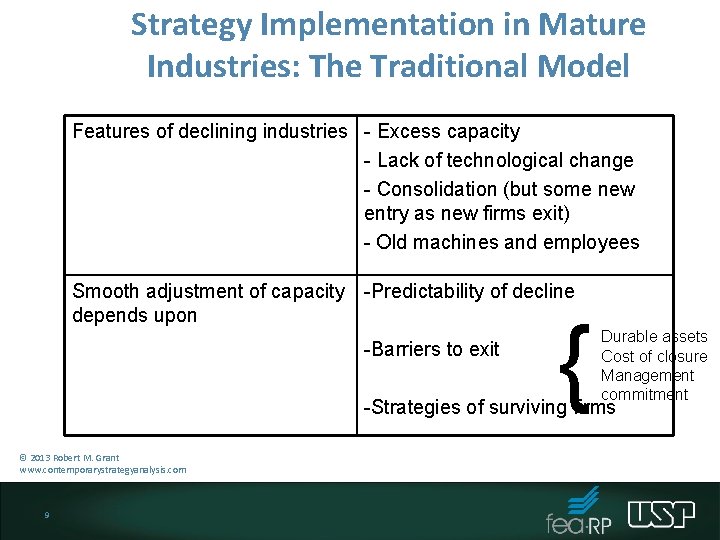
Strategy Implementation in Mature Industries: The Traditional Model Features of declining industries - Excess capacity - Lack of technological change - Consolidation (but some new entry as new firms exit) - Old machines and employees Smooth adjustment of capacity -Predictability of decline depends upon -Barriers to exit { Durable assets Cost of closure Management commitment -Strategies of surviving firms © 2013 Robert M. Grant www. contemporarystrategyanalysis. com 9
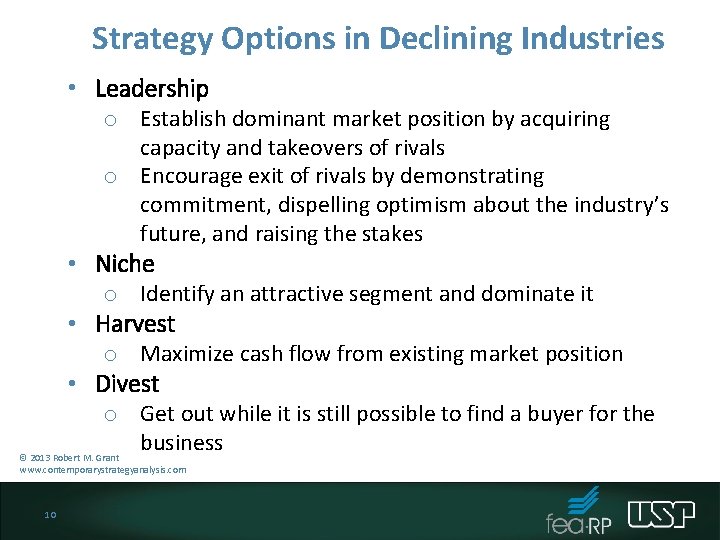
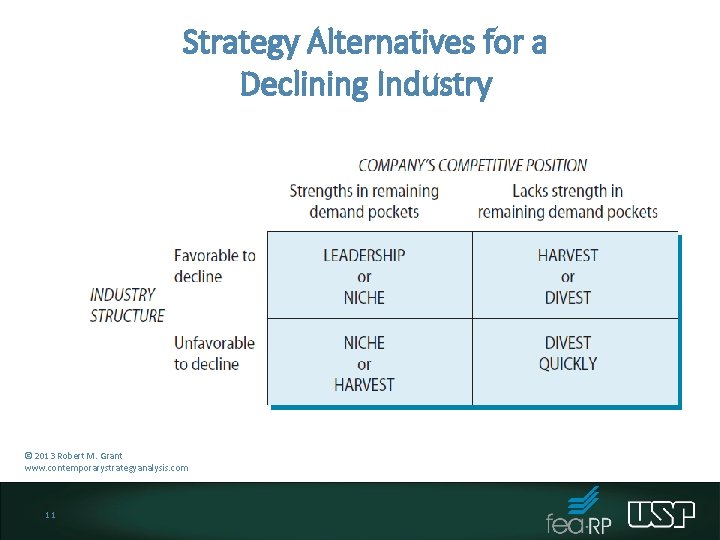
Strategy Options in Declining Industries • Leadership o Establish dominant market position by acquiring capacity and takeovers of rivals o Encourage exit of rivals by demonstrating commitment, dispelling optimism about the industry’s future, and raising the stakes • Niche o Identify an attractive segment and dominate it • Harvest o Maximize cash flow from existing market position • Divest o Get out while it is still possible to find a buyer for the business © 2013 Robert M. Grant www. contemporarystrategyanalysis. com 10
Strategy Alternatives for a Declining Industry © 2013 Robert M. Grant www. contemporarystrategyanalysis. com 11