Chapter 1 The Peopling of the World Prehistory

- Slides: 9
Chapter 1 The Peopling of the World Prehistory – 2500 B. C. Essential Question Where did early human beings originate and what were some of their technological and artistic achievements?
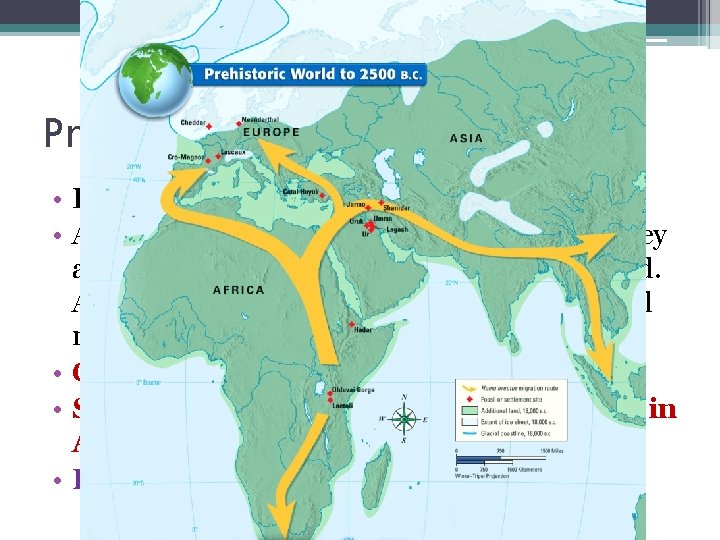
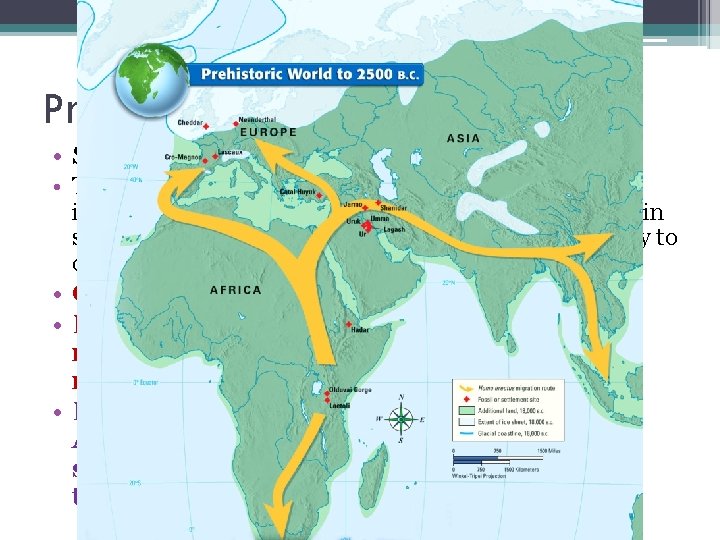
Previewing Themes • INTERACTION WITH ENVIRONMENT • As early humans spread out over the world, they adapted to each environment they encountered. As time progressed, they learned to use natural resources. • Geography • Study the time line and the map. Where in Africa did human life begin? • Human life began in eastern Africa.
Previewing Themes • SCIENCE AND TECHNOLOGY • The earliest peoples came up with new ideas and inventions in order to survive. As people began to live in settlements, they continued to develop new technology to control the environment. • Geography • Early Humans began to migrate about 1. 8 million years ago. What paths did these migrations take? • Early human migrations led to southern Africa; through western Africa and into southern Europe; and into Asia, splitting toward Europe and across Asia.
Previewing Themes • ECONOMICS • Early humans hunted animals and gathered wild plant foods for 3 to 4 million years. Then about 10, 000 years ago, they learned to tame animals and to plant crops. Gradually, more complex economies developed. • Geography • Early settlement sites were often near rivers. Why might they have been located there? • Rivers provide water for households, transport, and agriculture.
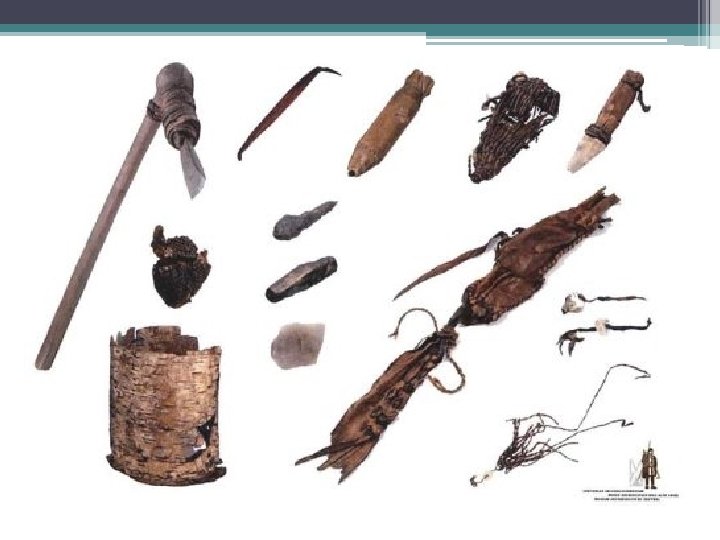
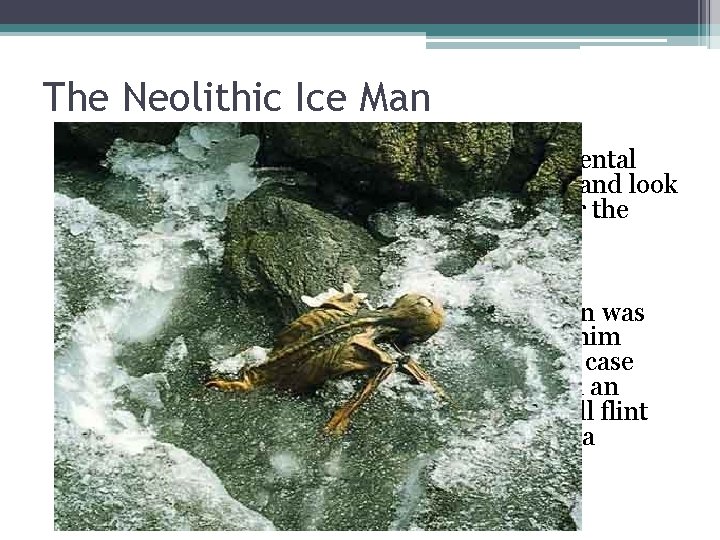
How would these tools help early humans survive? • You have joined a team of scientists on an expedition to an ancient site where early humans once lived. The scientists’ goal is to search for evidence that might unlock the mysteries of the past. • You’re an eyewitness to their astounding discovery--human-made tools about 5, 000 years old. They belonged to the so-called Ice Man, discovered in 1991.
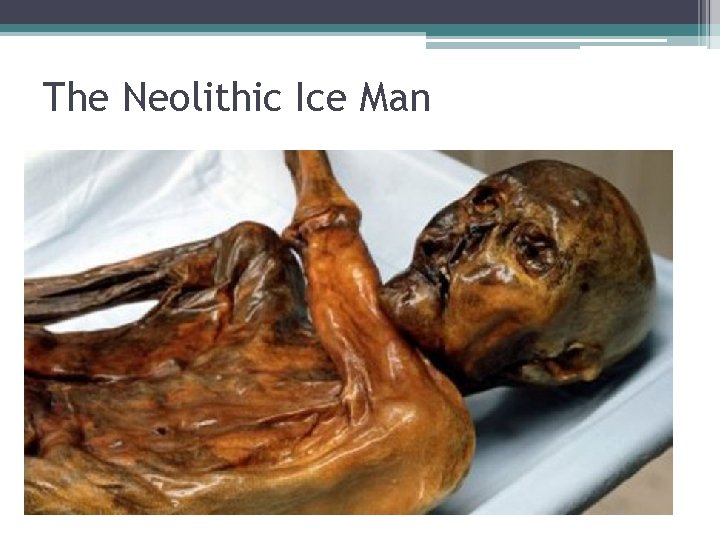
The Neolithic Ice Man • In 1991, two German hikers made an accidental discovery that gave archaeologists a firsthand look at the technology of early toolmakers. Near the border of Austria and Italy, they spotted the mummified body of a prehistoric traveler, preserved in ice for some 5, 000 years. • Nicknamed the “Ice Man, ” this early human was not empty-handed. The tool kit found near him included a six-foot longbow and a deerskin case with 14 arrows. It also contained a stick with an antler tip for sharpening flint blades, a small flint dagger in a woven sheath, a copper ax, and a medicine bag.
The Neolithic Ice Man • Scientific research on the body concluded that the Ice Man was in his 40 s when he died in the late spring or early summer from an arrow wound. Scientists also determined that in the hours before his death, he ate wild goat, red deer, and grains. The Ice Man is housed in a special museum in Bolzano, Italy.
How would these tools help early humans survive? • What did early humans need to do to survive? ØEarly humans needed to provide food and shelter for themselves and their families, and they needed to protect themselves from predators.
How would these tools help early humans survive? • What physical actions would these tools help humans do? ØThe dagger would help them hunt animals, the axe would enable them to chop wood to build fires and shelters, the container would allow them to store water, and the backpack would provide a means for transporting essential items.