The Neolithic From Prehistory to Primary Schools When

- Slides: 14
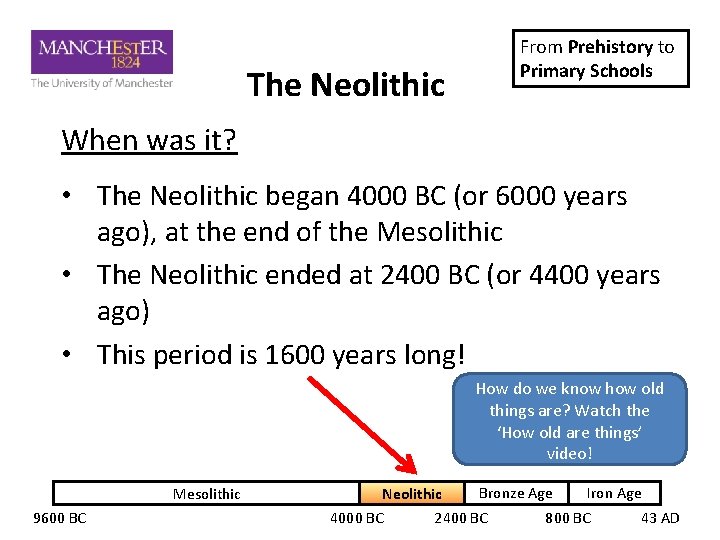
The Neolithic From Prehistory to Primary Schools When was it? • The Neolithic began 4000 BC (or 6000 years ago), at the end of the Mesolithic • The Neolithic ended at 2400 BC (or 4400 years ago) • This period is 1600 years long! How do we know how old things are? Watch the ‘How old are things’ video! Mesolithic 9600 BC Bronze Age Iron Age Neolithic 4000 BC 2400 BC 800 BC 43 AD
The Neolithic From Prehistory to Primary Schools Where people lived • What changes do you think Neolithic people made to their environment? • Neolithic people built Britain’s first monuments – what do you think they looked like? • What do you think Neolithic houses were like? Mesolithic 9600 BC Bronze Age Iron Age Neolithic 4000 BC 2400 BC 800 BC 43 AD
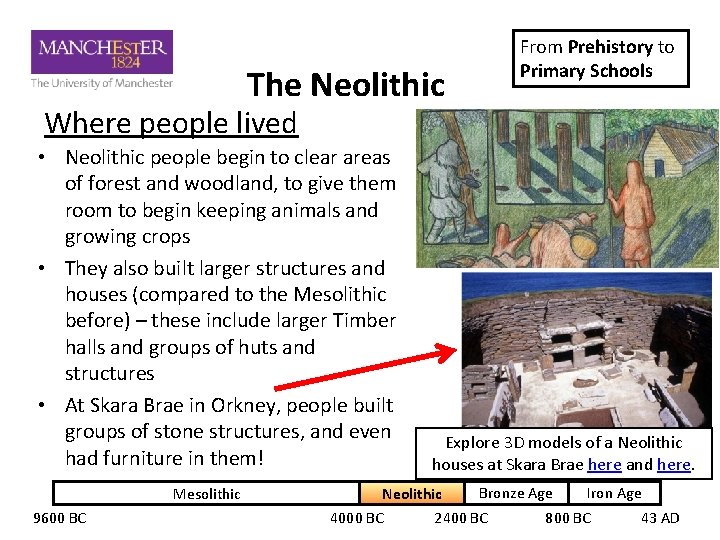
The Neolithic From Prehistory to Primary Schools Where people lived • Neolithic people begin to clear areas of forest and woodland, to give them room to begin keeping animals and growing crops • They also built larger structures and houses (compared to the Mesolithic before) – these include larger Timber halls and groups of huts and structures • At Skara Brae in Orkney, people built groups of stone structures, and even had furniture in them! Mesolithic 9600 BC Explore 3 D models of a Neolithic houses at Skara Brae here and here. Bronze Age Iron Age Neolithic 4000 BC 2400 BC 800 BC 43 AD
The Neolithic From Prehistory to Primary Schools Where people lived • Neolithic people started building the first monuments - -these were important sites for ceremonies and burials • Circular monuments made of banks and ditches (called Causewayed enclosures and Henges) were important gathering places. • Large mounds of earth with chambers build inside them, called ‘Long Barrows’, were used to hold remains of the dead Mesolithic 9600 BC How do find sites? Watch the ‘field archaeology’ video! Bronze Age Iron Age Neolithic 4000 BC 2400 BC 800 BC 43 AD
The Neolithic From Prehistory to Primary Schools How people lived • How do you think Neolithic people got their food? • Did people live in just one place in the Neolithic? • If you lived in the Neolithic, what do you think your social life would be like? Mesolithic 9600 BC Bronze Age Iron Age Neolithic 4000 BC 2400 BC 800 BC 43 AD
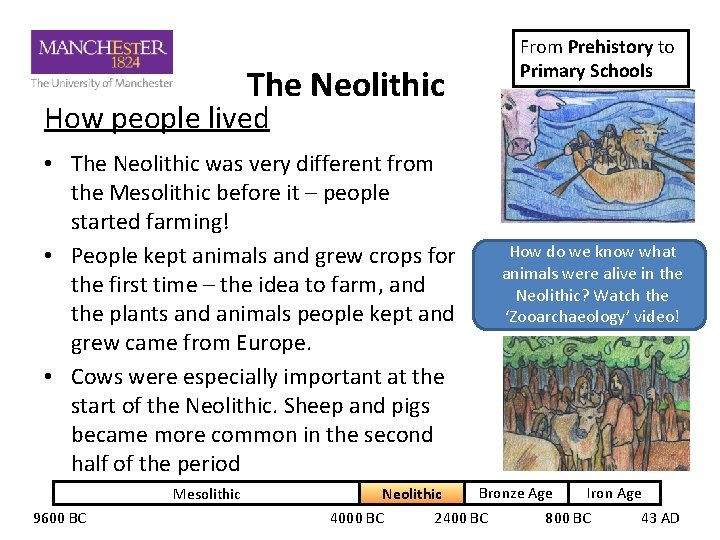
The Neolithic From Prehistory to Primary Schools How people lived • The Neolithic was very different from the Mesolithic before it – people started farming! • People kept animals and grew crops for the first time – the idea to farm, and the plants and animals people kept and grew came from Europe. • Cows were especially important at the start of the Neolithic. Sheep and pigs became more common in the second half of the period Mesolithic 9600 BC How do we know what animals were alive in the Neolithic? Watch the ‘Zooarchaeology’ video! Bronze Age Iron Age Neolithic 4000 BC 2400 BC 800 BC 43 AD
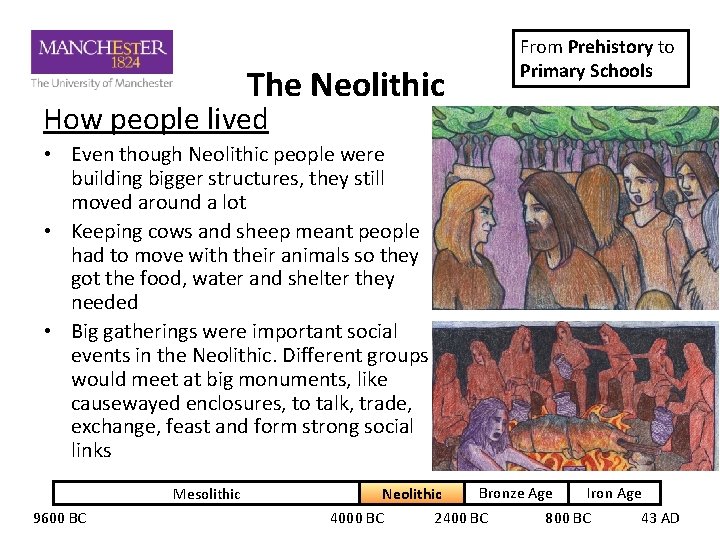
The Neolithic From Prehistory to Primary Schools How people lived • Even though Neolithic people were building bigger structures, they still moved around a lot • Keeping cows and sheep meant people had to move with their animals so they got the food, water and shelter they needed • Big gatherings were important social events in the Neolithic. Different groups would meet at big monuments, like causewayed enclosures, to talk, trade, exchange, feast and form strong social links Mesolithic 9600 BC Bronze Age Iron Age Neolithic 4000 BC 2400 BC 800 BC 43 AD
The Neolithic From Prehistory to Primary Schools Neolithic technology • What types of tools or objects did they make? • What new types of objects did people start using in the Neolithic? • Why might these new types of objects be important to Neolithic people? Mesolithic 9600 BC Bronze Age Iron Age Neolithic 4000 BC 2400 BC 800 BC 43 AD
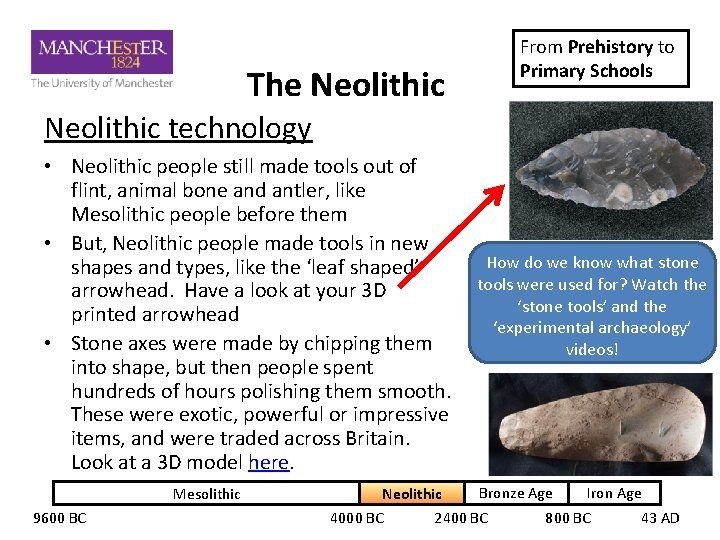
The Neolithic From Prehistory to Primary Schools Neolithic technology • Neolithic people still made tools out of flint, animal bone and antler, like Mesolithic people before them • But, Neolithic people made tools in new shapes and types, like the ‘leaf shaped’ arrowhead. Have a look at your 3 D printed arrowhead • Stone axes were made by chipping them into shape, but then people spent hundreds of hours polishing them smooth. These were exotic, powerful or impressive items, and were traded across Britain. Look at a 3 D model here. Mesolithic 9600 BC How do we know what stone tools were used for? Watch the ‘stone tools’ and the ‘experimental archaeology’ videos! Bronze Age Iron Age Neolithic 4000 BC 2400 BC 800 BC 43 AD
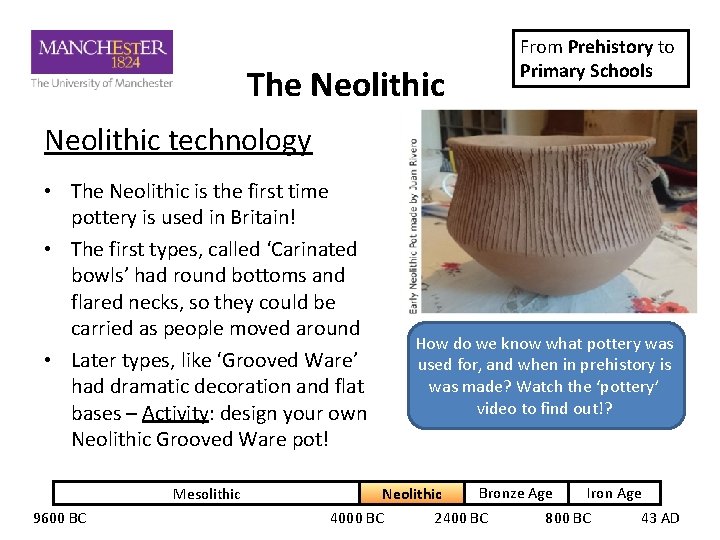
The Neolithic From Prehistory to Primary Schools Neolithic technology • The Neolithic is the first time pottery is used in Britain! • The first types, called ‘Carinated bowls’ had round bottoms and flared necks, so they could be carried as people moved around • Later types, like ‘Grooved Ware’ had dramatic decoration and flat bases – Activity: design your own Neolithic Grooved Ware pot! Mesolithic 9600 BC How do we know what pottery was used for, and when in prehistory is was made? Watch the ‘pottery’ video to find out!? Bronze Age Iron Age Neolithic 4000 BC 2400 BC 800 BC 43 AD
The Neolithic From Prehistory to Primary Schools What did they believe? • How did Neolithic people treat their dead? Did they bury or cremate them like we do today? • Were ancestors important to Neolithic people? • How were the sun and the moon important to Neolithic people? Mesolithic 9600 BC Bronze Age Iron Age Neolithic 4000 BC 2400 BC 800 BC 43 AD
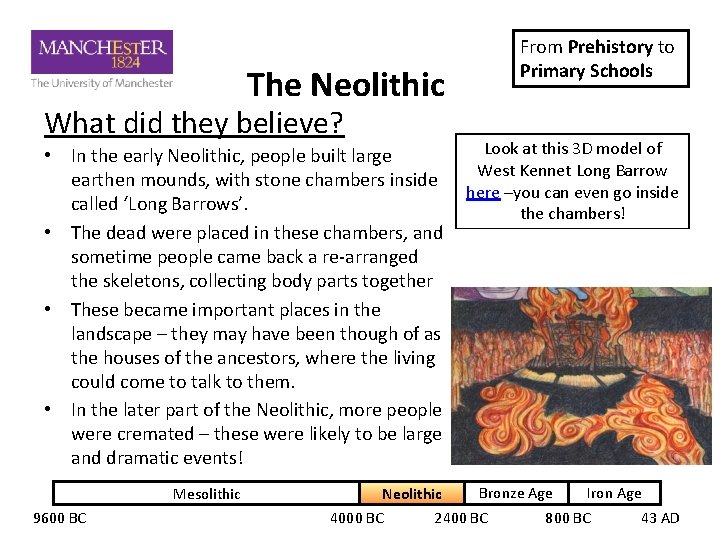
The Neolithic What did they believe? • In the early Neolithic, people built large earthen mounds, with stone chambers inside called ‘Long Barrows’. • The dead were placed in these chambers, and sometime people came back a re-arranged the skeletons, collecting body parts together • These became important places in the landscape – they may have been though of as the houses of the ancestors, where the living could come to talk to them. • In the later part of the Neolithic, more people were cremated – these were likely to be large and dramatic events! Mesolithic 9600 BC From Prehistory to Primary Schools Look at this 3 D model of West Kennet Long Barrow here –you can even go inside the chambers! Bronze Age Iron Age Neolithic 4000 BC 2400 BC 800 BC 43 AD
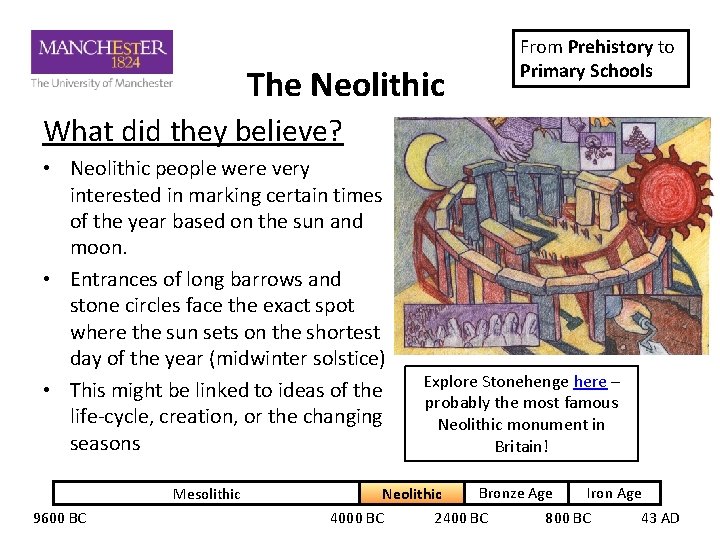
The Neolithic From Prehistory to Primary Schools What did they believe? • Neolithic people were very interested in marking certain times of the year based on the sun and moon. • Entrances of long barrows and stone circles face the exact spot where the sun sets on the shortest day of the year (midwinter solstice) • This might be linked to ideas of the life-cycle, creation, or the changing seasons Mesolithic 9600 BC Explore Stonehenge here – probably the most famous Neolithic monument in Britain! Bronze Age Iron Age Neolithic 4000 BC 2400 BC 800 BC 43 AD
The Neolithic From Prehistory to Primary Schools Digital Resources 3 D models Neolithic Polished Stone Axe 3 D scan: https: //sketchfab. com/3 d-models/polished-langdale-axe-3 b 72 d 49 bb 72 b 4 ddfb 16 fb 760 bdc 67743 Skara Brae House 3 D scans: https: //sketchfab. com/3 d-models/skara-brae-orkney-house-2 -e 12 c 4389 a 6154 bf 5 a 72 b 74 c 34 a 1823 b 8 and https: //sketchfab. com/3 d-models/neolithic-house-skara-brae-orkney-e 9 fee 2578 f 634 ea 1 a 9 c 710 ac 860844 c 0 West Kennet Long Barrow: https: //sketchfab. com/3 d-models/west-kennett-long-barrow-70 f 4537588 f 541119 c 4 e 9 cfc 02631 bd 4 Unstan Neolithic Tomb (use the annotations to take you on a 3 D tour, including inside the tomb!): https: //sketchfab. com/3 d-models/unstan-neolithic-tombstenness-orkney-72 c 745 a 55 b 5 b 47258882996 ef 819 e 7 cb Stonehenge: https: //sketchfab. com/3 d-models/stonehenge-dji-mavic-jaymie-james-0947 e 454 c 8 ad 491593 ce 867 f 3 d 29169 e Videos Making a Polished Stone Axe video : https: //youtu. be/ry. MJ 3 c 1 g. Huw Making a Grooved-ware pot video: https: //youtu. be/nr. I 1 LJb. KIvk Make your own Pinch Pot Video: https: //www. youtube. com/watch? v=b. ELg. M 8 a. Sq. Lc Further reading and Site Visits Getting to Arbor Low Directions: http: //www. english-heritage. org. uk/visit/places/arbor-low-stone-circle-and-gib-hill-barrow/ Prof. Howard Williams Arbor Low blog-post: https: //howardwilliamsblog. wordpress. com/2014/06/01/the-past-in-the-past-at-arbor-low-andgib-hill/ Mesolithic 9600 BC Bronze Age Iron Age Neolithic 4000 BC 2400 BC 800 BC 43 AD