Chapter 1 Cells Section Reviews and Chapter Review

- Slides: 13
Chapter 1 Cells Section Reviews and Chapter Review
1. 1 1. ) In your own words, write a definition for the term organelle. An organelle is a tiny organ within a cell that has its own unique function or job.
1. 1 2. ) Use the following terms in the same sentence: Prokaryotic, nucleus, and eukaryotic A prokaryotic cell is a cell that does NOT have a nucleus while a eukaryotic cell does have a nucleus.
1. 1 3. ) Cell size is limited by the A. Thickness of the cell wall B. Size of the cell’s nucleus C. Cell’s surface area-to-volume ratio. D. Amount of cytoplasm in a cell
1. 1 4. ) What are three parts of the cell theory? 1. ) All organisms are made of one or more cells. 2. ) The cell is the basic unit of all life. 3. ) All cells come from existing cells.
1. 1 5. ) Name three structures that every cell has. All cells have a cell membrane. All cells have cytoplasm. All cells have genetic material (DNA).
1. 1 6. ) Give two ways that archaebacteria are different from eubacteria Archaebacteria have a different type of cell wall and cell membrane and, Archaebacteria have different ribosomes. More like those of eukaryotes.
7. ) You have discovered a new single-celled organism. It has a cell wall, ribosomes, and long, circular DNA. Is it a eukaryote or prokaryote? Explain. The It organism is a prokaryote because; has long circular DNA and Doesn’t have a nucleus.
8. ) One of your students brings you a cell about the size of a period at the end of a sentence. It is a single cell, but it also forms chains. What characteristics would this cell have if the organism is a eukaryote? If the cell were a eukaryote it would have the following; A nucleus Membrane bound organelles
8. ) Continued: Prokaryote If the cell were a prokaryote you would not see a nucleus
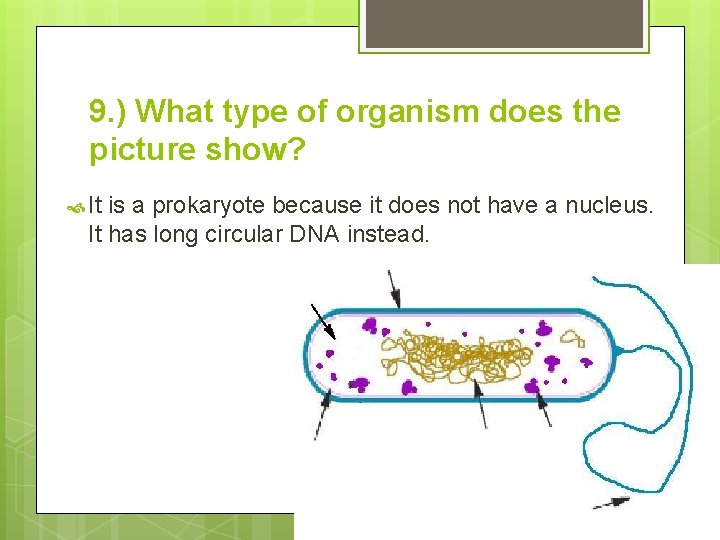
9. ) What type of organism does the picture show? It is a prokaryote because it does not have a nucleus. It has long circular DNA instead.
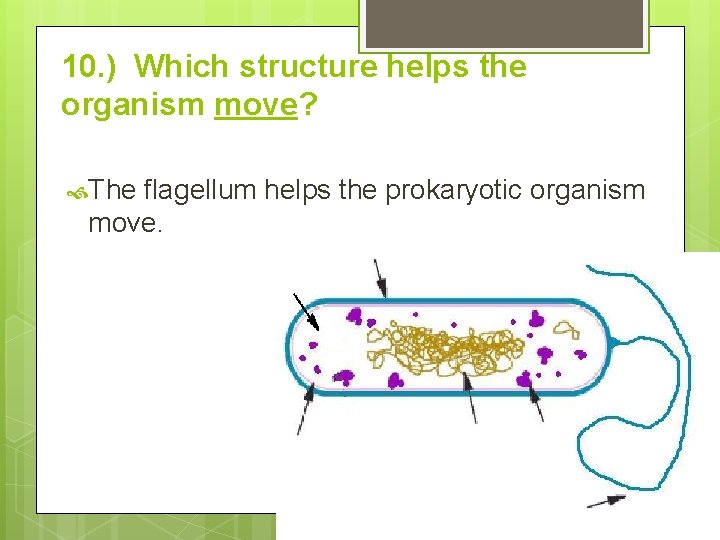
10. ) Which structure helps the organism move? The flagellum helps the prokaryotic organism move.
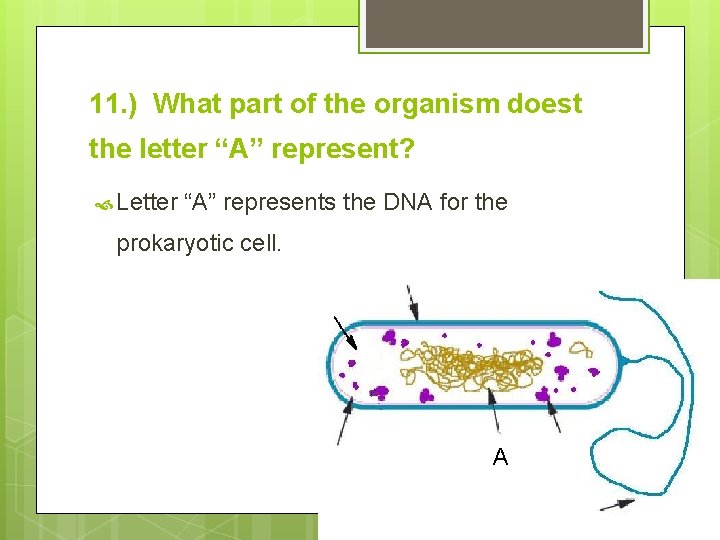
11. ) What part of the organism doest the letter “A” represent? Letter “A” represents the DNA for the prokaryotic cell. A