CDJEV Japanese Encephalitis Vaccine Introduction Training Modules for

- Slides: 17
CD-JEV Japanese Encephalitis Vaccine Introduction Training Modules for Health Care Workers Module 4 CD-JEV administration in routine immunization
Learning objectives At the end of the module, the participant will be able to: – Identify necessary steps to ensure good vaccine quality. – Describe how to administer CD-JEV. – Describe how to talk to parents about side effects. Duration: – 30 minutes 2 | CD-JEV administration in routine immunization, Module 4 | November 2020
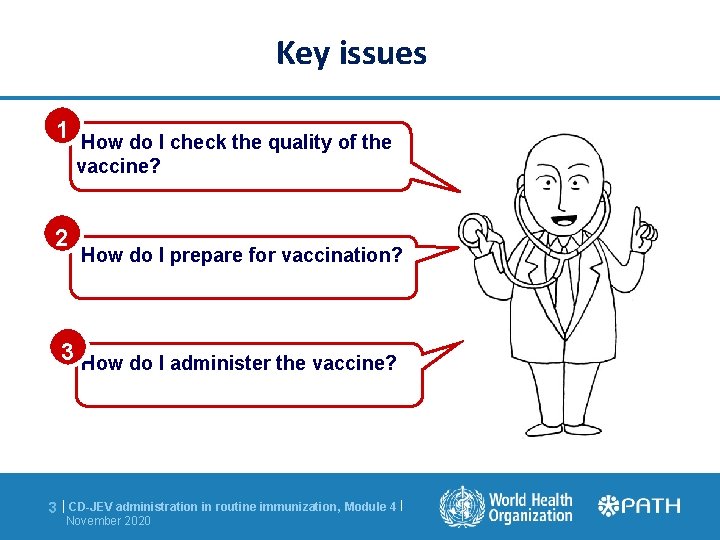
Key issues 1 How do I check the quality of the vaccine? 2 How do I prepare for vaccination? 3 How do I administer the vaccine? 3 | CD-JEV administration in routine immunization, Module 4 | November 2020
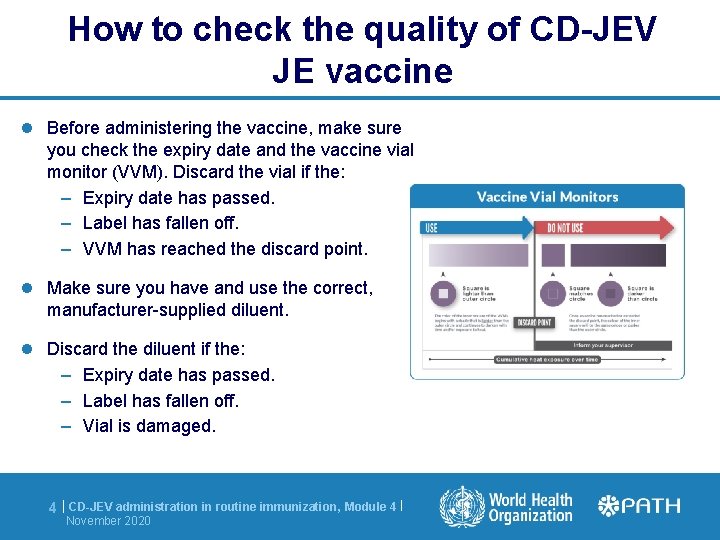
How to check the quality of CD-JEV JE vaccine Before administering the vaccine, make sure you check the expiry date and the vaccine vial monitor (VVM). Discard the vial if the: – Expiry date has passed. – Label has fallen off. – VVM has reached the discard point. Make sure you have and use the correct, manufacturer-supplied diluent. Discard the diluent if the: – Expiry date has passed. – Label has fallen off. – Vial is damaged. 4 | CD-JEV administration in routine immunization, Module 4 | November 2020
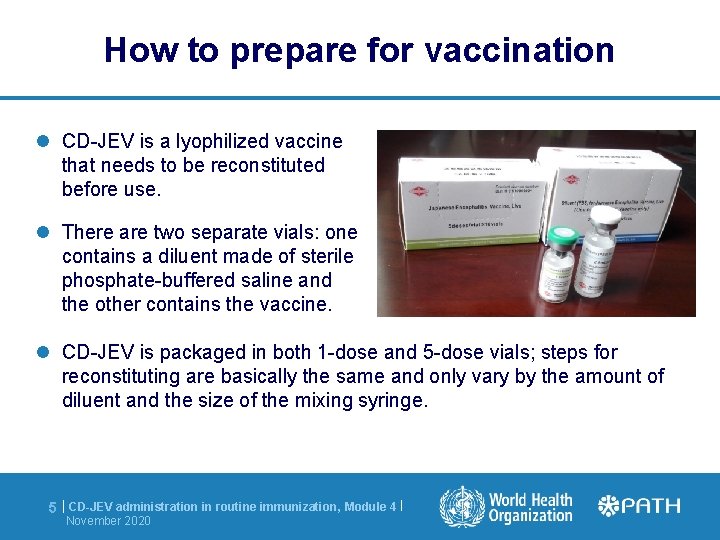
How to prepare for vaccination CD-JEV is a lyophilized vaccine that needs to be reconstituted before use. There are two separate vials: one contains a diluent made of sterile phosphate-buffered saline and the other contains the vaccine. CD-JEV is packaged in both 1 -dose and 5 -dose vials; steps for reconstituting are basically the same and only vary by the amount of diluent and the size of the mixing syringe. 5 | CD-JEV administration in routine immunization, Module 4 | November 2020
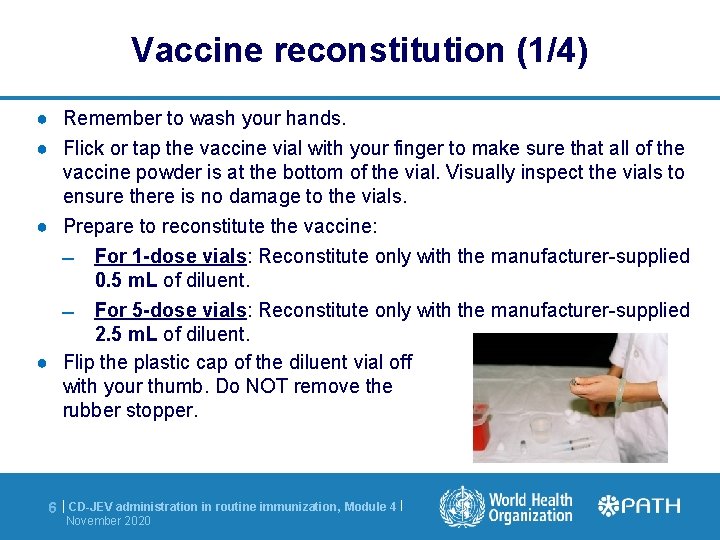
Vaccine reconstitution (1/4) ● Remember to wash your hands. ● Flick or tap the vaccine vial with your finger to make sure that all of the vaccine powder is at the bottom of the vial. Visually inspect the vials to ensure there is no damage to the vials. ● Prepare to reconstitute the vaccine: For 1 -dose vials: Reconstitute only with the manufacturer-supplied 0. 5 m. L of diluent. For 5 -dose vials: Reconstitute only with the manufacturer-supplied 2. 5 m. L of diluent. ● Flip the plastic cap of the diluent vial off with your thumb. Do NOT remove the rubber stopper. 6 | CD-JEV administration in routine immunization, Module 4 | November 2020
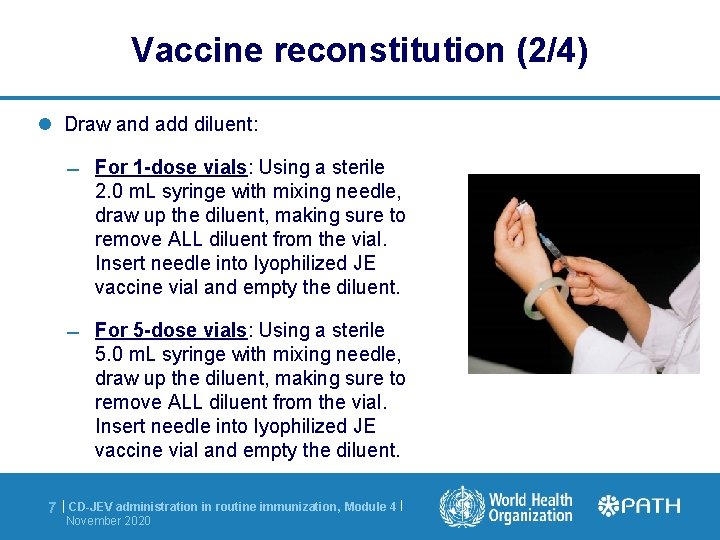
Vaccine reconstitution (2/4) Draw and add diluent: For 1 -dose vials: Using a sterile 2. 0 m. L syringe with mixing needle, draw up the diluent, making sure to remove ALL diluent from the vial. Insert needle into lyophilized JE vaccine vial and empty the diluent. For 5 -dose vials: Using a sterile 5. 0 m. L syringe with mixing needle, draw up the diluent, making sure to remove ALL diluent from the vial. Insert needle into lyophilized JE vaccine vial and empty the diluent. 7 | CD-JEV administration in routine immunization, Module 4 | November 2020
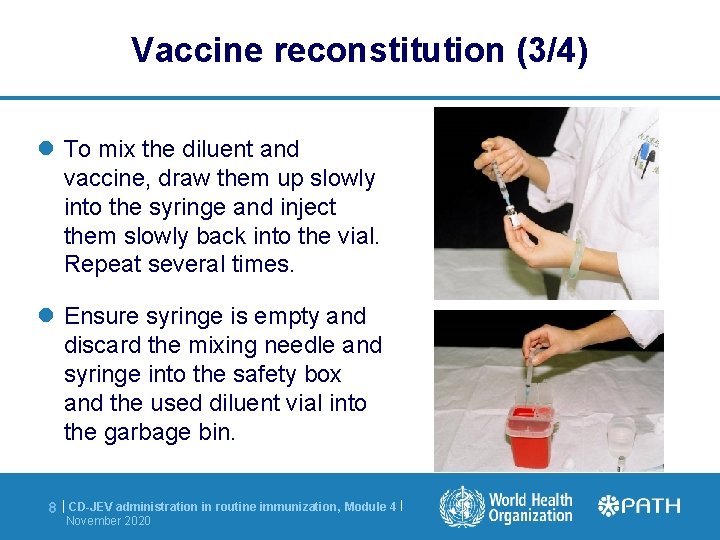
Vaccine reconstitution (3/4) To mix the diluent and vaccine, draw them up slowly into the syringe and inject them slowly back into the vial. Repeat several times. Ensure syringe is empty and discard the mixing needle and syringe into the safety box and the used diluent vial into the garbage bin. 8 | CD-JEV administration in routine immunization, Module 4 | November 2020
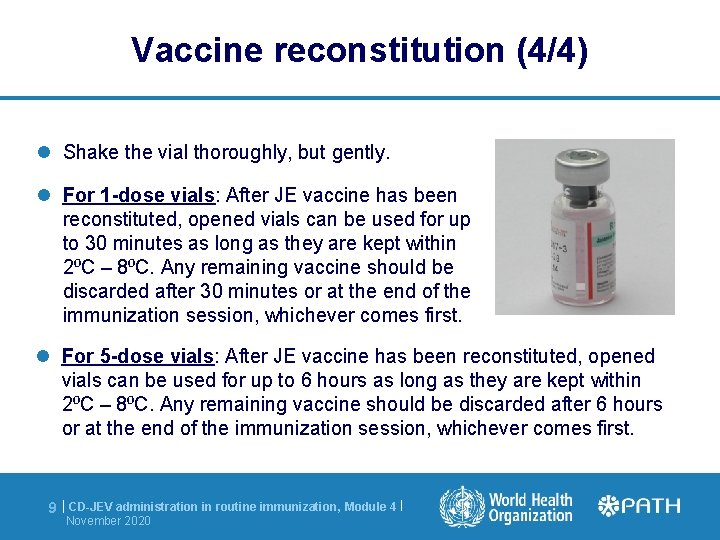
Vaccine reconstitution (4/4) Shake the vial thoroughly, but gently. For 1 -dose vials: After JE vaccine has been reconstituted, opened vials can be used for up to 30 minutes as long as they are kept within 2⁰C – 8⁰C. Any remaining vaccine should be discarded after 30 minutes or at the end of the immunization session, whichever comes first. For 5 -dose vials: After JE vaccine has been reconstituted, opened vials can be used for up to 6 hours as long as they are kept within 2⁰C – 8⁰C. Any remaining vaccine should be discarded after 6 hours or at the end of the immunization session, whichever comes first. 9 | CD-JEV administration in routine immunization, Module 4 | November 2020
How to talk to parents about side effects Explain to parents and caregivers that some children may experience common side effects after vaccination, such as tenderness or swelling at the injection site, or a rash or mild fever. The side effects are not serious and will not last more than a few days. This will help ease parents’ minds about mild symptoms. Explain that if a child becomes severely ill or appears to have an allergic reaction, such as fever higher than 38. 5⁰C, swelling, or hives, in the days following the immunization, then the parent should bring the child to a hospital or clinic as soon as possible. Reassure parents that serious side effects are rare. CD-JEV does not cause Japanese encephalitis. 10 | CD-JEV administration in routine immunization, Module 4 | November 2020
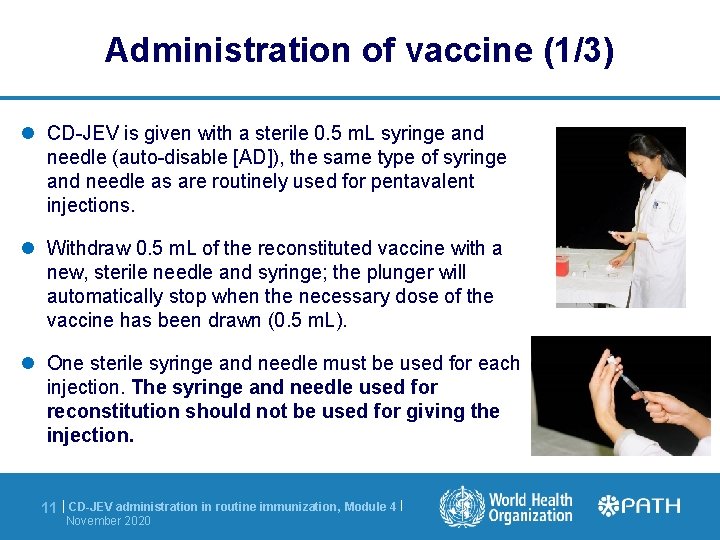
Administration of vaccine (1/3) CD-JEV is given with a sterile 0. 5 m. L syringe and needle (auto-disable [AD]), the same type of syringe and needle as are routinely used for pentavalent injections. Withdraw 0. 5 m. L of the reconstituted vaccine with a new, sterile needle and syringe; the plunger will automatically stop when the necessary dose of the vaccine has been drawn (0. 5 m. L). One sterile syringe and needle must be used for each injection. The syringe and needle used for reconstitution should not be used for giving the injection. 11 | CD-JEV administration in routine immunization, Module 4 | November 2020
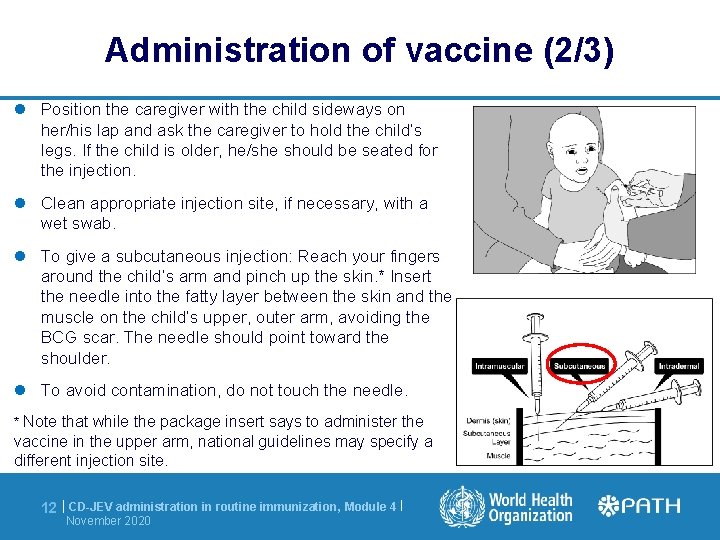
Administration of vaccine (2/3) Position the caregiver with the child sideways on her/his lap and ask the caregiver to hold the child’s legs. If the child is older, he/she should be seated for the injection. Clean appropriate injection site, if necessary, with a wet swab. To give a subcutaneous injection: Reach your fingers around the child’s arm and pinch up the skin. * Insert the needle into the fatty layer between the skin and the muscle on the child’s upper, outer arm, avoiding the BCG scar. The needle should point toward the shoulder. To avoid contamination, do not touch the needle. * Note that while the package insert says to administer the vaccine in the upper arm, national guidelines may specify a different injection site. 12 | CD-JEV administration in routine immunization, Module 4 | November 2020
Administration of vaccine (3/3) Press the top of the plunger with your thumb to inject the JE vaccine (0. 5 m. L). NOTE: Needles should not be recapped due to the danger of needle-stick injury and cross infection. Dispose of the needle and syringe immediately in a safety box. Countries using hub-cutters should cut the hub of the syringe immediately after use with a hub-cutter. IMPORTANT: Do not pre-prepare syringes with vaccine for injection. For 1 -dose vials: Discard any reconstituted JE vaccine after 30 minutes or at the end of the immunization session, whichever comes first. For 5 -dose vials: Discard any reconstituted JE vaccine after 6 hours or at the end of the immunization session, whichever comes first. 13 | CD-JEV administration in routine immunization, Module 4 | November 2020
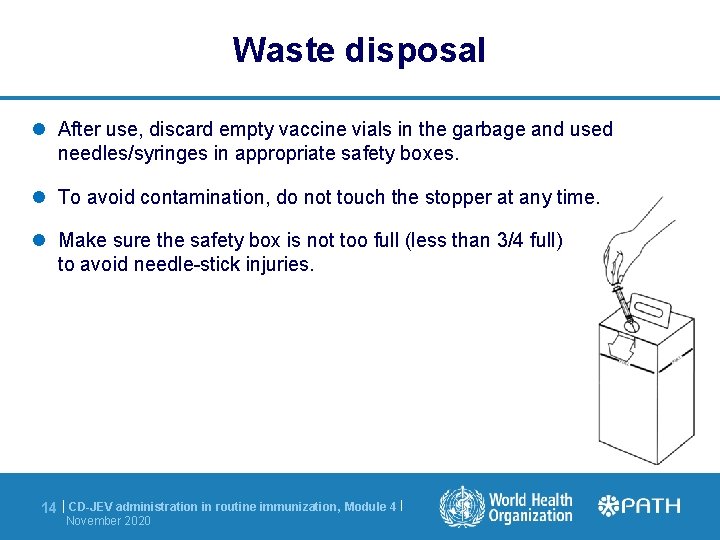
Waste disposal After use, discard empty vaccine vials in the garbage and used needles/syringes in appropriate safety boxes. To avoid contamination, do not touch the stopper at any time. Make sure the safety box is not too full (less than 3/4 full) to avoid needle-stick injuries. 14 | CD-JEV administration in routine immunization, Module 4 | November 2020
Key messages (1/2) Before administering the vaccine, check the expiry date, the vaccine vial monitor (VVM), and the diluent for quality. CD-JEV is packaged in both 1 -dose and 5 -dose vials; steps for reconstituting only vary by the amount of diluent and the size of the mixing syringe. After reconstituting: For 1 -dose vials: Discard any JE vaccine after 30 minutes or at the end of the immunization session, whichever comes first. For 5 -dose vials: Discard any JE vaccine after 6 hours or at the end of the immunization session, whichever comes first. 15 | CD-JEV administration in routine immunization, Module 4 | November 2020
Key messages (2/2) Although CD-JEV is very safe, some children may experience mild side effects after vaccination, such as tenderness or swelling at the injection site, rash, or mild fever. If a child becomes severely ill or appears to have an allergic reaction in the days following the immunization, the parent should bring the child to a hospital or clinic as soon as possible. A sterile syringe and needle must be used for each injection; the syringe and needle used for reconstitution should not be used for giving the injection. The dose of CD-JEV is 0. 5 m. L, given by subcutaneous injection normally in the outer upper arm. 16 | CD-JEV administration in routine immunization, Module 4 | November 2020
End of module Thank you for your attention! Ø Next is Module 5: Recording and monitoring uptake of CD-JEV 17 | CD-JEV administration in routine immunization, Module 4 | November 2020