CC 8 Acids and alkalis knowledge organiser H

- Slides: 3
CC 8: Acids and alkalis knowledge organiser (H) Lesson 1 Acids alkalis and indicators Acids contain Hydrogen ions H+ The common acids that you will come across at GCSE are Hydrochloric acid HCl Sulphuric acid H 2 SO 4 Nitric acid HNO 3 These are all acids as they produce hydrogen ions H+ in solution How acidic a solution is depends on the concentration of hydrogen ions and this can be measured using the p. H scale either using an indicator or a p. H meter An indicator is a substance which changes colour in acid/alkali p. H 1 2 3 4 5 6 7 8 9 10 11 12 13 14 Colour of Highly acidic weakly acidic neutral weakly alkaline Highly alkaline Universal orange yellow green purple blue Indicator Red Universal indicator is not good for doing titrations. For this you need either Phenol phthalein or methy orange Indicator Colour in acid Colour in alkali Phenol phthalein colourless pink Methyl orange red yellow Lesson 6 Acid and metal Acids can be neutralised with metals. If the metal is reactive enough hydrogen gas is produced as well as a solution of the salt. metal + acid → salt + hydrogen MASH magnesium + hydrochloric acid → magnesium chloride + hydrogen Mg + 2 HCl → Mg. Cl 2 + H 2 The test for hydrogen gas it that it makes a squeeky pop when a lit split is added Lesson 2 Strong and weak acids (HIGHER) Acids can be classified as concentrated or dilute or weak and strong Acids can be neutralised with metal carbonates. In this case carbon dioxide gas is produced as well as a solution of the salt. metal carbonate + acid → salt + water + carbon dioxide CASHOCO calcium carbonate + hydrochloric acid → calcium chloride + water + carbon dioxide Ca. CO 3 + 2 HCl → Ca. Cl 2 + H 2 O + CO 2 A strong acid A weak acid All of the acid splits up into ions (dissociates) when the acid dissolves in water High concentration of H+ Low p. H Only some of the acid splits up into ions when it is dissolve in water Lower concentration of H+ Higher p. H (still acidic) HCl Hydrochloric acid CH 3 COOH Ethanoic acid The concentration of hydrogen ions decreases by a factor of 10 every time the p. H is increased by 1 (HIGHER) Lesson 5 Titration To make a salt from an acid an alkali you need to use a titration • Using a pipette transfer a known volume of alkali into a conical flask • Add a few drops of indicator • Add acid from a burette slowly until you are near to the indicator changing colour Not universal indicator (end point) • Add the acid drop-wise until the indicator changes colour. Record the volume of acid. • Repeat the experiment with no indicator. • Evaporate the water from the solution to leave the salt The test for carbon dioxide gas is that lime water turns milky when carbon dioxide is bubbled through it Salts that are insoluble can be made using precipitation reactions. In a precipitation reaction the metal and non-metal part of two compound swap round to give two new compounds. If one of these is insoluble it forms a precipitate. Lead nitrate + potassium iodide → lead iodide + potassium nitrate Pb(NO 3)2 (aq) + 2 KI (aq) → Pb. I 2 (S) + 2 KNO 3 (aq) The precipitate must be lead iodide as potassium nitrate is soluble! To pepare an insoluble salt from a precipitation reaction simply mix the two solutions together, filter off the precipitate (salt) and dry A base is a metal oxide or hydroxide e. g. Cu. O or Ca(OH)2 Bases can neutralise acids to give salt and water only base + acid → salt + water General equation Lesson 8 Precipitation reactions Lesson 7 Acid and metal carbonate Lesson 3 Bases Solubility Rules To know if a salt is soluble in water or not you need to learn your solubility rules All group one metals salts are soluble All nitrates are soluble etc. Hydrochloric acid HCl Makes Chlorides Sulphuric acid Makes Sulphates Nitric acid Makes Nitrates Word equation Symbol equation BASHO The salt that is made depends on the acid used and the base copper oxide + sulphuric acid → copper sulphate + water Cu. O + H 2 SO 4 → Cu. SO 4 + H 2 O A salt can be made by the reaction of an acid and a base. For example you can make copper sulphate by reacting copper oxide with sulphuric acid • Add excess base to acid to neutralise all the acid • Filter off the excess base • Evaporate the water from the solution to get crystals of the salt Lesson 4 Alkalis and neutralisation An alkali is a base that is soluble in water e. g. Na. OH Alkalis produce hydroxide ions (OH-) when dissolved in water Since alklis are bases they react with acid to give salt and water acid + alkali → salt + water BASHO Hydrochloric acid + sodium hydroxide → sodium chloride + water HCl + Na. OH → Na. Cl + H 2 O A reaction in which the hydrogen ions from the acid are removed is a neutralisation reaction. In this case the hydrogen ions from the acid (H+) react with hydroxide ions from alkali (OH-) to make water H+ + OH- → H 2 O Lesson 9 Summary – Acids and making salts To make soluble salts neutralise acids use one of the 3 methods. Use a different method if starting with an insoluble base or an alkali base + acid → salt + water BASHO metal + acid → salt + hydrogen MASH metal carbonate + acid → salt + water + carbon dioxide CASHOCO To make an insoluble salt use a precipitation reaction and use solubility rules to determine which. You need to able to • Know the names and formulas of common acids • Know the colour changes for indicators in acid and alkali (not just UI) • Write word and symbol equations for the neutralisation reactions • Describe methods for making soluble and insoluble salts • Explain what happens in neutralisation reaction • Write ionic equations for neutralisation reactions (HIGHER)
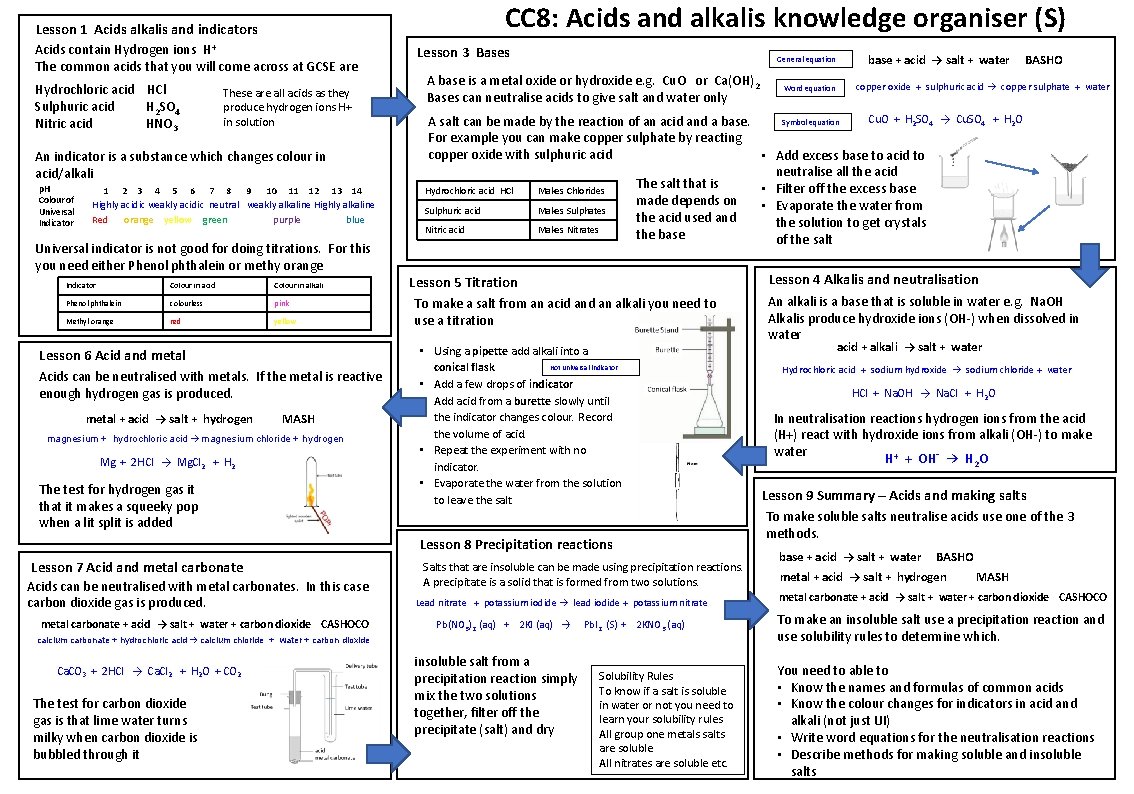
Lesson 1 Acids alkalis and indicators Acids contain Hydrogen ions H+ The common acids that you will come across at GCSE are Hydrochloric acid HCl Sulphuric acid H 2 SO 4 Nitric acid HNO 3 These are all acids as they produce hydrogen ions H+ in solution An indicator is a substance which changes colour in acid/alkali p. H 1 2 3 4 5 6 7 8 9 10 11 12 13 14 Colour of Highly acidic weakly acidic neutral weakly alkaline Highly alkaline Universal orange yellow green purple blue Indicator Red Universal indicator is not good for doing titrations. For this you need either Phenol phthalein or methy orange Indicator Colour in acid Colour in alkali Phenol phthalein colourless pink Methyl orange red yellow Lesson 6 Acid and metal Acids can be neutralised with metals. If the metal is reactive enough hydrogen gas is produced. metal + acid → salt + hydrogen MASH magnesium + hydrochloric acid → magnesium chloride + hydrogen Mg + 2 HCl → Mg. Cl 2 + H 2 The test for hydrogen gas it that it makes a squeeky pop when a lit split is added CC 8: Acids and alkalis knowledge organiser (S) Lesson 3 Bases General equation A base is a metal oxide or hydroxide e. g. Cu. O or Ca(OH)2 Bases can neutralise acids to give salt and water only metal carbonate + acid → salt + water + carbon dioxide CASHOCO Lesson 5 Titration To make a salt from an acid an alkali you need to use a titration • Using a pipette add alkali into a Not universal indicator conical flask • Add a few drops of indicator • Add acid from a burette slowly until the indicator changes colour. Record the volume of acid. • Repeat the experiment with no indicator. • Evaporate the water from the solution to leave the salt Salts that are insoluble can be made using precipitation reactions. A precipitate is a solid that is formed from two solutions. Lead nitrate + potassium iodide → lead iodide + potassium nitrate Pb(NO 3)2 (aq) + 2 KI (aq) → Pb. I 2 (S) + 2 KNO 3 (aq) calcium carbonate + hydrochloric acid → calcium chloride + water + carbon dioxide Ca. CO 3 + 2 HCl → Ca. Cl 2 + H 2 O + CO 2 The test for carbon dioxide gas is that lime water turns milky when carbon dioxide is bubbled through it BASHO copper oxide + sulphuric acid → copper sulphate + water Cu. O + H 2 SO 4 → Cu. SO 4 + H 2 O Symbol equation A salt can be made by the reaction of an acid and a base. For example you can make copper sulphate by reacting copper oxide with sulphuric acid • Add excess base to acid to neutralise all the acid The salt that is • Filter off the excess base Hydrochloric acid HCl Makes Chlorides made depends on • Evaporate the water from Sulphuric acid Makes Sulphates the acid used and the solution to get crystals Nitric acid Makes Nitrates the base of the salt Lesson 8 Precipitation reactions Lesson 7 Acid and metal carbonate Acids can be neutralised with metal carbonates. In this case carbon dioxide gas is produced. Word equation base + acid → salt + water insoluble salt from a precipitation reaction simply mix the two solutions together, filter off the precipitate (salt) and dry Solubility Rules To know if a salt is soluble in water or not you need to learn your solubility rules All group one metals salts are soluble All nitrates are soluble etc. Lesson 4 Alkalis and neutralisation An alkali is a base that is soluble in water e. g. Na. OH Alkalis produce hydroxide ions (OH-) when dissolved in water acid + alkali → salt + water Hydrochloric acid + sodium hydroxide → sodium chloride + water HCl + Na. OH → Na. Cl + H 2 O In neutralisation reactions hydrogen ions from the acid (H+) react with hydroxide ions from alkali (OH-) to make water H+ + OH- → H 2 O Lesson 9 Summary – Acids and making salts To make soluble salts neutralise acids use one of the 3 methods. base + acid → salt + water BASHO metal + acid → salt + hydrogen MASH metal carbonate + acid → salt + water + carbon dioxide CASHOCO To make an insoluble salt use a precipitation reaction and use solubility rules to determine which. You need to able to • Know the names and formulas of common acids • Know the colour changes for indicators in acid and alkali (not just UI) • Write word equations for the neutralisation reactions • Describe methods for making soluble and insoluble salts
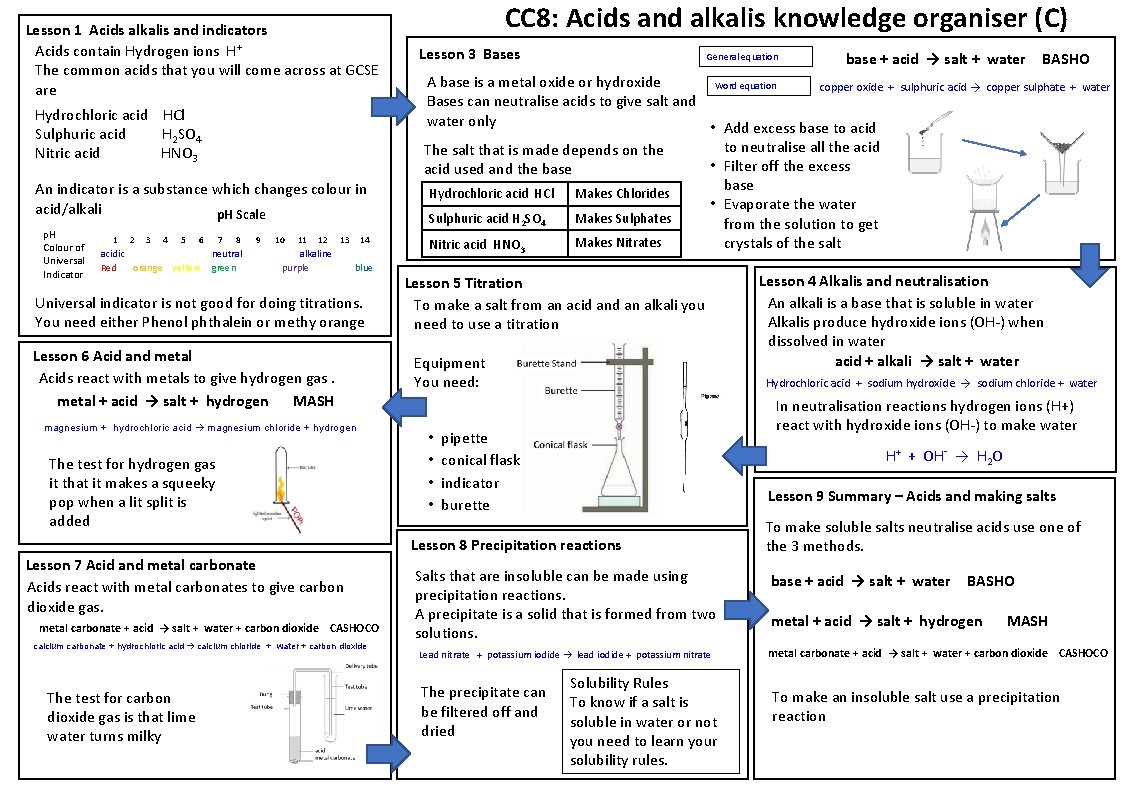
Lesson 1 Acids alkalis and indicators Acids contain Hydrogen ions H+ The common acids that you will come across at GCSE are Hydrochloric acid HCl Sulphuric acid H 2 SO 4 Nitric acid HNO 3 An indicator is a substance which changes colour in acid/alkali p. H Scale p. H 1 2 3 4 5 6 7 8 9 10 11 12 13 14 Colour of acidic neutral alkaline Universal Red orange yellow green purple blue Indicator Universal indicator is not good for doing titrations. You need either Phenol phthalein or methy orange Lesson 6 Acid and metal Acids react with metals to give hydrogen gas. metal + acid → salt + hydrogen MASH magnesium + hydrochloric acid → magnesium chloride + hydrogen The test for hydrogen gas it that it makes a squeeky pop when a lit split is added CC 8: Acids and alkalis knowledge organiser (C) Lesson 3 Bases General equation metal carbonate + acid → salt + water + carbon dioxide CASHOCO calcium carbonate + hydrochloric acid → calcium chloride + water + carbon dioxide The test for carbon dioxide gas is that lime water turns milky BASHO A base is a metal oxide or hydroxide Word equation copper oxide + sulphuric acid → copper sulphate + water Bases can neutralise acids to give salt and water only • Add excess base to acid to neutralise all the acid The salt that is made depends on the • Filter off the excess acid used and the base Hydrochloric acid HCl Makes Chlorides • Evaporate the water Sulphuric acid H 2 SO 4 Makes Sulphates from the solution to get Makes Nitrates crystals of the salt Nitric acid HNO 3 Lesson 5 Titration To make a salt from an acid an alkali you need to use a titration Equipment You need: • • In neutralisation reactions hydrogen ions (H+) react with hydroxide ions (OH-) to make water pipette conical flask indicator burette H+ + OH- → H 2 O Lesson 9 Summary – Acids and making salts Salts that are insoluble can be made using precipitation reactions. A precipitate is a solid that is formed from two solutions. Lead nitrate + potassium iodide → lead iodide + potassium nitrate The precipitate can be filtered off and dried Lesson 4 Alkalis and neutralisation An alkali is a base that is soluble in water Alkalis produce hydroxide ions (OH-) when dissolved in water acid + alkali → salt + water Hydrochloric acid + sodium hydroxide → sodium chloride + water Lesson 8 Precipitation reactions Lesson 7 Acid and metal carbonate Acids react with metal carbonates to give carbon dioxide gas. base + acid → salt + water Solubility Rules To know if a salt is soluble in water or not you need to learn your solubility rules. To make soluble salts neutralise acids use one of the 3 methods. base + acid → salt + water BASHO metal + acid → salt + hydrogen MASH metal carbonate + acid → salt + water + carbon dioxide CASHOCO To make an insoluble salt use a precipitation reaction