Carol Ann Duffy Valentine Learning Intention I can

- Slides: 29
Carol Ann Duffy Valentine Learning Intention; I can develop my understanding and analysis of a text I am studying
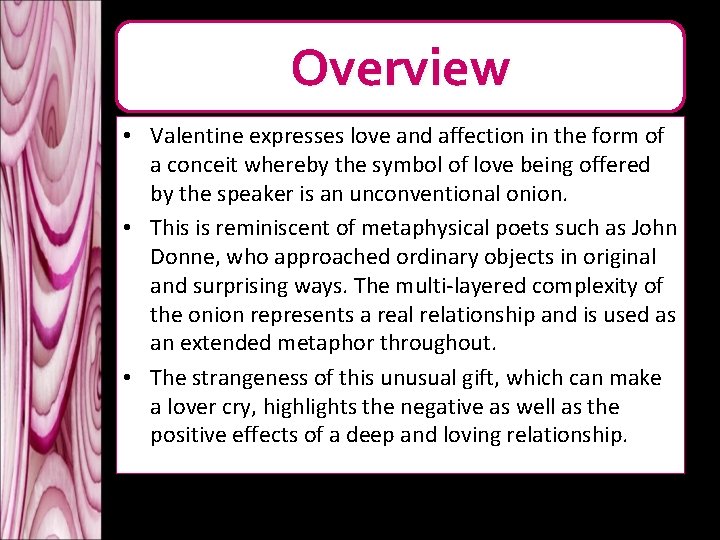
Overview • Valentine expresses love and affection in the form of a conceit whereby the symbol of love being offered by the speaker is an unconventional onion. • This is reminiscent of metaphysical poets such as John Donne, who approached ordinary objects in original and surprising ways. The multi-layered complexity of the onion represents a real relationship and is used as an extended metaphor throughout. • The strangeness of this unusual gift, which can make a lover cry, highlights the negative as well as the positive effects of a deep and loving relationship.
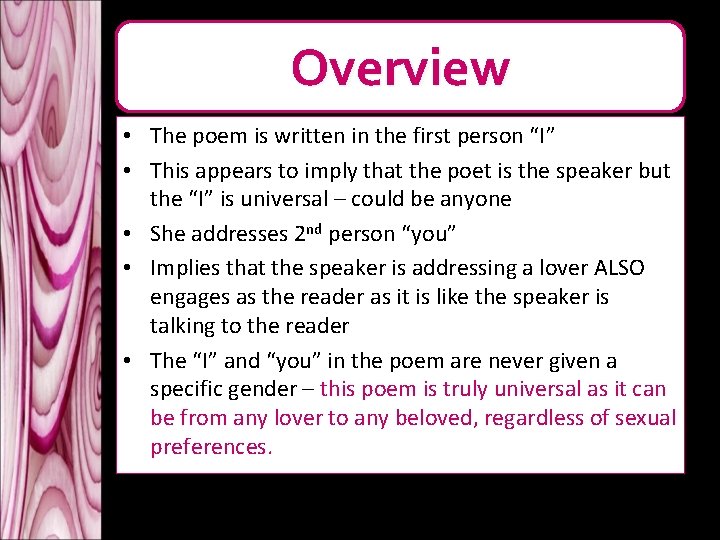
Overview • The poem is written in the first person “I” • This appears to imply that the poet is the speaker but the “I” is universal – could be anyone • She addresses 2 nd person “you” • Implies that the speaker is addressing a lover ALSO engages as the reader as it is like the speaker is talking to the reader • The “I” and “you” in the poem are never given a specific gender – this poem is truly universal as it can be from any lover to any beloved, regardless of sexual preferences.
Form and Structure • The poem is written in free verse using irregular stanzas to support its content and purpose, which is to reject traditional restrictive conventions such as marriage and other notions of love and to warn lovers that being overly possessive can have undesirable consequences. • While ostensibly a poem on theme of love, Duffy deliberately avoids the use of language or imagery that we associate with this type of poetry. • Instead, the words are often stark and monosyllabic to allow her to present her ideas clearly and unambiguously.
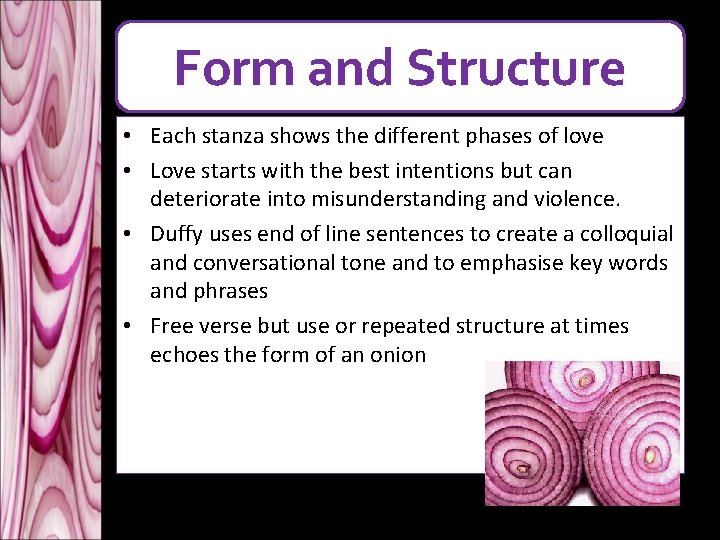
Form and Structure • Each stanza shows the different phases of love • Love starts with the best intentions but can deteriorate into misunderstanding and violence. • Duffy uses end of line sentences to create a colloquial and conversational tone and to emphasise key words and phrases • Free verse but use or repeated structure at times echoes the form of an onion
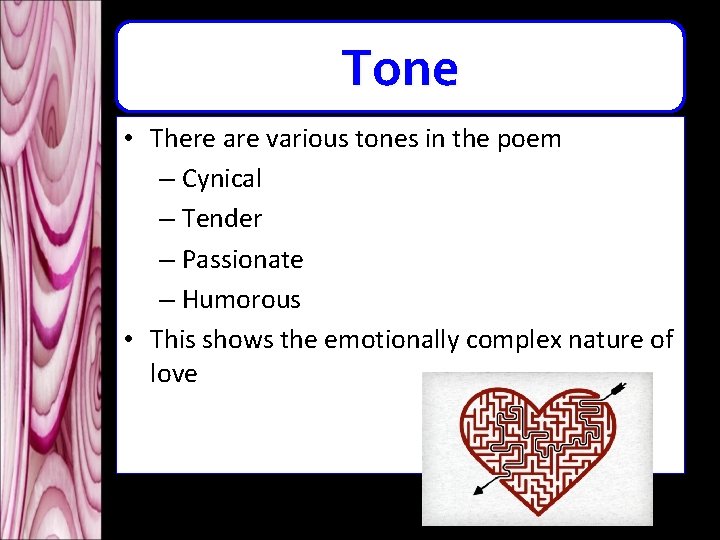
Tone • There are various tones in the poem – Cynical – Tender – Passionate – Humorous • This shows the emotionally complex nature of love
The Title - Valentine • The title suggests that this will be a traditional love poem that will use traditional (clichéd) words and phrases to explore the writer’s love. • It suggests that this will be a conventional poem.
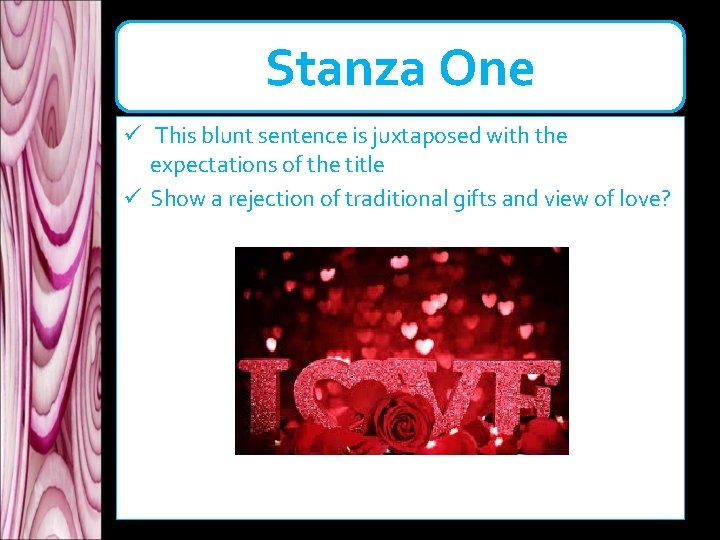
Stanza One ü This blunt sentence is juxtaposed with the expectations of the title ü Show a rejection of traditional gifts and view of love?
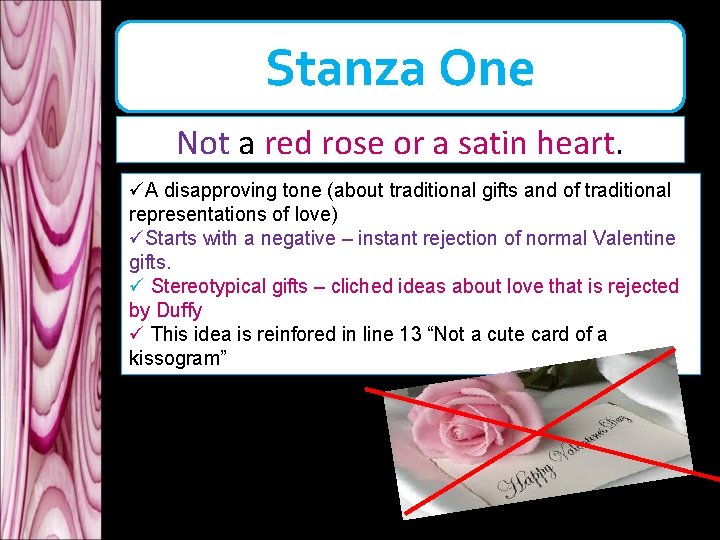
Stanza One Not a red rose or a satin heart. üA disapproving tone (about traditional gifts and of traditional representations of love) üStarts with a negative – instant rejection of normal Valentine gifts. ü Stereotypical gifts – cliched ideas about love that is rejected by Duffy ü This idea is reinfored in line 13 “Not a cute card of a kissogram”
Stanza Two ü This stanza introduces what the poet would give their love – an onion ü Like the metaphysical poets of the 17 th century Duffy uses a conceit to explore a familiar topic (love) in an unfamiliar and surprising way. ü The speaker is asserting then that the onion symbolises a positive aspect of love since it represents refreshing honesty and optimism, often experienced at the beginning of a relationship.
Literary Term; Conceit • Conceit is a figure of speech in which two vastly different objects are likened together with the help of similes or metaphors. A comparison turns into a conceit when the writer tries to make us admit a similarity between two things of whose unlikeness we are strongly conscious and for this reason, conceits are often surprising. • Function of Conceit • Because conceits make unusual and unlikely comparisons between two things, it allows readers to look at things in a new way. Similes and metaphor van become boring at times because of their predictable nature. Conceits, on the other hand, surprise and shock the readers by making farfetched
Stanza Two I give you an onion. It is a moon wrapped in brown paper. ü First line is a blunt statement – and is repeated in line 14. ü I – personal ü First line sounds humorous and will create confusion in the reader’s mind ü Moon is a common feature of romance (“Moonlight walks, etc) and is linked to the goddess Diana ü Metaphor describing the skin – emphasises that this is a gift. Simple wrapping – shows the honesty of the poem and emotion of poet
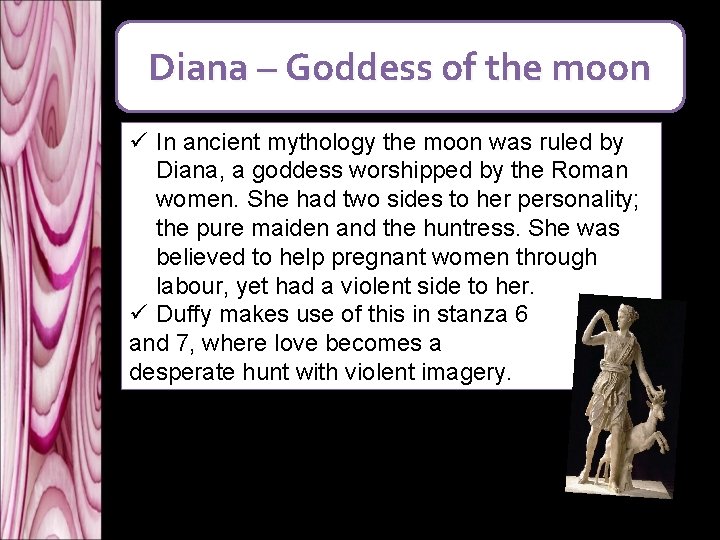
Diana – Goddess of the moon ü In ancient mythology the moon was ruled by Diana, a goddess worshipped by the Roman women. She had two sides to her personality; the pure maiden and the huntress. She was believed to help pregnant women through labour, yet had a violent side to her. ü Duffy makes use of this in stanza 6 and 7, where love becomes a desperate hunt with violent imagery.
Stanza Two It promises light like the careful undressing of love. ü This phrase indicates that this will be an enriching and fulfilling relationship for both parties. This too conveys the optimism and hopefulness of lovers embarking on a new relationship. ü Word choice – “careful” – shows tenderness and care of a new love ü Undressing of love - can be interpreted both as a reference to the sexual aspect of their relationship, and also the growth of their emotional bond which the peeling away of clothes and layers of personality may bring.
Stanza Two It promises light like the careful undressing of love. Positive – words linked with pleasant/enjoyable aspects of love; ‘promises’ also suggests assurance – a guarantee that the relationship will prosper.
Stanza Three • This verse opens with one commanding single word line: Here. • The full stop and solitary stance emphasise the forceful presentation of the gift. • In this way, the speaker reminds us that the onion, just like a lover, can elicit pain and distress as well as love and passion. This emphasises once more the vulnerability and danger people expose themselves to when they submit wholly and completely to a romantic relationship and reminds us of its destructive potential.
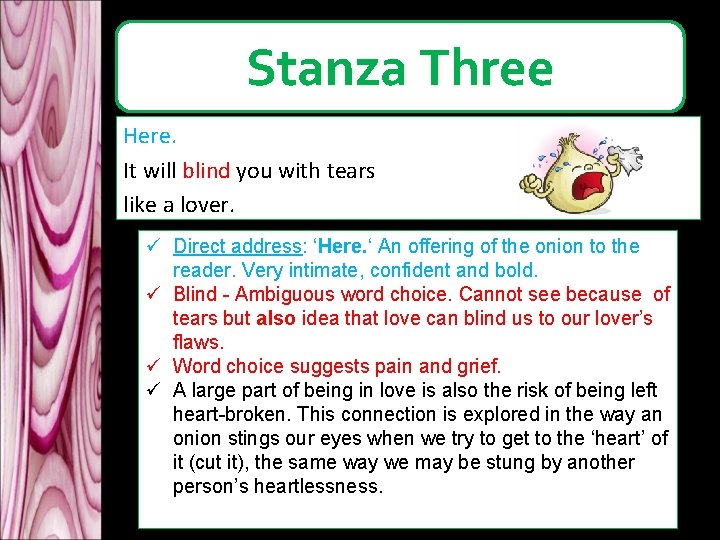
Stanza Three Here. It will blind you with tears like a lover. ü Direct address: ‘Here. ‘ An offering of the onion to the reader. Very intimate, confident and bold. ü Blind - Ambiguous word choice. Cannot see because of tears but also idea that love can blind us to our lover’s flaws. ü Word choice suggests pain and grief. ü A large part of being in love is also the risk of being left heart-broken. This connection is explored in the way an onion stings our eyes when we try to get to the ‘heart’ of it (cut it), the same way we may be stung by another person’s heartlessness.
Stanza Three It will make your reflection a wobbling photo of grief. üImagery where we are looking ‘through’ the eyes of the upset lover who may be gazing at a their own reflection in the mirror and crying at the same time. ü Reflection – comparing the white, shiny surface of a onion to a mirror. The onion is like a mirror – but the image may be distorted. ü Extended metaphor – ‘wobbling photo of grief’ – pain/tears/ distress can be caused by relationships Again the idea that love can twist/change your view of the world
Stanza Four I am trying to be truthful. üThis harsh disclosure (Stanza Three) is further supported by a single emphatic statement üIn doing so, the speaker is perhaps attempting to justify all that has been said so far, and continues to stress the desire for honesty within the relationship. üBefore this line, the speaker had described their love in mainly gentle terms to show the sincerity of their feelings, yet what follows is a change in tone to one which appears to be more brutal and threatening.
Stanza Four I am trying to be truthful. üThe alliteration of “t” strengthens feeling that love should be honest üFull stop again reinforces the statement.
Stanza Five Not a cute card or a kissogram. üCan be seen as the ‘second half’ of the poem and refers back to the first stanza. Repetition: Both stanzas have the same syllable count (9), similar wording ‘Not’ and a rejection of two typical symbols of love ‘cute card‘ and ‘kissogram‘. ü Implies that these clichéd gifts are not truthful, unlike the poem and therefore the poet.
Stanza Six ü Images of jealousy and violence begin to creep into the notion of romantic love. ü The onion is compared to a jealous lover and the way their kiss at this point in the relationship would be a mixture of passion and punishment.
Stanza Six I give you an onion. Its fierce kiss will stay on your lips, üMirrors the first line of stanza 2, carrying on with the pattern of repetition established in stanza 5 - suggests the rings of an onion üTaste of the onion is strong and difficult to erase – just like memory of a passionate relationship lasts after the relationship itself has ended. While this metaphor is truthful and sincere, the tone is forceful/aggressive. ü Word choice – fierce has connotations of anger and violence but can also reinforce the passion felt. üSibilance reinforces kissing sounds – onomatopoeic
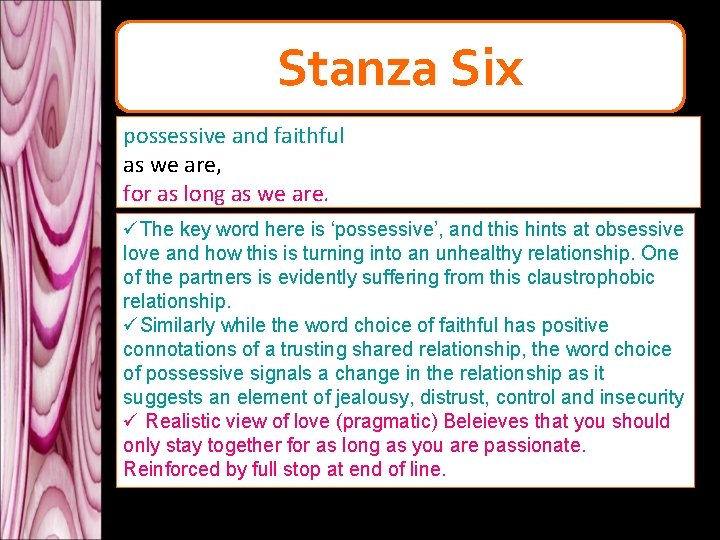
Stanza Six possessive and faithful as we are, for as long as we are. üThe key word here is ‘possessive’, and this hints at obsessive love and how this is turning into an unhealthy relationship. One of the partners is evidently suffering from this claustrophobic relationship. üSimilarly while the word choice of faithful has positive connotations of a trusting shared relationship, the word choice of possessive signals a change in the relationship as it suggests an element of jealousy, distrust, control and insecurity ü Realistic view of love (pragmatic) Beleieves that you should only stay together for as long as you are passionate. Reinforced by full stop at end of line.
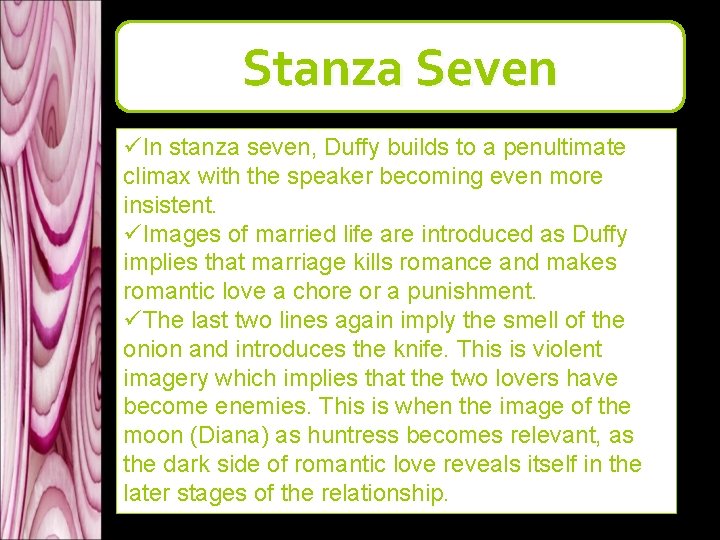
Stanza Seven üIn stanza seven, Duffy builds to a penultimate climax with the speaker becoming even more insistent. üImages of married life are introduced as Duffy implies that marriage kills romance and makes romantic love a chore or a punishment. üThe last two lines again imply the smell of the onion and introduces the knife. This is violent imagery which implies that the two lovers have become enemies. This is when the image of the moon (Diana) as huntress becomes relevant, as the dark side of romantic love reveals itself in the later stages of the relationship.
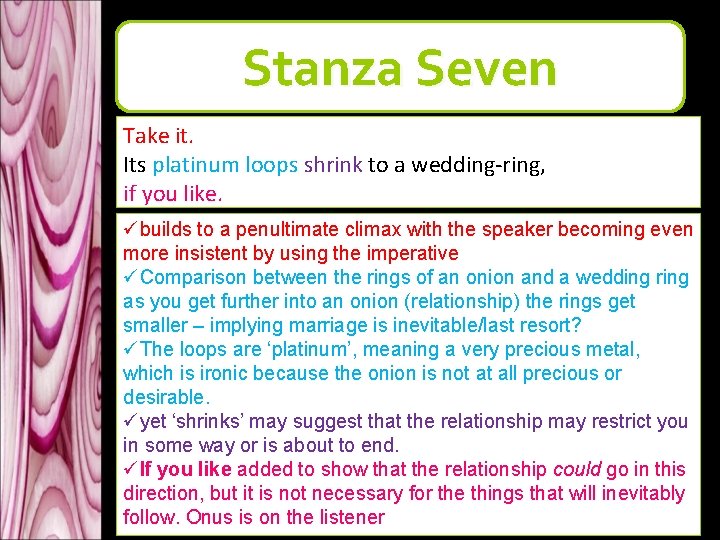
Stanza Seven Take it. Its platinum loops shrink to a wedding-ring, if you like. übuilds to a penultimate climax with the speaker becoming even more insistent by using the imperative üComparison between the rings of an onion and a wedding ring as you get further into an onion (relationship) the rings get smaller – implying marriage is inevitable/last resort? üThe loops are ‘platinum’, meaning a very precious metal, which is ironic because the onion is not at all precious or desirable. üyet ‘shrinks’ may suggest that the relationship may restrict you in some way or is about to end. üIf you like added to show that the relationship could go in this direction, but it is not necessary for the things that will inevitably follow. Onus is on the listener
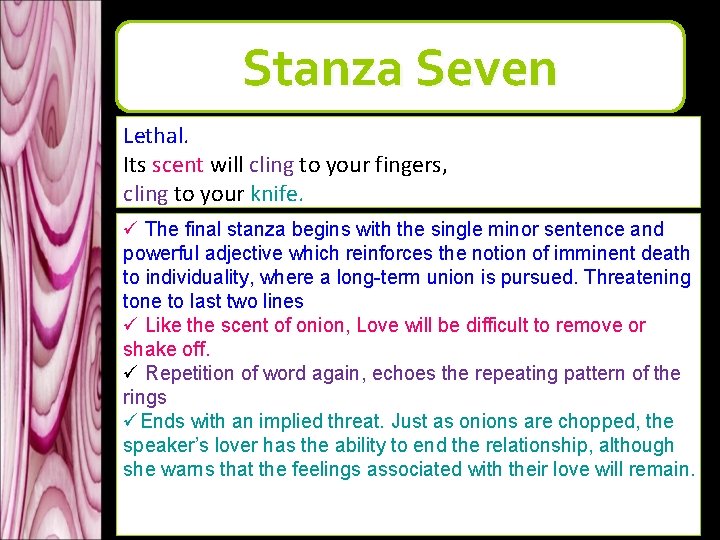
Stanza Seven Lethal. Its scent will cling to your fingers, cling to your knife. ü The final stanza begins with the single minor sentence and powerful adjective which reinforces the notion of imminent death to individuality, where a long-term union is pursued. Threatening tone to last two lines ü Like the scent of onion, Love will be difficult to remove or shake off. ü Repetition of word again, echoes the repeating pattern of the rings üEnds with an implied threat. Just as onions are chopped, the speaker’s lover has the ability to end the relationship, although she warns that the feelings associated with their love will remain.
Stanza Four “From aeroplane he stares impassively at where he earns a living and they do not care. ” üThe repetitive assonance of the ‘ay’ sound (‘aeroplane. . . stares. . . where. . . a. . . they. . . care’) helps create a monotonous feeling of drudgery: the photographer is resigned to the way things are. The poem definitely concludes on a negative note
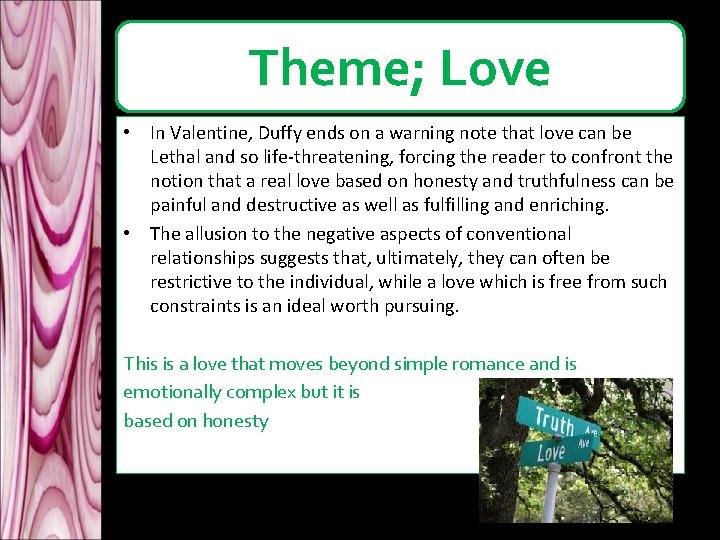
Theme; Love • In Valentine, Duffy ends on a warning note that love can be Lethal and so life-threatening, forcing the reader to confront the notion that a real love based on honesty and truthfulness can be painful and destructive as well as fulfilling and enriching. • The allusion to the negative aspects of conventional relationships suggests that, ultimately, they can often be restrictive to the individual, while a love which is free from such constraints is an ideal worth pursuing. This is a love that moves beyond simple romance and is emotionally complex but it is based on honesty