
Mrs Aesop By Carol Ann Duffy from The
+ Mrs Aesop By Carol Ann Duffy, from The World’s Wife
+ Major qualities of the poem: n Mrs Aesop’s words are honest, harsh, and somewhat abusive She shows no mercy for Aesop. n Mrs Aesop’s words have a darkly humorous effect This helps us feel her exasperation (intense irritation) and resentment (hatred; bitter feelings). n We don’t pity Aesop because he is too righteous (principled in an annoying) and patronizing (looking down on others) We take Mrs Aesop’s side.
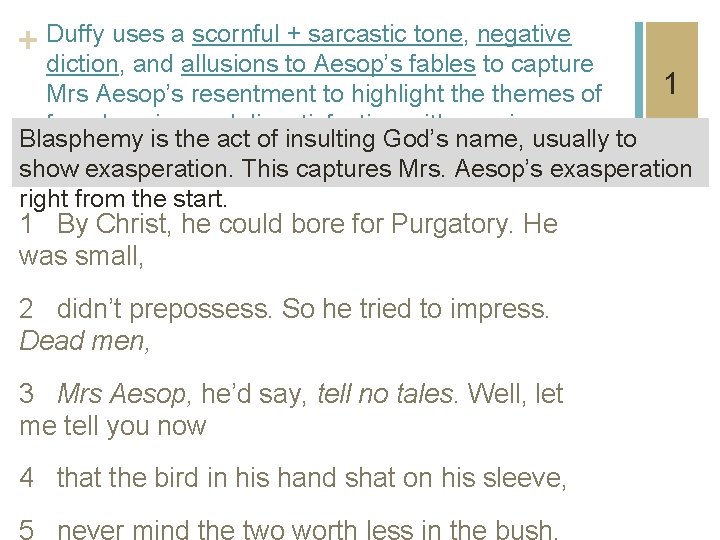
+ Duffy uses a scornful + sarcastic tone, negative diction, and allusions to Aesop’s fables to capture 1 Mrs Aesop’s resentment to highlight themes of female voice and dissatisfaction with marriage. Blasphemy is the act of insulting God’s name, usually to show exasperation. This captures Mrs. Aesop’s exasperation right from the start. 1 By Christ, he could bore for Purgatory. He was small, 2 didn’t prepossess. So he tried to impress. Dead men, 3 Mrs Aesop, he’d say, tell no tales. Well, let me tell you now 4 that the bird in his hand shat on his sleeve, 5 never mind the two worth less in the bush.
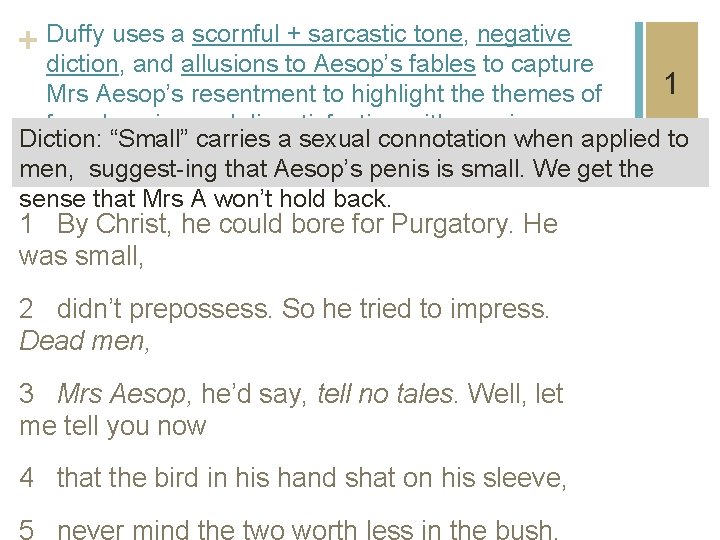
+ Duffy uses a scornful + sarcastic tone, negative diction, and allusions to Aesop’s fables to capture 1 Mrs Aesop’s resentment to highlight themes of female voice and dissatisfaction with marriage. Diction: “Small” carries a sexual connotation when applied to men, suggest-ing that Aesop’s penis is small. We get the sense that Mrs A won’t hold back. 1 By Christ, he could bore for Purgatory. He was small, 2 didn’t prepossess. So he tried to impress. Dead men, 3 Mrs Aesop, he’d say, tell no tales. Well, let me tell you now 4 that the bird in his hand shat on his sleeve, 5 never mind the two worth less in the bush.
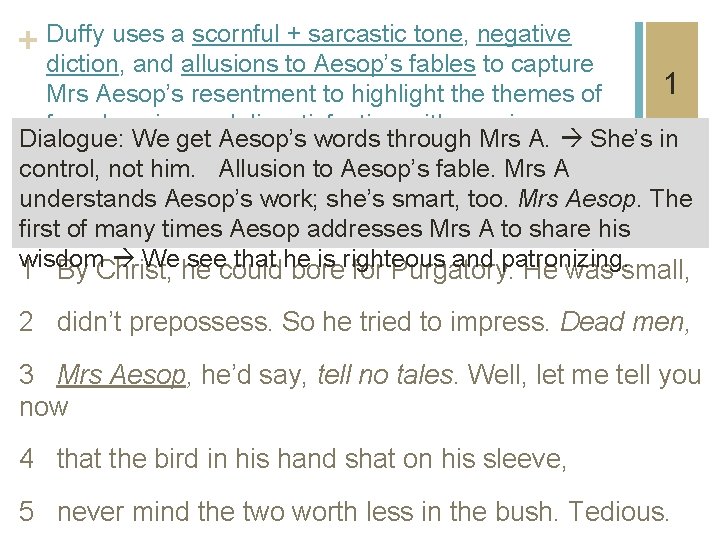
+ Duffy uses a scornful + sarcastic tone, negative diction, and allusions to Aesop’s fables to capture 1 Mrs Aesop’s resentment to highlight themes of female voice and dissatisfaction with marriage. Dialogue: We get Aesop’s words through Mrs A. She’s in control, not him. Allusion to Aesop’s fable. Mrs A understands Aesop’s work; she’s smart, too. Mrs Aesop. The first of many times Aesop addresses Mrs A to share his wisdom We he seecould that he is righteous and patronizing. 1 By Christ, bore for Purgatory. He was small, 2 didn’t prepossess. So he tried to impress. Dead men, 3 Mrs Aesop, he’d say, tell no tales. Well, let me tell you now 4 that the bird in his hand shat on his sleeve, 5 never mind the two worth less in the bush. Tedious.
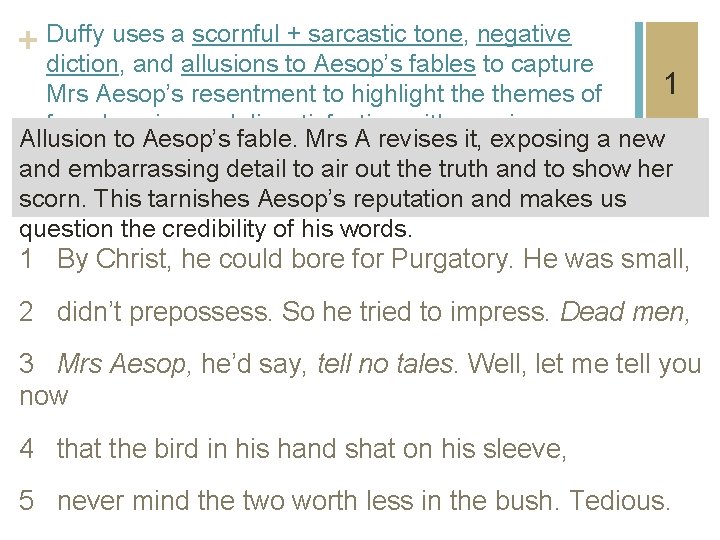
+ Duffy uses a scornful + sarcastic tone, negative diction, and allusions to Aesop’s fables to capture 1 Mrs Aesop’s resentment to highlight themes of female voice and dissatisfaction with marriage. Allusion to Aesop’s fable. Mrs A revises it, exposing a new and embarrassing detail to air out the truth and to show her scorn. This tarnishes Aesop’s reputation and makes us question the credibility of his words. 1 By Christ, he could bore for Purgatory. He was small, 2 didn’t prepossess. So he tried to impress. Dead men, 3 Mrs Aesop, he’d say, tell no tales. Well, let me tell you now 4 that the bird in his hand shat on his sleeve, 5 never mind the two worth less in the bush. Tedious.
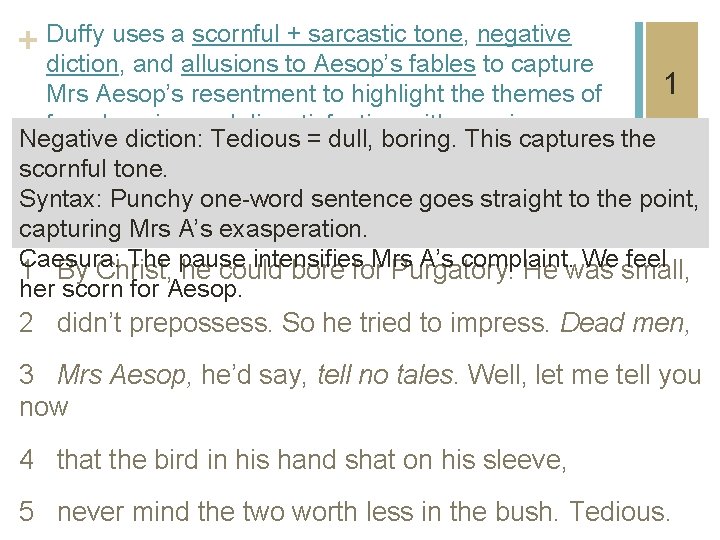
+ Duffy uses a scornful + sarcastic tone, negative diction, and allusions to Aesop’s fables to capture 1 Mrs Aesop’s resentment to highlight themes of female voice and dissatisfaction with marriage. Negative diction: Tedious = dull, boring. This captures the scornful tone. Syntax: Punchy one-word sentence goes straight to the point, capturing Mrs A’s exasperation. Caesura: The pause intensifies A’s complaint. We small, feel 1 By Christ, he could bore for. Mrs Purgatory. He was her scorn for Aesop. 2 didn’t prepossess. So he tried to impress. Dead men, 3 Mrs Aesop, he’d say, tell no tales. Well, let me tell you now 4 that the bird in his hand shat on his sleeve, 5 never mind the two worth less in the bush. Tedious.
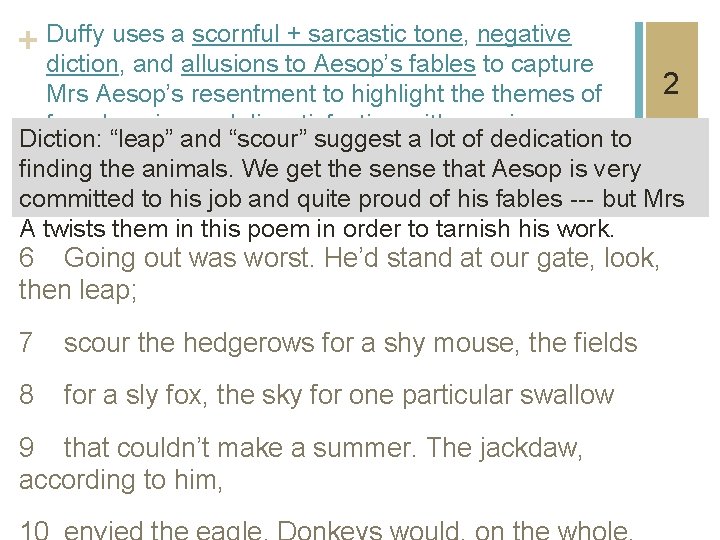
+ Duffy uses a scornful + sarcastic tone, negative diction, and allusions to Aesop’s fables to capture 2 Mrs Aesop’s resentment to highlight themes of female voice and dissatisfaction with marriage. Diction: “leap” and “scour” suggest a lot of dedication to finding the animals. We get the sense that Aesop is very committed to his job and quite proud of his fables --- but Mrs A twists them in this poem in order to tarnish his work. 6 Going out was worst. He’d stand at our gate, look, then leap; 7 scour the hedgerows for a shy mouse, the fields 8 for a sly fox, the sky for one particular swallow 9 that couldn’t make a summer. The jackdaw, according to him,
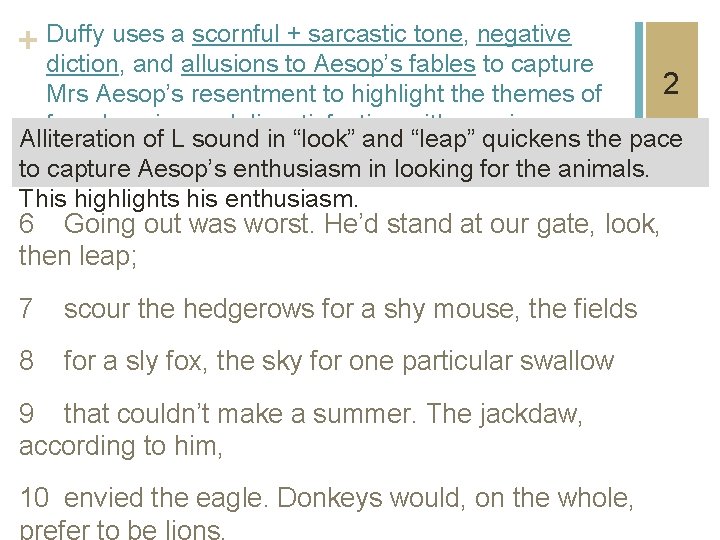
+ Duffy uses a scornful + sarcastic tone, negative diction, and allusions to Aesop’s fables to capture 2 Mrs Aesop’s resentment to highlight themes of female voice and dissatisfaction with marriage. Alliteration of L sound in “look” and “leap” quickens the pace to capture Aesop’s enthusiasm in looking for the animals. This highlights his enthusiasm. 6 Going out was worst. He’d stand at our gate, look, then leap; 7 scour the hedgerows for a shy mouse, the fields 8 for a sly fox, the sky for one particular swallow 9 that couldn’t make a summer. The jackdaw, according to him, 10 envied the eagle. Donkeys would, on the whole, prefer to be lions.
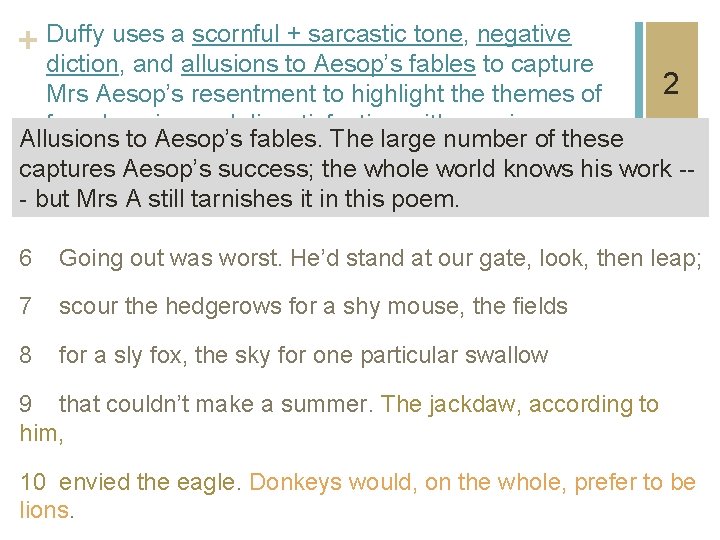
+ Duffy uses a scornful + sarcastic tone, negative diction, and allusions to Aesop’s fables to capture 2 Mrs Aesop’s resentment to highlight themes of female voice and dissatisfaction with marriage. Allusions to Aesop’s fables. The large number of these captures Aesop’s success; the whole world knows his work -- but Mrs A still tarnishes it in this poem. 6 Going out was worst. He’d stand at our gate, look, then leap; 7 scour the hedgerows for a shy mouse, the fields 8 for a sly fox, the sky for one particular swallow 9 that couldn’t make a summer. The jackdaw, according to him, 10 envied the eagle. Donkeys would, on the whole, prefer to be lions.
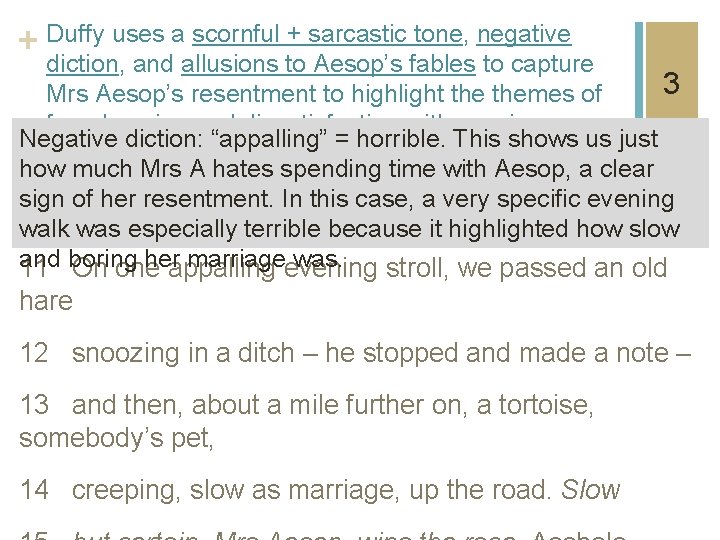
+ Duffy uses a scornful + sarcastic tone, negative diction, and allusions to Aesop’s fables to capture 3 Mrs Aesop’s resentment to highlight themes of female voice and dissatisfaction with marriage. Negative diction: “appalling” = horrible. This shows us just how much Mrs A hates spending time with Aesop, a clear sign of her resentment. In this case, a very specific evening walk was especially terrible because it highlighted how slow and boring her marriageevening was. 11 On one appalling stroll, we passed an old hare 12 snoozing in a ditch – he stopped and made a note – 13 and then, about a mile further on, a tortoise, somebody’s pet, 14 creeping, slow as marriage, up the road. Slow
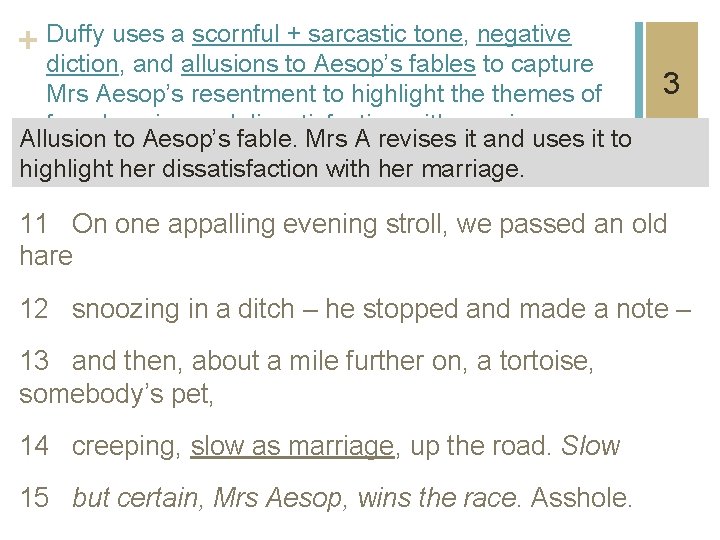
+ Duffy uses a scornful + sarcastic tone, negative diction, and allusions to Aesop’s fables to capture Mrs Aesop’s resentment to highlight themes of female voice and dissatisfaction with marriage. Allusion to Aesop’s fable. Mrs A revises it and uses it to highlight her dissatisfaction with her marriage. 3 11 On one appalling evening stroll, we passed an old hare 12 snoozing in a ditch – he stopped and made a note – 13 and then, about a mile further on, a tortoise, somebody’s pet, 14 creeping, slow as marriage, up the road. Slow 15 but certain, Mrs Aesop, wins the race. Asshole.
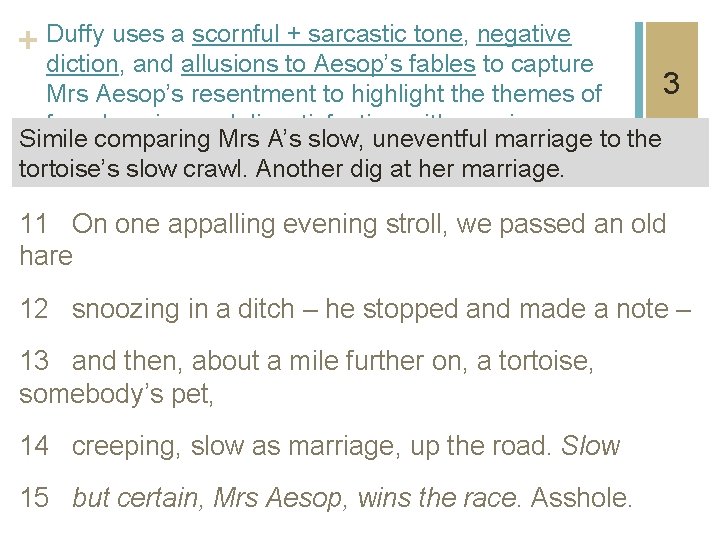
+ Duffy uses a scornful + sarcastic tone, negative diction, and allusions to Aesop’s fables to capture 3 Mrs Aesop’s resentment to highlight themes of female voice and dissatisfaction with marriage. Simile comparing Mrs A’s slow, uneventful marriage to the tortoise’s slow crawl. Another dig at her marriage. 11 On one appalling evening stroll, we passed an old hare 12 snoozing in a ditch – he stopped and made a note – 13 and then, about a mile further on, a tortoise, somebody’s pet, 14 creeping, slow as marriage, up the road. Slow 15 but certain, Mrs Aesop, wins the race. Asshole.
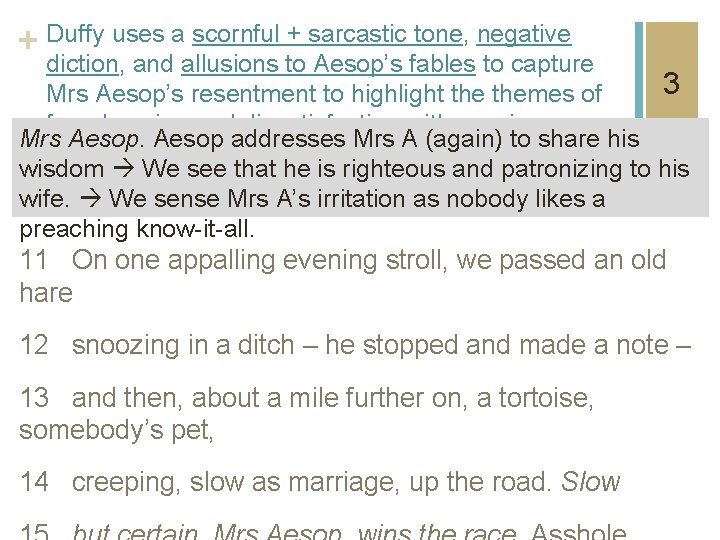
+ Duffy uses a scornful + sarcastic tone, negative diction, and allusions to Aesop’s fables to capture 3 Mrs Aesop’s resentment to highlight themes of female voice and dissatisfaction with marriage. Mrs Aesop addresses Mrs A (again) to share his wisdom We see that he is righteous and patronizing to his wife. We sense Mrs A’s irritation as nobody likes a preaching know-it-all. 11 On one appalling evening stroll, we passed an old hare 12 snoozing in a ditch – he stopped and made a note – 13 and then, about a mile further on, a tortoise, somebody’s pet, 14 creeping, slow as marriage, up the road. Slow
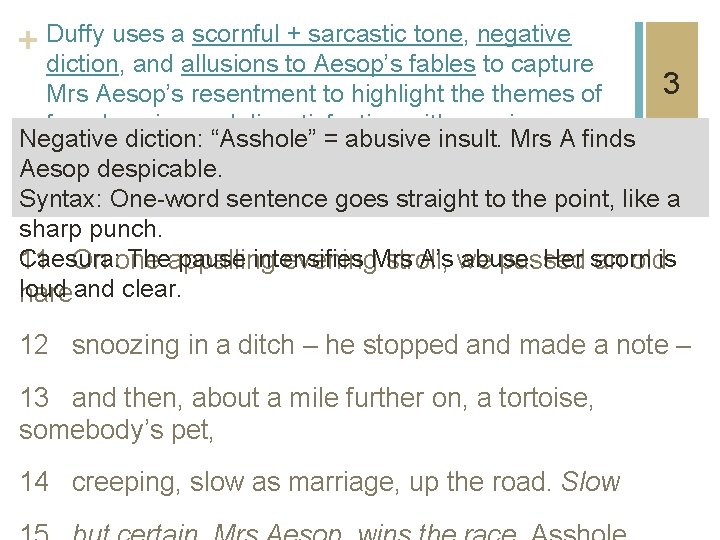
+ Duffy uses a scornful + sarcastic tone, negative diction, and allusions to Aesop’s fables to capture 3 Mrs Aesop’s resentment to highlight themes of female voice and dissatisfaction with marriage. Negative diction: “Asshole” = abusive insult. Mrs A finds Aesop despicable. Syntax: One-word sentence goes straight to the point, like a sharp punch. Caesura: Theappalling pause intensifies A’s we abuse. Her scorn 11 On one evening. Mrs stroll, passed an oldis loud and clear. hare 12 snoozing in a ditch – he stopped and made a note – 13 and then, about a mile further on, a tortoise, somebody’s pet, 14 creeping, slow as marriage, up the road. Slow
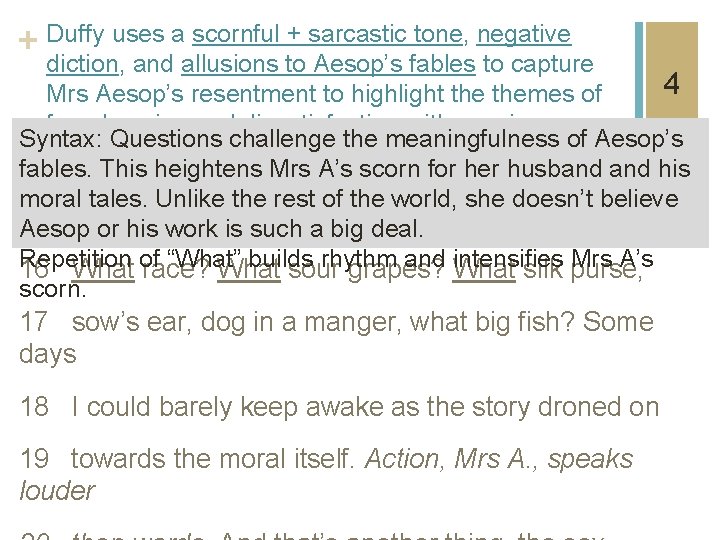
+ Duffy uses a scornful + sarcastic tone, negative diction, and allusions to Aesop’s fables to capture 4 Mrs Aesop’s resentment to highlight themes of female voice and dissatisfaction with marriage. Syntax: Questions challenge the meaningfulness of Aesop’s fables. This heightens Mrs A’s scorn for her husband his moral tales. Unlike the rest of the world, she doesn’t believe Aesop or his work is such a big deal. Repetition “What” builds rhythm and intensifies Mrs A’s 16 What of race? What sour grapes? What silk purse, scorn. 17 sow’s ear, dog in a manger, what big fish? Some days 18 I could barely keep awake as the story droned on 19 towards the moral itself. Action, Mrs A. , speaks louder
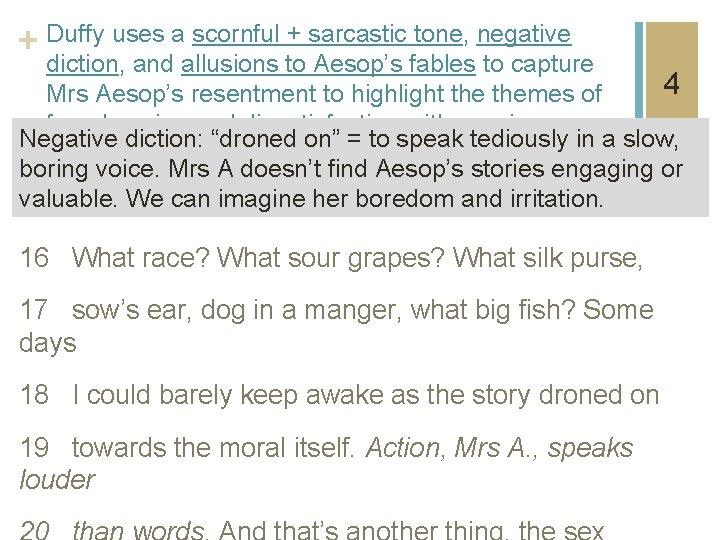
+ Duffy uses a scornful + sarcastic tone, negative diction, and allusions to Aesop’s fables to capture 4 Mrs Aesop’s resentment to highlight themes of female voice and dissatisfaction with marriage. Negative diction: “droned on” = to speak tediously in a slow, boring voice. Mrs A doesn’t find Aesop’s stories engaging or valuable. We can imagine her boredom and irritation. 16 What race? What sour grapes? What silk purse, 17 sow’s ear, dog in a manger, what big fish? Some days 18 I could barely keep awake as the story droned on 19 towards the moral itself. Action, Mrs A. , speaks louder
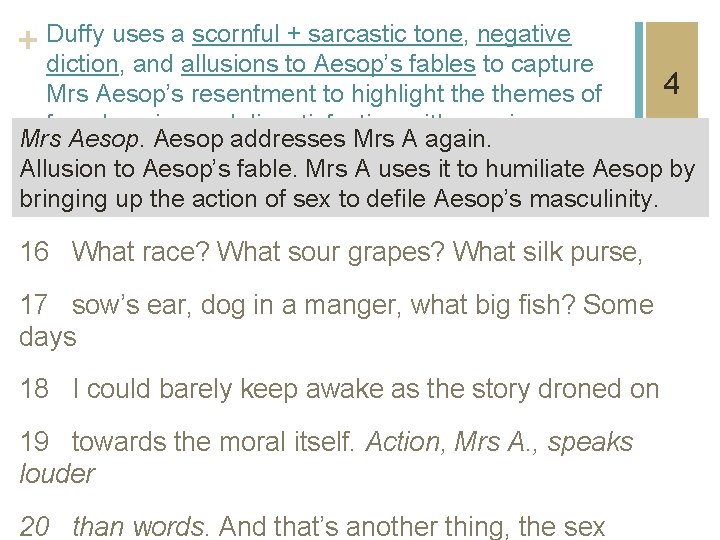
+ Duffy uses a scornful + sarcastic tone, negative diction, and allusions to Aesop’s fables to capture 4 Mrs Aesop’s resentment to highlight themes of female voice and dissatisfaction with marriage. Mrs Aesop addresses Mrs A again. Allusion to Aesop’s fable. Mrs A uses it to humiliate Aesop by bringing up the action of sex to defile Aesop’s masculinity. 16 What race? What sour grapes? What silk purse, 17 sow’s ear, dog in a manger, what big fish? Some days 18 I could barely keep awake as the story droned on 19 towards the moral itself. Action, Mrs A. , speaks louder 20 than words. And that’s another thing, the sex
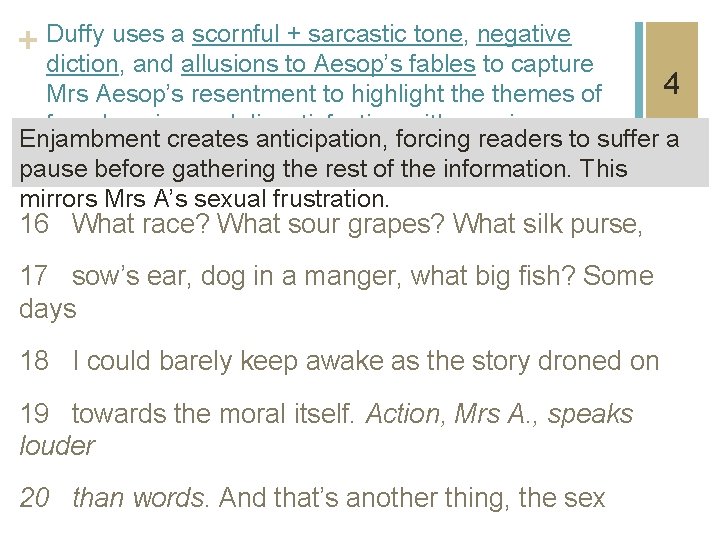
+ Duffy uses a scornful + sarcastic tone, negative diction, and allusions to Aesop’s fables to capture 4 Mrs Aesop’s resentment to highlight themes of female voice and dissatisfaction with marriage. Enjambment creates anticipation, forcing readers to suffer a pause before gathering the rest of the information. This mirrors Mrs A’s sexual frustration. 16 What race? What sour grapes? What silk purse, 17 sow’s ear, dog in a manger, what big fish? Some days 18 I could barely keep awake as the story droned on 19 towards the moral itself. Action, Mrs A. , speaks louder 20 than words. And that’s another thing, the sex
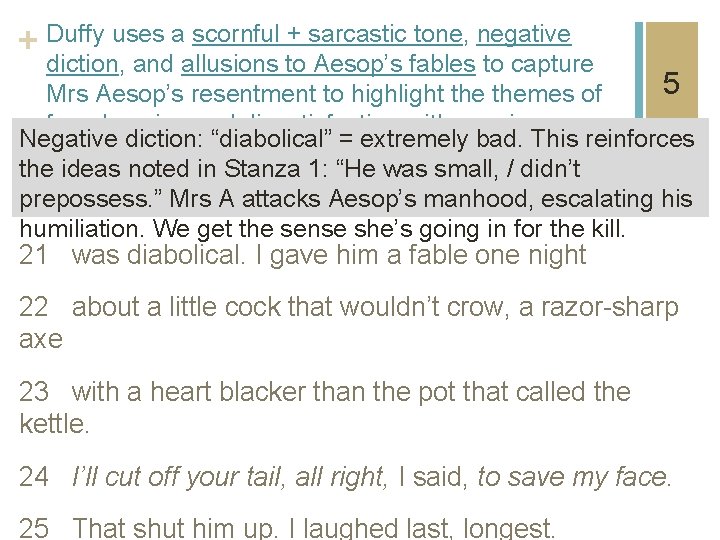
+ Duffy uses a scornful + sarcastic tone, negative diction, and allusions to Aesop’s fables to capture 5 Mrs Aesop’s resentment to highlight themes of female voice and dissatisfaction with marriage. Negative diction: “diabolical” = extremely bad. This reinforces the ideas noted in Stanza 1: “He was small, / didn’t prepossess. ” Mrs A attacks Aesop’s manhood, escalating his humiliation. We get the sense she’s going in for the kill. 21 was diabolical. I gave him a fable one night 22 about a little cock that wouldn’t crow, a razor-sharp axe 23 with a heart blacker than the pot that called the kettle. 24 I’ll cut off your tail, all right, I said, to save my face. 25 That shut him up. I laughed last, longest.
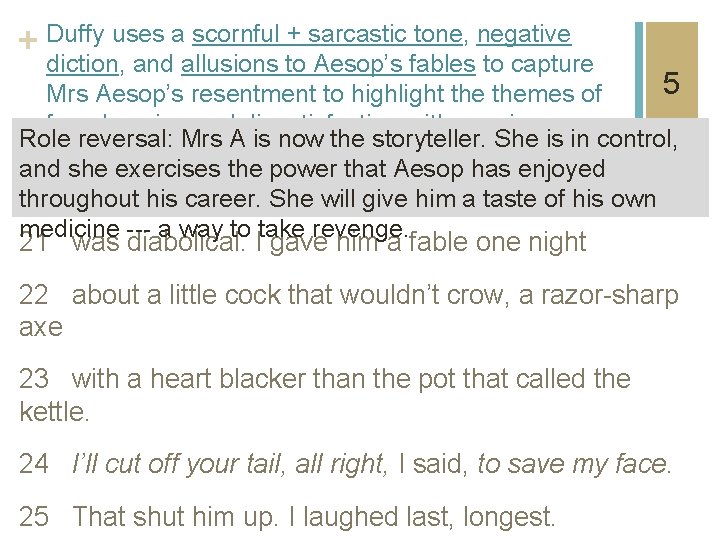
+ Duffy uses a scornful + sarcastic tone, negative diction, and allusions to Aesop’s fables to capture 5 Mrs Aesop’s resentment to highlight themes of female voice and dissatisfaction with marriage. Role reversal: Mrs A is now the storyteller. She is in control, and she exercises the power that Aesop has enjoyed throughout his career. She will give him a taste of his own medicine --- a way to take revenge. 21 was diabolical. I gave him a fable one night 22 about a little cock that wouldn’t crow, a razor-sharp axe 23 with a heart blacker than the pot that called the kettle. 24 I’ll cut off your tail, all right, I said, to save my face. 25 That shut him up. I laughed last, longest.
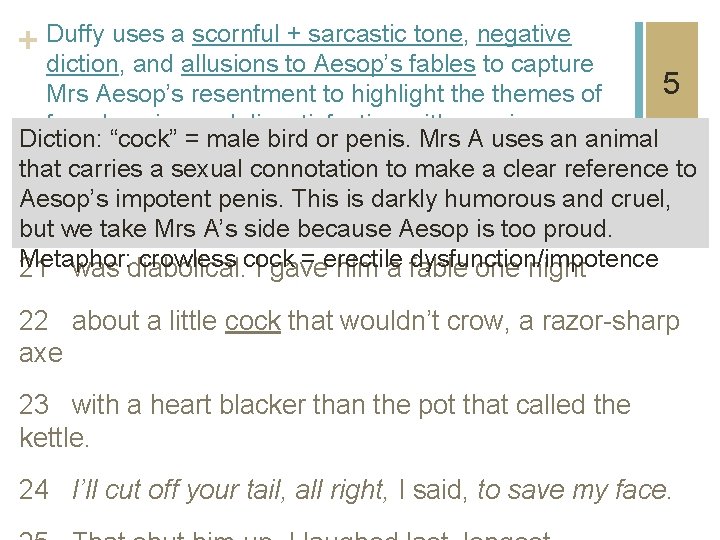
+ Duffy uses a scornful + sarcastic tone, negative diction, and allusions to Aesop’s fables to capture 5 Mrs Aesop’s resentment to highlight themes of female voice and dissatisfaction with marriage. Diction: “cock” = male bird or penis. Mrs A uses an animal that carries a sexual connotation to make a clear reference to Aesop’s impotent penis. This is darkly humorous and cruel, but we take Mrs A’s side because Aesop is too proud. Metaphor: crowless cock = erectile dysfunction/impotence 21 was diabolical. I gave him a fable one night 22 about a little cock that wouldn’t crow, a razor-sharp axe 23 with a heart blacker than the pot that called the kettle. 24 I’ll cut off your tail, all right, I said, to save my face.
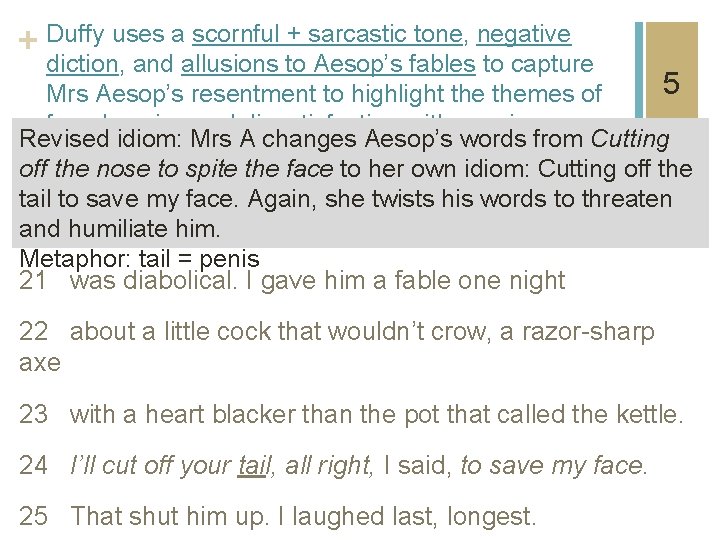
+ Duffy uses a scornful + sarcastic tone, negative diction, and allusions to Aesop’s fables to capture 5 Mrs Aesop’s resentment to highlight themes of female voice and dissatisfaction with marriage. Revised idiom: Mrs A changes Aesop’s words from Cutting off the nose to spite the face to her own idiom: Cutting off the tail to save my face. Again, she twists his words to threaten and humiliate him. Metaphor: tail = penis 21 was diabolical. I gave him a fable one night 22 about a little cock that wouldn’t crow, a razor-sharp axe 23 with a heart blacker than the pot that called the kettle. 24 I’ll cut off your tail, all right, I said, to save my face. 25 That shut him up. I laughed last, longest.
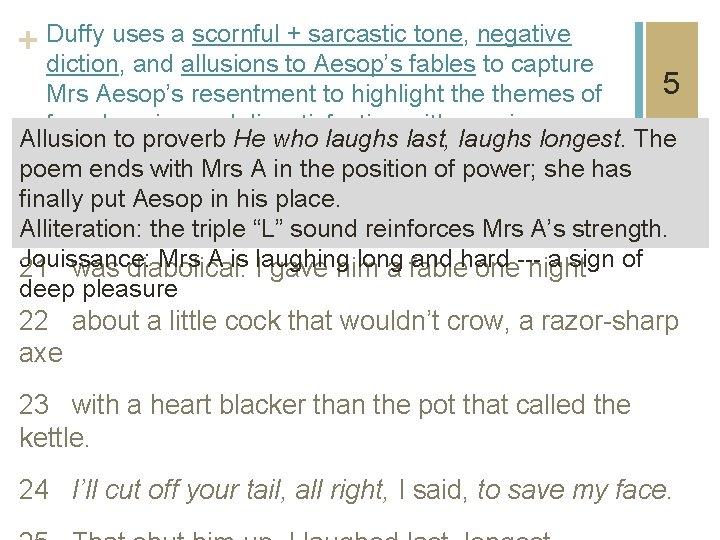
+ Duffy uses a scornful + sarcastic tone, negative diction, and allusions to Aesop’s fables to capture 5 Mrs Aesop’s resentment to highlight themes of female voice and dissatisfaction with marriage. Allusion to proverb He who laughs last, laughs longest. The poem ends with Mrs A in the position of power; she has finally put Aesop in his place. Alliteration: the triple “L” sound reinforces Mrs A’s strength. Jouissance: Mrs A is Ilaughing long and hard a sign of 21 was diabolical. gave him a fable one--night deep pleasure 22 about a little cock that wouldn’t crow, a razor-sharp axe 23 with a heart blacker than the pot that called the kettle. 24 I’ll cut off your tail, all right, I said, to save my face.
- Slides: 24