CAPITAL REVENUE Capital Receipt Receipts which are nonrecurring
- Slides: 9
CAPITAL & REVENUE
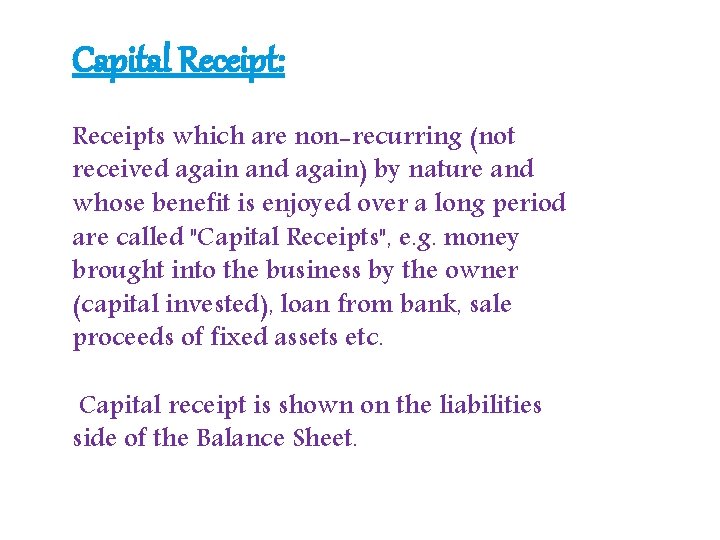
Capital Receipt: Receipts which are non-recurring (not received again and again) by nature and whose benefit is enjoyed over a long period are called "Capital Receipts", e. g. money brought into the business by the owner (capital invested), loan from bank, sale proceeds of fixed assets etc. Capital receipt is shown on the liabilities side of the Balance Sheet.
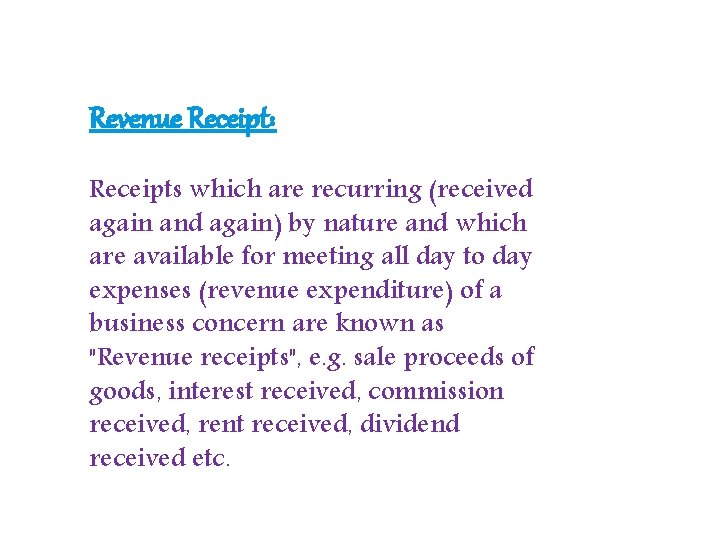
Revenue Receipt: Receipts which are recurring (received again and again) by nature and which are available for meeting all day to day expenses (revenue expenditure) of a business concern are known as "Revenue receipts", e. g. sale proceeds of goods, interest received, commission received, rent received, dividend received etc.
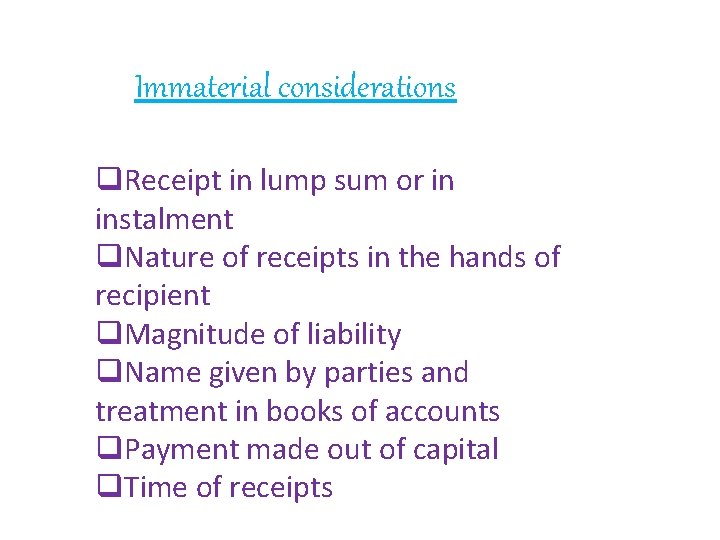
Immaterial considerations q. Receipt in lump sum or in instalment q. Nature of receipts in the hands of recipient q. Magnitude of liability q. Name given by parties and treatment in books of accounts q. Payment made out of capital q. Time of receipts
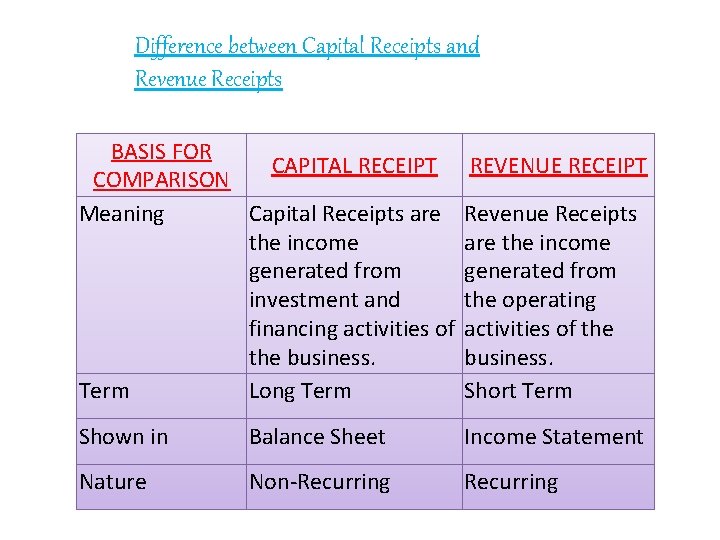
Difference between Capital Receipts and Revenue Receipts BASIS FOR CAPITAL RECEIPT COMPARISON Meaning Capital Receipts are the income generated from investment and financing activities of the business. Term Long Term Revenue Receipts are the income generated from the operating activities of the business. Short Term Shown in Balance Sheet Income Statement Nature Non-Recurring REVENUE RECEIPT
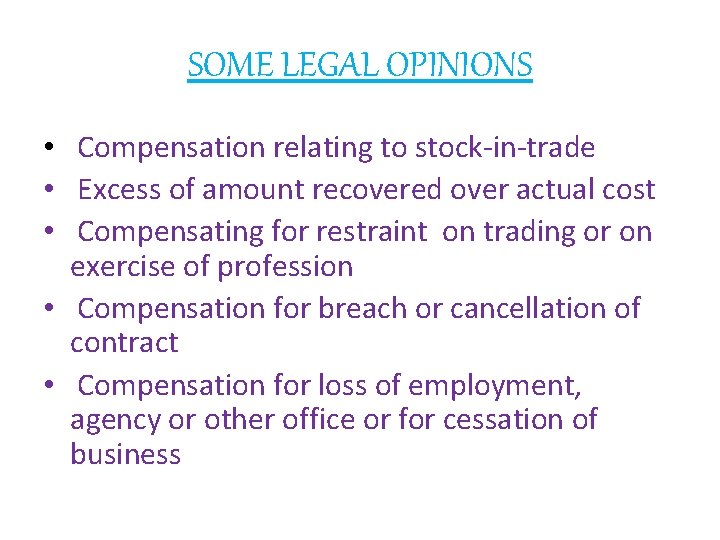
SOME LEGAL OPINIONS • Compensation relating to stock-in-trade • Excess of amount recovered over actual cost • Compensating for restraint on trading or on exercise of profession • Compensation for breach or cancellation of contract • Compensation for loss of employment, agency or other office or for cessation of business
• Compensation for requisition, acquisition, interference with business by government • Nature of subsidies or grants received from public bodies • Royalties of writers • Refund of a revenue payment
CAPITAL EXPENSES VS REVENUE EXPENSES • Timing. Capital expenditures are charged to expense gradually via depreciation, and over a long period of time. Revenue expenditures are charged to expense in the current period, or shortly thereafter. • Consumption. A capital expenditure is assumed to be consumed over the useful life of the related fixed asset. A revenue expenditure is assumed to be consumed within a very short period of time. • Size. A more questionable difference is that capital expenditures tend to involve larger monetary amounts than revenue expenditures. This is because an expenditure is only classified as a capital expenditure if it exceeds a certain threshold value; if not, it is automatically designated as a revenue expenditure. However, certain quite large expenditures can still be classified as revenue expenditures, as long they are directly associated with sale transactions or are period costs.
REVENUE LOSSES VS CAPITAL LOSSES • Capital Loss: • This is a Joss suffered by a business on the sale of a fixed asset or it is incurred on raising capital of a joint stock company. This is not a recurring loss and is not made in the ordinary course of the business. e. g. A machinery having book value of $50, 000 is sold for $45, 000, the loss of $ 5, 000 is a capital loss. In the same way, a company issued shares of $1, 000 at 10% discount, the loss of $10, 000 (10% of $1, 000) is a capital loss. Capital loss is sown in the Balance Sheet on the asset side as a fictitious asset which is gradually written off out of the profits every year. • Revenue Loss: • This loss is made in the ordinary course or day to day operation of a business such as loss on sale of goods etc. Revenue loss appears in the profit and loss account or income statement in the year in which it occurs.