Australian Teacher Guide Yearly Overviews Maths Sheds Mastery
- Slides: 19
Australian Teacher Guide & Yearly Overviews
Maths Shed’s Mastery Scheme and How to Use It Key features • Fully-resourced • Complete curriculum coverage • Practical tasks • Worksheets or worksheet-free teaching options • Whole-class with inbuilt differentiation and extension ideas • Prepared tasks for whole class instruction and practice • Concrete-pictorial-abstract approach applying micro-differentiation
Maths Shed’s Mastery Scheme and How to Use It Introduction Our click-and-play teaching slides have been designed to facilitate a discursive, wholeclass, teacher-led approach to the teaching and learning of mathematics. We have drawn inspiration from a number of places: Shanghai, Singapore, the USA’s NCTM, the UK’s NCETM, as well as a popular scheme in the UK, White Rose Maths. Each lesson is intended to be accessible for a mixed-ability class, with differentiation possible through adult or peer support (mixed-ability pairings or groupings) and particularly through the use of mathematical equipment (from Base 10 pieces, to Cuisenaire rods, to place value counters) and scaffolds, such as place value charts or times tables grids.
Maths Shed’s Mastery Scheme and How to Use It Worksheets or Worksheet-Free? We also hope the way the lesson presentations have been designed to allow teachers the choice of printing our materials or allowing children to work together from an interactive whiteboard. It offers the children an opportunity to grow in independence by taking ownership of the presentation of work in their books, responding to or representing tasks that require finemotor skill practice, as well as being more environmentally-friendly!
Maths Shed’s Mastery Scheme and How to Use It Starter Activities Every lesson begins with a Starter activity that will either follow on from the previous lesson’s learning or begin to introduce the focus of the particular lesson the class are embarking upon. We often lead with a question that requires some reasoning and that introduces children to the mathematical equipment or pictorial representations (such as bar models or part-whole models) that will be used throughout the lesson at hand. With your class or group, it is up to you to choose whether these tasks are completed independently, collaboratively, or as a whole class discussion.
Maths Shed’s Mastery Scheme and How to Use It Mastery and the Concrete-Pictorial-Abstract Approach You will notice when using our whole-class teaching presentations that we provide examples of most possible mathematical equipment that can be used for each topic, as well as various pictorial structures, allowing for optimal conceptual variation. Ultimately, a mastery approach is intended to allow children to become fluent and fluid in identifying, choosing and applying multiple models, structures and strategies when solving calculations, applying reasoning or solving mathematical problems or investigations. By introducing and revisiting multiple forms of representation and strategies, children are given the best possible opportunity of achieving mastery in mathematics! Equally, in doing so, children are able to engage in metacognition (more mindfully too) as they are enabled to grow in awareness of the thinking about the thinking they need to do to solve calculations or problems when choosing and applying mathematical strategies.
Maths Shed’s Mastery Scheme and How to Use It Talking Time Slides for Whole Class Discussion and Instruction Following the Starter activity, generally our lessons have Talking Time slides that either lead to discussions to draw out where the children may have encountered the mathematical concept before in real-life (or where to look out for it in future!). By building in multiple Talking Time slides, you are afforded greater opportunity to gauge the children’s current capabilities or know-how, and/or model the strategy or impart the knowledge the class require to access and succeed in the first activity (and often the following activities too).
Maths Shed’s Mastery Scheme and How to Use It Progression in Fluency Tasks For the majority of lessons, Activities 1, 2 and 3 tend to focus largely on fluency within the topic or method of that particular lesson and its core learning objective. There is also generally a progression through these Activities through using mathematical equipment, to applying that experience to sketches or pictorial representations, through to applying the knowledge gained or skill taught and learned in an abstract, less-scaffolded form. (You always have the choice of allowing pupils to continue using the equipment or scaffolds enabling them to access the later activities - or extension by asking children to write their own questions or problems similar to those included in each activity. )
Maths Shed’s Mastery Scheme and How to Use It Micro-differentiation, Confidence and Increasing Attainment You may also notice that the questions and activities in our lessons build in difficulty or complexity as the lesson progresses. We are big believers in confidence being the route to mathematical success for children, so have worked hard to make our lessons micro-differentiated so children have the chance to grow in assurance and self-reliance throughout their learning journey in mathematics, both within, through and across lessons and units of learning, leading to acceleration of progress and attainment.
Maths Shed’s Mastery Scheme and How to Use It Teacher-led Instruction and Continuous Formative Assessment Our lessons have also been designed to allow for staged instruction, with Talking Time slides allowing for a Me-We-You approach. Generally, there is a teacher model question, the class working through a question or problem alongside the class teacher, then example problems for fluency practice before embarking upon each Activity either independently, collaboratively or with adult support, based on your decisions regarding differentiation for the children in your class. Similarly, each Activity (and even the Talking Time slides) are split into question and answer slides, allowing for multiple mini-plenaries throughout the lesson to enable you to provide continuous formative assessment to be able to react to and address misconceptions and confusion in the moment (as well as an opportunity for live-, self- or peer-marking to reduce teacher workload outside of class time)!
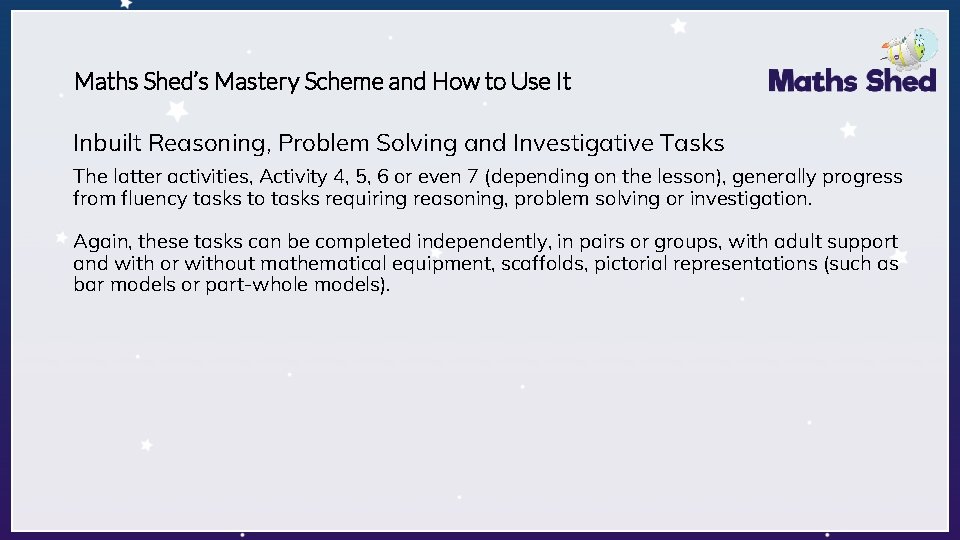
Maths Shed’s Mastery Scheme and How to Use It Inbuilt Reasoning, Problem Solving and Investigative Tasks The latter activities, Activity 4, 5, 6 or even 7 (depending on the lesson), generally progress from fluency tasks to tasks requiring reasoning, problem solving or investigation. Again, these tasks can be completed independently, in pairs or groups, with adult support and with or without mathematical equipment, scaffolds, pictorial representations (such as bar models or part-whole models).
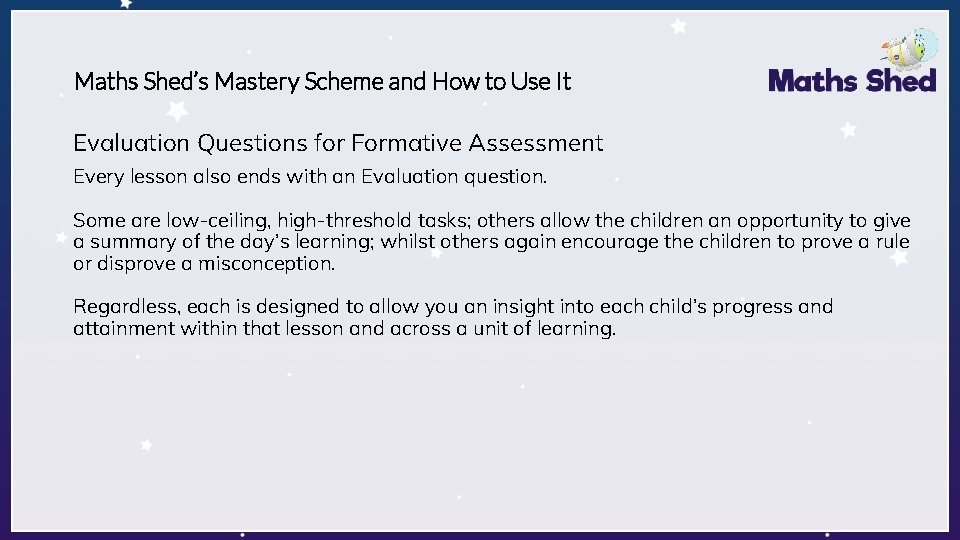
Maths Shed’s Mastery Scheme and How to Use It Evaluation Questions for Formative Assessment Every lesson also ends with an Evaluation question. Some are low-ceiling, high-threshold tasks; others allow the children an opportunity to give a summary of the day’s learning; whilst others again encourage the children to prove a rule or disprove a misconception. Regardless, each is designed to allow you an insight into each child’s progress and attainment within that lesson and across a unit of learning.
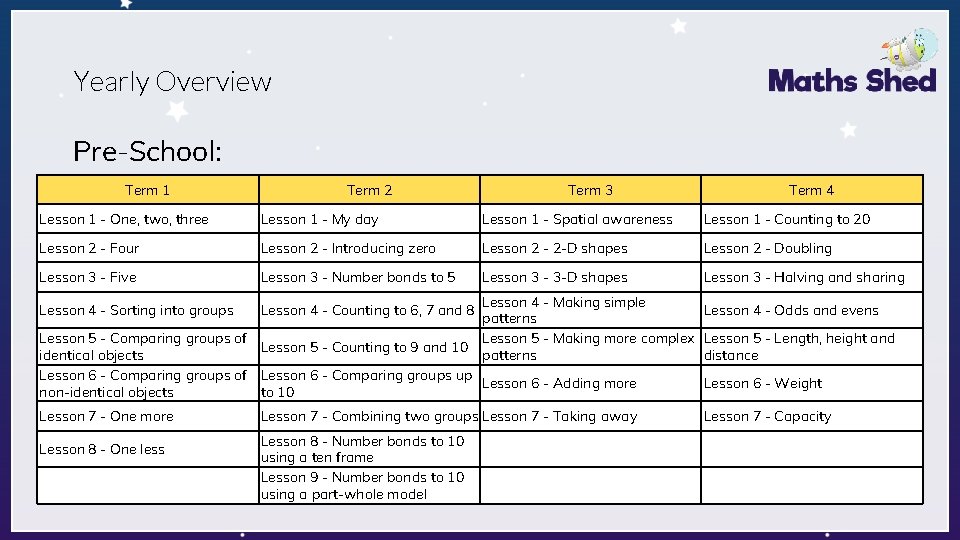
Yearly Overview Pre-School: Term 1 Term 2 Term 3 Term 4 Lesson 1 - One, two, three Lesson 1 - My day Lesson 1 - Spatial awareness Lesson 1 - Counting to 20 Lesson 2 - Four Lesson 2 - Introducing zero Lesson 2 - 2 -D shapes Lesson 2 - Doubling Lesson 3 - Five Lesson 3 - Number bonds to 5 Lesson 3 - 3 -D shapes Lesson 3 - Halving and sharing Lesson 4 - Sorting into groups Lesson 4 - Counting to 6, 7 and 8 Lesson 4 - Making simple Lesson 4 - Odds and evens patterns Lesson 5 - Making more complex Lesson 5 - Length, height and patterns distance Lesson 5 - Comparing groups of Lesson 5 - Counting to 9 and 10 identical objects Lesson 6 - Comparing groups of Lesson 6 - Comparing groups up Lesson 6 - Adding more non-identical objects to 10 Lesson 7 - One more Lesson 8 - One less Lesson 7 - Combining two groups Lesson 7 - Taking away Lesson 8 - Number bonds to 10 using a ten frame Lesson 9 - Number bonds to 10 using a part-whole model Lesson 6 - Weight Lesson 7 - Capacity
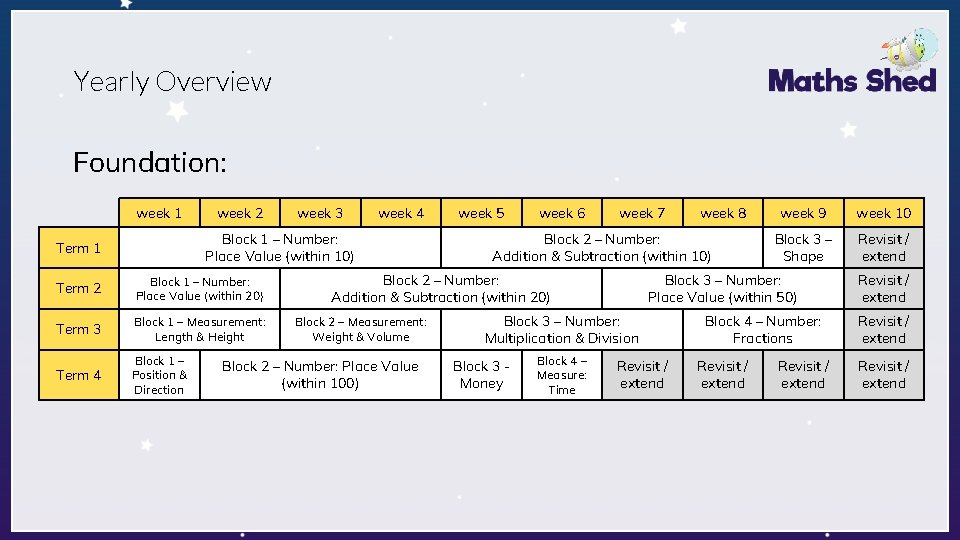
Yearly Overview Foundation: week 1 week 2 week 3 week 4 Block 1 – Number: Place Value (within 10) Term 1 Term 2 Block 1 – Number: Place Value (within 20) Term 3 Block 1 – Measurement: Length & Height Term 4 Block 1 – Position & Direction week 5 week 6 week 7 Block 2 – Number: Addition & Subtraction (within 10) Block 2 – Number: Addition & Subtraction (within 20) Block 2 – Measurement: Weight & Volume Block 2 – Number: Place Value (within 100) week 8 Block 4 – Measure: Time week 10 Block 3 – Shape Revisit / extend Block 3 – Number: Place Value (within 50) Block 3 – Number: Multiplication & Division Block 3 Money week 9 Revisit / extend Block 4 – Number: Fractions Revisit / extend Revisit / extend
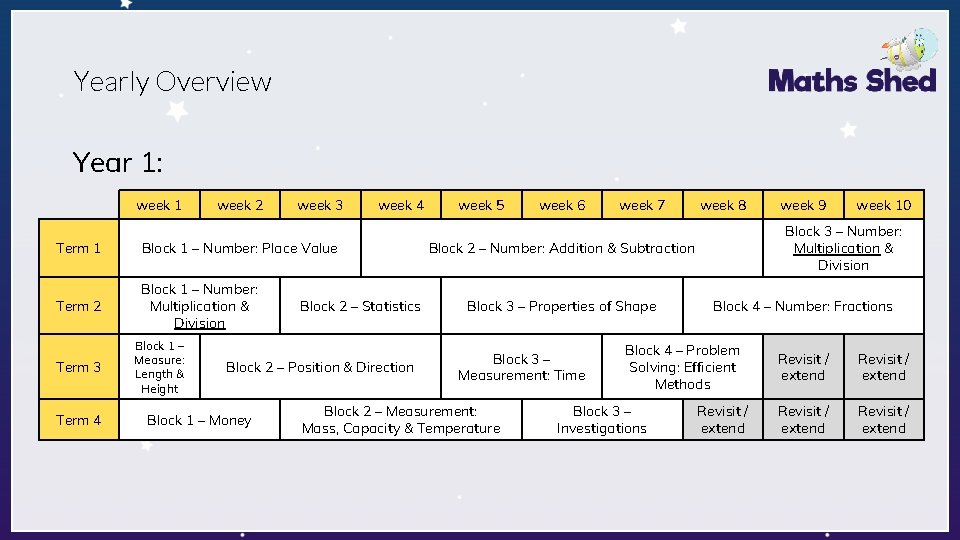
Yearly Overview Year 1: week 1 week 2 week 3 Term 1 Block 1 – Number: Place Value Term 2 Block 1 – Number: Multiplication & Division Term 3 Term 4 Block 1 – Measure: Length & Height week 4 Block 2 – Statistics Block 2 – Position & Direction Block 1 – Money week 5 week 6 week 7 week 8 Block 3 – Measurement: Time Block 2 – Measurement: Mass, Capacity & Temperature Block 4 – Number: Fractions Block 4 – Problem Solving: Efficient Methods Block 3 – Investigations week 10 Block 3 – Number: Multiplication & Division Block 2 – Number: Addition & Subtraction Block 3 – Properties of Shape week 9 Revisit / extend Revisit / extend
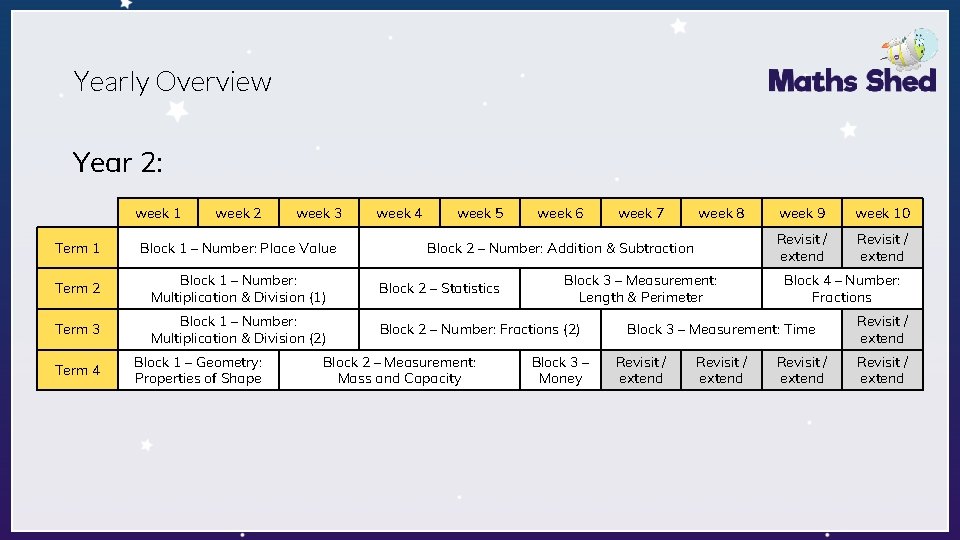
Yearly Overview Year 2: week 1 week 2 week 3 week 4 week 5 week 6 Term 1 Block 1 – Number: Place Value Term 2 Block 1 – Number: Multiplication & Division (1) Block 2 – Statistics Term 3 Block 1 – Number: Multiplication & Division (2) Block 2 – Number: Fractions (2) Term 4 Block 1 – Geometry: Properties of Shape week 7 week 8 Block 2 – Number: Addition & Subtraction Block 2 – Measurement: Mass and Capacity Block 3 – Measurement: Length & Perimeter Block 3 – Money week 9 week 10 Revisit / extend Block 4 – Number: Fractions Block 3 – Measurement: Time Revisit / extend Revisit / extend
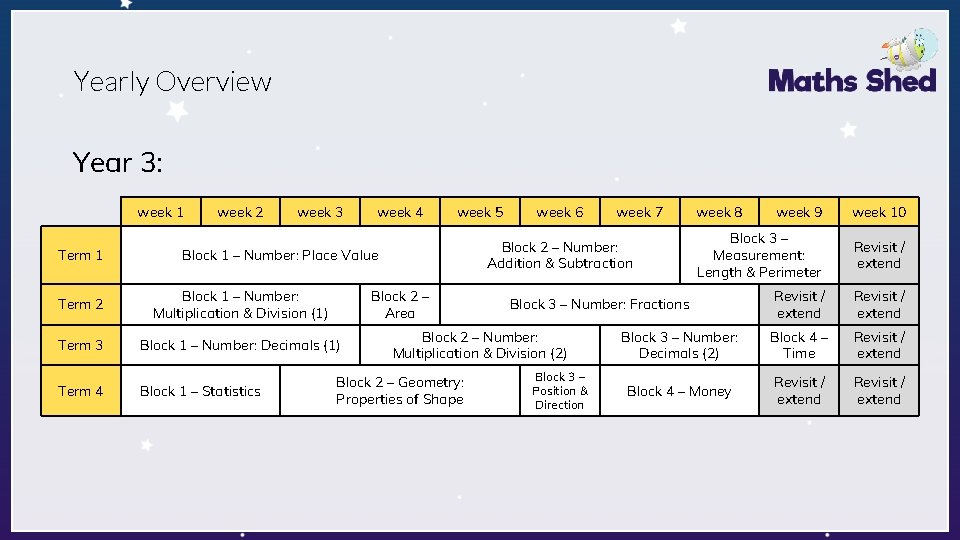
Yearly Overview Year 3: week 1 Term 1 week 2 week 3 week 4 week 5 Block 1 – Number: Multiplication & Division (1) Term 3 Block 1 – Number: Decimals (1) Term 4 Block 1 – Statistics week 7 week 9 week 10 Block 3 – Measurement: Length & Perimeter Revisit / extend Block 3 – Number: Decimals (2) Block 4 – Time Revisit / extend Block 4 – Money Revisit / extend Block 2 – Number: Addition & Subtraction Block 1 – Number: Place Value Term 2 week 6 Block 2 – Area Block 3 – Number: Fractions Block 2 – Number: Multiplication & Division (2) Block 2 – Geometry: Properties of Shape week 8 Block 3 – Position & Direction
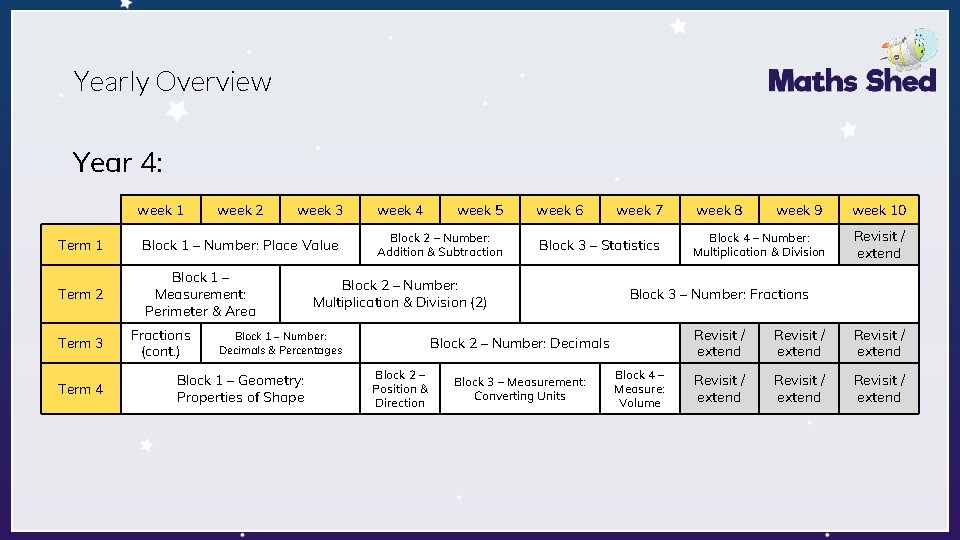
Yearly Overview Year 4: week 1 week 2 week 3 Term 1 Block 1 – Number: Place Value Term 2 Block 1 – Measurement: Perimeter & Area Term 3 Term 4 Fractions (cont. ) week 4 Block 2 – Number: Addition & Subtraction week 6 week 7 Block 3 – Statistics Block 2 – Number: Multiplication & Division (2) Block 1 – Number: Decimals & Percentages Block 1 – Geometry: Properties of Shape week 5 Block 3 – Measurement: Converting Units week 9 week 10 Block 4 – Number: Multiplication & Division Revisit / extend Block 3 – Number: Fractions Block 2 – Number: Decimals Block 2 – Position & Direction week 8 Block 4 – Measure: Volume Revisit / extend Revisit / extend
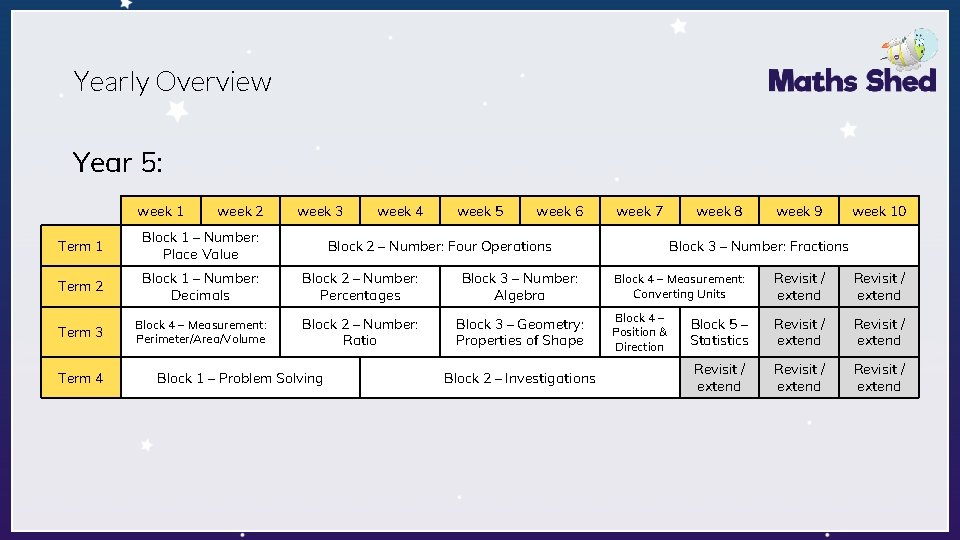
Yearly Overview Year 5: week 1 week 2 week 3 week 4 week 5 week 6 Term 1 Block 1 – Number: Place Value Term 2 Block 1 – Number: Decimals Block 2 – Number: Percentages Block 3 – Number: Algebra Term 3 Block 4 – Measurement: Perimeter/Area/Volume Block 2 – Number: Ratio Block 3 – Geometry: Properties of Shape Term 4 week 7 Block 2 – Number: Four Operations Block 1 – Problem Solving Block 2 – Investigations week 8 week 9 week 10 Block 3 – Number: Fractions Block 4 – Measurement: Converting Units Revisit / extend Block 4 – Position & Direction Block 5 – Statistics Revisit / extend Revisit / extend