
Welcome to The Farnborough Academy Maths We cant

Welcome to The Farnborough Academy Maths We can’t wait to meet you… All the Maths teachers at The Farnborough Academy are very much looking forward to meeting you, normally during transition you find out about us, we find out about you and together we do some Maths. Unfortunately due to transition being cancelled we won’t meet in person, however hopefully by completing this booklet you will be able to find out some facts about the Maths teachers at The Farnborough Academy, do some research into some of our favourite mathematicians and do some maths either on your own or with your family/carers. This is completely optional, we will not be asking to see this in year 7, it’s just a bit of fun to keep you busy. However we would love to see the booklets if you want to show us all the fantastic maths you have done.
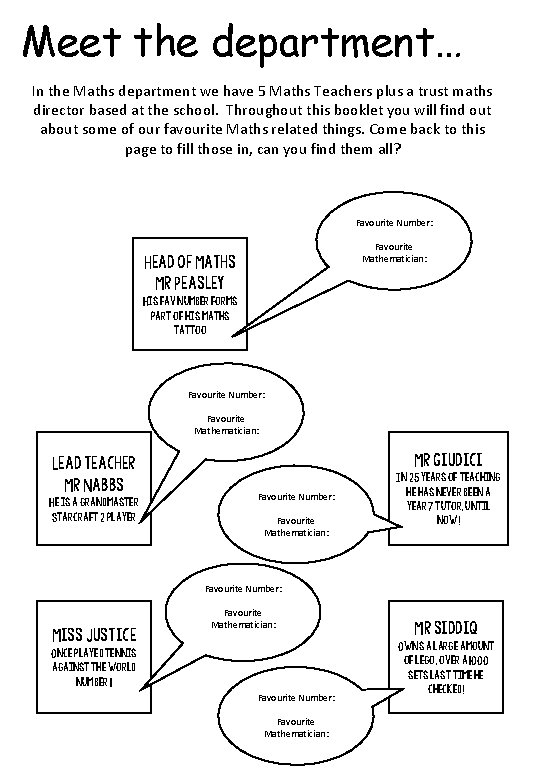
Meet the department… In the Maths department we have 5 Maths Teachers plus a trust maths director based at the school. Throughout this booklet you will find out about some of our favourite Maths related things. Come back to this page to fill those in, can you find them all? Favourite Number: Favourite Mathematician: Head of Maths Mr Peasley His fav number forms part of his maths tattoo Favourite Number: Favourite Mathematician: Lead teacher Mr Nabbs He is a grandmaster Starcraft 2 player Mr giudici Favourite Number: Favourite Mathematician: In 25 years of teaching he has never been a year 7 tutor, until now! Favourite Number: Miss Justice Favourite Mathematician: Once played tennis against the world number 1 Favourite Number: Favourite Mathematician: Mr siddiq Owns a large amount of lego, over a 1000 sets last time he checked!
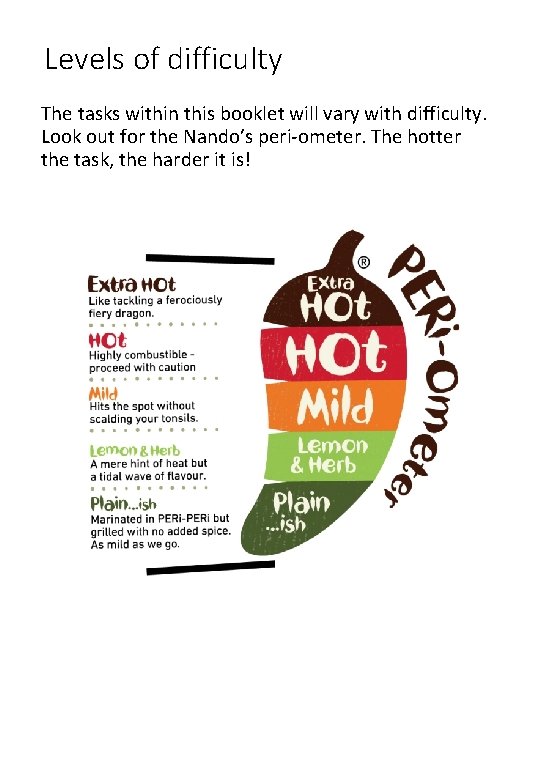
Levels of difficulty The tasks within this booklet will vary with difficulty. Look out for the Nando’s peri-ometer. The hotter the task, the harder it is!
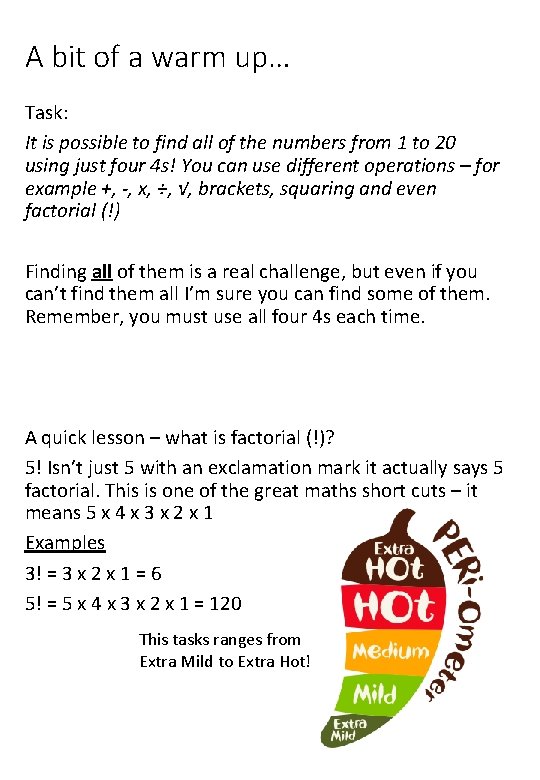
A bit of a warm up… Task: It is possible to find all of the numbers from 1 to 20 using just four 4 s! You can use different operations – for example +, -, x, ÷, √, brackets, squaring and even factorial (!) Finding all of them is a real challenge, but even if you can’t find them all I’m sure you can find some of them. Remember, you must use all four 4 s each time. A quick lesson – what is factorial (!)? 5! Isn’t just 5 with an exclamation mark it actually says 5 factorial. This is one of the great maths short cuts – it means 5 x 4 x 3 x 2 x 1 Examples 3! = 3 x 2 x 1 = 6 5! = 5 x 4 x 3 x 2 x 1 = 120 This tasks ranges from Extra Mild to Extra Hot!
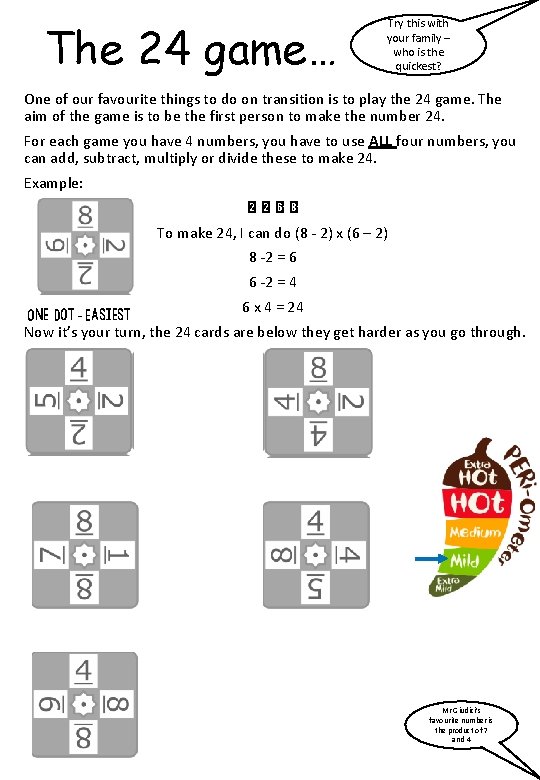
The 24 game… Try this with your family – who is the quickest? One of our favourite things to do on transition is to play the 24 game. The aim of the game is to be the first person to make the number 24. For each game you have 4 numbers, you have to use ALL four numbers, you can add, subtract, multiply or divide these to make 24. Example: 2268 To make 24, I can do (8 - 2) x (6 – 2) 8 -2 = 6 6 -2 = 4 6 x 4 = 24 One Dot - Easiest Now it’s your turn, the 24 cards are below they get harder as you go through. Mr Giudici’s favourite number is the product of 7 and 4
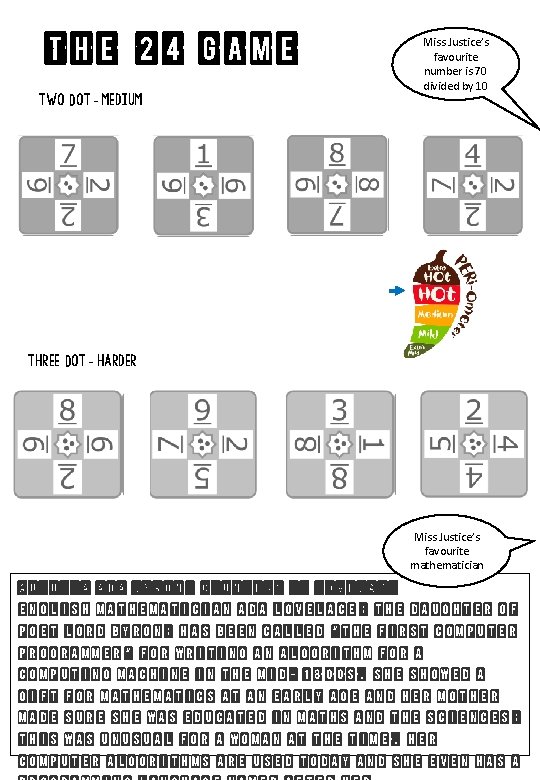
The 24 game… two Dot - medium Miss Justice’s favourite number is 70 divided by 10 three Dot - harder Miss Justice’s favourite mathematician Augusta Ada Byron, Countess of Lovelace English mathematician Ada Lovelace, the daughter of poet Lord Byron, has been called "the first computer programmer" for writing an algorithm for a computing machine in the mid-1800 s. She showed a gift for mathematics at an early age and her mother made sure she was educated in maths and the sciences; this was unusual for a woman at the time. Her computer algorithms are used today and she even has a
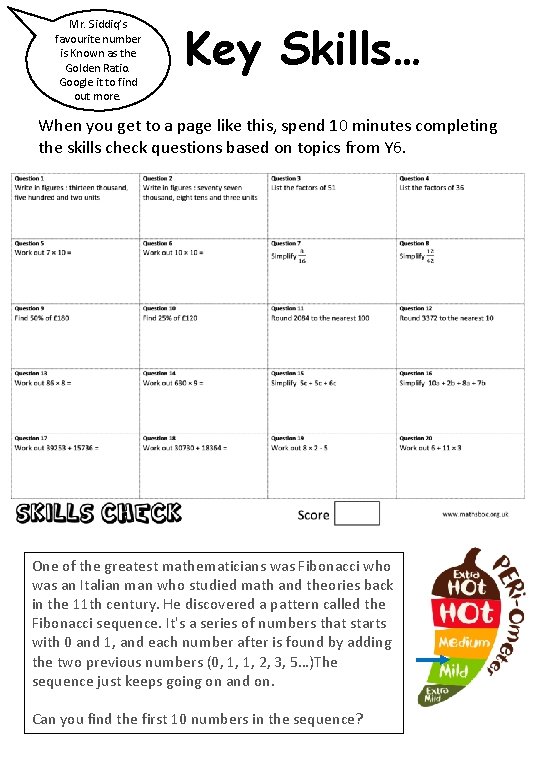
Mr. Siddiq’s favourite number is Known as the Golden Ratio. Google it to find out more. Key Skills… When you get to a page like this, spend 10 minutes completing the skills check questions based on topics from Y 6. One of the greatest mathematicians was Fibonacci who was an Italian man who studied math and theories back in the 11 th century. He discovered a pattern called the Fibonacci sequence. It's a series of numbers that starts with 0 and 1, and each number after is found by adding the two previous numbers (0, 1, 1, 2, 3, 5…)The sequence just keeps going on and on. Can you find the first 10 numbers in the sequence?
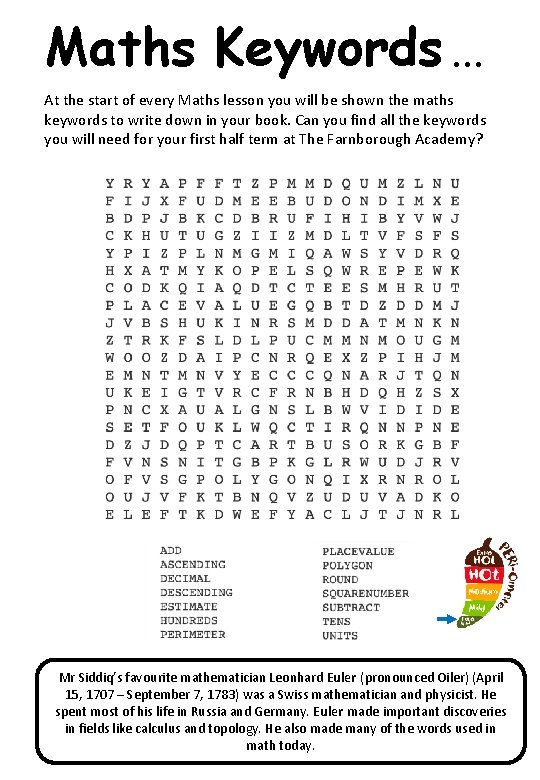
Maths Keywords … At the start of every Maths lesson you will be shown the maths keywords to write down in your book. Can you find all the keywords you will need for your first half term at The Farnborough Academy? Mr Siddiq’s favourite mathematician Leonhard Euler (pronounced Oiler) (April 15, 1707 – September 7, 1783) was a Swiss mathematician and physicist. He spent most of his life in Russia and Germany. Euler made important discoveries in fields like calculus and topology. He also made many of the words used in math today.
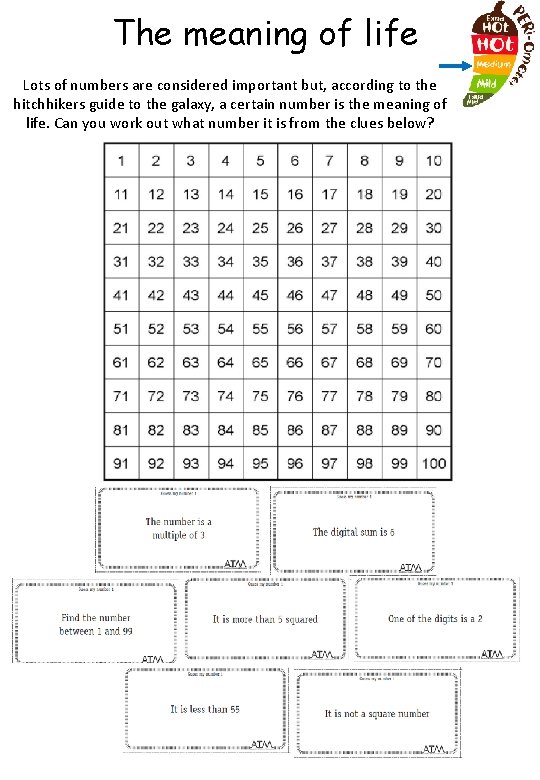
The meaning of life Lots of numbers are considered important but, according to the hitchhikers guide to the galaxy, a certain number is the meaning of life. Can you work out what number it is from the clues below?
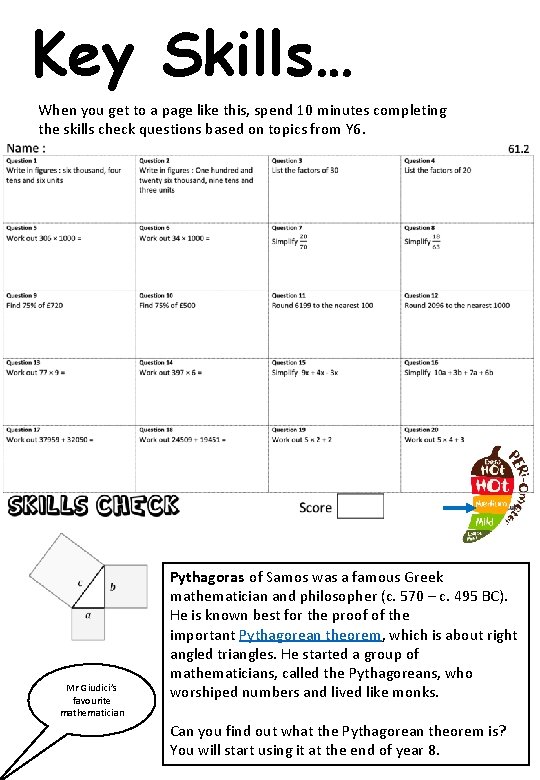
Key Skills… When you get to a page like this, spend 10 minutes completing the skills check questions based on topics from Y 6. Mr Giudici’s favourite mathematician Pythagoras of Samos was a famous Greek mathematician and philosopher (c. 570 – c. 495 BC). He is known best for the proof of the important Pythagorean theorem, which is about right angled triangles. He started a group of mathematicians, called the Pythagoreans, who worshiped numbers and lived like monks. Can you find out what the Pythagorean theorem is? You will start using it at the end of year 8.
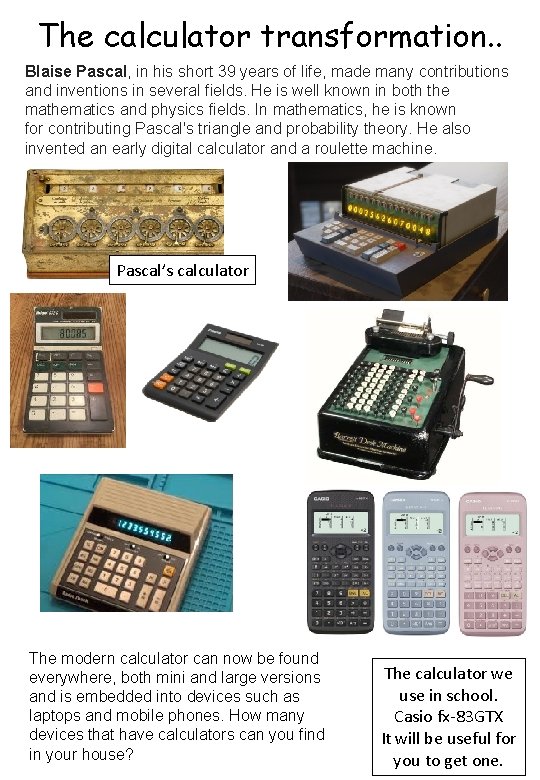
The calculator transformation. . Blaise Pascal, in his short 39 years of life, made many contributions and inventions in several fields. He is well known in both the mathematics and physics fields. In mathematics, he is known for contributing Pascal's triangle and probability theory. He also invented an early digital calculator and a roulette machine. Pascal’s calculator The modern calculator can now be found everywhere, both mini and large versions and is embedded into devices such as laptops and mobile phones. How many devices that have calculators can you find in your house? The calculator we use in school. Casio fx-83 GTX It will be useful for you to get one.
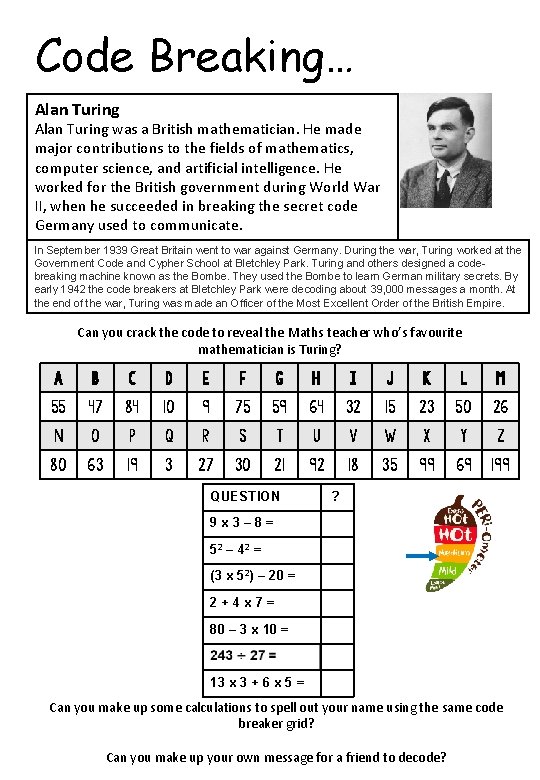
Code Breaking… Alan Turing was a British mathematician. He made major contributions to the fields of mathematics, computer science, and artificial intelligence. He worked for the British government during World War II, when he succeeded in breaking the secret code Germany used to communicate. In September 1939 Great Britain went to war against Germany. During the war, Turing worked at the Government Code and Cypher School at Bletchley Park. Turing and others designed a codebreaking machine known as the Bombe. They used the Bombe to learn German military secrets. By early 1942 the code breakers at Bletchley Park were decoding about 39, 000 messages a month. At the end of the war, Turing was made an Officer of the Most Excellent Order of the British Empire. Can you crack the code to reveal the Maths teacher who’s favourite mathematician is Turing? A B C D E F G H I J K L M 55 47 84 10 9 75 59 64 32 15 23 50 26 N O P Q R S T U V W X Y Z 80 63 19 3 27 30 21 92 18 35 99 69 199 QUESTION ? 9 x 3– 8= 52 – 4 2 = (3 x 52) – 20 = 2+4 x 7= 80 – 3 x 10 = 13 x 3 + 6 x 5 = Can you make up some calculations to spell out your name using the same code breaker grid? Can you make up your own message for a friend to decode?
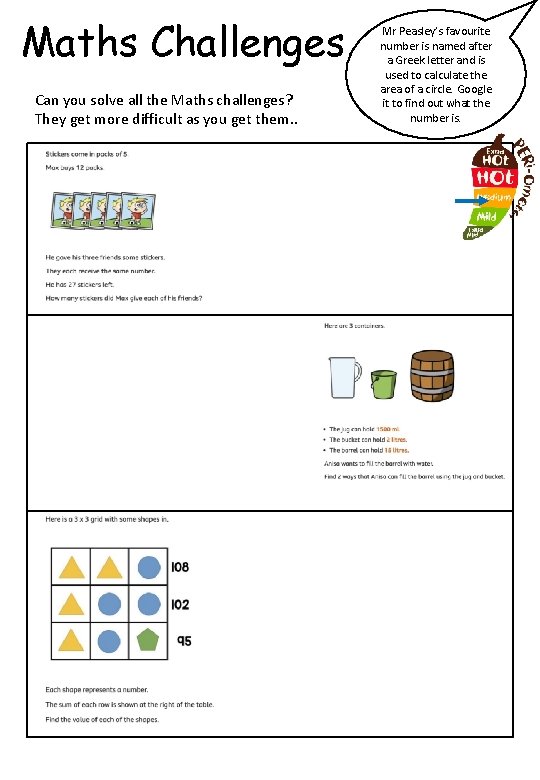
Maths Challenges… Can you solve all the Maths challenges? They get more difficult as you get them. . Mr Peasley’s favourite number is named after a Greek letter and is used to calculate the area of a circle. Google it to find out what the number is.
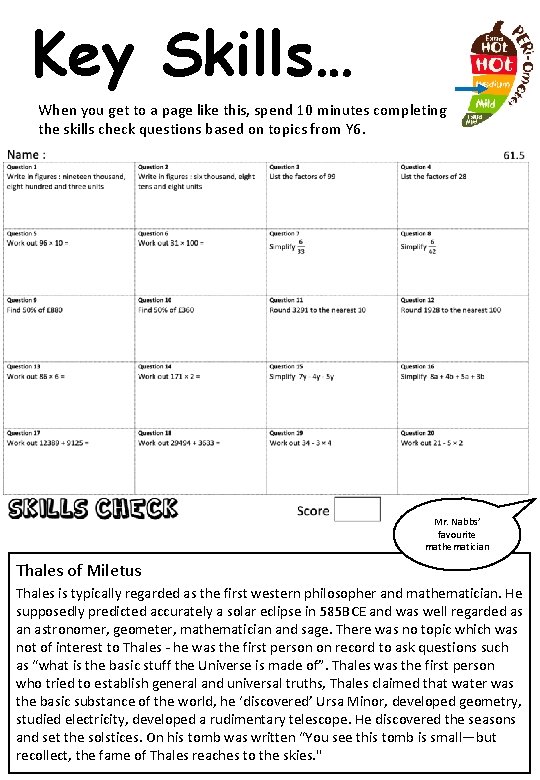
Key Skills… When you get to a page like this, spend 10 minutes completing the skills check questions based on topics from Y 6. Mr. Nabbs’ favourite mathematician Thales of Miletus Thales is typically regarded as the first western philosopher and mathematician. He supposedly predicted accurately a solar eclipse in 585 BCE and was well regarded as an astronomer, geometer, mathematician and sage. There was no topic which was not of interest to Thales - he was the first person on record to ask questions such as “what is the basic stuff the Universe is made of”. Thales was the first person who tried to establish general and universal truths, Thales claimed that water was the basic substance of the world, he ‘discovered’ Ursa Minor, developed geometry, studied electricity, developed a rudimentary telescope. He discovered the seasons and set the solstices. On his tomb was written “You see this tomb is small—but recollect, the fame of Thales reaches to the skies. "
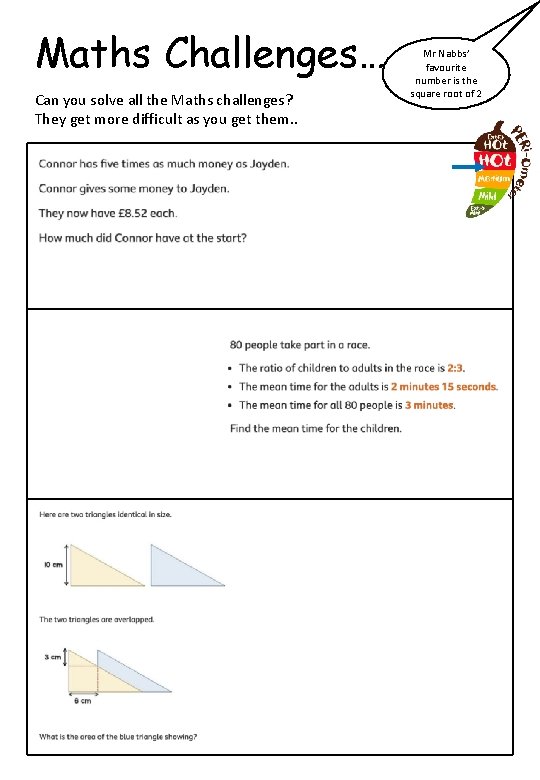
Maths Challenges… Can you solve all the Maths challenges? They get more difficult as you get them. . Mr Nabbs’ favourite number is the square root of 2
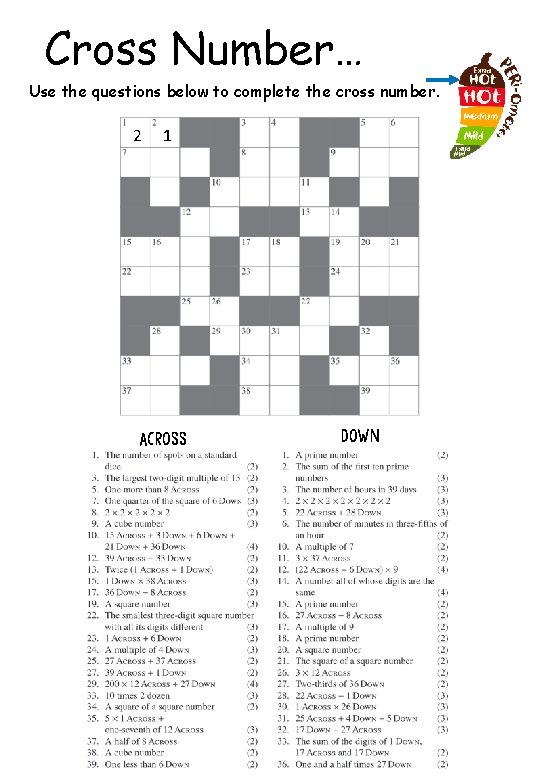
Cross Number… Use the questions below to complete the cross number. 2 1 Across down
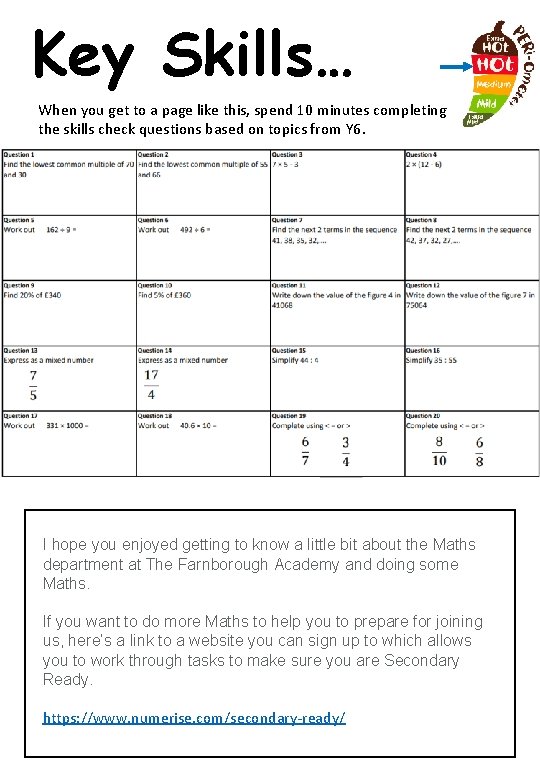
Key Skills… When you get to a page like this, spend 10 minutes completing the skills check questions based on topics from Y 6. I hope you enjoyed getting to know a little bit about the Maths department at The Farnborough Academy and doing some Maths. If you want to do more Maths to help you to prepare for joining us, here’s a link to a website you can sign up to which allows you to work through tasks to make sure you are Secondary Ready. https: //www. numerise. com/secondary-ready/
- Slides: 17