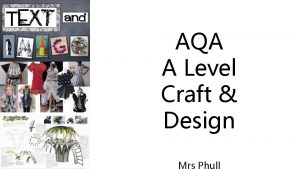
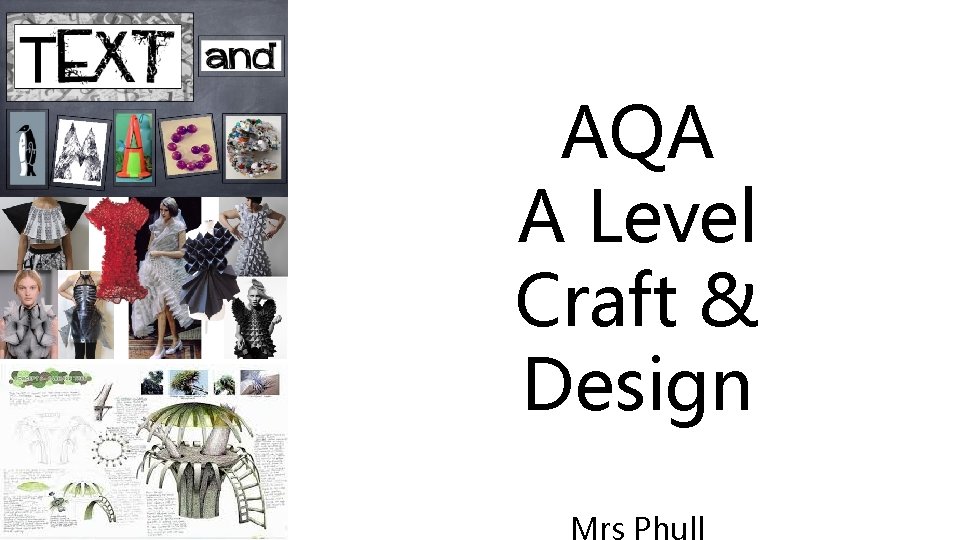
AQA A Level Craft Design Mrs Phull AQA
- Slides: 10
AQA A Level Craft & Design Mrs Phull
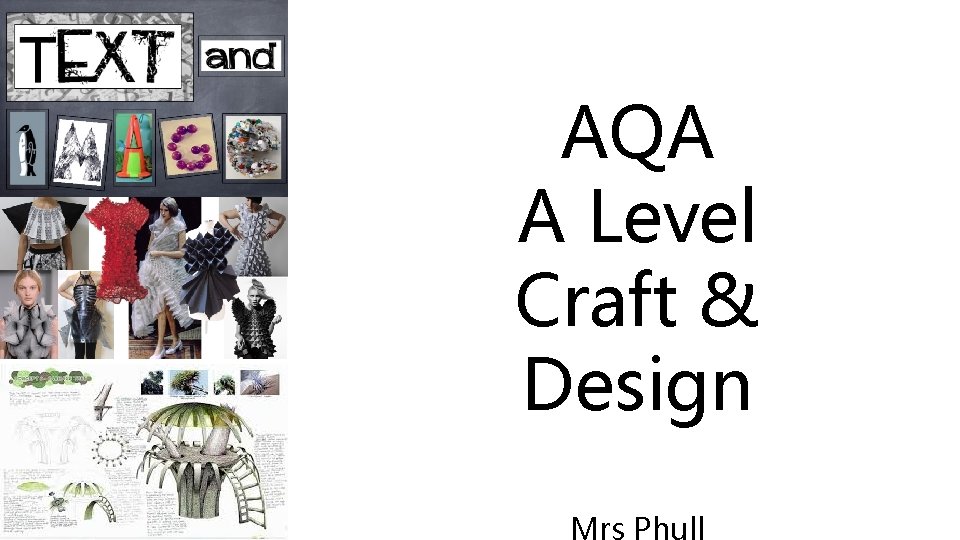
AQA A Level Craft & Design Examples of subjects you can study on this course: Graphic communication: for example communication graphics, design for print, advertising and branding, illustration, package design, typography, signage and exhibition graphics. Textile design: for example art textiles, fashion design and illustration, costume design, constructed textiles, printed and dyed textiles, surface pattern, stitched and/or embellished textiles, soft furnishings and/or textiles for interiors, and installed textiles. Three-dimensional design: for example architectural design, sculpture, ceramics, product design, jewellery and body adornment, interior design, environmental/landscape/garden design, exhibition design, three-dimensional digital design and designs for theatre, film and television.
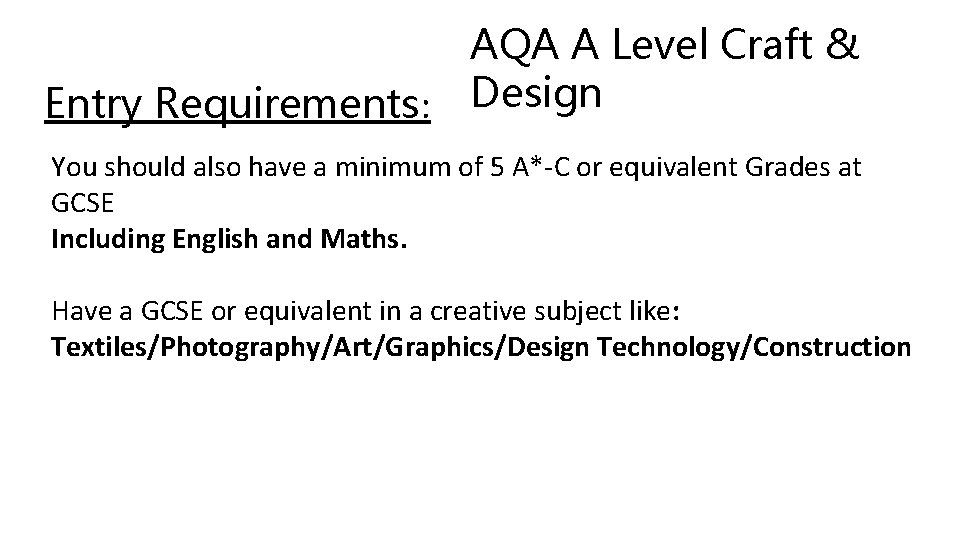
AQA A Level Craft & Entry Requirements: Design You should also have a minimum of 5 A*-C or equivalent Grades at GCSE Including English and Maths. Have a GCSE or equivalent in a creative subject like: Textiles/Photography/Art/Graphics/Design Technology/Construction
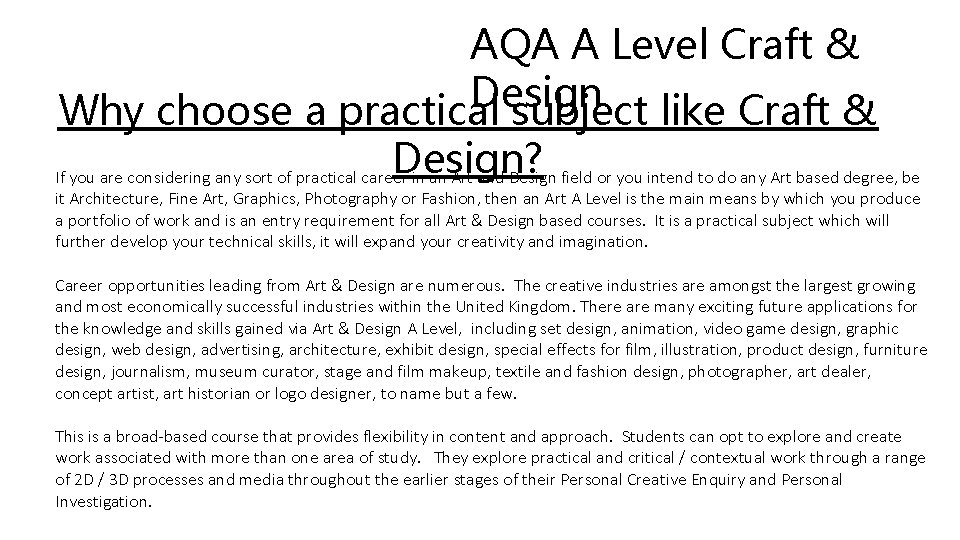
AQA A Level Craft & Design Why choose a practical subject like Craft & Design? If you are considering any sort of practical career in an Art and Design field or you intend to do any Art based degree, be it Architecture, Fine Art, Graphics, Photography or Fashion, then an Art A Level is the main means by which you produce a portfolio of work and is an entry requirement for all Art & Design based courses. It is a practical subject which will further develop your technical skills, it will expand your creativity and imagination. Career opportunities leading from Art & Design are numerous. The creative industries are amongst the largest growing and most economically successful industries within the United Kingdom. There are many exciting future applications for the knowledge and skills gained via Art & Design A Level, including set design, animation, video game design, graphic design, web design, advertising, architecture, exhibit design, special effects for film, illustration, product design, furniture design, journalism, museum curator, stage and film makeup, textile and fashion design, photographer, art dealer, concept artist, art historian or logo designer, to name but a few. This is a broad-based course that provides flexibility in content and approach. Students can opt to explore and create work associated with more than one area of study. They explore practical and critical / contextual work through a range of 2 D / 3 D processes and media throughout the earlier stages of their Personal Creative Enquiry and Personal Investigation.
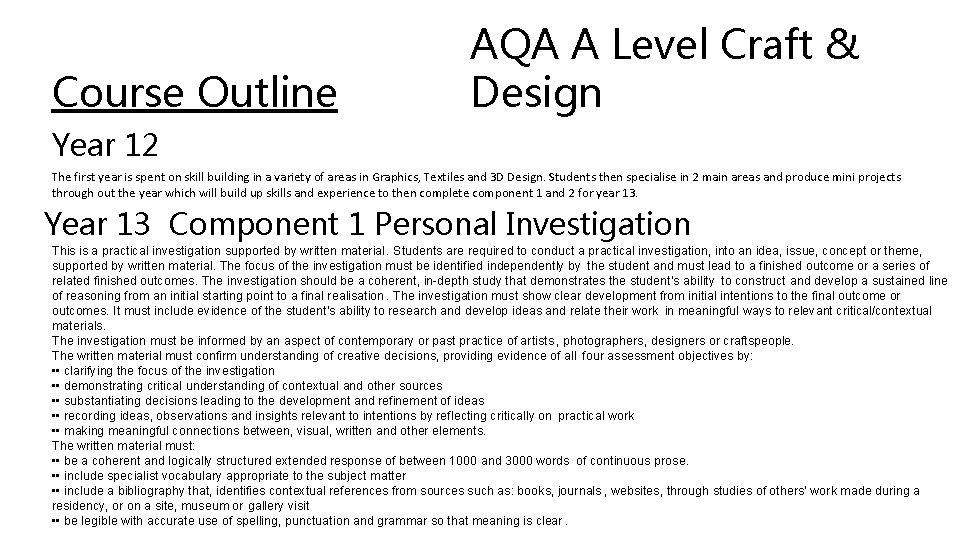
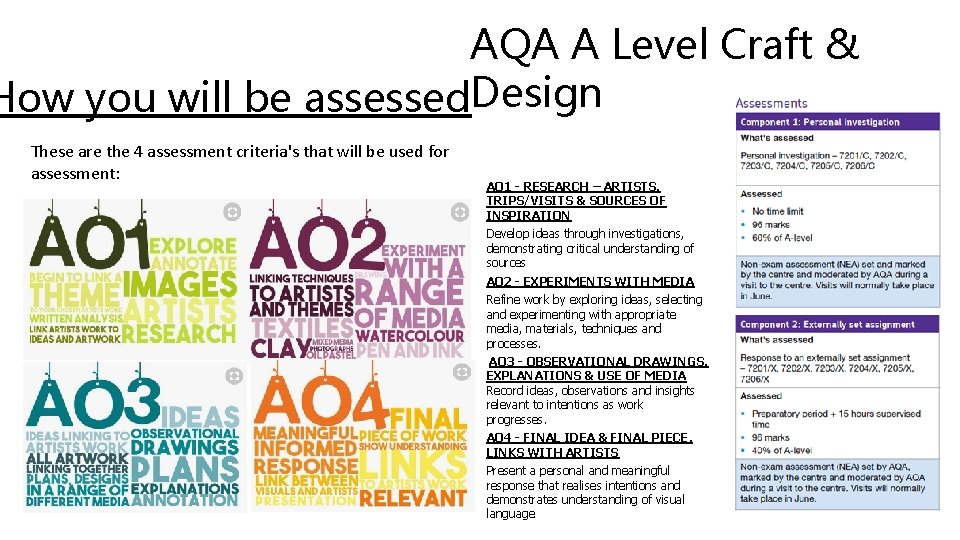
Course Outline AQA A Level Craft & Design Year 12 The first year is spent on skill building in a variety of areas in Graphics, Textiles and 3 D Design. Students then specialise in 2 main areas and produce mini projects through out the year which will build up skills and experience to then complete component 1 and 2 for year 13. Year 13 Component 1 Personal Investigation This is a practical investigation supported by written material. Students are required to conduct a practical investigation, into an idea, issue, concept or theme, supported by written material. The focus of the investigation must be identified independently by the student and must lead to a finished outcome or a series of related finished outcomes. The investigation should be a coherent, in-depth study that demonstrates the student’s ability to construct and develop a sustained line of reasoning from an initial starting point to a final realisation. The investigation must show clear development from initial intentions to the final outcome or outcomes. It must include evidence of the student’s ability to research and develop ideas and relate their work in meaningful ways to relevant critical/contextual materials. The investigation must be informed by an aspect of contemporary or past practice of artists , photographers, designers or craftspeople. The written material must confirm understanding of creative decisions, providing evidence of all four assessment objectives by: • • clarifying the focus of the investigation • • demonstrating critical understanding of contextual and other sources • • substantiating decisions leading to the development and refinement of ideas • • recording ideas, observations and insights relevant to intentions by reflecting critically on practical work • • making meaningful connections between, visual, written and other elements. The written material must: • • be a coherent and logically structured extended response of between 1000 and 3000 words of continuous prose. • • include specialist vocabulary appropriate to the subject matter • • include a bibliography that, identifies contextual references from sources such as: books, journals , websites, through studies of others’ work made during a residency, or on a site, museum or gallery visit • • be legible with accurate use of spelling, punctuation and grammar so that meaning is clear.
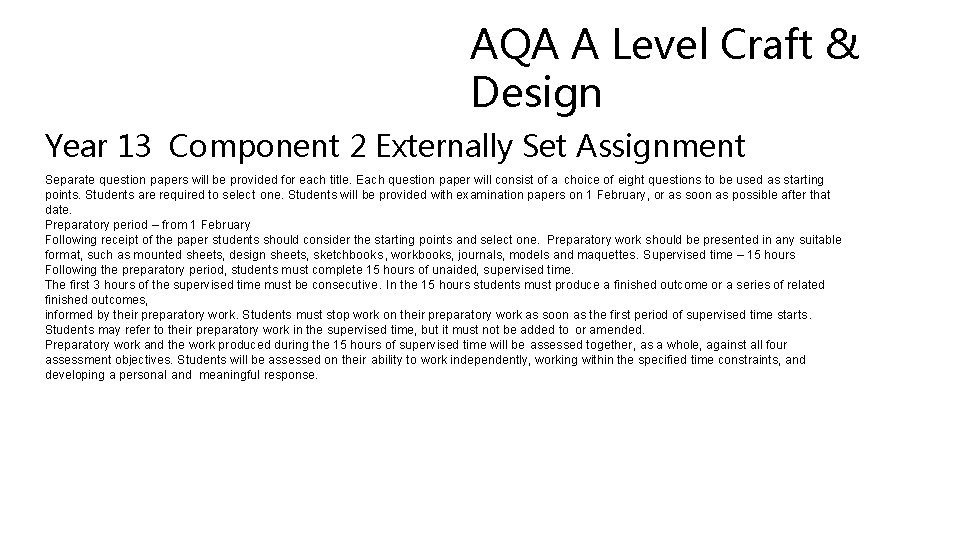
AQA A Level Craft & Design Year 13 Component 2 Externally Set Assignment Separate question papers will be provided for each title. Each question paper will consist of a choice of eight questions to be used as starting points. Students are required to select one. Students will be provided with examination papers on 1 February, or as soon as possible after that date. Preparatory period – from 1 February Following receipt of the paper students should consider the starting points and select one. Preparatory work should be presented in any suitable format, such as mounted sheets, design sheets, sketchbooks , workbooks, journals, models and maquettes. Supervised time – 15 hours Following the preparatory period, students must complete 15 hours of unaided, supervised time. The first 3 hours of the supervised time must be consecutive. In the 15 hours students must produce a finished outcome or a series of related finished outcomes, informed by their preparatory work. Students must stop work on their preparatory work as soon as the first period of supervised time starts. Students may refer to their preparatory work in the supervised time, but it must not be added to or amended. Preparatory work and the work produced during the 15 hours of supervised time will be assessed together, as a whole, against all four assessment objectives. Students will be assessed on their ability to work independently, working within the specified time constraints, and developing a personal and meaningful response.
AQA A Level Craft & How you will be assessed. Design These are the 4 assessment criteria's that will be used for assessment: AO 1 - RESEARCH – ARTISTS, TRIPS/VISITS & SOURCES OF INSPIRATION Develop ideas through investigations, demonstrating critical understanding of sources AO 2 - EXPERIMENTS WITH MEDIA Refine work by exploring ideas, selecting and experimenting with appropriate media, materials, techniques and processes. AO 3 - OBSERVATIONAL DRAWINGS, EXPLANATIONS & USE OF MEDIA Record ideas, observations and insights relevant to intentions as work progresses. AO 4 - FINAL IDEA & FINAL PIECE, LINKS WITH ARTISTS Present a personal and meaningful response that realises intentions and demonstrates understanding of visual language
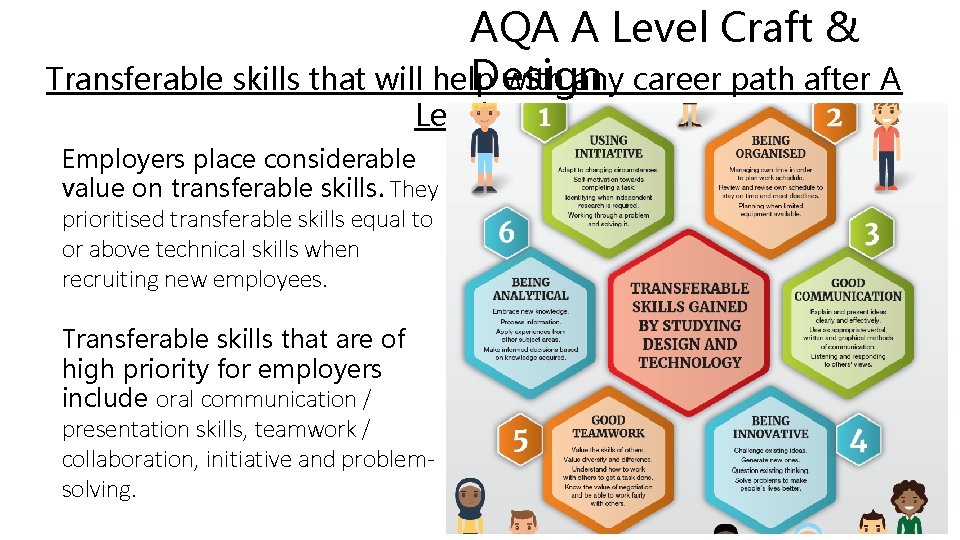
AQA A Level Craft & Design Transferable skills that will help with any career path after A Levels…. Employers place considerable value on transferable skills. They prioritised transferable skills equal to or above technical skills when recruiting new employees. Transferable skills that are of high priority for employers include oral communication / presentation skills, teamwork / collaboration, initiative and problemsolving.
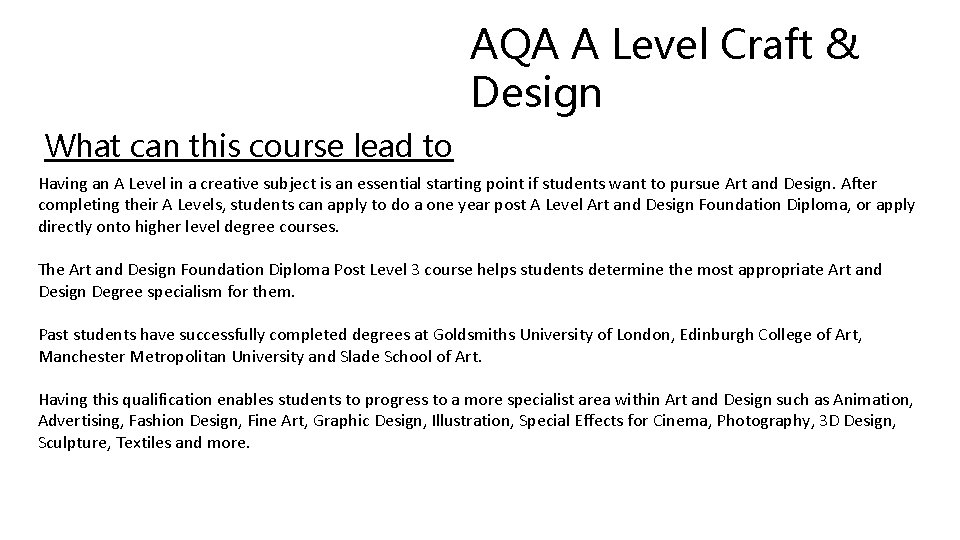
AQA A Level Craft & Design What can this course lead to Having an A Level in a creative subject is an essential starting point if students want to pursue Art and Design. After completing their A Levels, students can apply to do a one year post A Level Art and Design Foundation Diploma, or apply directly onto higher level degree courses. The Art and Design Foundation Diploma Post Level 3 course helps students determine the most appropriate Art and Design Degree specialism for them. Past students have successfully completed degrees at Goldsmiths University of London, Edinburgh College of Art, Manchester Metropolitan University and Slade School of Art. Having this qualification enables students to progress to a more specialist area within Art and Design such as Animation, Advertising, Fashion Design, Fine Art, Graphic Design, Illustration, Special Effects for Cinema, Photography, 3 D Design, Sculpture, Textiles and more.
AQA A Level Craft & Design Mrs Phull