Applying realism Nick Emmel Joanne Greenhalgh and Geoff

- Slides: 6
Applying realism Nick Emmel, Joanne Greenhalgh, and Geoff Wong
The three features of an applied realist methodology we want to talk about today Realist methods are theory incarnate Explanation depends on context Mechanisms are transferable
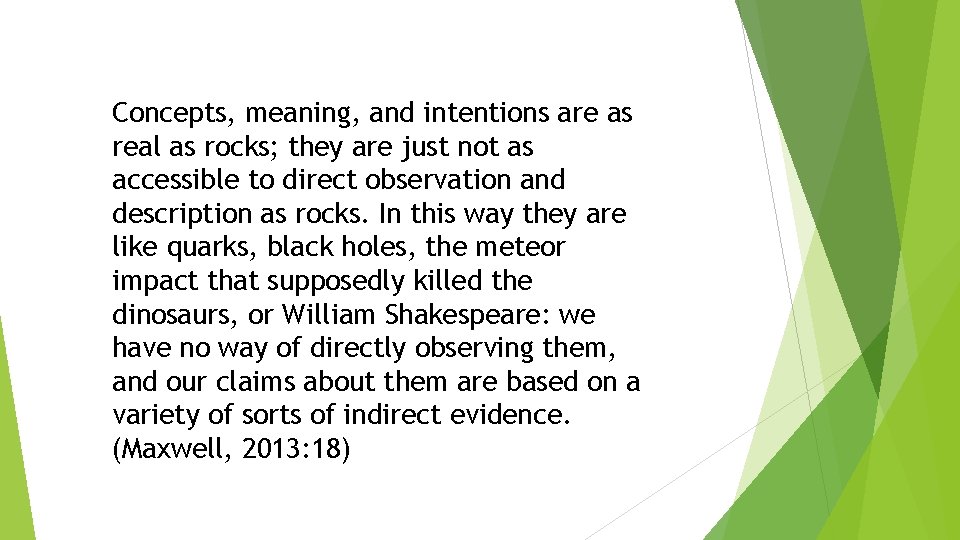
Concepts, meaning, and intentions are as real as rocks; they are just not as accessible to direct observation and description as rocks. In this way they are like quarks, black holes, the meteor impact that supposedly killed the dinosaurs, or William Shakespeare: we have no way of directly observing them, and our claims about them are based on a variety of sorts of indirect evidence. (Maxwell, 2013: 18)
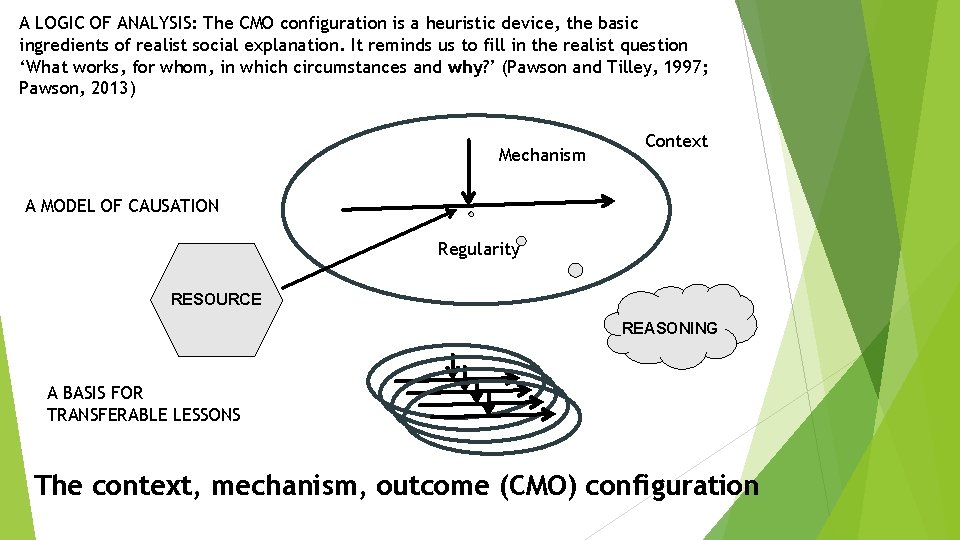
A LOGIC OF ANALYSIS: The CMO configuration is a heuristic device, the basic ingredients of realist social explanation. It reminds us to fill in the realist question ‘What works, for whom, in which circumstances and why? ’ (Pawson and Tilley, 1997; Pawson, 2013) Mechanism Context A MODEL OF CAUSATION Regularity RESOURCE REASONING A BASIS FOR TRANSFERABLE LESSONS The context, mechanism, outcome (CMO) configuration
Discovery does not go up or down, but follows a zig-zag path, prodded by counterexamples, it moves from the naïve conjecture to the premises and then turns back again to delete the naïve conjecture and replace it by theorem. Naïve conjecture and counter examples do not appear in the fully fledged [inferential] structure; the zig-zag of discovery cannot be discerned in the end-product […] our proofs do not prove’ (Lakatos, 1976: 42; 75)
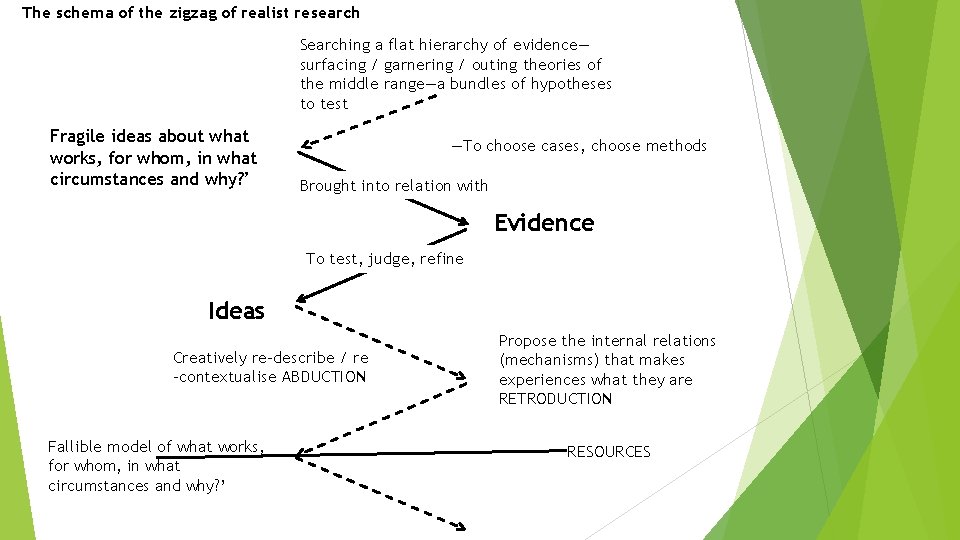
The schema of the zigzag of realist research Searching a flat hierarchy of evidence— surfacing / garnering / outing theories of the middle range—a bundles of hypotheses to test Fragile ideas about what works, for whom, in what circumstances and why? ’ —To choose cases, choose methods Brought into relation with Evidence To test, judge, refine Ideas Creatively re-describe / re -contextualise ABDUCTION Fallible model of what works, for whom, in what circumstances and why? ’ Propose the internal relations (mechanisms) that makes experiences what they are RETRODUCTION RESOURCES