Appearance vs Reality Adin Ward Joshua Rollins Sofia
- Slides: 15
Appearance vs. Reality Adin Ward Joshua Rollins Sofia Valenzuela
Thesis The hypocrisy surrounding the characters Claudius, Polonius, and Ophelia in Hamlet, coupled with the obsession that the main character, Hamlet, possesses, leads him to be constantly torn between the reality of his own character state-of-being and the utter “feigned” insanity to which he seems to fall victim to.
Hamlet: Feigned or True Madness? “Must I remember? Why, she would hang on him as if increase of appetite had grown by what if fed on; and yet within a month - Let me not think on’t! Frailty, thy name is woman! A little month, or ere those shoes were old with which she followed my poor father’s body…” - 1. 2. 145 -152 Excerpted from Hamlet’s first soliloquy within the play Foreshadowing the seemingly drastic actions Hamlet will take within the latter part of the play Conveys Hamlet’s rationale, even before the ghost of King Hamlet appears to him
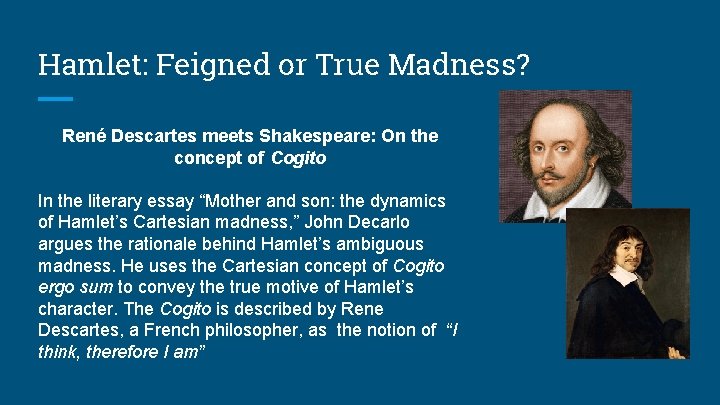
Hamlet: Feigned or True Madness? René Descartes meets Shakespeare: On the concept of Cogito In the literary essay “Mother and son: the dynamics of Hamlet’s Cartesian madness, ” John Decarlo argues the rationale behind Hamlet’s ambiguous madness. He uses the Cartesian concept of Cogito ergo sum to convey the true motive of Hamlet’s character. The Cogito is described by Rene Descartes, a French philosopher, as the notion of “I think, therefore I am”
Hamlet: Feigned or True Madness? HAMLET: Come, come, and sit you down, you shall not budge. You go not till I set you up a glass where you may see the inmost part of you. QUEEN: What wilt thou do? Thou wilt not murder me? Help, ho! 3. 4. 20 -24 HAMLET: Such an act that blurs the grace and blush of modesty, calls virtue hypocrite, takes off the rose from the fair forehead of an innocent love and sets blister there, makes marriage vows as false as dicers’ oaths. 3. 4. 46 -51
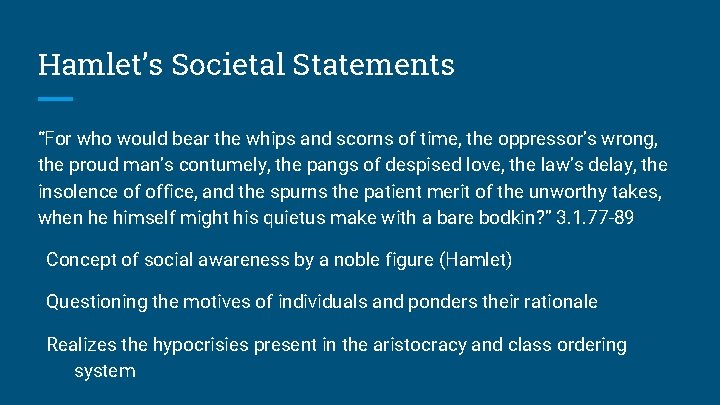
Hamlet’s Societal Statements “For who would bear the whips and scorns of time, the oppressor’s wrong, the proud man’s contumely, the pangs of despised love, the law’s delay, the insolence of office, and the spurns the patient merit of the unworthy takes, when he himself might his quietus make with a bare bodkin? ” 3. 1. 77 -89 Concept of social awareness by a noble figure (Hamlet) Questioning the motives of individuals and ponders their rationale Realizes the hypocrisies present in the aristocracy and class ordering system
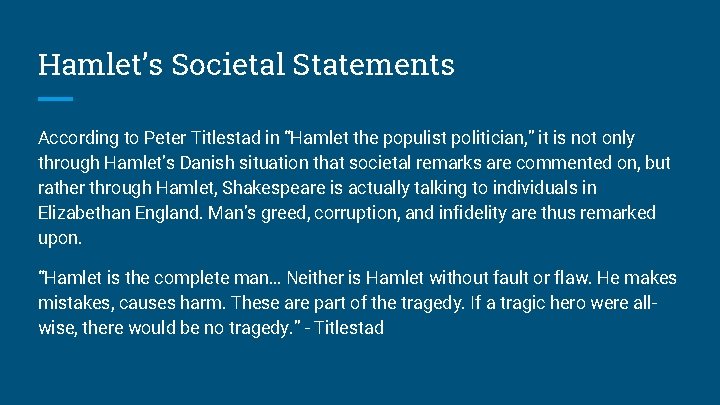
Hamlet’s Societal Statements According to Peter Titlestad in “Hamlet the populist politician, ” it is not only through Hamlet’s Danish situation that societal remarks are commented on, but rather through Hamlet, Shakespeare is actually talking to individuals in Elizabethan England. Man’s greed, corruption, and infidelity are thus remarked upon. “Hamlet is the complete man… Neither is Hamlet without fault or flaw. He makes mistakes, causes harm. These are part of the tragedy. If a tragic hero were allwise, there would be no tragedy. ” - Titlestad
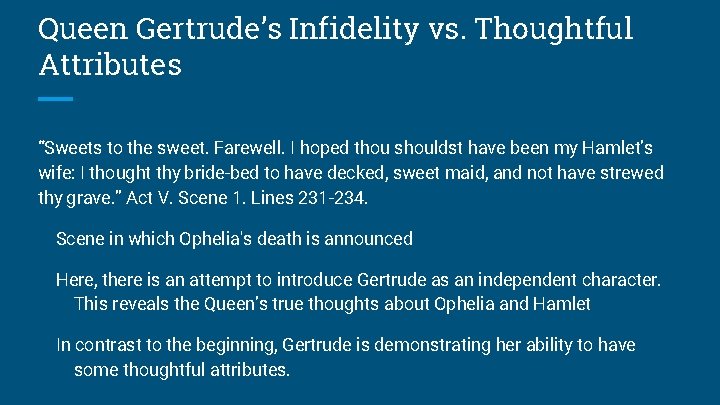
Queen Gertrude’s Infidelity vs. Thoughtful Attributes “Sweets to the sweet. Farewell. I hoped thou shouldst have been my Hamlet’s wife: I thought thy bride-bed to have decked, sweet maid, and not have strewed thy grave. ” Act V. Scene 1. Lines 231 -234. Scene in which Ophelia's death is announced Here, there is an attempt to introduce Gertrude as an independent character. This reveals the Queen’s true thoughts about Ophelia and Hamlet In contrast to the beginning, Gertrude is demonstrating her ability to have some thoughtful attributes.
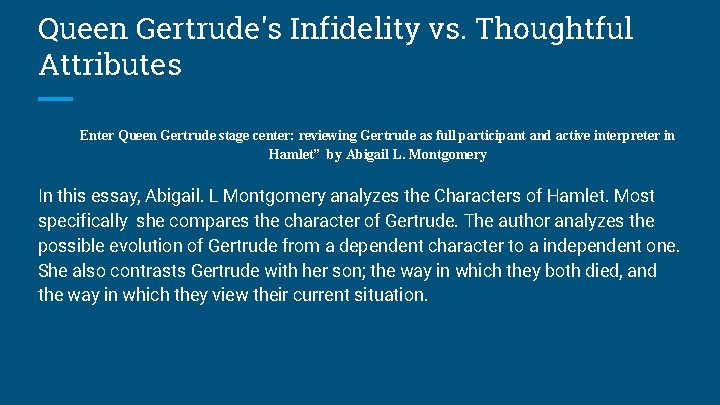
Queen Gertrude's Infidelity vs. Thoughtful Attributes Enter Queen Gertrude stage center: reviewing Gertrude as full participant and active interpreter in Hamlet” by Abigail L. Montgomery In this essay, Abigail. L Montgomery analyzes the Characters of Hamlet. Most specifically she compares the character of Gertrude. The author analyzes the possible evolution of Gertrude from a dependent character to a independent one. She also contrasts Gertrude with her son; the way in which they both died, and the way in which they view their current situation.
Hamlet and the King’s Motives HAMLET: What frighted with false fire? QUEEN: How fares my lord? POLONIUS: Give o’er the play. KING: Give me some light. Away. - Act III. Scene 2. Lines 257 -260 Reveals the King is indeed affected by Hamlet’s plot As Grace Tiffany suggests in “Hamlet, reconciliation, and the just state, ” Elizabethans would be able to easily grasp this concept of spiritual vengeance and guilt.
Polonius and his Short-Sighted Views Polonius: “Affection? Pooh! You speak like a green girl, Unsifted in such perilous circumstance. Do you believe his tenders, as you call them? ” Ophelia: “I do not know, my lord, what I should think. ” Polonius: “Marry, I will teach you. Think yourself a baby That you have ta’en these tenders for true pay Which are not sterling. Tender yourself more dearly Or - not to crack the wind of the poor phrase, Running it thus - you’ll tender me a fool. ” Act 1, Scene 3, Lines 107 -115 Polonius refuses to consider Ophelia’s feelings towards Hamlet and considers her a fool. He continues to manipulate her in order to get her to end the relationship as he sees the bond as “counterfeit” or fake.
Polonius and his Short-Sighted Views Even though Polonius cares for Ophelia, his advice to her in regards of Hamlet is insensitive and short sighted His lack of thinking makes him stubbornly opinionated Talks far more than he listens According to “Polonius, Our Pundit” by Catharine R. Stimpson, Polonius is weak minded and easily used and manipulated which is exactly why the snake that Claudius is would want him to be an adviser. When it comes to being a father, he is not truly loving and deeply caring where he would do much more listening than talking. For, in the end, “one can’t be a better father than one is a person. ”
Ophelia’s Lack of Understanding Laertes: “For Hamlet, and the trifling of his favours, Hold it a fashion and a toy in blood, A violet in the youth of primy nature, Forward, not permanent, sweet, not lasting, The perfume and suppliance of a minute, No more. ” -Act 1, Scene 2, 6 -11 Laertes goes on to tell Ophelia that while Hamlet may love her, he his subject to the desires of the state and will necessarily break her heart. The question is whether Ophelia is driven mad by her love for Hamlet or if she is the victim of a society with impossible expectations for women. Either way, caught in the middle of her father’s restrictive commands and her brother’s strict guidance, Ophelia is trapped in a choice-less existence which leads to her drastic decision to drown herself in the river.
Ophelia’s Lack of Understanding As a woman in a patriarchal society, Ophelia must be obedient to her father and therefore cannot express herself and her true feelings She is full of passion which eventually dissolves into irrationality According to “Ophelia's "old lauds": madness and hagiography in Hamlet” by Alison A. Chapman, male characters in Shakespeare have limited perception of female characters. Often, the male character will completely misread their women where the consequences are often tragic. Ophelia, therefore, cannot meet the demands of the men around her because their underlying assumptions are flawed.
Citations Decarlo, John. "Mother and son: the dynamics of Hamlet's Cartesian madness. " Journal of Philosophy: A Cross Disciplinary Inquiry 6. 14 (2011): 51+. Academic One. File. Web. 17 Oct. 2016. Titlestad, Peter. "Hamlet the populist politician. " Shakespeare in Southern Africa 25 (2013): 43+. Academic One. File. Web. 17 Oct. 2016. Stimpson, Catharine R. "Polonius, Our Pundit. " (2002): n. pag. Web. 17 Oct. 2016. Chapman, Alison A. "“Ophelia's "old Lauds": Madness and Hagiography in Hamlet”. " (2007): n. pag. Academic One. File. Web. 17 Oct. 2016. Montgomery, Abigail L. "Enter Queen Gertrude stage center: re-viewing Gertrude as full participant and active interpreter in Hamlet. " South Atlantic Review 74. 3 (2009): 99+. Academic One. File. Web. 18 Oct. 2016. Tiffany, Grace. "Hamlet, reconciliation, and the just state. " Renascence: Essays on Values in Literature 58. 2 (2005): 111+. Academic One. File. Web. 18 Oct. 2016.