Animal Farm George Orwell Chapter 1 All of













- Slides: 41
Animal Farm George Orwell
Chapter 1 • All of Orwell’s writing focused on destroying totalitarianism • Published in 1945 • Animal Farm is a Fable: – A story where the characters are less important for individual characteristics and more important for the characters/people which they represent – Many of the characters in Animal Farm represent real figures from the Russian Revolution
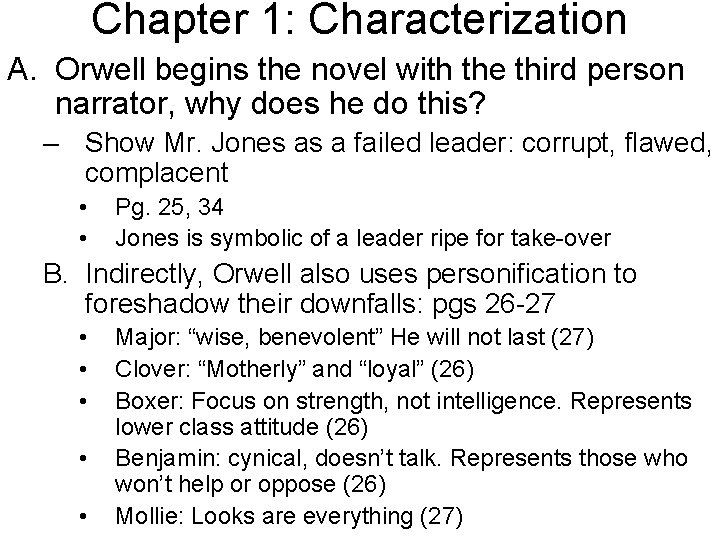
Chapter 1: Characterization A. Orwell begins the novel with the third person narrator, why does he do this? – Show Mr. Jones as a failed leader: corrupt, flawed, complacent • • Pg. 25, 34 Jones is symbolic of a leader ripe for take-over B. Indirectly, Orwell also uses personification to foreshadow their downfalls: pgs 26 -27 • • • Major: “wise, benevolent” He will not last (27) Clover: “Motherly” and “loyal” (26) Boxer: Focus on strength, not intelligence. Represents lower class attitude (26) Benjamin: cynical, doesn’t talk. Represents those who won’t help or oppose (26) Mollie: Looks are everything (27)
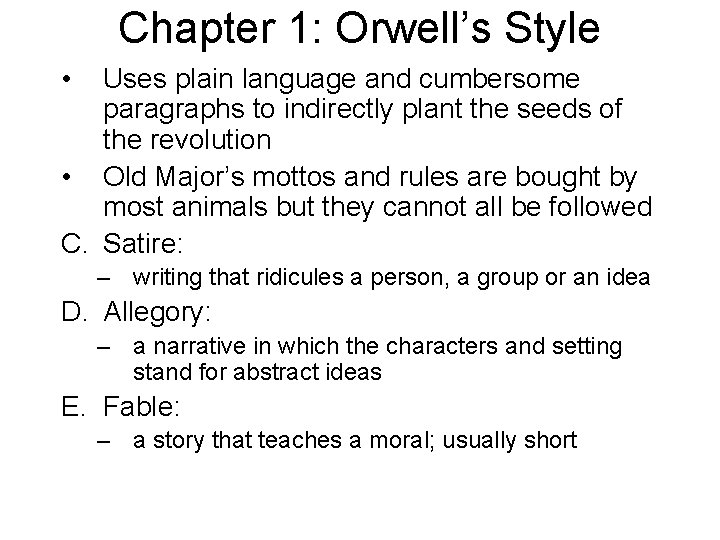
Chapter 1: Orwell’s Style • Uses plain language and cumbersome paragraphs to indirectly plant the seeds of the revolution • Old Major’s mottos and rules are bought by most animals but they cannot all be followed C. Satire: – writing that ridicules a person, a group or an idea D. Allegory: – a narrative in which the characters and setting stand for abstract ideas E. Fable: – a story that teaches a moral; usually short
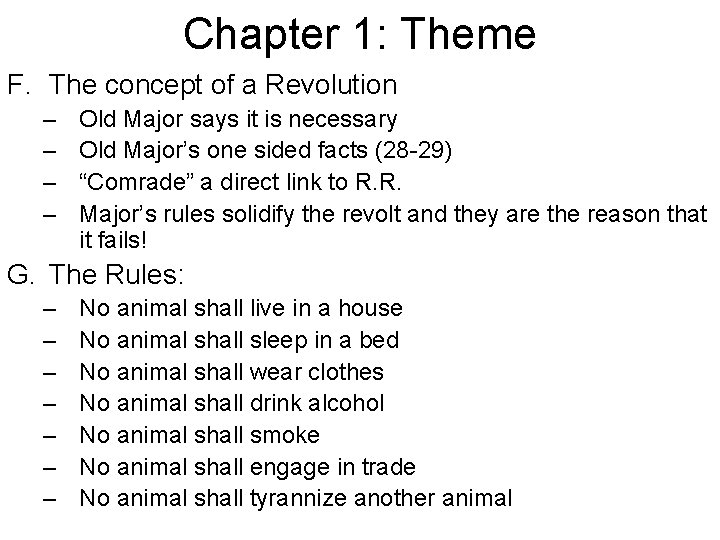
Chapter 1: Theme F. The concept of a Revolution – – Old Major says it is necessary Old Major’s one sided facts (28 -29) “Comrade” a direct link to R. R. Major’s rules solidify the revolt and they are the reason that it fails! G. The Rules: – – – – No animal shall live in a house No animal shall sleep in a bed No animal shall wear clothes No animal shall drink alcohol No animal shall smoke No animal shall engage in trade No animal shall tyrannize another animal
Chapter 2 A. Old Major’s Death: – Very important because it allows the younger figures to take control – He is an idealist and one would always wonder how the revolution would have gone with him there B. The Hesitant Animals: – These animals represent the peasants in Russia (26) – Don’t want to give up the security of their current government for the unknown
Chapter 2 C. The Importance of Persuasion-Squealer: – Squealer could “turn black into white” – Squealer is persuasive and cunning – Through Squealer, Orwell shows that charisma and persuasive speakers are very important – He tells animals what they want to hear; Raven tells tales; Snowball is very firm with Mollie – How would Squealer have handled Mollie?
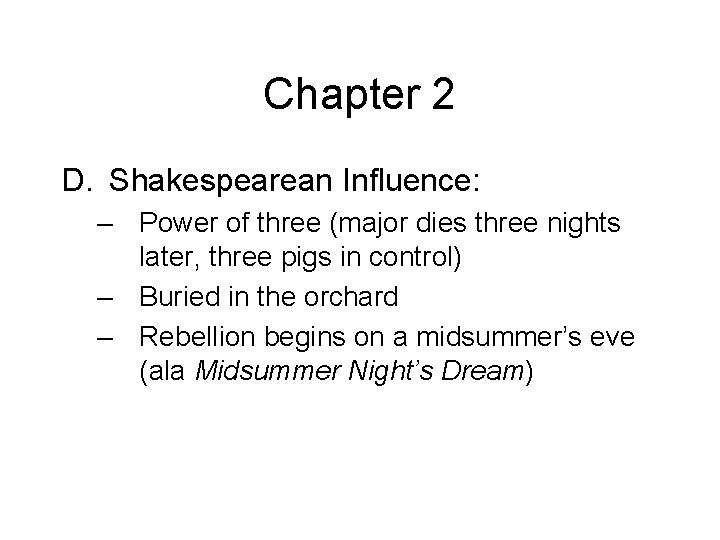
Chapter 2 D. Shakespearean Influence: – Power of three (major dies three nights later, three pigs in control) – Buried in the orchard – Rebellion begins on a midsummer’s eve (ala Midsummer Night’s Dream)
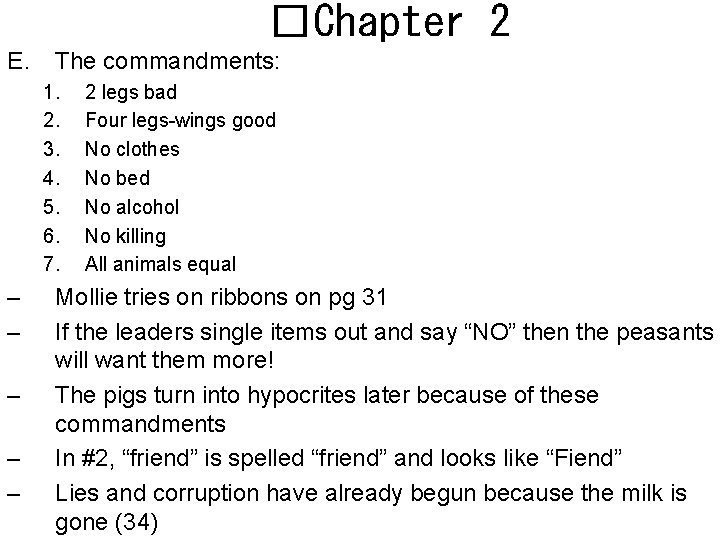
�Chapter 2 E. The commandments: 1. 2. 3. 4. 5. 6. 7. – – – 2 legs bad Four legs-wings good No clothes No bed No alcohol No killing All animals equal Mollie tries on ribbons on pg 31 If the leaders single items out and say “NO” then the peasants will want them more! The pigs turn into hypocrites later because of these commandments In #2, “friend” is spelled “friend” and looks like “Fiend” Lies and corruption have already begun because the milk is gone (34)
Chapter 2 E. The commandments: 1. 2. 3. 4. 5. 6. 7. 2 legs bad Four legs-wings good No clothes No bed No alcohol No killing All animals equal – These are written in parallel; begin and end with commandments aimed at uniting the animals and establishing basic beliefs – 3 -5 are big mistakes based on psychology, these items make the citizens what to do these things more
Chapter 3 A. Moving Away from Old Major’s Vision: A. Classless society? B. Squealer destroys this society when he says that Jones would come back without the pigs (42) C. The pigs do no work (35) D. A class system is beginning to emerge…
Chapter 3 A. The New Vision… – Squealer always uses fear to solidify the pig’s place and this fear is used to persuade others into submission (41 -43) – The new system of manipulation is based on fear and psychology – Old Major would have opposed all of this
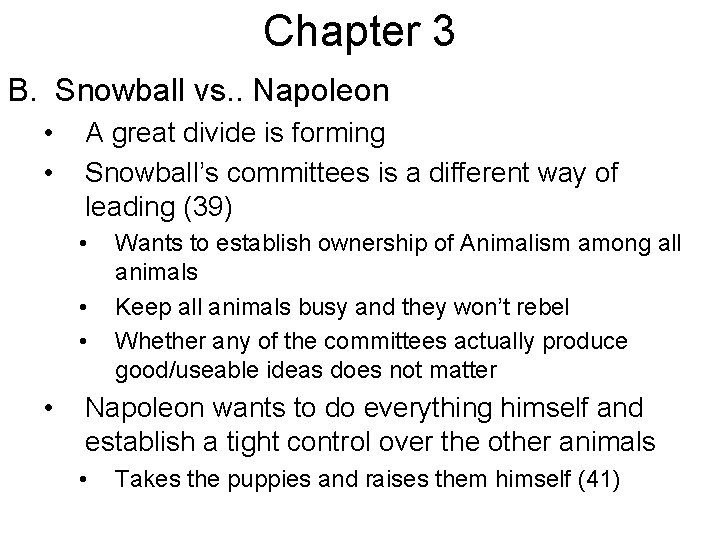
Chapter 3 B. Snowball vs. . Napoleon • • A great divide is forming Snowball’s committees is a different way of leading (39) • • Wants to establish ownership of Animalism among all animals Keep all animals busy and they won’t rebel Whether any of the committees actually produce good/useable ideas does not matter Napoleon wants to do everything himself and establish a tight control over the other animals • Takes the puppies and raises them himself (41)
Chapter 3 C. Orwell’s Style: • • • The book is narrated from the unquestioning point of view of the animals This perspective is used to create irony Even though the narrator is not questioning, the reader should be…Why? Napoleon takes the puppies The animals forget about them The milk disappears The apples preserved only for pigs The pigs do no work All of this should raise suspicion in the reader, even if it doesn’t in the animals (35, 36, 43)
Chapter 3 • Evolution of Animalism: – Ironic that the narrator calls the animals “parasites” on page 36. • What are the pigs, then? • Aren’t they doing the same things that the humans did?
Chapter 4 A. Napoleon: • • He is not mentioned in this chapter This is the only post-revolution chapter where he is not mentioned This contrasts with Snowball’s bravery Napoleon did not fight, is he dedicated to the revolution?
Chapter 4 B. Snowball: • • • Leads the charge Planned defense and military strategies Snowball studied Julius Caesar (47) • • • An allusion that shows his scholarship and intellect Snowball earns a medal (49) Huge gap now between Napoleon and Snowball
The Townspeople C. This chapter shows the first reactions to the revolution: • Apathy -> Disbelief -> Fear -> Self-interest • This attitude represents the attitude of other countries towards rebellion • As the townspeople spread rumors of cannibalism, infidelity, and torture, it shows their feelings of being threatened • This is a parody: • The propaganda the farmers use in their discussions is the same as the propaganda other nations use as a weapon
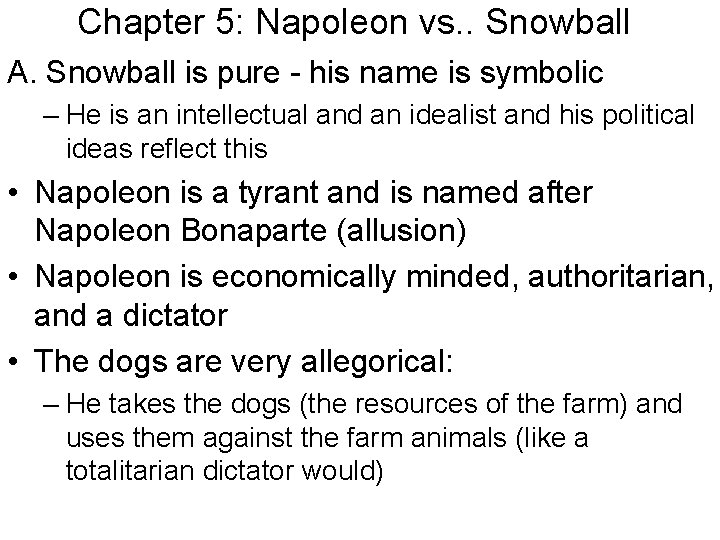
Chapter 5: Napoleon vs. . Snowball A. Snowball is pure - his name is symbolic – He is an intellectual and an idealist and his political ideas reflect this • Napoleon is a tyrant and is named after Napoleon Bonaparte (allusion) • Napoleon is economically minded, authoritarian, and a dictator • The dogs are very allegorical: – He takes the dogs (the resources of the farm) and uses them against the farm animals (like a totalitarian dictator would)
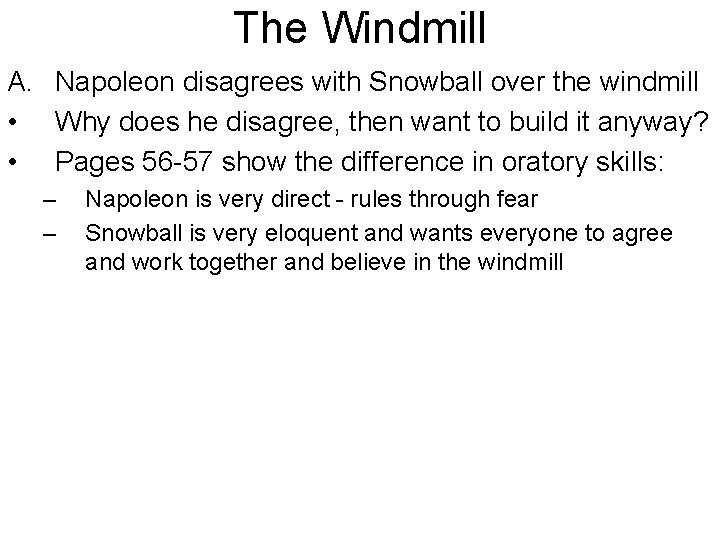
The Windmill A. Napoleon disagrees with Snowball over the windmill • Why does he disagree, then want to build it anyway? • Pages 56 -57 show the difference in oratory skills: – – Napoleon is very direct - rules through fear Snowball is very eloquent and wants everyone to agree and work together and believe in the windmill
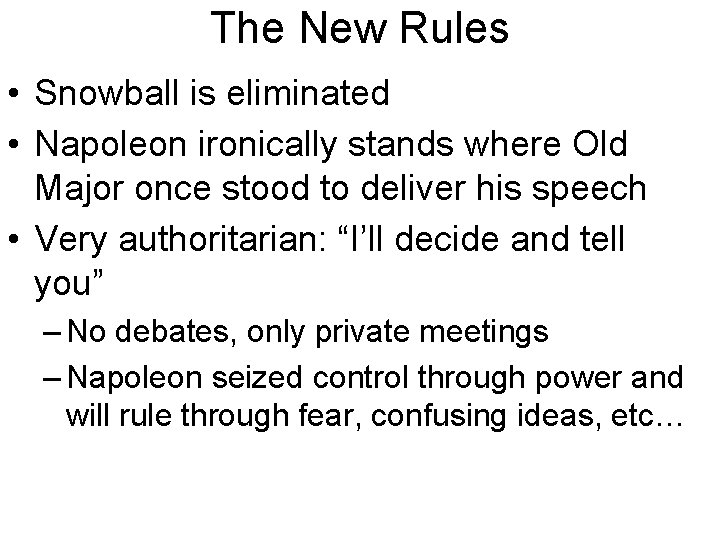
The New Rules • Snowball is eliminated • Napoleon ironically stands where Old Major once stood to deliver his speech • Very authoritarian: “I’ll decide and tell you” – No debates, only private meetings – Napoleon seized control through power and will rule through fear, confusing ideas, etc…
The Characterization of Squealer • Characterization: – Has some of Snowball’s traits – Persuasive and eloquent speaker – Unlike Snowball, however, Squealer is shallow and a propaganda machine of the government – Squealer would never express his own opinions, even if he had them – He is exactly what Napoleon needs, but he is very detrimental to Animal Farm as a whole
Squealer in Action B 1: Page 59: – Everything Squealer says contradicts the truth – No more meetings, but all animals are equal? – Extra Labor - Napoleon makes all the decisions but does not work B 2: Page 60: – Completely discounts Snowball’s role in the battle – Even though the animals saw Snowball fight, they believe Squealer B 3: Pages 60 - 61: – The pigs are guarded by the dogs – Them vs. . Us mentality
Mollie Vs. Boxer C 1: Mollie (51, 52): – symbolic of the rich, pampered class during a revolution – Just like Zaroff described in “Game” they leave because they are interested only in luxury and their way of life C 2: Boxer (60): – symbolic of the blind and trusting followers who follows the leader no matter what
Chapter 6 A. A Tyrant’s Trade – Reintroduced by Napoleon and dissolves the remaining parts of Old Major’s plan (66 – Mr. Whymper comes to Animal Farm and humans reemerge (66, 67) – After trade begins, the pigs move into the farmhouse (69) – Squealer reasons this out with the animals through repetition (67, 69, 70) – Double standards concerning work continue to manifest but are dismissed right away (63, 65, 70)
The Rewording of the 4 th Commandment B. Napoleon’s Leadership: • Napoleon loves to take very general ideas and narrow them • His changes are so slight that there appears to be no change at all • He changes: – The commandment (69) – Ideas on work (63) – The interpretation of Snowball’s work (72)
The Windmill C: Napoleon refuses to believe that the project is difficult (63) • Napoleon uses his intelligence after the windmill is destroyed: – Many psychologists say man needs something to love and something to hate – Educational psychology says that people who are kept very busy are easily controlled • Napoleon uses both of these ideas to rebuild the windmill (71, 72) • Snowball is blamed and this unites the comrades against a common enemy (someone to hate) • Ironically, the animals unite against the true leader of the revolution
Chapter 7: Napoleon’s Decisions: A: Napoleon’s Leadership: – When he lies to save face he is hurting his own people (82) – Orwell uses this to satirize the authoritarian governments and how they never reach for outside help because it would show weakness in govt! (83) – Put citizen’s welfare at risk to save face (75, 76) • Where are some examples of Napoleon doing this in chapter 7?
Squealer’s Propaganda B: Napoleon desires to sever all remaining ties with the original revolution- but not before he gets a medal (83) • Snowball is the subject of most of the propaganda. Most of this is ironic and really refers to Napoleon: – He was a traitor from Day 1 (77, 78) – He was never concerned with the welfare of the animals (75) – Napoleon needs to discredit the early days of the revolution (79) • Napoleon wants to change their ideology so that they will accept future changes
The Beasts of England C: Napoleon’s final act of chapter 7 is simple, yet difficult for the animals (86 -87) • The animals can accept laws, killings, food rations, and lies but have trouble with the song being abolished • It is a low-level need, deeply rooted in their psyche: It is a cultural tradition • Why would Napoleon do this?
Chapter 8: The Poem A. Full of ironic statements – “Friend of fatherless, ” “faithful”, etc… • Napoleon lives in almost complete seclusion, lies to the animals and kills them • He is neither a friend nor a help
Complete Success B: Napoleon’s persona has been built up too much, a common mistake in authoritarian govt. • He can never be wrong, which is why: – The gun is fired after the attack by Fredrick – A new war decoration is created to hide the forged notes Napoleon accepted from Fredrick – Plinkington refuses to help and Napoleon chose the wrong farmer to give the wood to – Every time the pigs break a commandment, Squealer goes out at night and alters it – “Traitors” are murdered
The Effectiveness of Propaganda • • Shows effectiveness of propaganda A theme of “Reliability of Memory” is emerging Later, Orwell would continue to explore this in 1984 Muriel, through Orwell’s description of his mannerisms, seems to know something that the others do not • “Remembering wrong” is what the animals call their incorrect interpretations • Orwell uses propaganda, humor, and comedy to satirize how a nation’s collective memory can be called into question
Chapter 9 A. The Republic? – Social commentary – Many totalitarian governments implement dummy democracies – Animal Farm does this and the citizens are so brainwashed that they cannot see that one choice is no choice! – This is meant to be a chilling parallel to Old Major and the days when everything was decided by majority vote
Chapter 9 B. Squealer’s use of language: – Very important because it plays a huge part in his ability to successfully brainwash the citizens – Repetition in many of his speeches is significant • If one hears things over and over again, it will be believed • “A better life now” is contrasted with the narrator saying and Orwell showing the opposite • The sheep and Boxer are the best examples of blind followers
Chapter 9 C. Boxer’s Final Days: – Very ironic – Several things become apparent: • There has been foreshadowing of this: – Dogs attack him, Clover warns him, injury • Squealer and the narrator are in constant competition and this comes out in chapter 9 • Muriel finally reads
Chapter 9 D. Ignorance: – Boxer’s death brings the ignorance of the animals to the forefront – Boxer was the hardest worker and was killed when his usefulness ran out – This should make it clear that no one will retire and that Animalism is a farce – This deductive reasoning hits Muriel, but no one else – Squealer’s lies about being at Boxer’s bedside and Boxer’s last words accentuate this concept
Chapter 10 A. Theme: Reliability of memory – Few animals remain who remember Old Major, Jones, or Snowball – Orwell is commenting on the effect of time and brainwashing on memory – If something is not remembered, does it matter if it really happened? • The elimination of the characters, flag, and meetings makes it seem like none of this ever happened
Chapter 10 B. Bureaucracy: – Squealer invents important work for the growing number of pigs to do – The “files…” convince the animals, but the audience knows that these ate lies! – Totalitarian governments of ten do this because they favor one class of citizens over another
Chapter 10 • The Ending: – The pigs have slowly been assimilating into human culture: • Hind legs, houses, beer, visits with humans – Now it is too late: • They realize that the revolution is a joke but it is too late to do anything about it – Basically, they have traded on totalitarian government for another