Ancient Greece and Rome Legacy to Western Civilization



- Slides: 18
Ancient Greece and Rome Legacy to Western Civilization
Political System Greek Legacy Western Civilization �Democracy developed in �The USA government Athens. today can be described as a democratic republic.
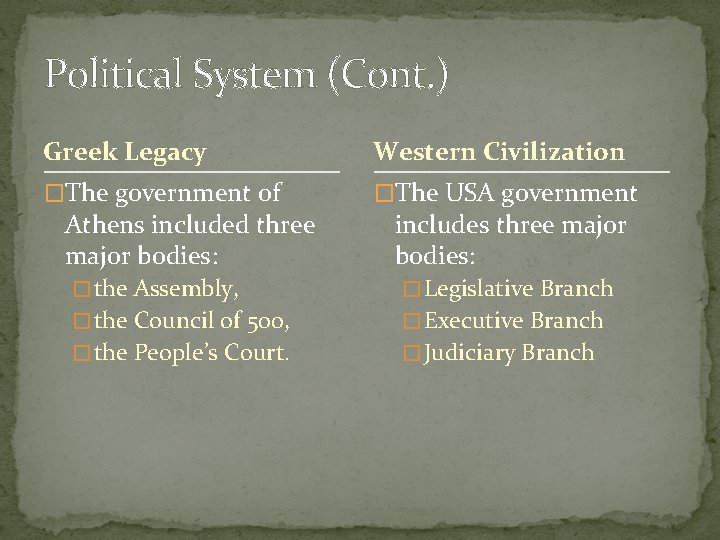
Political System (Cont. ) Greek Legacy Western Civilization �The government of �The USA government � the Assembly, � Legislative Branch � the Council of 500, � Executive Branch � the People’s Court. � Judiciary Branch Athens included three major bodies: includes three major bodies:
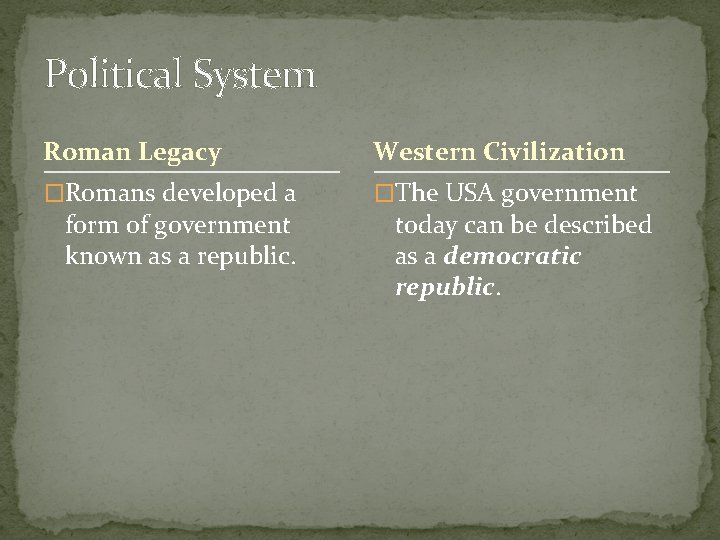
Political System Roman Legacy Western Civilization �Romans developed a �The USA government form of government known as a republic. today can be described as a democratic republic.
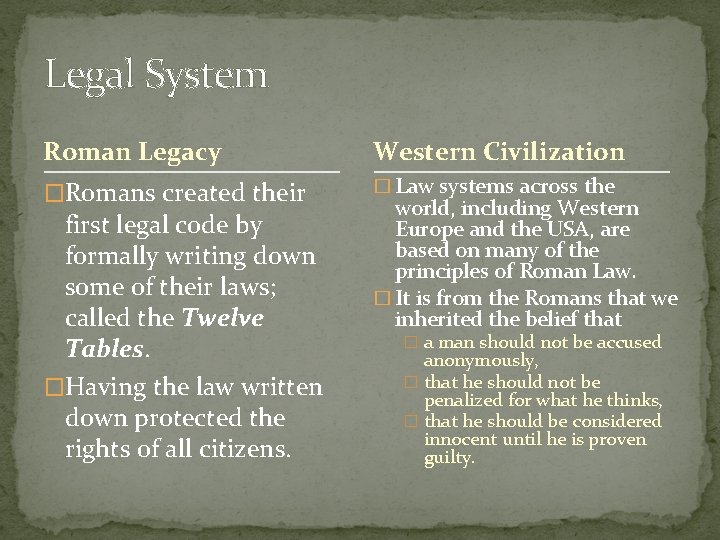
Legal System Roman Legacy Western Civilization �Romans created their � Law systems across the first legal code by formally writing down some of their laws; called the Twelve Tables. �Having the law written down protected the rights of all citizens. world, including Western Europe and the USA, are based on many of the principles of Roman Law. � It is from the Romans that we inherited the belief that � a man should not be accused anonymously, � that he should not be penalized for what he thinks, � that he should be considered innocent until he is proven guilty.
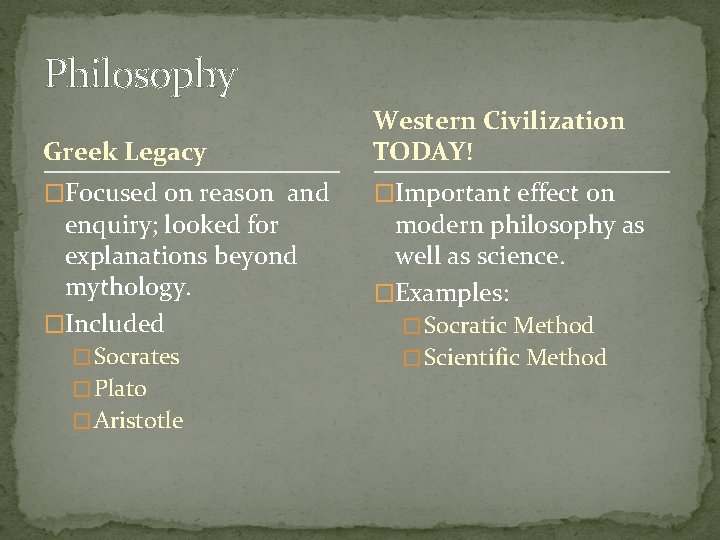
Philosophy Greek Legacy Western Civilization TODAY! �Focused on reason and �Important effect on enquiry; looked for explanations beyond mythology. �Included � Socrates � Plato � Aristotle modern philosophy as well as science. �Examples: � Socratic Method � Scientific Method
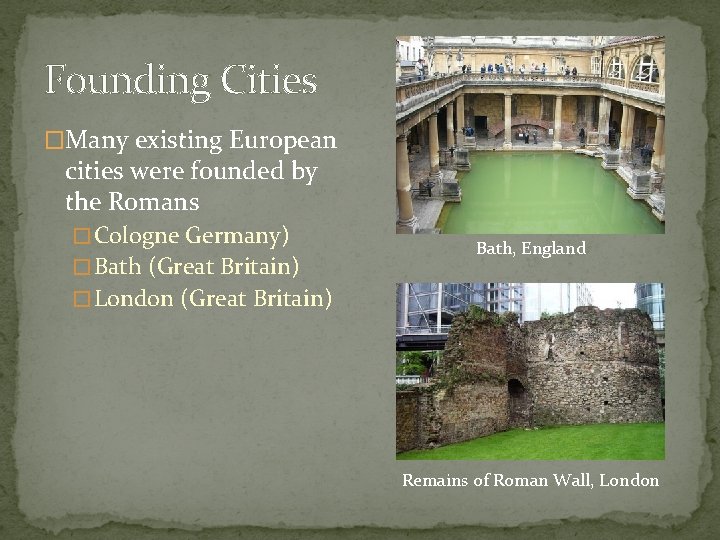
Founding Cities �Many existing European cities were founded by the Romans � Cologne Germany) � Bath (Great Britain) Bath, England � London (Great Britain) Remains of Roman Wall, London
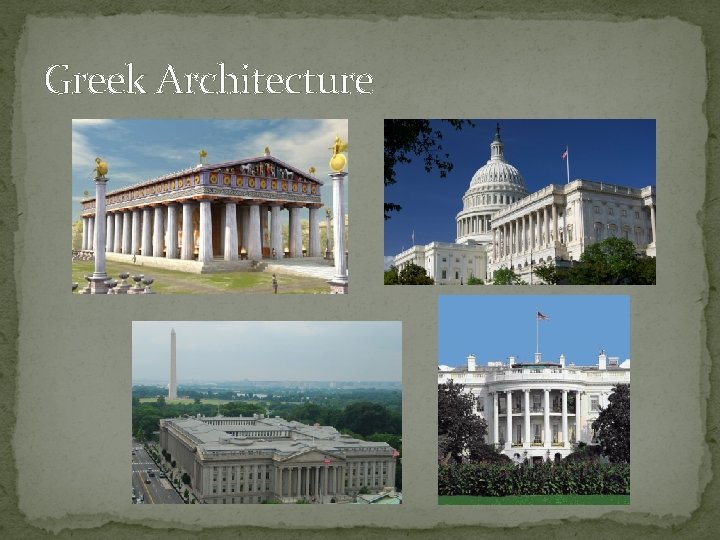
Greek Architecture
Roman Architecture
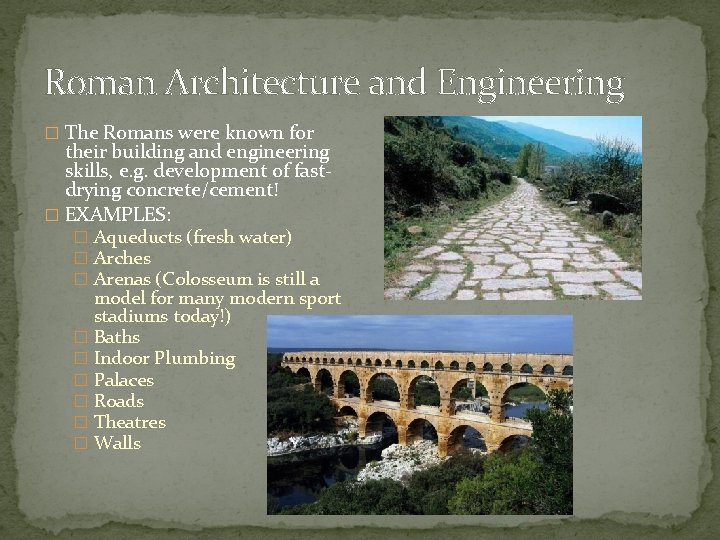
Roman Architecture and Engineering � The Romans were known for their building and engineering skills, e. g. development of fastdrying concrete/cement! � EXAMPLES: � Aqueducts (fresh water) � Arches � Arenas (Colosseum is still a model for many modern sport stadiums today!) � Baths � Indoor Plumbing � Palaces � Roads � Theatres � Walls
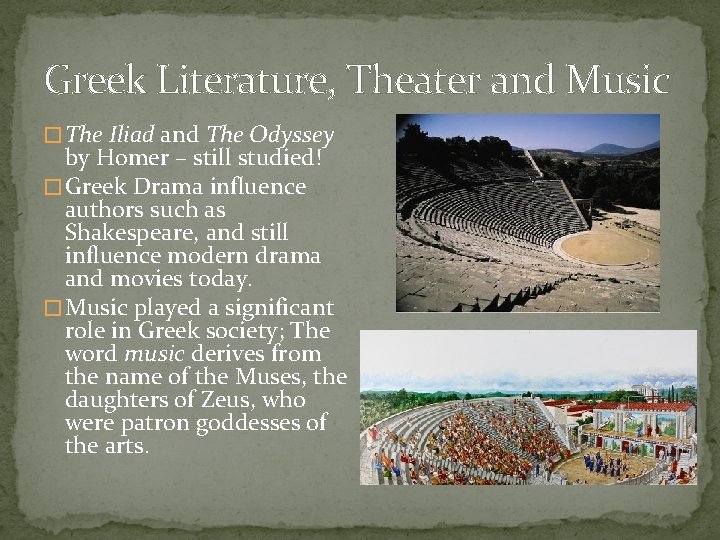
Greek Literature, Theater and Music � The Iliad and The Odyssey by Homer – still studied! � Greek Drama influence authors such as Shakespeare, and still influence modern drama and movies today. � Music played a significant role in Greek society; The word music derives from the name of the Muses, the daughters of Zeus, who were patron goddesses of the arts.
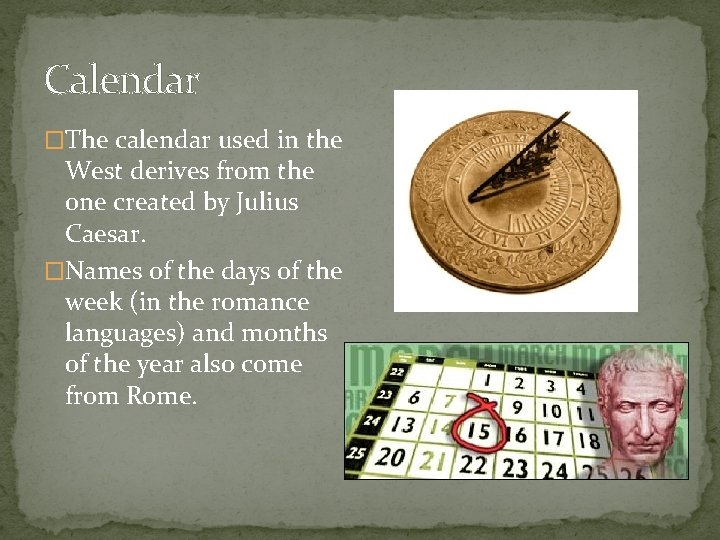
Calendar �The calendar used in the West derives from the one created by Julius Caesar. �Names of the days of the week (in the romance languages) and months of the year also come from Rome.
Languages �Greek and Roman alphabet – basis for our alphabet �Greek root words � ancient, autobiography, chronic, democracy, encyclopedia, geography, Minneapolis, telephone �Latin – basis for many languages spoken today � French, Italian, Portuguese and Spanish �Latin root words � box, delete, erase, enquire, hyphen, joke, merge, obnoxious, query, retaliate, scholar, trivia
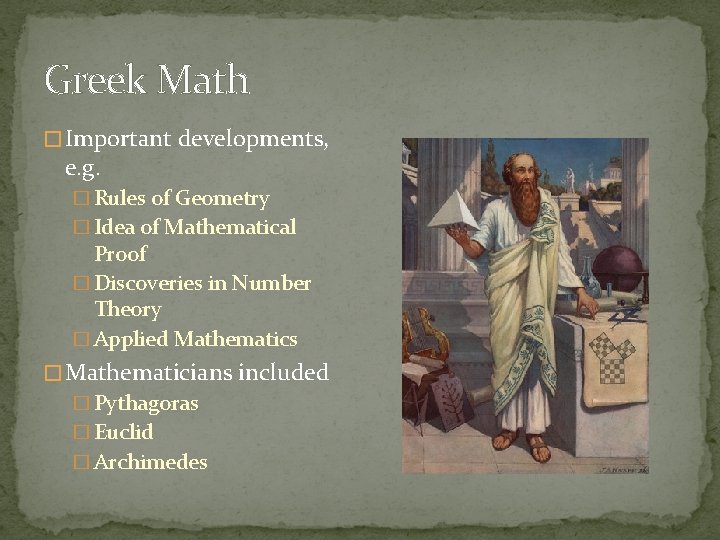
Greek Math � Important developments, e. g. � Rules of Geometry � Idea of Mathematical Proof � Discoveries in Number Theory � Applied Mathematics � Mathematicians included � Pythagoras � Euclid � Archimedes
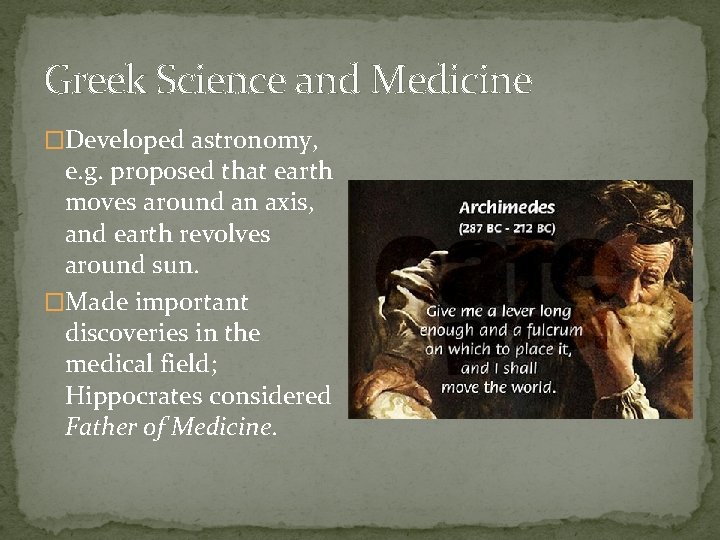
Greek Science and Medicine �Developed astronomy, e. g. proposed that earth moves around an axis, and earth revolves around sun. �Made important discoveries in the medical field; Hippocrates considered Father of Medicine.
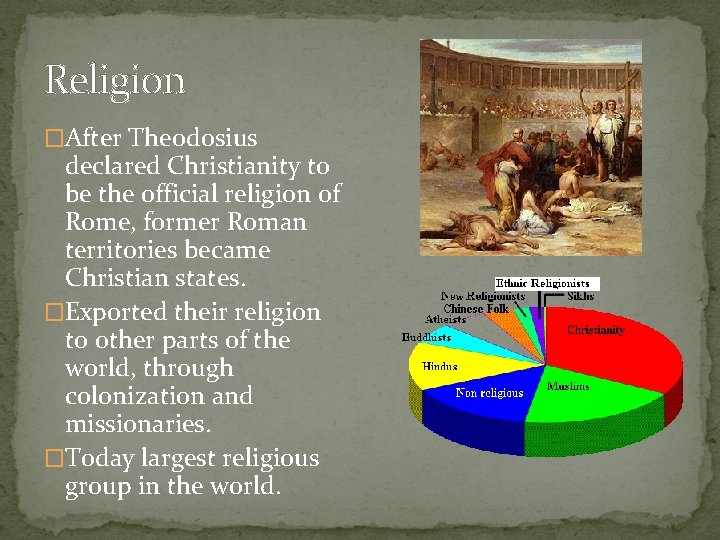
Religion �After Theodosius declared Christianity to be the official religion of Rome, former Roman territories became Christian states. �Exported their religion to other parts of the world, through colonization and missionaries. �Today largest religious group in the world.
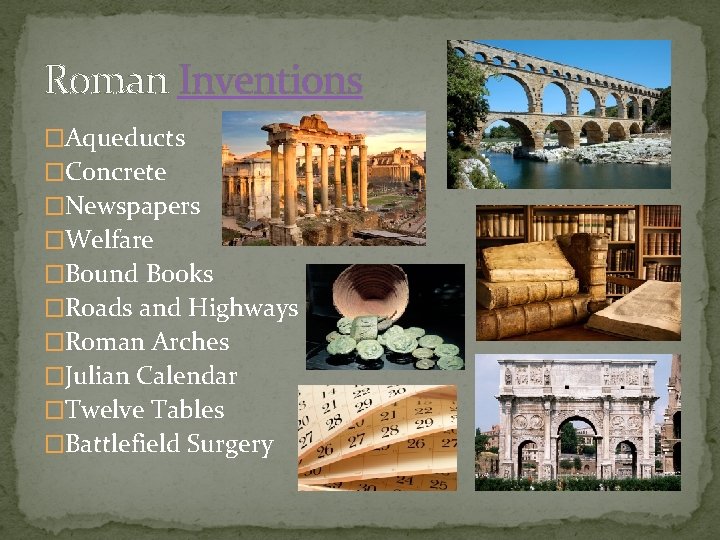
Roman Inventions �Aqueducts �Concrete �Newspapers �Welfare �Bound Books �Roads and Highways �Roman Arches �Julian Calendar �Twelve Tables �Battlefield Surgery
In conclusion. . . �The lessons of history would suggest that civilizations move in cycles. You can track that back quite far – the Babylonians, the Sumerians, followed by the Egyptians, the Romans, China. We’re obviously in an upward cycle right now, and hopefully that remains the case. But, it may not. (Elon Musk)