
Rome and the Roots of Western Civilization Rome


- Slides: 19
Rome and the Roots of Western Civilization
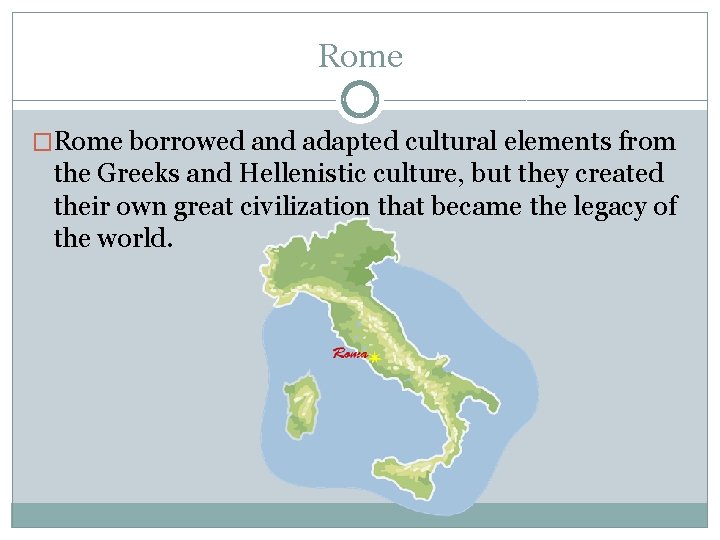
Rome �Rome borrowed and adapted cultural elements from the Greeks and Hellenistic culture, but they created their own great civilization that became the legacy of the world.
The Legacy of Greco-Roman Civilization �Under the Roman empire hundreds of territories were knitted into a single state governed in the same manner. �The Romans were proud of their ability to rule but acknowledged Greek leadership in the fields of art, architectures, literature, and philosophy. �By second century B. C. , Rome had conquered Greece and educated Romans learned the Greek language.
The Legacy of Greco-Roman Civilization �The mixing of elements of Greek, Hellenistic, and Roman culture produced a new culture called, Greco. Roman Culture. (aka classical civilization) �Roman artist and philosophers did not simply copy the Greek and Hellenistic models, but adapted them to their own purpose and use. �Roman literature and art came to convey the Roman ideals of strength, permanence and solidity.
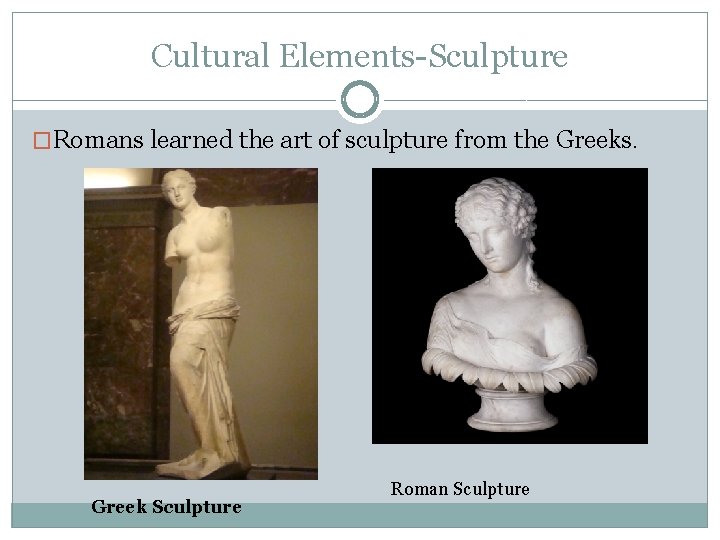
Cultural Elements-Sculpture �Romans learned the art of sculpture from the Greeks. Greek Sculpture Roman Sculpture
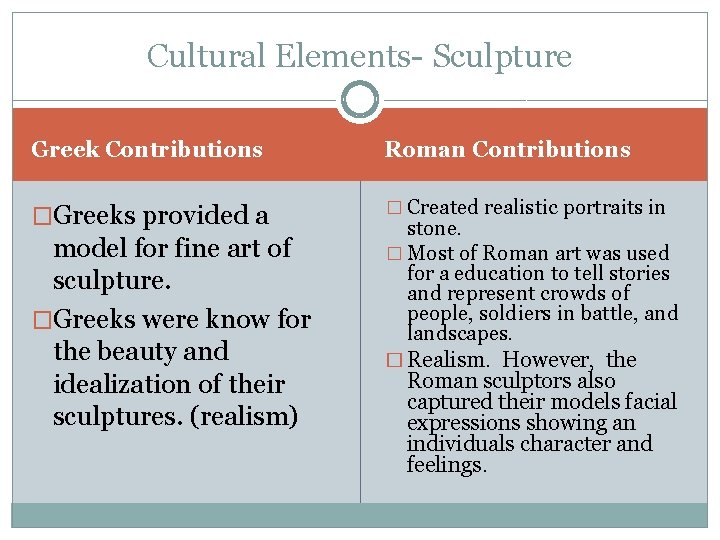
Cultural Elements- Sculpture Greek Contributions Roman Contributions �Greeks provided a � Created realistic portraits in model for fine art of sculpture. �Greeks were know for the beauty and idealization of their sculptures. (realism) stone. � Most of Roman art was used for a education to tell stories and represent crowds of people, soldiers in battle, and landscapes. � Realism. However, the Roman sculptors also captured their models facial expressions showing an individuals character and feelings.
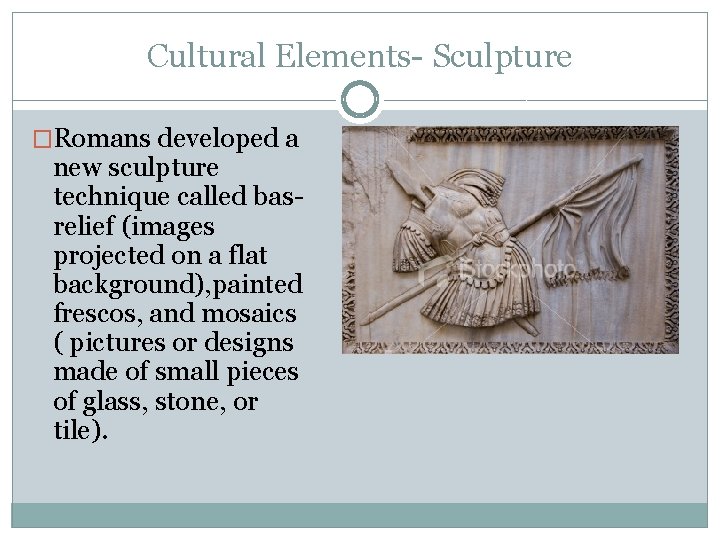
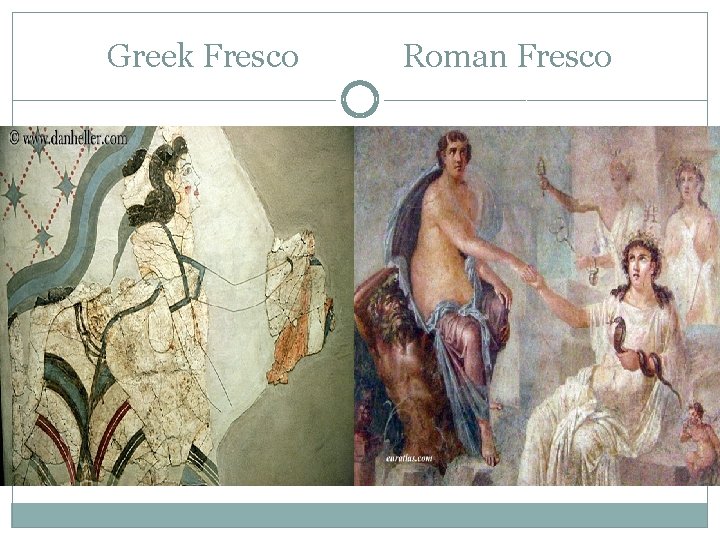
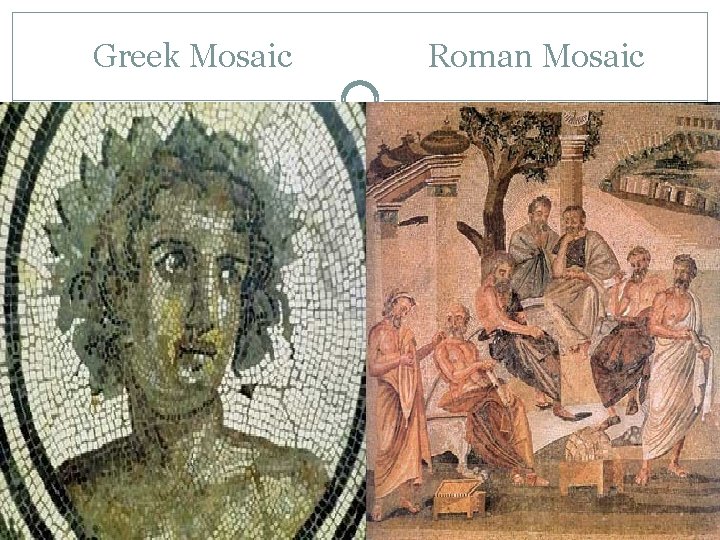
Cultural Elements- Sculpture �Romans developed a new sculpture technique called basrelief (images projected on a flat background), painted frescos, and mosaics ( pictures or designs made of small pieces of glass, stone, or tile).
Greek Fresco Roman Fresco
Greek Mosaic Roman Mosaic
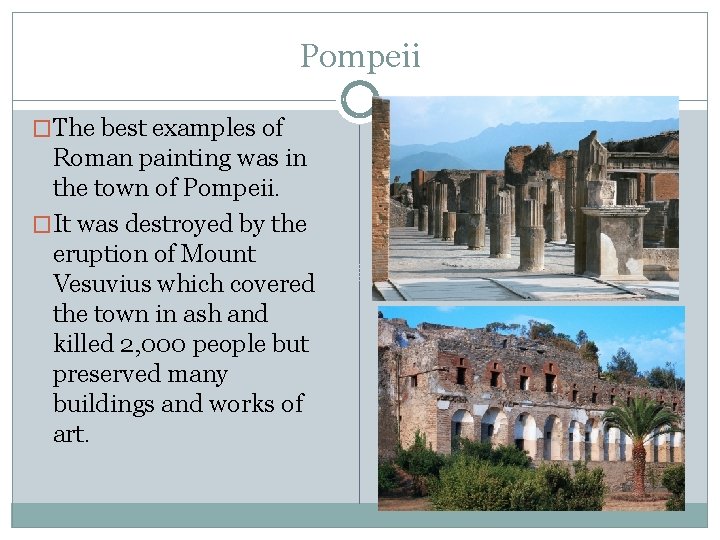
Pompeii �The best examples of Roman painting was in the town of Pompeii. �It was destroyed by the eruption of Mount Vesuvius which covered the town in ash and killed 2, 000 people but preserved many buildings and works of art.
Cultural Elements-Philosophy Greek Contribution Roman Contribution �Philosophers founded �Applied the teachings schools of philosophy, such as Stoicism, which encouraged virtue, duty, moderation, and endurance of Greek philosophers to administration of their empire
Cultural Elements-Literature Greek Contribution Roman Contribution �Provided forms and �Wrote epics as well as models for literary works, such as epics by Homer. �Homer wrote Odyssey light, witty, poetry and prose, especially history. �Used themes about everyday life in Rome. �Virgil- Wrote the Aeneid.
Roman Achievements-Language �Romans introduced and spread Latin, which remained the language of learning and the Roman Catholic church long after the Roman empire fell.
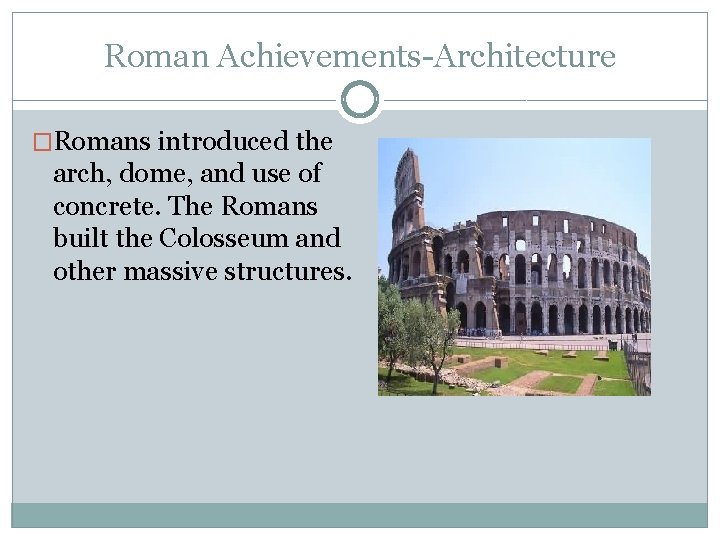
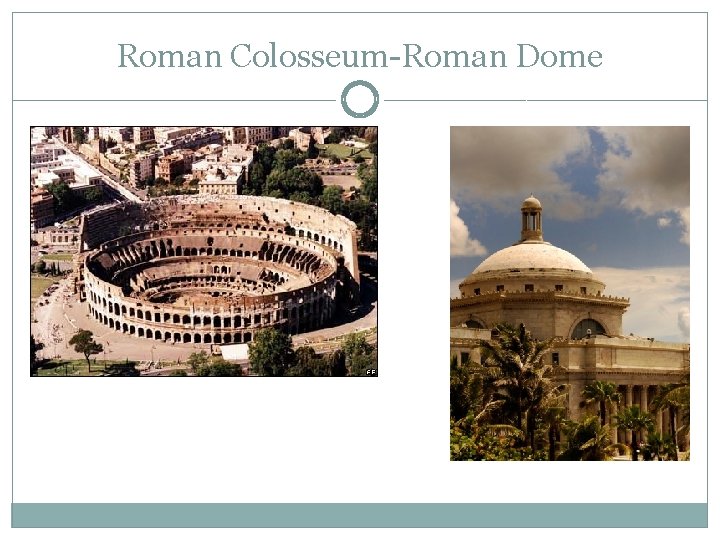
Roman Achievements-Architecture �Romans introduced the arch, dome, and use of concrete. The Romans built the Colosseum and other massive structures.
Roman Colosseum-Roman Dome
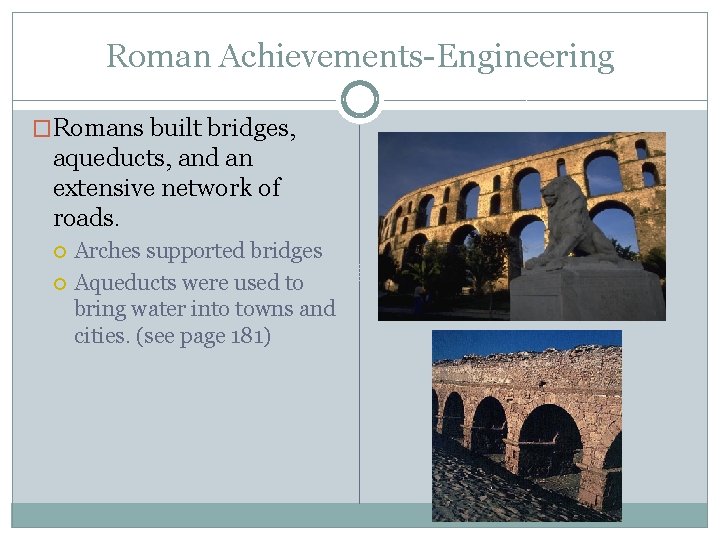
Roman Achievements-Engineering �Romans built bridges, aqueducts, and an extensive network of roads. Arches supported bridges Aqueducts were used to bring water into towns and cities. (see page 181)
Greek Science Roman Galen- used experiments to Aristarchus heliocentric theory. further medical research. Developed an encyclopedia § Euclid geometry. that was used for over a 1, 000 yrs later. § Archimedes -Applied geographic features to pulley. maps § Ptolemy Pliny the elder- compiled geocentric theory. encyclopedia volumes on such topic as zoology, geography, and botany. Volumes were based on other peoples work.
Rome’s lasting legacy �Rome’s most widespread contribution was not only cultural but their system of law. �The Romans created the systems of criminal and civil laws. Civil laws-laws which dealt primarily with the individual rights of citizens. Criminal law- Crimes against the rights of people or breaking the laws of government.
Citation � http: //lh 5. ggpht. com/_y. Vh. SO 7 hax. Vg/SK 2 -t. T 4 q-8 I/AAAAE- M/b 0 Uj 6 HZxw. XY/DSC 00270. JPG � http: //www. istockphoto. com/file_thumbview_approve/2612566/2/ist ockphoto_2612566_ancient_roman_bas_relief_showing_flag_spears _and_armor. jpg � http: //www. euratlas. com/Atlas/southern_italy/artemis. jpg � http: //www. stenudd. com/myth/greek/aristotle/images/Romanmosaic-Plato-academy. jpg � http: //www. iho-ohi. org/wp-content/concrete-roman-colosseum. jpg � http: //www. instatravel. org/images/the-roman-colosseum_2263. jpg