ANALYTICAL EXPOSITION Definition Analytical Exposition type of spoken









- Slides: 14
ANALYTICAL EXPOSITION
Definition Analytical Exposition type of spoken or written text that is intended to persuade the listeners or readers by presenting arguments to analyze or explain ‘how’ and ‘why’
Purpose To persuade by presenting arguments To tell the readers that something is important
Generic Structure l Thesis Introduces topic and indicates the writer’s position. The writer also outlines the main arguments to be presented l Argument Shows a series of arguments that support thesis l Conclusion In this stage, the writer restates his/her point of view
Language features ¢ SIMPLE PRESENT TENSE example: In my opinion elementary school teacher works hard. English is the world’s most important language. ¢ CONNECTORS * to mention several parts of arguments Firstly, … Secondly, … First, … Second, … moreover furthermore Finally, … also etc. * to summarize or conclude the points SUMMARIZING CONCLUDING In short, … In conclusion, … In a word, … On the whole, … In brief, … Altogether, … To sum up, … In all, … etc.
¢ Emotive words e. g. : I’m worried of his safety. She felt in love with him since her first sight. ¢ Words that qualify statements e. g. : My son's friend probably will eat at our house tonight. We left for work at our usual time. ¢ Words that link arguments e. g. : Firstly, add some sugar into the glass. However, they have no other way. Therefore, i have to go home before the rain.
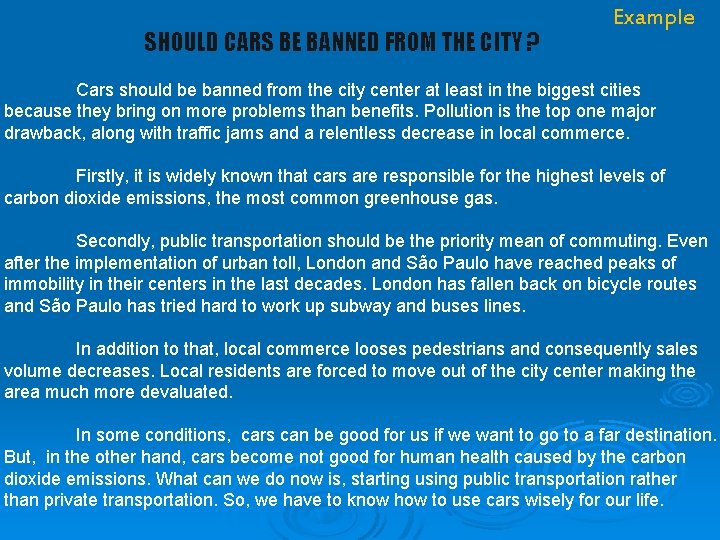
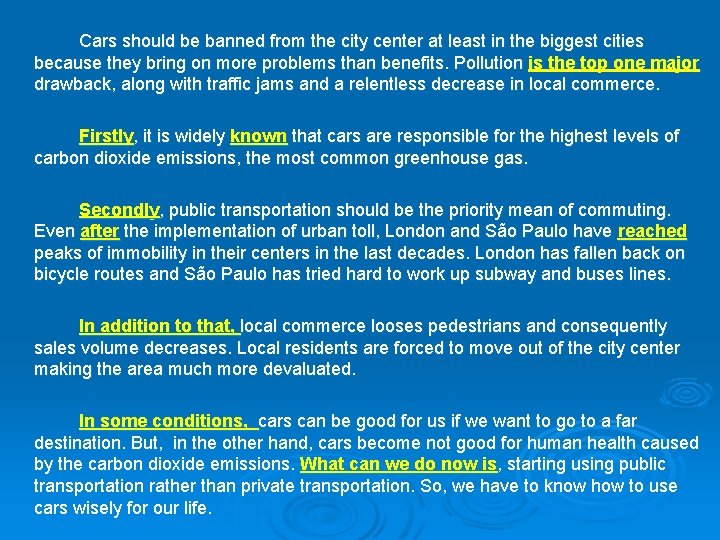
SHOULD CARS BE BANNED FROM THE CITY ? Example Cars should be banned from the city center at least in the biggest cities because they bring on more problems than benefits. Pollution is the top one major drawback, along with traffic jams and a relentless decrease in local commerce. Firstly, it is widely known that cars are responsible for the highest levels of carbon dioxide emissions, the most common greenhouse gas. Secondly, public transportation should be the priority mean of commuting. Even after the implementation of urban toll, London and São Paulo have reached peaks of immobility in their centers in the last decades. London has fallen back on bicycle routes and São Paulo has tried hard to work up subway and buses lines. In addition to that, local commerce looses pedestrians and consequently sales volume decreases. Local residents are forced to move out of the city center making the area much more devaluated. In some conditions, cars can be good for us if we want to go to a far destination. But, in the other hand, cars become not good for human health caused by the carbon dioxide emissions. What can we do now is, starting using public transportation rather than private transportation. So, we have to know how to use cars wisely for our life.
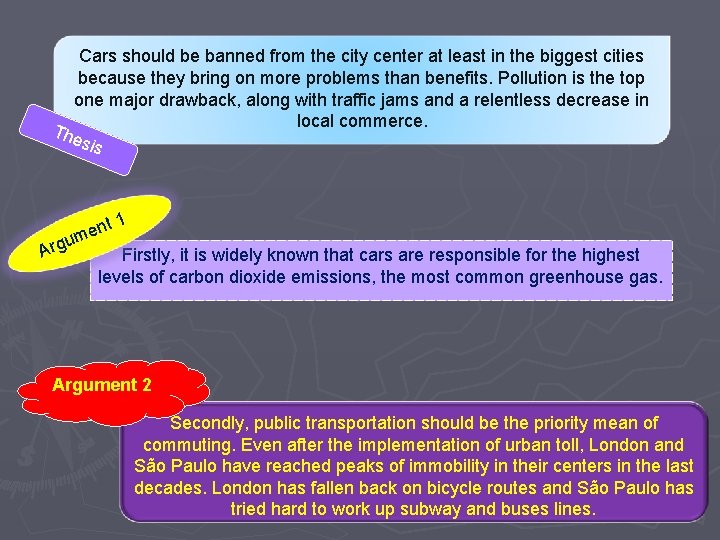
Cars should be banned from the city center at least in the biggest cities because they bring on more problems than benefits. Pollution is the top one major drawback, along with traffic jams and a relentless decrease in local commerce. The sis u Arg nt me 1 Firstly, it is widely known that cars are responsible for the highest levels of carbon dioxide emissions, the most common greenhouse gas. Argument 2 Secondly, public transportation should be the priority mean of commuting. Even after the implementation of urban toll, London and São Paulo have reached peaks of immobility in their centers in the last decades. London has fallen back on bicycle routes and São Paulo has tried hard to work up subway and buses lines.
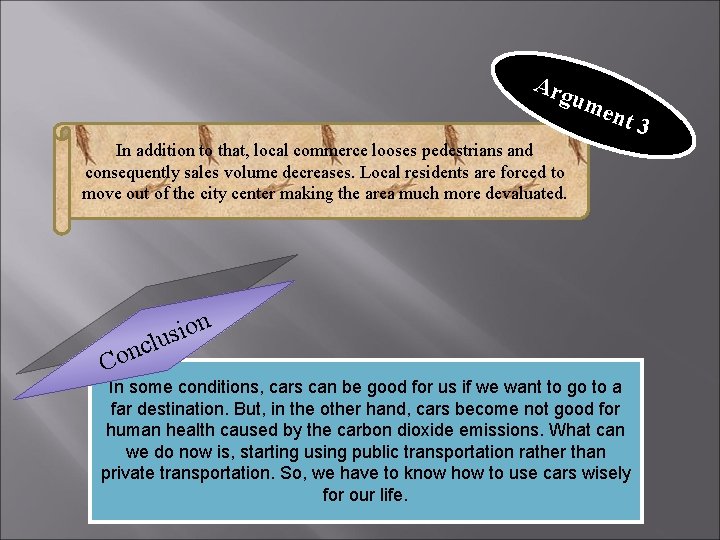
Arg um ent In addition to that, local commerce looses pedestrians and consequently sales volume decreases. Local residents are forced to move out of the city center making the area much more devaluated. Con n o i s clu In some conditions, cars can be good for us if we want to go to a far destination. But, in the other hand, cars become not good for human health caused by the carbon dioxide emissions. What can we do now is, starting using public transportation rather than private transportation. So, we have to know how to use cars wisely for our life. 3
Cars should be banned from the city center at least in the biggest cities because they bring on more problems than benefits. Pollution is the top one major drawback, along with traffic jams and a relentless decrease in local commerce. Firstly, it is widely known that cars are responsible for the highest levels of carbon dioxide emissions, the most common greenhouse gas. Secondly, public transportation should be the priority mean of commuting. Even after the implementation of urban toll, London and São Paulo have reached peaks of immobility in their centers in the last decades. London has fallen back on bicycle routes and São Paulo has tried hard to work up subway and buses lines. In addition to that, local commerce looses pedestrians and consequently sales volume decreases. Local residents are forced to move out of the city center making the area much more devaluated. In some conditions, cars can be good for us if we want to go to a far destination. But, in the other hand, cars become not good for human health caused by the carbon dioxide emissions. What can we do now is, starting using public transportation rather than private transportation. So, we have to know how to use cars wisely for our life.
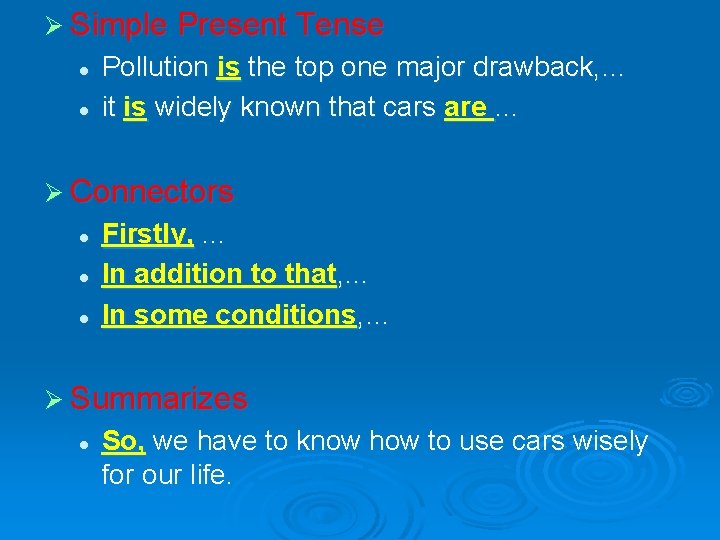
Ø Simple Present Tense l l Pollution is the top one major drawback, … it is widely known that cars are … Ø Connectors l l l Firstly, … In addition to that, … In some conditions, … Ø Summarizes l So, we have to know how to use cars wisely for our life.
DIFFICULT WORDS Detriment Perverse Devaluated Relentless Drawback Implementation kerugian jahat devaluasi tanpa belas kasihan kekurangan pelaksanaan
Sources www. google. co. th http: //dictionary. reference. com/ http: //understandingtext. blogspot. com/2007/12/what-is-analytical-exposition. html http: //typeoftext. blogspot. com/2009/01/analytical-exposition. html Look Ahead 3 English Book
Thank you for your attention. ขอบคณครบ Copyright 2012