AMONG FLORIDAS DEAF POPULATION The information included in
- Slides: 21
AMONG FLORIDA’S DEAF POPULATION The information included in this presentation was extracted from multiple internet searches; the Florida Vital Statistics Office; and the Florida Department of Health, Bureau of HIV/AIDS, Surveillance Section.
When a phenomenon like AIDS hits the deaf community, an entire new vocabulary is suddenly required; a vocabulary that is uniform across the country and understood by interpreters as well as members of the deaf community. The interpreters need to quickly become familiar with many medical terms.
Terms • Deafness is a hearing loss that precludes the learning of language through hearing. • Hard of Hearing describes hearing loss that, although serious, is less severe than deafness and usually permits understanding of spoken language through hearing aids. • Hearing Impairment refers to all degrees of hearing loss, from slight to profound. Source: Health Resources and Services Administration, April 2001
Barriers for Deaf / Hard-of-Hearing Persons • Access to information via television or print media • Cultural attitudes towards deaf • Cultural attitudes of deaf towards those that can hear • Communication access - how can they reach you if you don’t have a TTY or an interpreter on staff • Lack of familiarity or training in ASL (deaf who use gestures unique to their circumstances)
AIDS In The Deaf Community Statistics and Notes • Worldwide, about 70 million individuals have a hearing problem. • There are up to 28 million hearing-impaired Americans in the United States. • Between 8, 000 to 40, 000 deaf persons in the United States are living with HIV. • Deaf high school students have a much lower knowledge level about HIV transmission than do their hearing counterparts. Source: Health Resources and Services Administration, April 2001
AIDS In The Deaf Community Statistics and Notes • Deaf men who have sex with men (MSM) may face discrimination from within the deaf community. For this reason, deaf MSM often conceal their identity and engage in high risk behaviors. • Children with disabilities, including deaf children, have been found to be at higher risk for sexual abuse, both at residential schools and at home. • High rates of substance use exist among the deaf community. (One in seven deaf persons has a history of substance abuse compared to one in ten in the hearing population). Source: Center for AIDS Prevention Studies at the University of California San Francisco
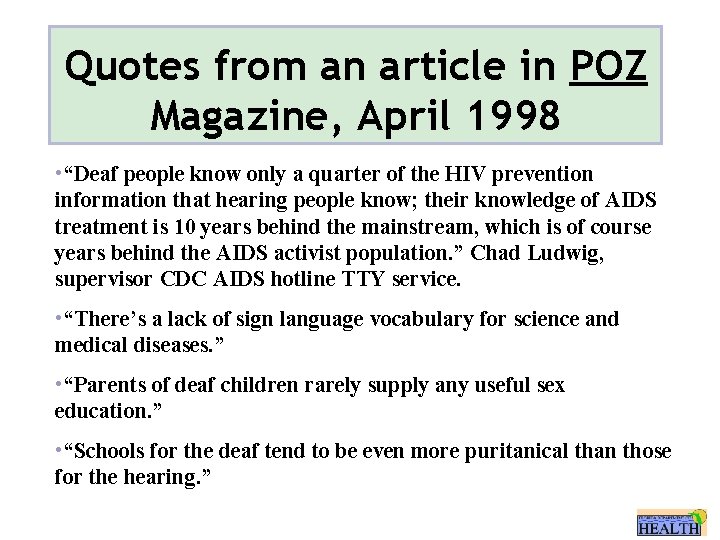
Quotes from an article in POZ Magazine, April 1998 • “Deaf people know only a quarter of the HIV prevention information that hearing people know; their knowledge of AIDS treatment is 10 years behind the mainstream, which is of course years behind the AIDS activist population. ” Chad Ludwig, supervisor CDC AIDS hotline TTY service. • “There’s a lack of sign language vocabulary for science and medical diseases. ” • “Parents of deaf children rarely supply any useful sex education. ” • “Schools for the deaf tend to be even more puritanical than those for the hearing. ”
Stop the Silence Deaf and Hard of Hearing Survey Miami, Florida, 2001 Miami-Dade County Health Department Office of HIV/AIDS Services Director: Evelyn Ullah Consultant: Alex Moreno Staff: Kira Villamazar, Martina De. Varona, Frank Ebagua, Wendy Cousino
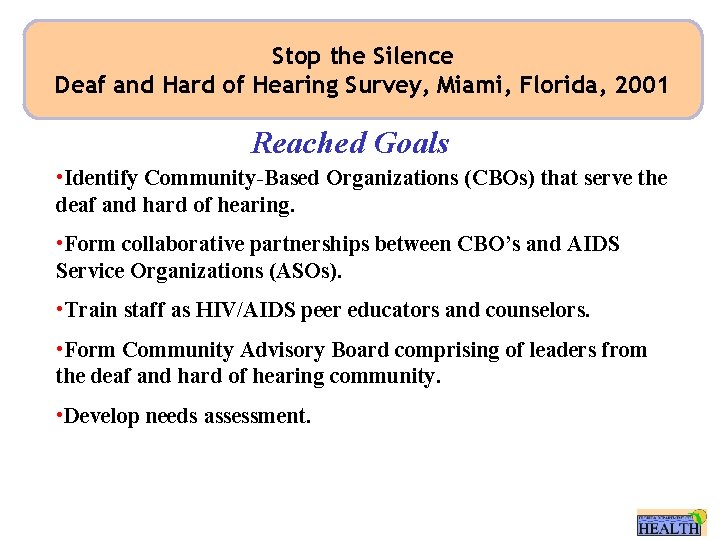
Stop the Silence Deaf and Hard of Hearing Survey, Miami, Florida, 2001 Reached Goals • Identify Community-Based Organizations (CBOs) that serve the deaf and hard of hearing. • Form collaborative partnerships between CBO’s and AIDS Service Organizations (ASOs). • Train staff as HIV/AIDS peer educators and counselors. • Form Community Advisory Board comprising of leaders from the deaf and hard of hearing community. • Develop needs assessment.
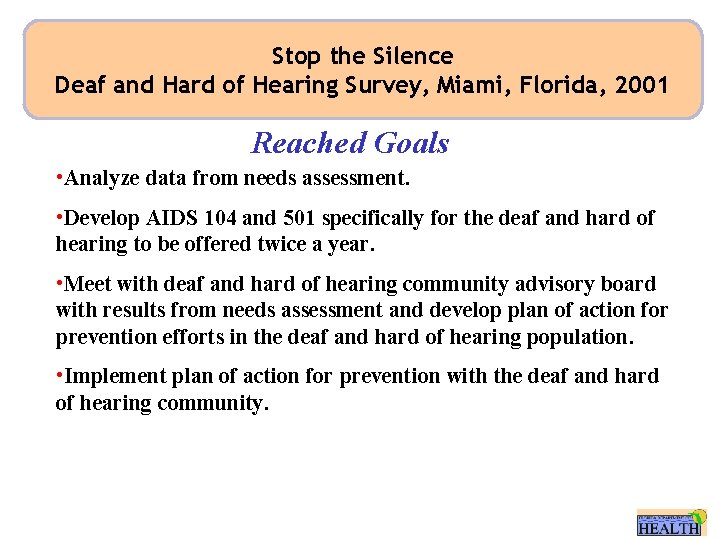
Stop the Silence Deaf and Hard of Hearing Survey, Miami, Florida, 2001 Reached Goals • Analyze data from needs assessment. • Develop AIDS 104 and 501 specifically for the deaf and hard of hearing to be offered twice a year. • Meet with deaf and hard of hearing community advisory board with results from needs assessment and develop plan of action for prevention efforts in the deaf and hard of hearing population. • Implement plan of action for prevention with the deaf and hard of hearing community.
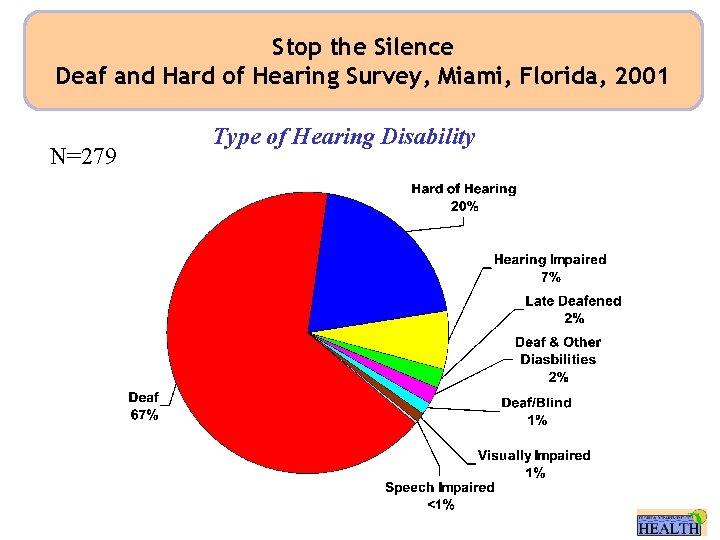
Stop the Silence Deaf and Hard of Hearing Survey, Miami, Florida, 2001 N=279 Type of Hearing Disability
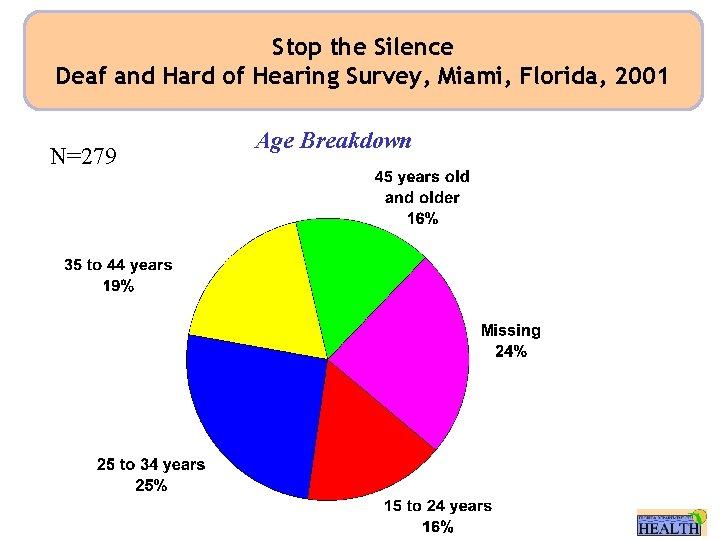
Stop the Silence Deaf and Hard of Hearing Survey, Miami, Florida, 2001 N=279 Age Breakdown
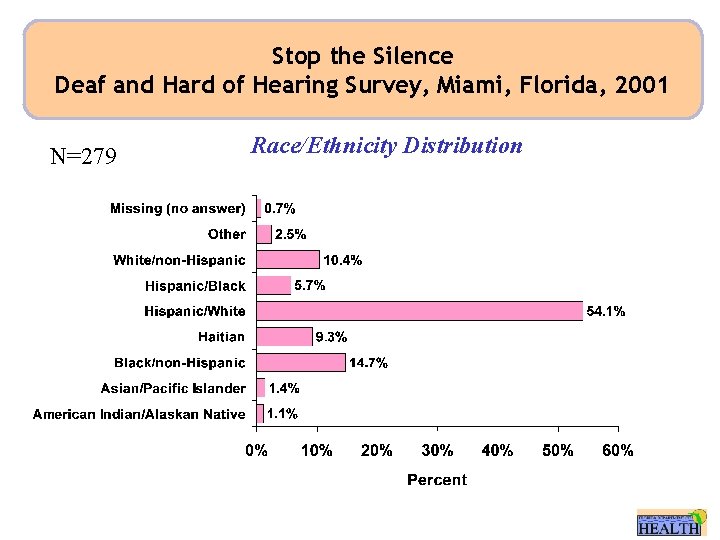
Stop the Silence Deaf and Hard of Hearing Survey, Miami, Florida, 2001 N=279 Race/Ethnicity Distribution
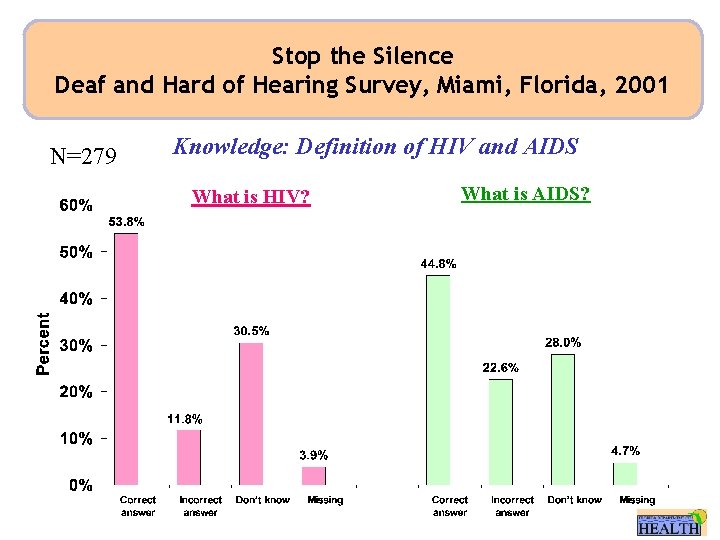
Stop the Silence Deaf and Hard of Hearing Survey, Miami, Florida, 2001 N=279 Knowledge: Definition of HIV and AIDS What is HIV? What is AIDS?
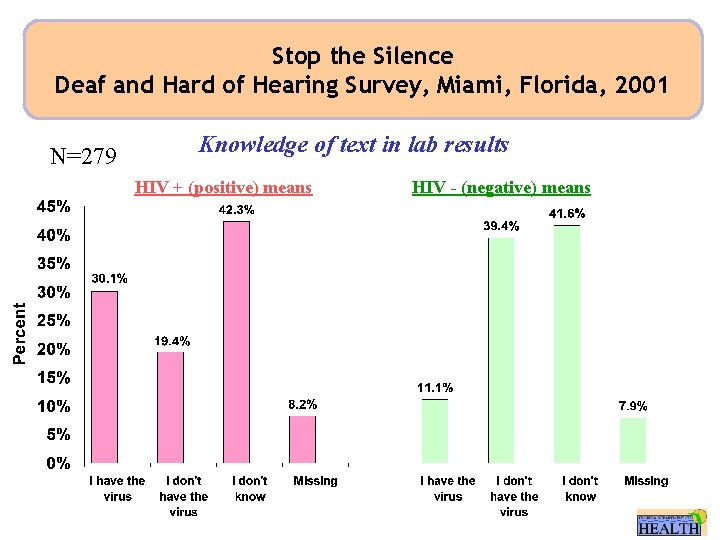
Stop the Silence Deaf and Hard of Hearing Survey, Miami, Florida, 2001 N=279 Knowledge of text in lab results HIV + (positive) means HIV - (negative) means
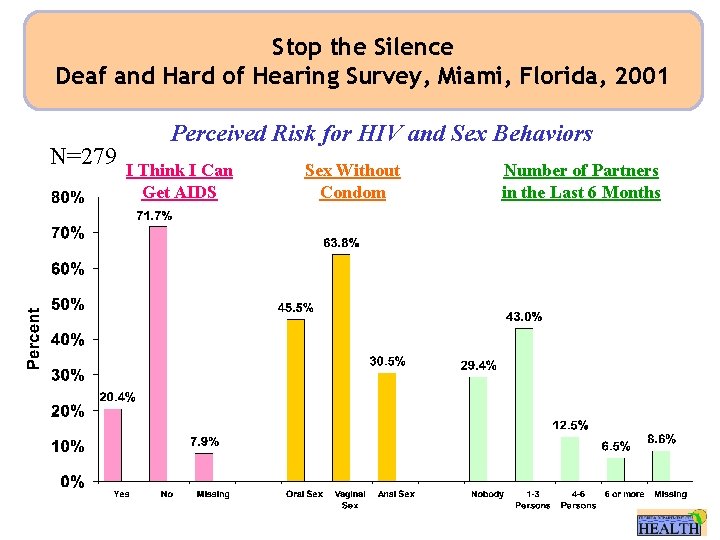
Stop the Silence Deaf and Hard of Hearing Survey, Miami, Florida, 2001 N=279 Perceived Risk for HIV and Sex Behaviors I Think I Can Get AIDS Sex Without Condom Number of Partners in the Last 6 Months
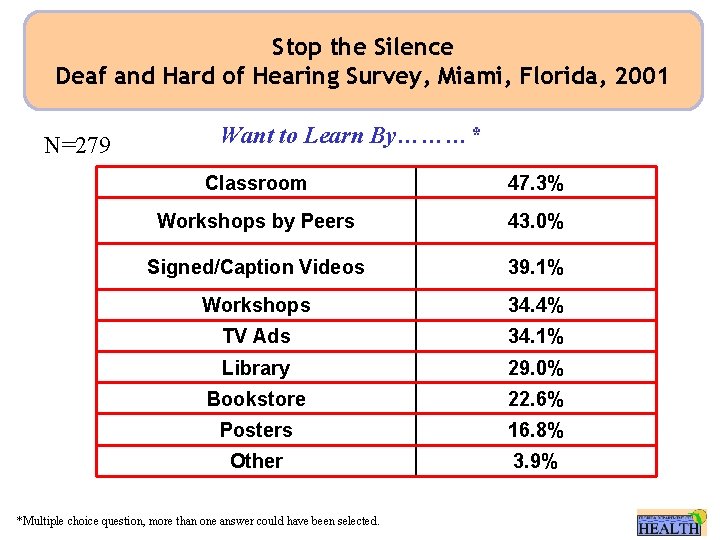
Stop the Silence Deaf and Hard of Hearing Survey, Miami, Florida, 2001 N=279 Want to Learn By………* Classroom 47. 3% Workshops by Peers 43. 0% Signed/Caption Videos 39. 1% Workshops 34. 4% TV Ads 34. 1% Library 29. 0% Bookstore 22. 6% Posters 16. 8% Other 3. 9% *Multiple choice question, more than one answer could have been selected.
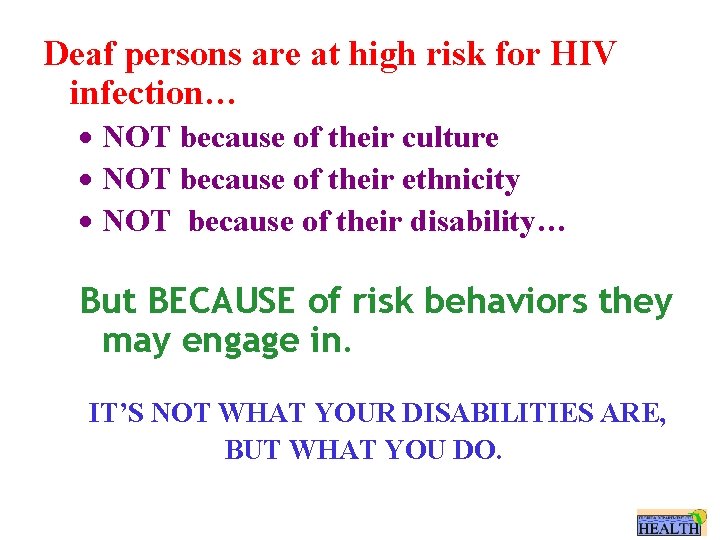
Deaf persons are at high risk for HIV infection… · NOT because of their culture · NOT because of their ethnicity · NOT because of their disability… But BECAUSE of risk behaviors they may engage in. IT’S NOT WHAT YOUR DISABILITIES ARE, BUT WHAT YOU DO.
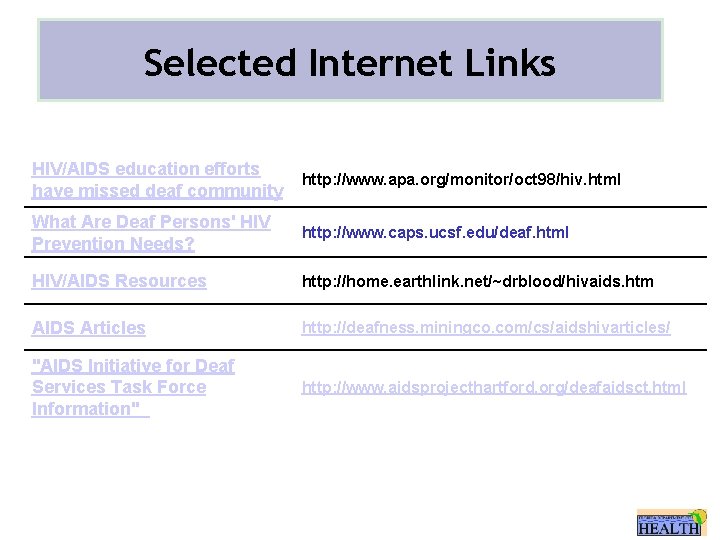
Selected Internet Links HIV/AIDS education efforts http: //www. apa. org/monitor/oct 98/hiv. html have missed deaf community What Are Deaf Persons' HIV Prevention Needs? http: //www. caps. ucsf. edu/deaf. html HIV/AIDS Resources http: //home. earthlink. net/~drblood/hivaids. htm AIDS Articles http: //deafness. miningco. com/cs/aidshivarticles/ "AIDS Initiative for Deaf Services Task Force Information" http: //www. aidsprojecthartford. org/deafaidsct. html
National AIDS Hotline for the deaf and hearing impaired: 1 -800 -AIDS-TTY (243 -7889) Call 10 AM to 10 PM (Eastern Standard Time)
For Florida HIV/AIDS Surveillance Data Contact: (850) 245 -4444 Lorene Maddox, MPH Ext. 2613 Tracina Bush, BSW Julia Fitz, MPH Ext. 2612 Ext. 2373 Visit Florida’s internet site for: • Monthly Surveillance Reports • Slide Sets and Fact Sheets • Annual Reports and Epi Profiles http: //www. doh. state. fl. us/disease_ctrl/aids/trends. html Visit CDC’s HIV/AIDS Internet site for: Surveillance Reports, fact sheets and slide sets http: //www. cdc. gov/hiv/topics/surveillance/resources/reports/index. htm