American Puritanism Early American Literature up to 1700

- Slides: 14
American Puritanism Early American Literature up to 1700
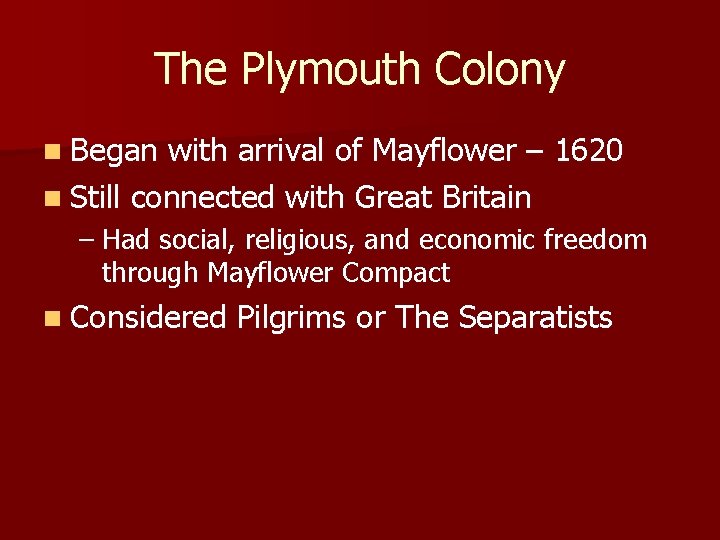
The Plymouth Colony n Began with arrival of Mayflower – 1620 n Still connected with Great Britain – Had social, religious, and economic freedom through Mayflower Compact n Considered Pilgrims or The Separatists
The Massachusetts Bay Colony n Began with arrival of Arbella – 1630 n Leader – John Winthrop n Settlement is based on religion – is a theocracy and is free of Great Britain n Considered Congregational Puritans
Basic Puritan Beliefs - TULIP n. T = Total Depravity – we are all sinners through concept of original sin/fall of Adam n U = Unconditional Election – only certain people are saved by God – your fate is predestined n L = Limited Atonement – Jesus only died for those who are saved, not everyone
TULIP Continued n. I = Irresistible Grace – You cannot earn or deny God’s grace, He gives it to you freely n P = Perseverance of the “’Saints’” – people who God chooses can determine His will and live “right. ” Once one feels God’s will in his/her life, they cannot go against it because that is against Puritan beliefs
Some Other Puritan Beliefs n Typology – God’s works can be seen in what people and nature both do. A Puritan must understand this. – Natural disasters, fires, etc. show what God wants n Backsliding – Puritans can fall from grace, so must always have Godly characteristics
Purpose of Puritan Writers n To make God more understandable to others n To show God fits into the world n To give God glory
Puritan Writing Style n Protestant – not flowery/wordy – show honor to the Bible n Purposeful – written for the reasons in previous slide n It fit in with how Puritans were as people in terms of religious beliefs and education
Common Themes n Idealism – optimistic in terms of religion and politics n Pragmatism – writing had a purpose that showed things were achievable
Things that Helped End Puritanism n n n People wanting to do good – against predestination Wanting freedom with life Dislike of power balance – few over many Economy – taking an interest in earning money Strong voices against Puritanism in New England Frontier ideas like being an individual, being optimistic, and taking care of oneself
Cont. n Politics – Massachusetts becoming loyal to Britain n No flexibility in theocratic government – all rules/laws based on Bible n Rational over religious thought – looking to science and logic to explain things n Rich immigrants
Signs of Puritanism’s End n n n Lack of godliness Pride “Heretics” – people not behaving religiously Disrespect of Sabbath; swearing, sleeping during church Family government issues Discord among society members – litigation/suing over many superficial things
Cont. n n Sexual and drinking sins – living together/having children without marriage; alcoholism Immoral business practices – cheating No desire to make positive change No real social behavior
Credits n Reuben, Paul P. “Early American Literature to 1700 – American Puritanism: A Brief Introduction. ” PAL: Perspectives in American Literature A Research and Reference Guide – An Ongoing Project. 17 Oct. 2003. 15 Oct. 2003. <www. csustan. edu/english/reuben/pal/ch ap 1/intro. html>