Alfred Gessow Rotorcraft Center Aerospace Engineering Department University



- Slides: 16
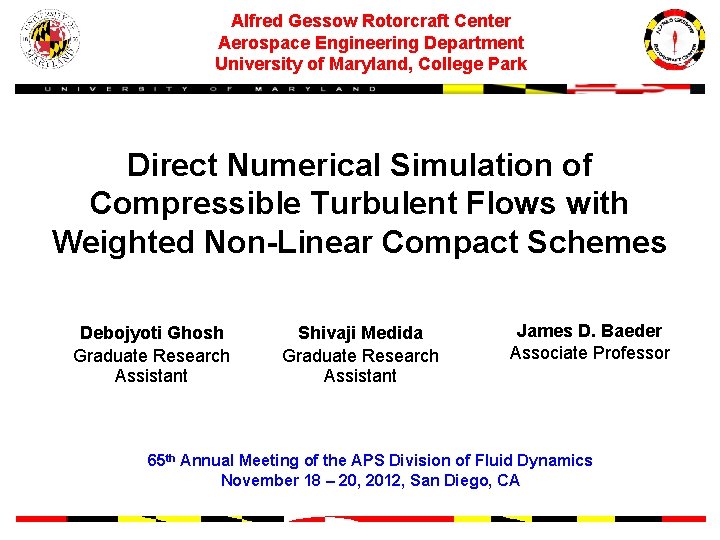
Alfred Gessow Rotorcraft Center Aerospace Engineering Department University of Maryland, College Park Direct Numerical Simulation of Compressible Turbulent Flows with Weighted Non-Linear Compact Schemes Debojyoti Ghosh Graduate Research Assistant Shivaji Medida Graduate Research Assistant James D. Baeder Associate Professor 65 th Annual Meeting of the APS Division of Fluid Dynamics November 18 – 20, 2012, San Diego, CA
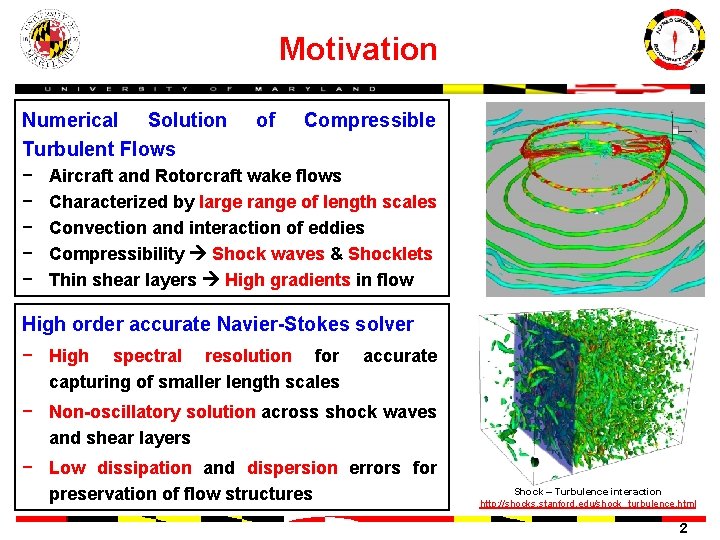
Motivation Numerical Solution Turbulent Flows − − − of Compressible Aircraft and Rotorcraft wake flows Characterized by large range of length scales Convection and interaction of eddies Compressibility Shock waves & Shocklets Thin shear layers High gradients in flow High order accurate Navier-Stokes solver − High spectral resolution for capturing of smaller length scales accurate − Non-oscillatory solution across shock waves and shear layers − Low dissipation and dispersion errors for preservation of flow structures Shock – Turbulence interaction http: //shocks. stanford. edu/shock_turbulence. html 2
Compact-Reconstruction WENO Schemes The Compact-Reconstruction WENO (CRWENO)★ scheme • • • Convex combination of r-th order candidate compact interpolations Optimal weights in smooth regions (2 r-1)-th order compact interpolation Smoothness - dependent weights Non-oscillatory interpolation for discontinuities Optimal Weights Smoothness Indicators WENO Weights Interface flux Candidate compact stencils Why Compact Reconstruction? • High order accuracy with smaller stencils • Better spectral resolution than explicit interpolation (bandwidth resolving efficiency) • Lower dissipation at resolved frequencies • Taylor series error order of magnitude lower Dispersion and dissipation relationships ★ Ghosh & Baeder, SIAM J. Sci. Comp. , 34(3), 2012 3
5 th Order CRWENO scheme 4
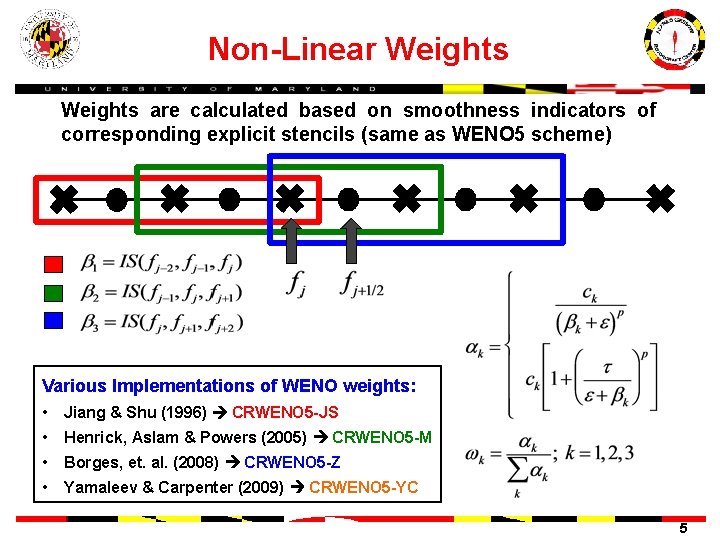
Non-Linear Weights are calculated based on smoothness indicators of corresponding explicit stencils (same as WENO 5 scheme) Various Implementations of WENO weights: • Jiang & Shu (1996) CRWENO 5 -JS • Henrick, Aslam & Powers (2005) CRWENO 5 -M • Borges, et. al. (2008) CRWENO 5 -Z • Yamaleev & Carpenter (2009) CRWENO 5 -YC 5
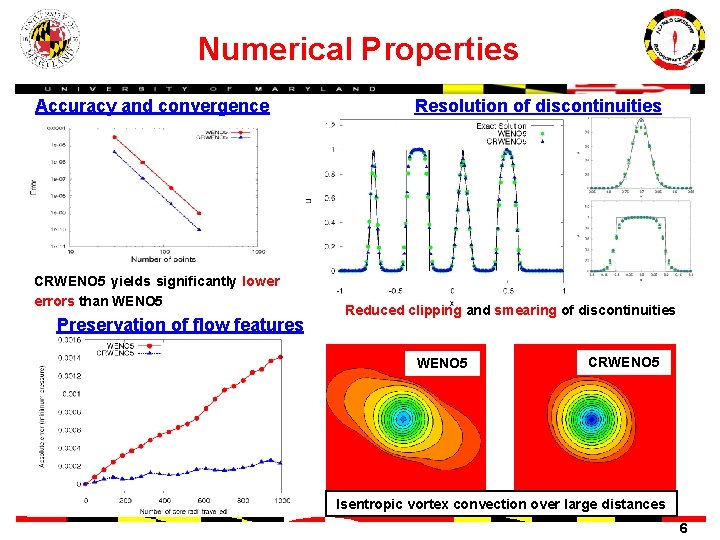
Numerical Properties Accuracy and convergence CRWENO 5 yields significantly lower errors than WENO 5 Preservation of flow features Resolution of discontinuities Reduced clipping and smearing of discontinuities WENO 5 CRWENO 5 Isentropic vortex convection over large distances 6
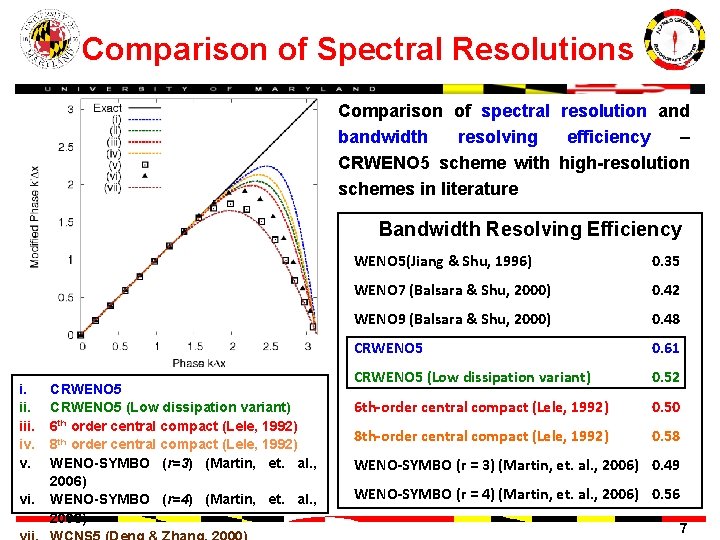
Comparison of Spectral Resolutions Comparison of spectral resolution and bandwidth resolving efficiency – CRWENO 5 scheme with high-resolution schemes in literature Bandwidth Resolving Efficiency i. iii. iv. v. vi. CRWENO 5 (Low dissipation variant) 6 th order central compact (Lele, 1992) 8 th order central compact (Lele, 1992) WENO-SYMBO (r=3) (Martin, et. al. , 2006) WENO-SYMBO (r=4) (Martin, et. al. , 2006) WENO 5(Jiang & Shu, 1996) 0. 35 WENO 7 (Balsara & Shu, 2000) 0. 42 WENO 9 (Balsara & Shu, 2000) 0. 48 CRWENO 5 0. 61 CRWENO 5 (Low dissipation variant) 0. 52 6 th-order central compact (Lele, 1992) 0. 50 8 th-order central compact (Lele, 1992) 0. 58 WENO-SYMBO (r = 3) (Martin, et. al. , 2006) 0. 49 WENO-SYMBO (r = 4) (Martin, et. al. , 2006) 0. 56 7
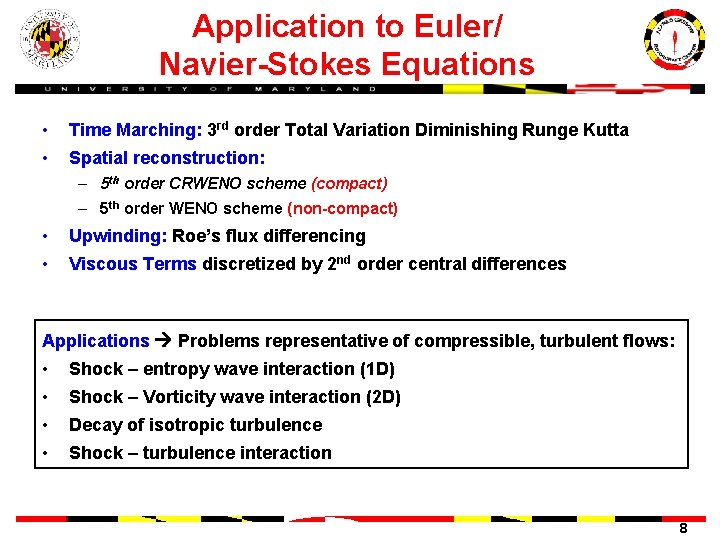
Application to Euler/ Navier-Stokes Equations • Time Marching: 3 rd order Total Variation Diminishing Runge Kutta • Spatial reconstruction: – 5 th order CRWENO scheme (compact) – 5 th order WENO scheme (non-compact) • Upwinding: Roe’s flux differencing • Viscous Terms discretized by 2 nd order central differences Applications Problems representative of compressible, turbulent flows: • Shock – entropy wave interaction (1 D) • Shock – Vorticity wave interaction (2 D) • Decay of isotropic turbulence • Shock – turbulence interaction 8
Shock – Entropy Interaction (1 D) 6 points per wavelength • Interaction of a shock wave with a density wave resulting in high-frequency waves and discontinuities • CRWENO scheme shows better resolution of high-resolution waves than WENO 5 • Further improvement by using the alternative formulations for the WENO weights ε = 10 -6, p = 1 9
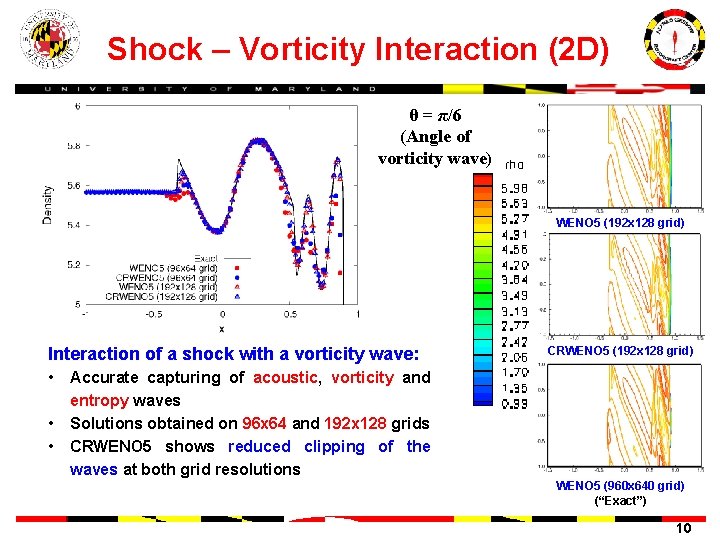
Shock – Vorticity Interaction (2 D) θ = π/6 (Angle of vorticity wave) WENO 5 (192 x 128 grid) Interaction of a shock with a vorticity wave: • • • CRWENO 5 (192 x 128 grid) Accurate capturing of acoustic, vorticity and entropy waves Solutions obtained on 96 x 64 and 192 x 128 grids CRWENO 5 shows reduced clipping of the waves at both grid resolutions WENO 5 (960 x 640 grid) (“Exact”) 10
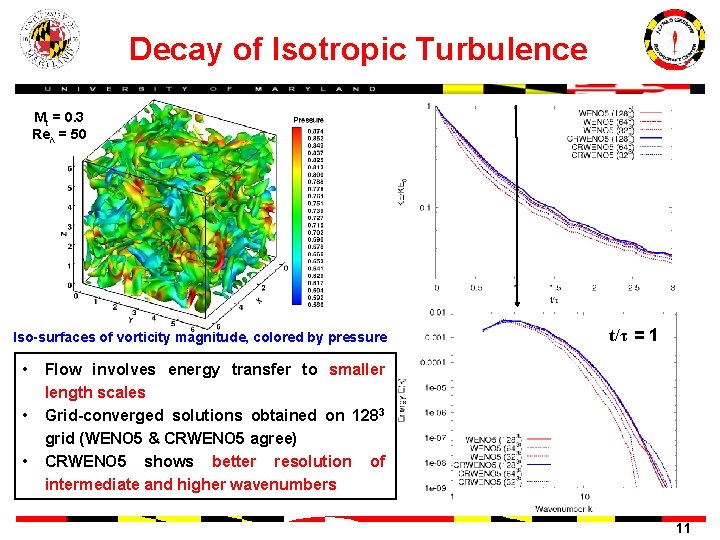
Decay of Isotropic Turbulence Mt = 0. 3 Reλ = 50 Iso-surfaces of vorticity magnitude, colored by pressure • • • t/τ = 1 Flow involves energy transfer to smaller length scales Grid-converged solutions obtained on 1283 grid (WENO 5 & CRWENO 5 agree) CRWENO 5 shows better resolution of intermediate and higher wavenumbers 11
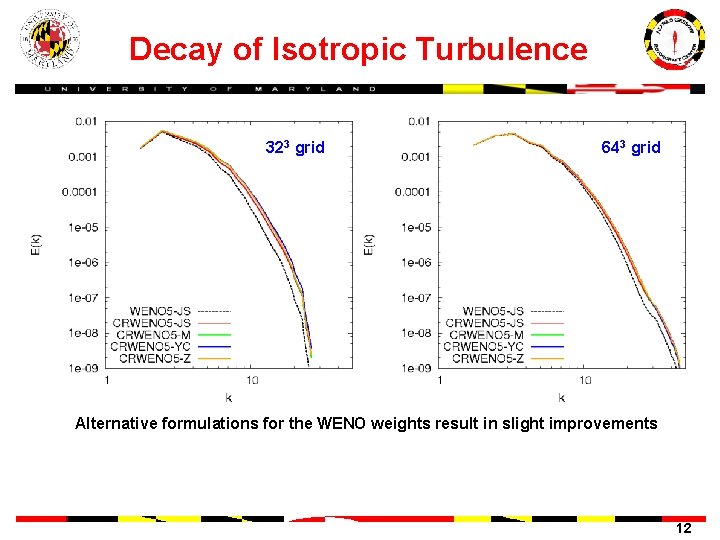
Decay of Isotropic Turbulence 323 grid 643 grid Alternative formulations for the WENO weights result in slight improvements 12
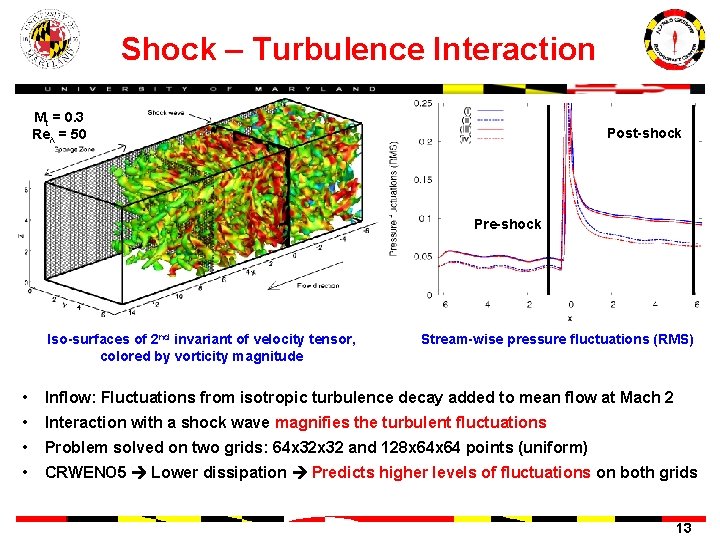
Shock – Turbulence Interaction Mt = 0. 3 Reλ = 50 Post-shock Pre-shock Iso-surfaces of 2 nd invariant of velocity tensor, colored by vorticity magnitude Stream-wise pressure fluctuations (RMS) • Inflow: Fluctuations from isotropic turbulence decay added to mean flow at Mach 2 • Interaction with a shock wave magnifies the turbulent fluctuations • Problem solved on two grids: 64 x 32 and 128 x 64 points (uniform) • CRWENO 5 Lower dissipation Predicts higher levels of fluctuations on both grids 13
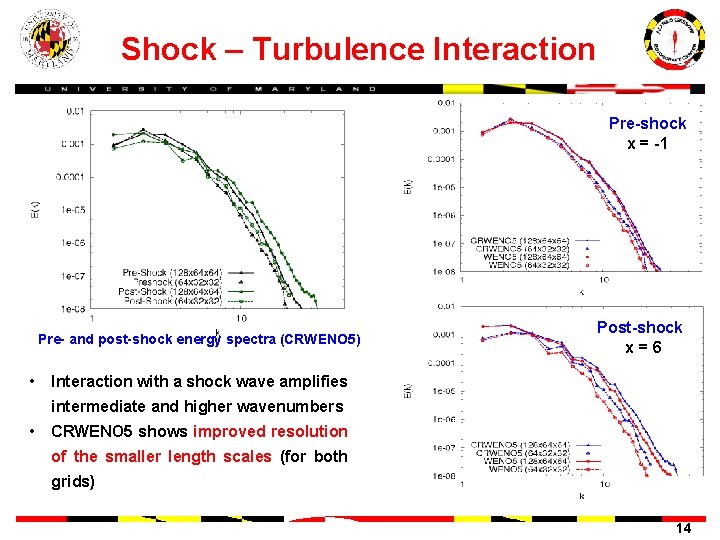
Shock – Turbulence Interaction Pre-shock x = -1 Pre- and post-shock energy spectra (CRWENO 5) • Post-shock x=6 Interaction with a shock wave amplifies intermediate and higher wavenumbers • CRWENO 5 shows improved resolution of the smaller length scales (for both grids) 14
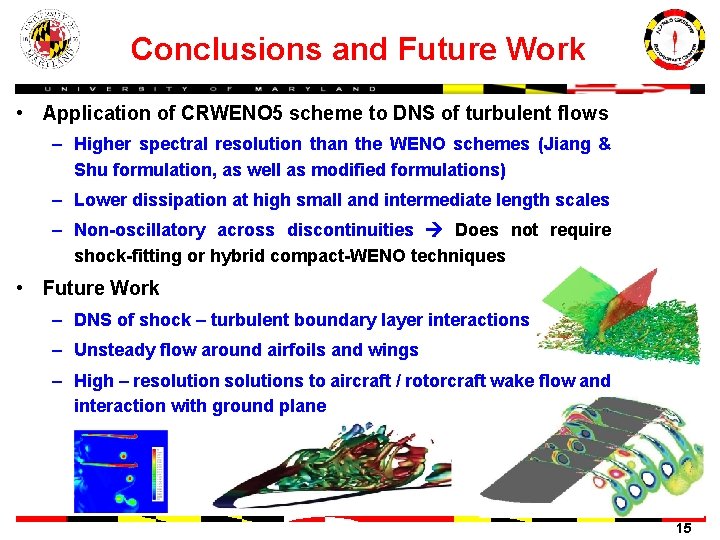
Conclusions and Future Work • Application of CRWENO 5 scheme to DNS of turbulent flows – Higher spectral resolution than the WENO schemes (Jiang & Shu formulation, as well as modified formulations) – Lower dissipation at high small and intermediate length scales – Non-oscillatory across discontinuities Does not require shock-fitting or hybrid compact-WENO techniques • Future Work – DNS of shock – turbulent boundary layer interactions – Unsteady flow around airfoils and wings – High – resolutions to aircraft / rotorcraft wake flow and interaction with ground plane 15
Acknowledgments This research was supported by the U. S. Army's MAST CTA Center for Microsystem Mechanics with Mr. Chris Kroninger (ARL-VTD) as Technical Monitor. http: //www. mast-cta. org/ 16